Close Navigation

Search

Health & Safety when you have 5 employees or more

Insight by

amanda

Amanda Lambert

Published on

14 April 2026

Competent person

Table of contents

Health & Safety when you have 5 employees or more

As soon as you have 5 employees or more, you have a legal requirement to comply with all work-related health and safety legislation.

Your obligations are outlined in the Safety at Work Regulations 1974.

How this changes from less than five employees is you now need to ensure you have:

  • Written Health and Safety Policy
  • Written Health and Safety Policy Statement
  • Written Risk Assessments
  • COSHH assessments
  • Toolbox talks
  • A competent person either within your business or a consultant.

We act as competent people for over 800 companies. When we act as your competent person, we will complete all the documents you need to comply and keep the documents up to date as legislation changes. You also have access to over 1,000 documents including risk and method statements, COSHH data, toolbox talks, and more. We charge a small monthly fee. 

If you are not sure exactly what your business will require, you can find details on it by visiting the HSE website. Every business is different, and a competent person will be able to cover all aspects for you.

If you wish to employ your own competent person, they should be fully qualified in all aspects of Health & Safety; this can prove to be an expensive requirement if you employ them full-time. 

A more competitive way is to use a remote competent person service. We offer this service using one of our safety consultants as your competent person. We will make sure all your documents and training are up to date today, and be there to answer any questions. You also get free access to over 1,000 safety documents including RAMS.

There are a number of resources on the HSE website that can help you with any changes that may affect you as you continue to grow.

We are a friendly and professional team working in the background to help and support like-minded people get on with their work.

Request a call back for more information or call 0800 031 5404

Request a call back

shape Health & Safety Consultancy, Safety Advisor, Safety Consultant

Frequently Asked Questions

Do I need a health and safety policy if I have 5 employees or more?

Yes. If your business has 5 or more employees, you must have a written health and safety policy. The policy should explain how your business manages health and safety, who is responsible, and what arrangements are in place to protect employees and others affected by your work.

What health and safety documents do I need when I have 5 employees or more?

Businesses with 5 or more employees should have a written health and safety policy, written risk assessments, COSHH assessments where hazardous substances are used, training records, toolbox talk evidence, accident procedures and access to a competent person for health and safety advice.

Do I need written risk assessments if I employ 5 people?

Yes. If you employ 5 or more people, your significant risk assessment findings must be recorded in writing. This helps show that hazards have been identified and suitable control measures have been put in place.

Do subcontractors count as employees for health and safety?

Subcontractors may not count as PAYE employees, but you still have health and safety duties towards anyone affected by your work. If subcontractors are working under your control, you must ensure their work is planned, managed and carried out safely.

Do I need a competent person for health and safety?

Yes. Employers must have access to competent health and safety advice. This can be someone within the business with suitable knowledge and experience, or an external health and safety consultant or safety advisor.

What is a competent person in health and safety?

A competent person is someone with the knowledge, training and experience needed to help a business meet its health and safety duties. They can advise on policies, risk assessments, training, compliance, accident procedures and safe working arrangements.

Do I need COSHH assessments if I have 5 employees or more?

If your business uses substances that could be hazardous to health, you need COSHH assessments. This applies to materials such as chemicals, dusts, fumes, paints, solvents, adhesives and cleaning products.

What happens if I do not have proper health and safety documents in place?

Without proper health and safety documents, your business may fail client checks, struggle with CHAS or SSIP accreditation, be refused access to sites, face enforcement action, or increase the risk of accidents and legal claims.

Can Seguro help my business meet health and safety requirements?

Yes. Seguro can support businesses with health and safety policies, risk assessments, COSHH assessments, toolbox talks, training evidence, competent person support and accreditation preparation.

Do I need health and safety support if I am a small business?

Yes. Small businesses still have legal health and safety duties. If you have 5 or more employees, your responsibilities increase because key documents such as your health and safety policy and risk assessments must be recorded in writing.

How can i check if someone is SSIP registered?

Insight by

amanda

Amanda Lambert

Published on

18 September 2025

Accreditations

How Can I Check if Someone Is SSIP Registered?

If you’re hiring contractors, awarding construction work, or managing supply chains, verifying a contractor’s health and safety credentials is an important part of due diligence.

One of the most common questions clients ask is:

“How can I check if a contractor is SSIP registered?”

The good news is that checking a contractor’s SSIP status is usually straightforward. In this guide, we’ll explain what SSIP registration means, how to verify it, and what to do if a contractor claims to be accredited but cannot provide evidence.

What Does SSIP Registered Mean?

SSIP stands for Safety Schemes in Procurement.

It is a framework that allows contractors to demonstrate compliance with recognised health and safety standards through an approved assessment scheme.

A contractor who is SSIP registered has successfully completed an assessment through an SSIP member scheme such as:

  • CHAS
  • SafeContractor
  • SMAS
  • Constructionline
  • CQMS
  • PQS

The assessment reviews the contractor’s health and safety management arrangements, including policies, risk assessments, training records, insurance and competent health and safety support.

Why Check a Contractor’s SSIP Registration?

Verifying accreditation helps ensure that contractors have demonstrated a suitable level of health and safety management.

Benefits include:

  • Reducing supply chain risk
  • Meeting procurement requirements
  • Supporting contractor selection decisions
  • Demonstrating due diligence
  • Improving workplace safety standards
  • Helping satisfy CDM and client compliance obligations

Many principal contractors and organisations make accreditation checks part of their onboarding process.

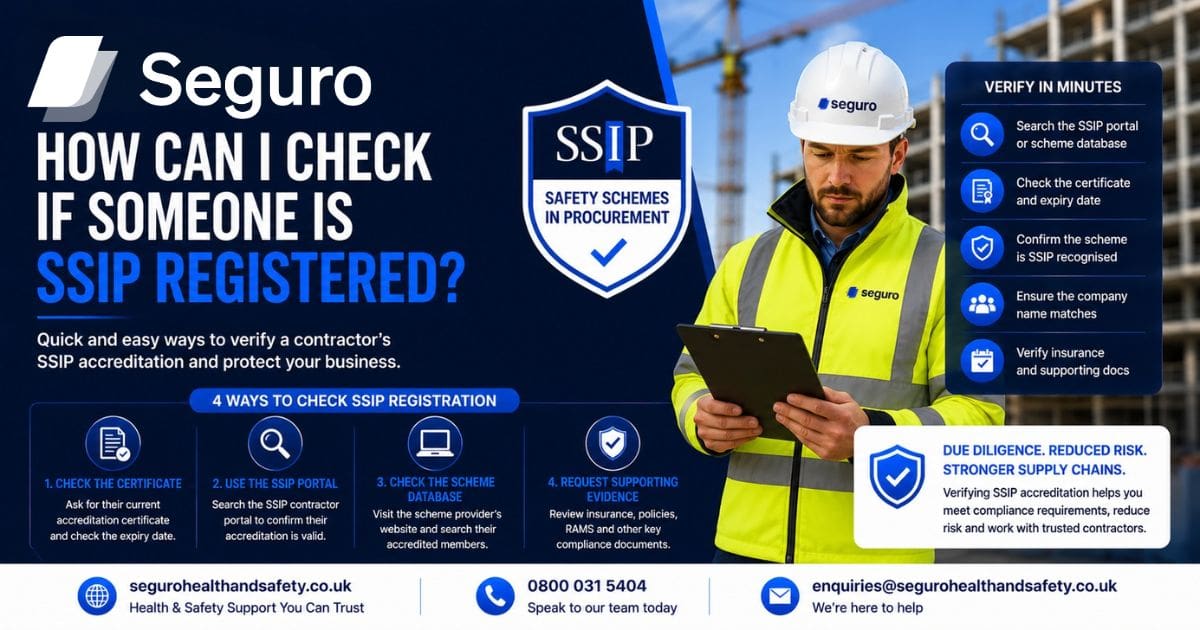
How to Check if Someone Is SSIP Registered

There are several ways to verify a contractor’s SSIP status.

1. Ask for Their Accreditation Certificate

The simplest method is to request a copy of the contractor’s current accreditation certificate.

The certificate should include:

  • Company name
  • Accreditation scheme
  • Registration number
  • Expiry date
  • Scope of certification

Always check that the accreditation is still valid and has not expired.

2. Use the SSIP Portal

SSIP provides a contractor search facility that allows clients to verify whether a business holds a recognised SSIP accreditation.

By searching the contractor’s:

  • Company name
  • Registration number
  • Accreditation details

You can confirm whether they are currently recognised under the SSIP framework.

This is often the quickest and most reliable verification method.

3. Check the Accreditation Provider’s Database

Many SSIP member schemes operate their own contractor directories.

For example, accredited contractors may be searchable through their scheme provider’s database.

Common schemes include:

If the contractor appears within the scheme’s directory and the accreditation is current, this generally confirms their status.

4. Request Supporting Evidence

In addition to accreditation certificates, many clients request:

  • Employers’ Liability Insurance
  • Public Liability Insurance
  • Health & Safety Policy
  • RAMS
  • Training records
  • Competent person details

Accreditation should complement wider contractor due diligence rather than replace it completely.

What Information Should You Check?

When reviewing accreditation, verify:

Company Name

Ensure the legal trading name matches the business you are engaging.

Expiry Date

Many SSIP accreditations require annual renewal.

An expired accreditation should not be treated as current.

Scheme Provider

Confirm the accreditation is from a recognised SSIP member scheme.

Scope of Work

Check that the accreditation aligns with the contractor’s activities.

Insurance Status

Ensure insurance documents remain valid and current.

Can You Trust SSIP Accreditation?

SSIP accreditation provides independent verification that a contractor has been assessed against recognised health and safety standards.

However, accreditation should form part of a wider contractor selection process.

Clients should still consider:

  • Experience
  • References
  • Competence
  • Qualifications
  • Insurance
  • Project suitability

Accreditation is an important indicator but should not be the only factor in contractor approval.

What If a Contractor Claims to Be SSIP Registered but Cannot Prove It?

If a contractor cannot provide evidence of accreditation:

Request Documentation

Ask for a current certificate or registration number.

Verify Directly

Use the SSIP portal or accreditation provider database.

Confirm Expiry Dates

Some contractors may have previously held accreditation that has since lapsed.

Proceed With Caution

If accreditation is a contractual requirement, work should not proceed until suitable evidence is provided.

How Long Does SSIP Accreditation Last?

Most SSIP accreditations are valid for approximately 12 months.

Contractors must renew their accreditation annually to maintain recognised status.

Failure to renew can result in removal from contractor databases and loss of approved status.

Which Accreditations Are Recognised Under SSIP?

Examples of recognised SSIP member schemes include:

  • CHAS
  • SafeContractor
  • SMAS
  • Constructionline
  • CQMS
  • PQS

All assess contractors against the SSIP core health and safety criteria.

Although schemes differ in branding and additional services, the underlying assessment standards remain broadly consistent.

Why Many Clients Require SSIP Registration

Clients increasingly request SSIP accreditation because it helps:

  • Demonstrate compliance
  • Simplify contractor pre-qualification
  • Reduce repeated assessments
  • Improve supply chain consistency
  • Support health and safety management

For contractors, accreditation can improve credibility and access to larger projects and framework opportunities.

How Seguro Can Help

Seguro Health & Safety helps contractors achieve and maintain SSIP accreditation through:

  • CHAS applications
  • SafeContractor applications
  • SMAS accreditation
  • Constructionline support
  • CQMS accreditation
  • PQS accreditation
  • Health & Safety Policies
  • Risk Assessments
  • RAMS
  • Competent Person Services
  • Accreditation renewals

Whether you are checking accreditation as a client or applying for accreditation as a contractor, professional support can help ensure compliance and reduce delays.

Conclusion

Checking whether someone is SSIP registered is an important part of contractor due diligence.

The easiest methods are to request a current accreditation certificate, use the SSIP contractor search facility, or check the accreditation provider’s database.

By verifying accreditation status, reviewing supporting documentation and confirming renewal dates, clients can make more informed contractor selection decisions while helping maintain high health and safety standards across their projects.

CALL Amanda today on 0800 031 5404 and see how we can support you

Amanda is our technical sales advisor

Get Started Today
shape Ask Amanda

Frequently Asked Questions

How can I check if someone is SSIP registered?

You can check if someone is SSIP registered by requesting a copy of their accreditation certificate, searching the SSIP contractor database, checking the accreditation provider’s online directory, or asking for their accreditation registration number.

What does SSIP registered mean?

SSIP registered means a contractor has successfully completed a health and safety assessment through a recognised SSIP member scheme such as CHAS, SafeContractor, SMAS, Constructionline, CQMS or PQS and has demonstrated compliance with the SSIP core criteria.

Can I verify a contractor’s SSIP accreditation online?

Yes. Many SSIP member schemes provide online contractor directories and the SSIP portal offers contractor verification tools that allow clients to check accreditation status and validity.

What information do I need to check SSIP registration?

You will usually need the contractor’s company name, accreditation number, registration details or a copy of their accreditation certificate to verify their SSIP status.

How long does SSIP accreditation remain valid?

Most SSIP accreditations are valid for 12 months and must be renewed annually to maintain recognised accreditation status.

What should I check on an SSIP certificate?

You should verify the company name, accreditation scheme, registration number, issue date, expiry date and scope of certification to ensure the accreditation is current and relevant.

Which accreditation schemes are recognised by SSIP?

Recognised SSIP member schemes include CHAS, SafeContractor, SMAS, Constructionline, CQMS and PQS. All assess contractors against the SSIP core health and safety criteria.

What if a contractor claims to be SSIP registered but cannot provide evidence?

If a contractor cannot provide evidence of accreditation, you should request a current certificate, verify their status through the SSIP database or accreditation provider and confirm that the accreditation has not expired before proceeding.

Does SSIP accreditation guarantee contractor competence?

SSIP accreditation demonstrates that a contractor has been assessed against recognised health and safety standards. However, clients should also consider experience, qualifications, references, insurance and project suitability as part of their contractor selection process.

Why do clients require contractors to be SSIP registered?

Clients often require SSIP registration to simplify contractor pre-qualification, demonstrate health and safety compliance, reduce supply chain risk, support due diligence and improve consistency across procurement processes.

Can Seguro help contractors become SSIP registered?

Yes. Seguro Health & Safety helps contractors achieve and maintain SSIP accreditation through support with CHAS, SafeContractor, SMAS, Constructionline, CQMS and PQS applications, health and safety policies, RAMS, risk assessments and accreditation renewals.

Which Accreditation is best for my business?

Insight by

amanda

Amanda Lambert

Published on

7 March 2024

Constructionline

Which Accreditation is best for my business?

The question which accreditation is best for my business is asked on a daily basis, as a consultant that is not a question we can answer for your business. There are a number of factors you should take into account when you are making the decision:

  • Have you been asked by a client to have a particular one?
  • Are you looking to get on a certain clients supplier list – they may have a preference?
  • What is the purpose of the accreditation?
  • Do you have a budget in mind?
  • Do you have all the necessary paperwork?

If you have an answer to any of the above then that accreditation is the best one for your business as there is already the promise of a return on your investment.

Our advice where a client has no preference and there is a possibility that they will need both in the future is to follow this process:

Which assessment company do you select?

CHAS
PQS
Construction line
Safe Contractor
SMAS
CQMA
Builders profile
Avetta

The most expensive is CHAS, and the least costly is PQS. Due to the Deem to Satisfy system by SSIP, a PQS accreditation is equivalent to a CHAS accreditation, and for a small fee, you can obtain certificates for both.

The driver for selection usually is your customer; if they insist on CHAS, you can get accredited with PQS and request a certificate for CHAS within the process.

Impartial advise

Feel free to call us, and we can advise you on the best selection for your needs. We have completed thousands of applications and understand the market inside out. We don’t mind which company you select; the assessment process is the same, thanks to SSIP.

Who is Seguro

Seguro Health and Safety Management employs qualified health and safety consultants who complete the application to obtain accreditation from all the assessment companies. Seguro removes the pain of completing all the documentation and ensuring you comply.

Stage one: Apply for your PQS accreditation as this can be used for the Health & Safety Section of CHAS or Constructionline as well as being able to be used for many deem to satisfy schemes under the SSIP umbrella scheme.

Stage Two: Once you have your certificate for PQS apply for your CHAS and Constructionline status.

Each business is individual so if you want to get bespoke advice, please give us a ring on 0800 031 5404


Toolbox Talk Topics

Insight by

amanda

Amanda Lambert

Published on

19 February 2024

Health and safety blog

Toolbox Talk Topics

Toolbox Talk Topics are a list of toolbox talks and is a good way for employers and supervisors to ensure employees are all given key information and details of business processes in the simple structure. Toolbox Talk Topics are quick 15 minute sessions which can ensure your employees are up to date with important information  They are ideal for training of Health & Safety topics as well as good housekeeping.

Why are they called Toolbox Talks?

The term Toolbox talks originated as they were originally used for the Construction industry as a way to give employees quick precise training on Health & Safety topics such as Manual Handling and PPE.  These are now being used more industry wide as a way to communicate with employees topics that are important to the day to day running of the business.

How do I deliver a Toolbox Talk?

The best way to deliver a Toolbox talk is to have the information on screen as well as a handout for your employees to make notes as you are going through it. You can also play your team a full screen toolbox talk video as the one above. A complete list of our Toolbox Talk Topics are below:

Download 70 FREE toolbox talk now.

What’s included with the FREE toolbox talk download

The full list of all 70 toolbox talks are listed below.

TT1 – Abrasive Wheels
This talk will cover hazards and using portable and bench-mounted abrasive wheels.

TT2 – Accident Prevention & Control
Covers the cause, costs, and prevention of accidents.

TT3 – Accident Reporting & Investigation
Health and safety law requires that the following types of accidents be reported to the HSE:

  • Fatalities and major accidents
  • Injuries resulting in more than 7 days off work or inability to carry on with normal work
  • Dangerous occurrences

TT4 – Alcohol and Drugs
This talk will cover the effects of alcohol and drugs on your safety and others.

TT5 – Asbestos
This talk will cover where you will find asbestos, how it can affect you and hazardous work.

TT6 – Benefits of Safety
This talk will cover how everyone benefits from working on a safe site and the costs of not doing so.

TT7 – Buried Services
This talk will cover gas, water mains, sewers and colour coding for buried services.

TT8 – Cartridge-Operated Tools
This talk will cover before use, safe use, hazards and after use of tools.

TT9 – Chainsaws
This talk will cover preparation for use, refuelling and safe use of chainsaws.

TT10 – Control of Dust & Fumes
This talk will cover some sources and dangers of dust and fumes, as well as examples of precautions that can be taken.

TT11 – Control of Noise
This talk will cover hazards, controlling noise and ear protection.

TT11 – COSHH
This talk will cover risk assessment, hazards, control measures and safe use of substances.                                                                                                        

TT13 – Electricity on Site
This talk will cover underground cables and overhead power lines.

TT14 – Excavations
This talk will cover precautions and accidents.                                                                                       

TT15 – Fire Prevention & Control
This talk will cover fire prevention, precautions, types of extinguishers and actions on fire.

TT16 – First Aid
This talk will cover the following: before first aid, when first aid is required, and basic first aid.

TT17 – General Safety Legislation
This talk will cover details of legislation introduced to protect your health and safety whilst at work.

TT18 – General Site Health & Safety
This talk will cover responsibilities under health and safety legislation and on-site safety.

TT19 – Health & Safety at Work Act 1974
This talk will cover legal responsibilities and penalties under the Act.

TT20 – Health on Site
This talk will cover types of health issues affecting construction workers and the preventative measures.

TT21 – HFLs & Petroleum Based Adhesives
This talk will cover the hazards, storage and use of these products.

TT22 – Hoists and Hoist Towers
This talk will cover safe working practices when using hoists.

TT23 – Hydro Demolition
This talk will cover the dangers associated with hydro demolition and how they can be overcome.

TT24 – Ladders
This talk will cover before-use checks, use of ladders and hazards.

TT25 – Lead Hazards
This talk will cover the effects of lead on the body, the methods of controlling exposure and sources of exposure.

TT26 – Legal Duties of Employees
This talk will cover the legal duties of employees under the Health and Safety at Work Act 1974 and regulations.

TT27 – Lifting Accessories
This talk will cover slings, chains, shackles, hooks and eyebolts.

TT28 – Lifting Equipment & Operations
This talk will cover the procedures to follow to ensure that lifting operations are carried out in a safe manner.

TT29 – LPG & Other Compressed Gases
This talk will cover hazards, use, storage and transport.

TT30 – Manual Handling
This talk will cover considerations and good techniques for manual handling.

TT31 – Mobile Elevating Work Platforms
This talk will cover the hazards and safe operating methods for MEWPs.

TT32 – Mobile Plant
This talk will cover the dangers associated with mobile plant and how they can be overcome.

TT33 – Mobile Scaffold Towers
This talk will cover erection, use, stability and hazards.

TT34 – Needle-stick Injuries
This talk will cover the actions you should take if you discover a needle and if you prick your skin with it.

TT35 – Personal Hygiene
This talk will cover the price that you may have to pay for poor standards of personal hygiene and what you can do to prevent it.

TT36 – Personal Protective Equipment
This talk will cover the measures necessary to ensure that the use of PPE is effective.

TT37 – Piling
This talk will cover The dangers and precautions to be taken.

TT38 – Plant & Equipment
This talk will cover safe operating procedures for plants and equipment; please note that lifting equipment, woodworking machines, MEWP and electrical hand tools are covered in other toolbox talks

TT39 – Pollution Control
This talk will cover sources of pollution and ways in which operatives can ensure that they don’t contribute to the pollution of the environment.

TT40 – Portable, Hand-held Tools
This talk will cover before-use checks, the use of electric tools and hazards.

TT41 – Powers of the HSE
This talk will cover what you should be aware of and what to do if an inspector visits your place of work.

TT42 – Protection of Eyes
This talk will cover hazards and wearing eye protection.

TT43 – Protection of Skin
This talk will cover hazards to the skin and precautions to protect the skin.

TT44 – Risk Assessment & Method Statements
This talk will cover what risk assessments and method statements mean to you.

TT45 – Road & Street Safety
This talk will cover the precautions necessary to protect operatives and road users.

TT46 – Safe Stacking of Materials
This talk will cover general points and stacking of bricks, timber, pipes and prefabricated panels.

TT47 – Safe Working at Height
The talk covers the hazards of working on roofs and safety when working at height.

TT48 – Safety in Demolition
This talk will cover before and during the demolition, as well as hazards on the demolition site

TT49 – Safety Inspections & Consultation
This talk will cover the benefits of safety inspections and consultation.

TT50 – Safety Nets & Suspension Equipment
This talk will cover items to be considered before, during and after using safety nets and suspension equipment.

TT51 – Safety with Steelwork
This talk will cover the hazards associated with the erection of steelwork and the precautions to be taken.

TT52 – Security on Site
This talk will cover the hazards to unauthorised visitors and ways of preventing unauthorised access.   

TT53 – Signallers and Slingers
This talk will cover lifting gear, before lifting, during lifting and potential hazards

TT54 – Site Transport
This talk will cover the dangers associated with site transport and how they can be overcome.

TT55 – Slips, Trips and Falls
This talk will cover the causes and prevention of slips, trips and falls.

TT56 – Sun Safety
This talk will cover the facts and statistics about skin cancer, who is at risk and how to protect yourself.

TT57 – System Scaffolds
This talk covers safety features, which are specific system scaffolds. In addition to other safety features that are common to all scaffolds,

TT58 – Trackside Safety
This talk will cover some hazards and precautions associated with working on railways.

TT59 – Trestles and Stepladders
This talk will cover folding adjustable trestles and stepladders.

TT60 – Tube & Fittings Scaffolding
This talk will cover access, loading, hazards, inspection and security.

TT61 – Vehicle Fuels
This talk will cover the hazards created by different fuels and the precautions necessary.

TT62 – Vibration
This talk will cover the sources, effects and methods of overcoming excessive vibration.

TT63 – Waste Management
This talk will cover the risks to health and safety resulting from poor housekeeping.

TT64 – Water Jetting
This talk will cover the dangers associated with water jetting and how they can be overcome.

TT65 – Weil’s Disease
This talk will cover the effects and symptoms of Weil’s disease, the measures you should take to avoid it, and who may be at risk.

TT66 – Welfare Arrangements
This talk will cover the factors determining whether site welfare facilities are adequate.

TT67 – Woodworking Machines
This talk will cover the safety precautions in the use of hand-held circular saws and floor-mounted woodworking machines.

TT68 – Working in Confined Spaces
This talk will cover hazards, such as before entry, work in confined spaces, and emergency procedures.

TT69 – Working over Water
This talk will cover the prevention of drowning and rescue from the water.

TT70 – Young People on Site
This talk will cover why young people are vulnerable and what we should all be doing to safeguard their health and safety on site.

Download the 70 FREE toolbox talk topics now.

CHAS or Not?

Insight by

amanda

Amanda Lambert

Published on

12 December 2023

CHAS

CHAS or NO CHAS?

Are you thinking about getting your CHAS accreditation but not sure if it is the right one for you and your business?

Most of the requests we get to help people with their CHAS applications are from companies who have been asked to have CHAS by a client that they are working with for the first time or for a tender they are applying for.

CHAS is part of the SSIP umbrella group, so it is seen in the industry as a measure of a company’s ability to deliver its services while complying with Health & Safety. As CHAS measures the Health & Safety process within your company, looking at your risk assessments and method statements that you use on current projects to achieve the accreditation shows you meet the required standard.

The accreditation can help you gain more work and open doors for you to work with larger clients and public bodies. A membership fee is applicable, and if you choose to get help with completing the paperwork, there will also be a fee payable for that process. So, you need to make a business decision.

Is the initial cost worth it for the potential gain?

Learn more about SSIP

We have a series of articles where you can learn more about SSIP. The list of articles is below:

What is SSIP

SSIP accreditation

Remote Competent Safety Advisor Vs Onsite Visiting

Insight by

amanda

Amanda Lambert

Published on

5 July 2023

Competent person

Remote Competent Safety Advisor Vs Onsite Visiting

We often get asked the question about our Competent Safety Advisor Service to see what the benefits are compared to having someone employed onsite. The obvious one is cost, it is much more cost effective to have a remote competent person as a service, a service like ours starts from £50 per month compared to a full time salary.

Why use an outsourced service?

  • We supply a comprehensive Health and Safety Management System
  • We develop a bespoke company Health and Safety Policy for your business
  • We work with you to develop a company employee handbook
  • We develop an Environmental Policy specific to you
  • We provide assistance in Accident Reporting to Enforcing Authorities/Accident Investigation
  • We will liaison with Enforcing Authorities on your behalf

Ongoing support

  • Access to telephone advice on an unlimited number of occasions
  • Updates on any changes in Health and Safety legislation
  • Access to over 80 risk assessments and various supporting documentation held on our website
  • Yearly review of all documentation and revised documents issued
  • Monthly newsletters giving you latest Health & Safety News as well as legislation updates.

With over 200 clients we provide a comprehensive service that is affordable and reliable so SME’s can have peace of mind that they are compliant with their legal obligations.

There are no hidden fees and we pride ourselves with having an 95% retention record year on year. You can see testimonials on our website or on Trust pilot which is an independent review platform.

Competent Safety Advisor Support

Here at Seguro, we pride ourselves on being able to support all businesses regardless of their size. We can provide your business with less than five employees a service, ensuring you meet all your Health & Safety needs.

Our service provides you with:

  • Support to implement new documentation into your business
  • Provide support ongoing should you need it for all Health & Safety advice.
  • Provide off-the-shelf risk assessments and method statements should they be needed (bespoke ones are chargeable)
  • Enable you to name us should you need to on PQQ documentation
  • Provide you with General pre-prepared COSHH from our library

We are available throughout the working day by email or telephone, whichever way you prefer to communicate.

This service is available to anyone who needs it, and there is a fixed cost for everyone.

This service is also FREE with any accreditation we submit for you so if you are looking to get CHAS or a similar SSIP we can assist with that and provide this service for FREE.

If you need more information about SSIP, we have lots of blogs to help or you can visit SSIP directly.

Included in our competent safety advisor service

  • Put Seguro down as your named health & safety advisor.
  • Use our name when filling out pre-tender qualification questionnaires.
  • Use a CV from one of our Consultants.
  • We are here as back-up should you require advice and guidance on health & safety issues.

Competent Safety Advisor Support

Complete the form, and we will get in touch and give you free advice and direction on outsourcing your health and safety.

    CHAS v Constructionline how do you decide?

    Insight by

    amanda

    Amanda Lambert

    Published on

    4 May 2023

    CHAS

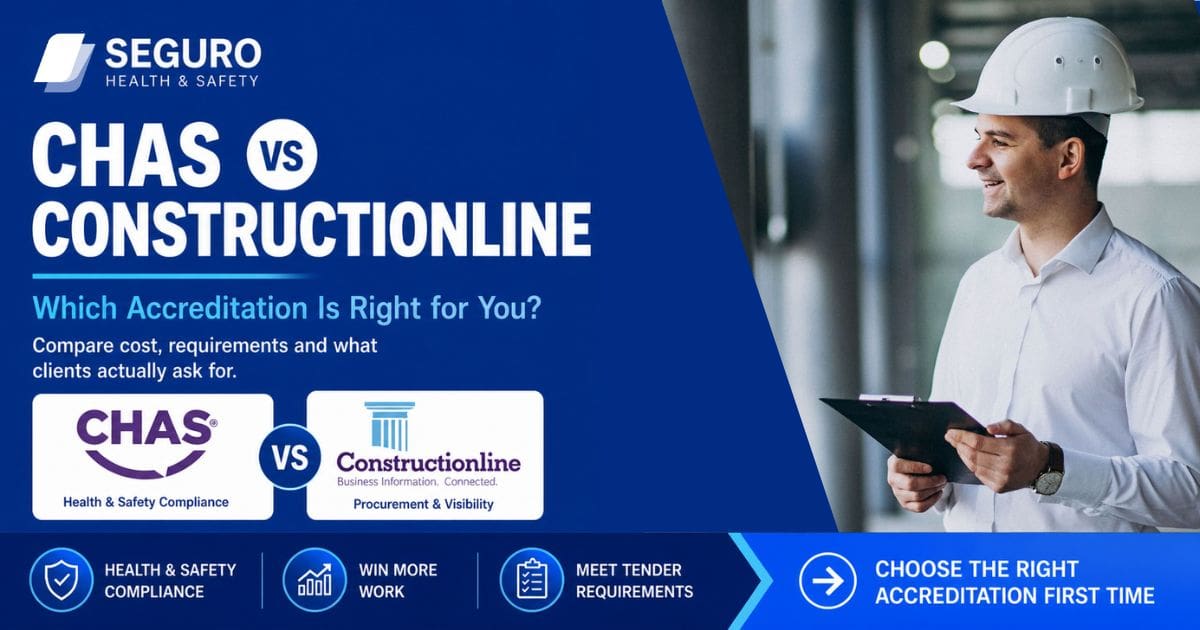
    CHAS vs Constructionline: Which Accreditation Do You Need? (2026 Guide)

    Quick Answer

    CHAS and Constructionline are both UK contractor accreditation schemes used to demonstrate health and safety compliance.

    • CHAS focuses primarily on health & safety and SSIP compliance
    • Constructionline combines health & safety with supplier verification, financial checks, and procurement tools
    • If you’ve decided on CHAS, follow our step-by-step CHAS accreditation guide.

    What is the Difference Between CHAS and Constructionline?

    CHAS (Contractors Health and Safety Assessment Scheme)

    • Health & safety focused
    • SSIP accredited
    • Recognised by public and private sector clients
    • Often required for site access and contractor approval
    • To understand how both schemes align, see our SSIP and CHAS explanation.

    Best for:

    • Contractors needing SSIP compliance
    • Businesses working with main contractors or local authorities

    Constructionline

    • Broader pre-qualification platform
    • Includes:
      • Health & safety (via SSIP at higher levels)
      • Financial checks
      • Company verification
    • Acts as a supplier database for buyers

    Best for:

    • Contractors bidding for larger frameworks and tenders
    • Businesses needing visibility to buyers

    Key Differences (Simple Comparison)

    Feature

    CHAS

    Constructionline

    Focus

    Health & Safety

    Full supplier pre-qualification

    SSIP Accreditation

    Yes

    Yes (Gold level)

    Financial Checks

    No

    Yes

    Procurement Platform

    No

    Yes

    Typical Use

    Compliance & site approval

    Tendering & supply chain access

    Which One Do Clients Prefer?

    It depends on the client:

    • Main contractors / local authorities
      → Often ask for CHAS or SSIP
    • Large frameworks/procurement platforms
      → Often specify Constructionline

    Some clients accept either, as both align with SSIP standards

    Cost Comparison (Overview)

    Costs vary based on:

    • Business size
    • Level of accreditation

    Do You Need Both?

    No one is enough

    BUT:

    • Some contractors choose both to maximise opportunities
    • Certain clients specify one by name

    When to Choose CHAS

    Choose CHAS if you need to:

    Meet SSIP requirements
    Get approved for site work
    Demonstrate health & safety compliance
    Work with public sector or main contractors

    When to Choose Constructionline

    Choose Constructionline if you want to:

    Access procurement platforms
    Pass financial and supplier checks
    Bid for larger contracts
    Increase visibility to buyers

    Pro Tip (Most Contractors Miss This)

    All SSIP schemes (including CHAS and Constructionline )
    follow the same core health & safety criteria

    This means:

    You may not need to duplicate applications.
    You can often use one accreditation to support another

    Final Thought

    CHAS proves you are safe and compliant.
    Constructionline helps you get found and win work

    The best choice depends on:

    • Your clients
    • Your sector
    • Your growth strategy

    Want to Choose the Right Accreditation?

    Choosing the wrong scheme can:

    • Cost you money
    • Delay work
    • Limit opportunities

    The right advice can save you time, cost, and stress. Need help getting approved? Our CHAS support service handles the full process for you.

    CALL Amanda on 0800 031 5404 to get started

    Get a price
    shape Ask Amanda

    Frequently asked questions

    What is the difference between CHAS and Constructionline?

    CHAS focuses mainly on health and safety compliance and SSIP accreditation, while Constructionline is a broader pre-qualification platform that includes financial checks, supplier verification and procurement visibility.

    Is CHAS better than Constructionline?

    Neither CHAS nor Constructionline is better overall. CHAS is better for demonstrating health and safety compliance, while Constructionline is better for accessing procurement opportunities and supplier databases. The right choice depends on your client’s requirements.

    Do I need CHAS or Constructionline?

    You may only need one accreditation, depending on your clients. Many contractors choose CHAS to meet SSIP requirements, while others choose Constructionline for tendering and visibility. Some businesses use both to maximise opportunities.

    Is Constructionline SSIP accredited?

    es. Constructionline Gold includes SSIP accreditation, meaning it meets the same core health and safety criteria as schemes like CHAS.

    “Is CHAS part of SSIP?

    Yes. CHAS is a founding member of SSIP and provides recognised health and safety accreditation that aligns with SSIP standards.

    Which is cheaper, CHAS or Constructionline?

    Costs vary depending on company size and level. CHAS typically costs from around £400 per year, while Constructionline starts from around £498 per year, with higher tiers costing more.

    Can I have both CHAS and Constructionline?

    Yes. Many contractors hold both CHAS and Constructionline to meet different client requirements and increase their chances of winning work.

    Which accreditation do main contractors prefer?

    Main contractors and local authorities often require CHAS or another SSIP scheme for health and safety compliance. Some larger frameworks and procurement systems may specify Constructionline.

    Related CHAS Guides

    Risk Assessments and Method Statements

    Insight by

    amanda

    Amanda Lambert

    Published on

    8 March 2023

    Health and safety blog

    Risk Assessments and Method Statements

    Here at Seguro we know that Risk Assessments & Method Statements (RAMS) can seem a daunting task when you have to start them from scratch. We have developed a library of documents that can be used within your business on a day to day basis.

    We constantly update our shop section with the latest activity based ones we have created.

    Our RAMS can be purchased individually  for only £10 + vat or in a pack depending on what you need.

    If you are unsure if we have the document you need please visit our SHOP and see what you can find.

    Here are some examples listed below:

    RAMS For Screeding
    Plumbing RAMS
    External Painting RAMS
    RAMS for commercial electrical installation

    We also offer a RAMS Pack which contains 65 templates covering a range of subjects.

    Standard RAMS

    We provide a wide range of RAMS in template format on our website. Each can be five to sixteen pages long and contain between 3,000 and 9,000 words.

    The RAMS are within a template and cover all the principal risks and methods to carry out a specific job. The RAM Templates need the client’s involvement as there will be a comprehensive sequence of work that could apply. As the client, you would be responsible for ensuring that this sequence was relevant to yourself and, if not amended to reflect your process.

    Our standard RAMS cost from £6 to £12 per RAM or are provided free as part of our Safety Advisory service or Competent person service.

    Review our standard RAMS

    Risk assessment training

    If the tasks you are carrying out are different and unique to your business a  Bespoke RAMS might be better for you.

    This is where we create a RAMS that is 100% specific to your needs., prices start at £150 + vat

    We would need information from you to create the documents please find the criteria we would need here.

    Legislative Calendar

    Insight by

    Avatar photo

    Matthew Weatherston

    Published on

    26 January 2023

    Health and safety blog
    Legislation/Consultation In force/Closes Need to know Applies In Resources
    Health and Safety (Enforcing Authority) Regulations 1998 28/07/2016 Informal consultation on the effectiveness of the division of regulatory responsibility between the HSE and the local authorities GB hse.gov.uk
    Control of Electromagnetic Fields at Work Regulations 2016 01/07/2016 Implements the EU’s EMF directive. Introduces requiremnt to assess levels of EMF exposure against specific thresholds. GB hse.gov.uk
    Explosives Regulations 2014 (amendment) Regulations 2016 20/04/2016 Implements the recast of the Explosives for Civil Uses Directive. Changes include new requirements for the civil use of explosives to be accompanied by instructions and safety information GB hse.gov.uk
    Freight Containers (Safety Convention) (Amendment) Regulations 2016 Feb-16 Amendments to the Freight Containers (Safety Convention) Regulations 1984. Proposals include major changes to the Safety Approval Plates and additional safety tests. GB hse.gov.uk
    Definitive guideline for health and safety offences, corporate manslaughter and food safety and hygiene offences 01/02/2016 Gives judges a framework of tiered penalties based on the offending organisation’s turnover, the level of harm risked and culpability. England/Wales bit.ly
    Construction (Design and Management) Regulations 2015 23/12/2015 Transitional period for projects started before April 2015 ends. Works with more than one contractor must have appointed a principal designer. GB hse.gov.uk
    Transportation of Directive 2013/35/EU on exposure to electromagnetic fields (EMFs) 03/12/2015 Proposed Control of Electromagnetic Fields at Work Regulations will require duty holders to assess exposure to EMFs GB hse.gov.uk
    Deregulation Act 2015 03/12/2015 Turban wearing Sikhs do not have to wear head protection in any industries. GB hse.gov.uk
    The Health and safety at Work ect. Act 1974 (General Duties of Self-Employed Persons ) (Prescribed Undertakings) Regulations 2015 Oct-15 Changes the law to exempt self-employed people whose work activity poses no potential risk to other workers or the public. GB hse.gov.uk
    Offshore Installations (Offshore Safety Directive) (Safety Case ect) Regulations 2015 Jul-15 Applies to offshore oil and gas operators, interoperating additional requirements of directive 2013/30/EU England/Wales hse.gov.uk
    Control of Major Accident Hazards Regulations (COMAH) 2015 Jun-15 Main Duties unchanged from 1999 regs; lower tier operators must provide public information about their site and its hazards for the first time; both upper tier and lower tier operators must provide public information electronically. GB hse.gov.uk
    Control of Asbestos Regulations 2012 May-15 Workers undertaking non-licensed work for the first time must have a medical examination before they start. England/Wales legislation.gov.uk
    Construction (Design and Management) regulations 2015 Apr-15 CDM coordinator replaced with principal designer, prescriptive requirements for duty holders to check contractors’ competence removed, CDM duties extended to domestic clients. GB hse.gov.uk
    Road Traffic Act 1988 Mar-15 Section 5 amended to include an offence of driving under the influence of a controlled drug – including some prescription medications. England/Wales lexisurl.com

    The different between a small and a large CHAS application

    Insight by

    amanda

    Amanda Lambert

    Published on

    18 October 2022

    CHAS

    The different between a small and a large CHAS application

    Understand the difference between a small and a large CHAS application and the impact of employee numbers on requirements. We often get companies asking us what is the difference between having 4 employees or 5 when applying for CHAS. CHAS define an employee as someone who you pay through your PAYE system, there are different assessment fees due depending on the number of employees you declare.

    In particular to CHAS there is an increased number of documents you need to provide as well as evidence of your safety arrangements including Health & Safety policy.

    Once you have 5 employees or more you have legal requirements under the Health & Safety at Work Regulations 1974, you need to have formal arrangements in place for competent Safety advice as well as a full Heath & Safety Management system.

    Learn more about CHAS

    We have a series of articles where you can learn more about CHAS. The list of articles is below:

    If you are not sure which bracket you fall under, or if you have enough documentation to satisfy the assessment get in touch and we will be able to provide you with advice.