Close Navigation

Search

SSIP Accreditations – Complete Guide for UK Contractors

Insight by

amanda

Amanda Lambert

Published on

5 February 2026

Accreditations

Table of contents

SSIP Accreditations: Complete Guide for UK Contractors

If you work in construction, facilities management, engineering, or maintenance, you’ve probably been asked whether your business has SSIP accreditation.

For many contractors, SSIP accreditation is no longer optional. It has become a key requirement for winning contracts, passing pre-qualification questionnaires (PQQs), gaining site access, and working for larger organisations.

This guide explains what SSIP accreditations are, why they matter, and how to choose the right scheme for your business.

What Is SSIP Accreditation?

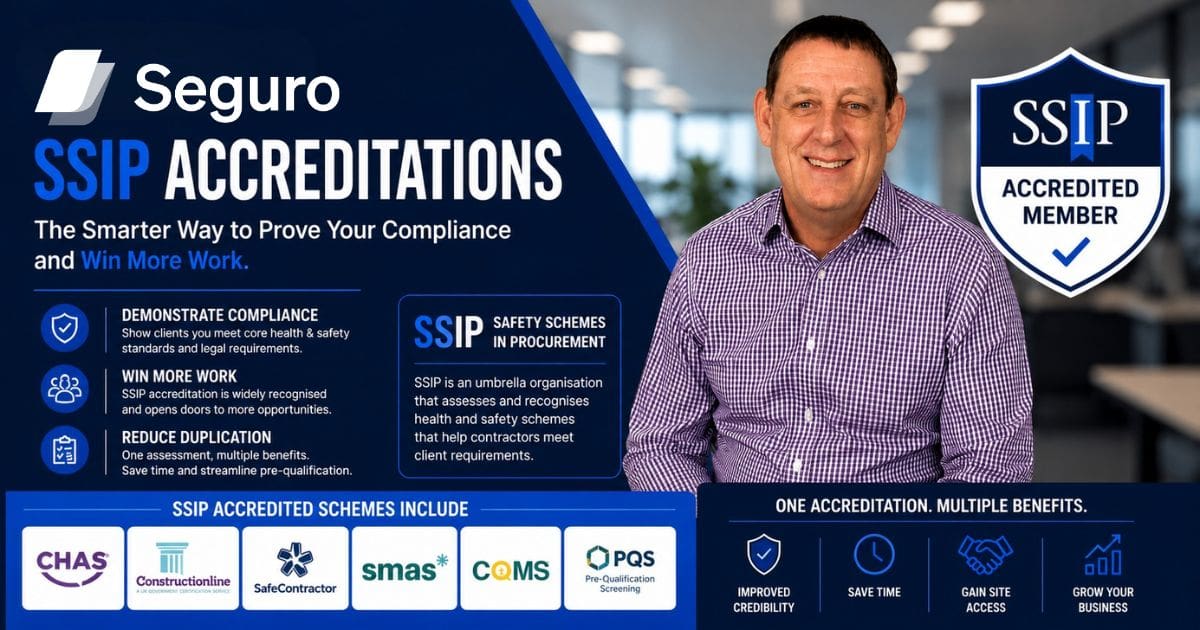
SSIP stands for Safety Schemes in Procurement.

It is an umbrella organisation that assesses and recognises health and safety accreditation schemes operating within the UK.

The purpose of SSIP is to reduce duplication during contractor pre-qualification by ensuring member schemes assess contractors against the same core health and safety standards.

Rather than completing separate health and safety assessments for every client, contractors can demonstrate compliance through a recognised SSIP accreditation.

Why Is SSIP Important?

Many clients use SSIP accreditation as evidence that a contractor has suitable health and safety management arrangements in place.

Benefits include:

  • Demonstrates compliance with health and safety legislation
  • Improves credibility with clients
  • Simplifies contractor pre-qualification
  • Reduces repeated health and safety assessments
  • Helps win more work
  • Improves access to public and private sector contracts
  • Supports supply chain approval

For many contractors, SSIP accreditation is now a basic requirement before being invited to tender.

Which Schemes Are SSIP Accredited?

Several popular contractor accreditation schemes are recognised under SSIP.

Common examples include:

CHAS

One of the UK’s most recognised contractor accreditation schemes.

Suitable for:

  • Construction contractors
  • Facilities management companies
  • Engineers
  • Maintenance businesses

Benefits:

  • Strong brand recognition
  • Widely accepted by clients
  • Multiple membership levels available

Constructionline

Combines health and safety assessment with contractor verification and supply chain management.

Benefits:

  • Contractor database exposure
  • Tender opportunities
  • Enhanced verification options

SafeContractor

Widely used across multiple industries.

Benefits:

  • Recognised by large organisations
  • Supports contractor compliance
  • Popular with facilities management providers

SMAS

A dedicated SSIP member scheme focused on health and safety assessment.

Benefits:

  • Straightforward assessment process
  • Good value for SMEs
  • Accepted across many sectors

CQMS

Provides health and safety accreditation and compliance support.

Benefits:

  • Competitive pricing
  • Additional support services
  • Suitable for smaller contractors

PQS

Popular among smaller contractors and subcontractors.

Benefits:

  • Cost-effective
  • Simple application process
  • SSIP recognised

What Does SSIP Assess?

All SSIP schemes assess the same core health and safety standards.

Typical requirements include:

Health & Safety Policy

A current and signed policy outlining how health and safety is managed.

Risk Assessments

Evidence that workplace hazards have been identified and controlled.

RAMS

Risk Assessments and Method Statements relevant to work activities.

Training Records

Evidence of competence including:

  • CSCS cards
  • First Aid
  • Asbestos Awareness
  • Working at Height
  • Plant qualifications

Insurance

Current insurance documentation including:

  • Employers’ Liability Insurance
  • Public Liability Insurance

Accident Reporting

Procedures for recording and reporting incidents.

Competent Health & Safety Support

Evidence that the business has access to competent health and safety advice.

How Much Does SSIP Accreditation Cost?

Costs vary depending on the scheme selected.

Typical entry-level costs include:

Scheme Typical Entry Cost
CHAS Standard From £429 + VAT
Constructionline Bronze From £498 + VAT
SafeContractor From £419 + VAT
SMAS From £317 + VAT
CQMS From £175 + VAT
PQS From £119 + VAT

The assessment criteria are largely identical because all SSIP member schemes assess the same core requirements.

The differences are usually related to:

  • Brand recognition
  • Market demand
  • Additional services
  • Membership benefits
  • More on SSIP Cost

Common Reasons Applications Fail

Most SSIP applications fail because the documentation does not adequately demonstrate compliance.

Common issues include:

  • Missing documents
  • Unsigned policies
  • Expired insurance
  • Generic RAMS
  • Missing training evidence
  • Incorrect company details
  • Lack of competent person evidence

Most problems can be resolved before submission with a thorough compliance review.

Why SSIP Applications Fail

Do Small Contractors Need SSIP Accreditation?

Not every contractor requires SSIP accreditation immediately.

However, accreditation is often beneficial if you:

  • Work for principal contractors
  • Tender for public sector work
  • Apply for framework agreements
  • Require site approval
  • Want to improve credibility
  • Need access to larger contracts

Many small contractors obtain accreditation specifically to unlock growth opportunities.

SSIP For Small Businesses

How to Get SSIP Accreditation

The process is generally straightforward:

Step 1

Gather your health and safety documents.

Step 2

Review policies, RAMS, training records and insurance.

Step 3

Choose an SSIP member scheme.

Step 4

Complete the online application.

Step 5

Respond to any assessor queries.

Step 6

Receive accreditation approval.

Many contractors use professional support to speed up the process and improve approval success.

How to Get SSIP Accreditation

How Seguro Can Help

Preparing for SSIP accreditation can be time-consuming, especially if documentation needs updating.

Seguro Health & Safety supports contractors with:

  • Health & Safety Policies
  • Risk Assessments
  • RAMS
  • Training reviews
  • Competent Person services
  • CHAS applications
  • Constructionline applications
  • SMAS applications
  • SafeContractor applications
  • SSIP compliance reviews

Whether you’re applying for your first accreditation or renewing an existing scheme, professional support can help reduce delays and improve approval success.

Conclusion

SSIP accreditations provide contractors with a recognised way to demonstrate health and safety compliance.

They help simplify contractor approval, improve credibility, and open access to larger contracts and supply chains.

Whether you choose CHAS, Constructionline, SafeContractor, SMAS, CQMS or PQS, the core assessment requirements remain largely the same. The key to success is having organised, accurate, and up-to-date health and safety documentation that clearly demonstrates compliance.

For many UK contractors, SSIP accreditation is one of the most effective investments they can make to win more work and grow their business.

CALL Matt on 0800 031 5404 to get started

Get a price


shape Safety Advisor

Frequently Asked Questions

What are SSIP accreditations?

SSIP accreditations are recognised health and safety assessments used in contractor pre-qualification. SSIP stands for Safety Schemes in Procurement and helps contractors demonstrate that they meet core health and safety standards.

What does SSIP stand for?

SSIP stands for Safety Schemes in Procurement. It is used to help reduce duplication in contractor health and safety assessments by recognising member schemes that assess against common core standards.

Which schemes are SSIP accredited?

Common SSIP-accredited schemes include CHAS, Constructionline, SafeContractor, SMAS, CQMS and PQS. Each scheme assesses contractors against core health and safety requirements.

What does SSIP accreditation assess?

SSIP accreditation usually assesses health and safety policies, risk assessments, RAMS, training records, insurance, accident reporting procedures and evidence of competent health and safety support.

Do contractors need SSIP accreditation?

Contractors often need SSIP accreditation when working for principal contractors, tendering for public sector work, applying for framework agreements, gaining site approval or trying to access larger contract opportunities.

How much does SSIP accreditation cost?

SSIP accreditation costs vary depending on the scheme. Typical entry-level costs include CHAS from £429 plus VAT, Constructionline Bronze from £498 plus VAT, SafeContractor from £419 plus VAT, SMAS from £317 plus VAT, CQMS from £175 plus VAT and PQS from £119 plus VAT.

Why do SSIP applications fail?

SSIP applications often fail because of missing documents, unsigned policies, expired insurance, generic RAMS, missing training evidence, incorrect company details or lack of competent health and safety support.

Can small contractors apply for SSIP accreditation?

Yes. Small contractors can apply for SSIP accreditation. Many small businesses use SSIP accreditation to improve credibility, satisfy client requirements, access larger projects and support tender applications.

How do you get SSIP accreditation?

To get SSIP accreditation, gather your health and safety documents, review policies, RAMS, training records and insurance, choose an SSIP member scheme, complete the online application, respond to assessor queries and wait for approval.

Can Seguro help with SSIP accreditation?

Yes. Seguro Health & Safety can support contractors with SSIP accreditation by helping prepare health and safety policies, risk assessments, RAMS, training reviews, competent person evidence and applications for schemes such as CHAS, Constructionline, SafeContractor and SMAS.

More Articles


What is PQS accreditation

Insight by

Bob Evans

Bob Evans

Published on

1 January 2026

PQS accreditation

What Is PQS Accreditation? (UK Contractors Explained)

PQS accreditation stands for Pre-Qualification Scheme accreditation. It is used in the UK construction and services sectors to assess whether a contractor meets recognised standards for health & safety, insurance, financial stability, and legal compliance.

Many clients and principal contractors require the accreditation before allowing businesses to tender for work.

What Does PQS Mean?

A PQS accreditation confirms that a business has been independently assessed against industry-recognised criteria. It demonstrates that a contractor:

  • Manages health and safety effectively
  • Has appropriate insurance in place
  • Is financially viable
  • Meets legal and regulatory obligations

Instead of completing multiple PQQs, accredited contractors can use PQS as proof of compliance.

Who Needs PQS Accreditation?

The accreditation is commonly required for:

  • Construction contractors and subcontractors
  • Electrical, mechanical, and building services companies
  • Maintenance and facilities management providers
  • Businesses tendering for commercial or public sector work

For many buyers, PQS accreditation is a minimum entry requirement.

What Does The Accreditation Assess?

A PQS assessment typically reviews:

Health & Safety Management

  • Health & Safety Policy
  • Risk assessments and method statements (RAMS)
  • Training and competence records
  • Accident reporting procedures

Company and Financial Information

  • Business structure and ownership
  • Public and employers’ liability insurance
  • Financial declarations or accounts

Compliance and Governance

  • Legal compliance
  • Modern slavery and equality policies (where applicable)
  • Environmental considerations

Get a price for a PQS accreditation

How Long Does The Accreditation Last?

PQS accreditations are valid for 12 months and require annual renewal to ensure information remains current and compliant.

Benefits of the Accreditation

PQS accreditation helps contractors:

  • Win more work
  • Reduce repeated PQQ paperwork
  • Demonstrate competence to buyers
  • Meet procurement requirements quickly

For small contractors, it saves time and improves credibility.

Common Misunderstandings

  • It is not optional for many contracts
  • Generic policies are not sufficient
  • Accreditation must be maintained, not just achieved

Conclusion

  • PQS accreditation is a UK pre-qualification assessment

  • It proves contractor competence and compliance

  • Often required before tendering

  • Covers health & safety, insurance and financial checks

  • Typically renewed annually


Expert Advice

Choosing the right PQS scheme, and getting your documentation right first time, can be the difference between winning work and being delayed or rejected at the pre-qualification stage.

The first question most contractors ask is “how much does it cost?”


In many cases, PQS accreditation is significantly more cost-effective than other SSIP schemes such as CHAS, while meeting the same SSIP-recognised standards. All SSIP accreditations follow the same core criteria, so you’re not compromising on compliance.

PQS fees can vary, so rather than guessing, complete a short form and we’ll confirm the exact current cost for your business.

Click the button below.

How to Get Constructionline Accreditation 2026 Guide – Step by Step Process

Insight by

Bob Evans

Bob Evans

Published on

4 December 2025

Constructionline

How to Get Constructionline Accreditation (Step-by-Step Guide for 2026)

What is Constructionline?

Constructionline is the UK’s largest pre-qualification platform for contractors, suppliers, and construction businesses. It provides clients with verified evidence of your:

  • Health and safety compliance
  • Business legitimacy
  • Financial stability
  • Environmental and quality management
  • Social responsibility
  • Supply-chain reliability

It helps contractors win more work and reduce repetitive PQQ paperwork.

Quick Answer: How to Get Constructionline Accreditation in 2026

To get Constructionline accredited, you must:

  1. Choose your Constructionline level (Associate, Silver, Gold, or Platinum).
  2. Register your business on the Constructionline portal.
  3. Complete the PAS 91-aligned questionnaire.
  4. Upload evidence of health and safety, insurance, finances, and policies.
  5. Complete a third-party SSIP assessment (if applying for Gold).
  6. Respond to assessor queries.
  7. Receive approval and appear on the Constructionline database.


How can we help?

We can complete the application, gather all required documents and answers to questions, and compile all necessary evidence, allowing you to focus on your job. We are efficient, economical and have a 100% success rate. Get accredited and win more work.

Get ConstructionLine Accredited Today

Constructionline Accreditation Levels (Explained)

1. Constructionline Associate

Entry-level listing. Shows your company exists and provides basic company information.

Suitable for very small firms, new businesses, and subcontractors.

2. Constructionline Silver (PAS 91 Basic Compliance)

Most common level. Requires:

  • Business details
  • Financial information
  • Insurance
  • Health & safety documentation
  • Environmental & quality basics

Silver is generally enough for subcontractors and suppliers.

3. Constructionline Gold (PAS 91 + Enhanced Standards)

Includes everything from Silver plus:

  • Environmental management (ISO 14001 or equivalent)
  • Quality management (ISO 9001 or equivalent)
  • Equality & diversity
  • Anti-bribery
  • GDPR compliance
  • Modern slavery
  • Social value evidence
  • Full SSIP accreditation (CHAS, SMAS, SafeContractor)

Often required for principal contractors, councils, and large tenders.

4. Constructionline Platinum (Highest Level)

Includes enhanced audits and validation of:

  • Financial performance and ratios
  • Supply-chain management
  • CSR and sustainability
  • BIM capabilities
  • Risk management strategy

Required for the most complex, high-value projects.

How to Get Constructionline Accreditation (Step-by-Step Guide)

Step 1 — Choose Your Constructionline Level

Your level depends on:

  • Size of your business
  • Type of work you do
  • Tender requirements
  • Client expectations

Most construction firms aim for Silver or Gold.

Step 2 — Register on the Constructionline Portal

You’ll need to enter:

  • Company name and address
  • Legal structure
  • Registration details (Companies House, VAT, etc.)
  • Sector and service type
  • Number of employees

Once complete, you’ll receive login details to begin the assessment.

Step 3 — Complete the PAS 91 Questionnaire

PAS 91 is the standard UK pre-qualification questionnaire used across construction procurement.

Questions cover:

  • Company identity
  • Insurance
  • Financial stability
  • Health & safety compliance
  • Environmental management
  • Quality management
  • Equal opportunities
  • Modern slavery
  • GDPR compliance

Constructionline will not proceed until all sections are complete.

Step 4 — Upload Required Documents

This is the core of your accreditation.

Key Documents for Silver Level

You MUST provide:

  • Health & Safety Policy
  • Risk assessments & method statements (RAMS)
  • Training records & competence (CSCS, NVQs, CPCS)
  • Insurance certificates (EL/PL/PI)
  • Accident reporting procedures
  • Environmental policy
  • Quality policy
  • Anti-bribery and corruption policy
  • Equality & diversity policy

Additional Documents for Gold Level

Gold requires evidence, not just policies:

  • ISO 9001 / quality management system
  • ISO 14001 / environmental management
  • GDPR processes
  • Modern slavery documentation
  • Carbon reduction / sustainability evidence
  • Full SSIP certificate (CHAS, SMAS, SafeContractor or equivalent)

Platinum Requirements (Advanced)

For high-value contractors only:

  • Audited financial accounts
  • BIM Level 2 capability
  • Corporate social responsibility report
  • Advanced supply-chain management plans
  • Risk management framework

Step 5 — Undergo SSIP Health & Safety Assessment (Gold Only)

If you don’t already have SSIP, Constructionline partners with:

  • CHAS
  • SMAS
  • SafeContractor
  • Acclaim

This verifies you meet health & safety standards aligned with CDM 2015.

Step 6 — Assessment & Clarifications

Constructionline assessors review your evidence.
They may request:

  • Extra documents
  • Updated policies
  • Missing certificates
  • Clarification on processes

Responding quickly reduces assessment time.

Step 7 — Approval & Certificate Issued

Once approved, you will receive:

  • Your Constructionline certificate
  • A listing on the national database
  • Access to client tenders
  • Your verified badge to add to your website

Accreditation lasts 12 months.

How can we help?

We can complete the application, gather all required documents and answers to questions, and compile all necessary evidence, allowing you to focus on your job. We are efficient, economical and have a 100% success rate. Quote Request.

Common Reasons Constructionline Applications Fail

❌ Insurance expired or incorrect levels
❌ No evidence of competence (CSCS, NVQs)
❌ Out-of-date policies (must be reviewed annually)
❌ No subcontractor management system
❌ RAMS missing or generic
❌ No evidence for ISO-equivalent systems
❌ Missing SSIP certificate (Gold level)

Avoid these, and your application is far more likely to pass the first time.

Get ConstructionLine Accredited Today

FAQs

How long does Constructionline accreditation take?

Most applications take 5–15 working days, depending on document readiness.

How much does Constructionline accreditation cost?

Prices vary by company size and level:

  • Associate: £100–£150
  • Silver: £300–£600
  • Gold: £600–£1,200
  • Platinum: £2,000+

Do I need Constructionline to win work?

Not legally — but many main contractors, councils, and housing associations require Silver or Gold.

Can sole traders join Constructionline?

Yes. Sole traders often start with Associate or Silver depending on client requirements.

Does Constructionline include SSIP?

SSIP is included only at Gold level via partner schemes.

More information can be found below: 

What is SSIP? – A Contractors Guide

Insight by

Bob Evans

Bob Evans

Published on

4 November 2025

Health and safety blog

SSIP Accreditation: What It Is & Why It Matters for Contractors Guide

What is SSIP? Everything construction businesses need to know about the pre qualification and winning more opportunities.

What Is SSIP?

SSIP (Safety Schemes in Procurement) is the UK’s national umbrella organisation for health & safety assessment schemes.
Instead of completing multiple safety accreditations, SSIP allows businesses to gain recognition once and have it accepted by many different buyers.

SSIP includes well known schemes such as:

  • CHAS
  • PQS
  • Constructionline
  • SafeContractor
  • SMAS Worksafe

If a contractor holds a CHAS, Constructionline, or PQS-approved accreditation, clients can trust that their health & safety systems meet core standards.

Why The Accreditation Matters

SSIP is now one of the most important benchmarks for contractors, subcontractors, and trades in the UK. Here’s why:

1. Win More Work With Recognised Safety Standards

Major contractors, councils, FM companies, and developers increasingly require CHAS, Constructionline, and PQS as part of PQQ or onboarding.

2. Saves Time on Repetitive Safety Pre-Qualification

SSIP prevents businesses from having to complete multiple health & safety assessments for different clients—saving hours of admin every month.

3. Reduces Cost of Compliance

Instead of paying for several accreditations, one SSIP certificate is accepted by many buyers.

4. Demonstrates Legal Compliance

SSIP assessments align with UK safety laws including:

  • Health and Safety at Work Act

  • Management of Health and Safety at Work Regulations

  • CDM Regulations

This reassures clients that your company operates safely and competently.

5. Strengthens Your Brand & Credibility

Displaying an SSIP badge shows customers, inspectors, and project managers that you take safety seriously.

What Do The Assessors Check?

To gain accreditation through any approved scheme, your company must provide evidence of:

Health & Safety Management

  • Up to date H&S policy
  • Competent person support
  • Safety arrangements
  • Toolbox talks & site inductions

Risk Management

  • Recent RAMS
  • COSHH assessments
  • Site-specific risk controls

Training & Competence

  • CSCS/CPCS evidence
  • Certificates of training
  • Induction process

Incident & Reporting Systems

  • Accident records
  • RIDDOR procedures
  • Near-miss processes

Insurance

  • Employer’s liability
  • Public liability
  • Professional indemnity (if relevant)

When applying for enhanced schemes (e.g., SafePQQ), additional checks are conducted to assess environmental, quality, and social value standards.

How to Get SSIP Accreditation (Step-by-Step)

Step 1: Choose a Scheme

Decide whether CHAS, SafeContractor, SMAS, or Constructionline best matches your business needs.

Step 2: Complete the Online Assessment

Provide your company details, trade activities, and scope of works.

Step 3: Upload Documentation

Submit your health & safety policy, RAMS, training records, and insurance certificates.

Step 4: Assessment Review

An SSIP auditor reviews everything and may request additional evidence.

Step 5: Receive Your Certificate

Once approved, your business is added to the national database and can display the SSIP badge.

Accreditation lasts 12 months and must be renewed annually.

Most Common Reasons Applications Fail

Avoid these issues to secure fast approval:

❌ Outdated or missing H&S policy
❌ No recent or adequate RAMS
❌ Missing staff training certificates
❌ Incomplete accident records
❌ Insurance out of date or incorrect
❌ Competent person details missing

Fixing these in advance boosts your first-time pass rate.

SSIP vs Non-SSIP Schemes

Scheme Type Accepted by Buyers? Benefits
SSIP Certified Widely accepted Saves time, reduces cost, proves competence
Non-SSIP Schemes Limited acceptance May require additional paperwork

SSIP is designed to simplify compliance across the entire supply chain.

Is it Worth It for Contractors?

Absolutely. The Accreditation helps you:

✔ Win more work
✔ Reduce tendering admin
✔ Get recognised by major contractors
✔ Demonstrate health & safety competence
✔ Strengthen your professional image

If you want to grow in construction, FM, engineering, or local authority supply chains, SSIP is now an essential requirement—not just a “nice to have.”

CALL Amanda on 0800 031 5404 to get started

shape Ask Amanda

Frequently Asked Questions

What does SSIP accreditation mean?

SSIP accreditation means your business has been assessed against recognised health and safety standards and can demonstrate that it has suitable policies, procedures, risk assessments and evidence of compliance in place. For more information, go to SSIP Accreditations: The Complete Guide

Is CHAS an SSIP scheme?

Yes. CHAS is an SSIP member scheme. This means CHAS assesses contractors against the SSIP core health and safety criteria.

Which schemes are SSIP recognised?

Common SSIP recognised schemes include CHAS, SMAS, SafeContractor and Constructionline Acclaim. These schemes assess contractors against the SSIP core criteria.

Do contractors need SSIP accreditation?

Many UK contractors need SSIP accreditation because main contractors, local authorities and commercial clients often request it before allowing businesses to tender for work or start on site.

What documents are needed for the accreditation?

Typical documents include a Health and Safety Policy, risk assessments, method statements, training records, insurance certificates, accident reporting procedures and evidence of competent health and safety advice.

How long does the accreditation take?

The accreditation can often be completed within one to three weeks, depending on the scheme, the quality of your documents and whether the assessor asks for further evidence.

Can Seguro help with accreditations?

Yes. Seguro Health and Safety can help prepare your documents, complete your application, respond to assessor queries and support you through the accreditation process.

SSIP Assessment and Renewal – Complete Guide for UK Contractors

Insight by

Bob Evans

Bob Evans

Published on

21 September 2025

Accreditations

SSIP Assessment and Renewal

If your business holds an SSIP accreditation such as CHAS, SMAS, SafeContractor, CQMS, PQS, or Constructionline, understanding the assessment and renewal process is essential.

Many contractors focus heavily on gaining accreditation but give little thought to maintaining it. However, accreditation renewal is just as important as the initial assessment. Failure to renew on time can result in lost accreditation status, delays to contract awards, and difficulties meeting client requirements.

This guide explains how SSIP assessments work, what assessors look for, and how to prepare for a successful renewal.

What Is an SSIP Assessment?

An SSIP assessment is a review of your company’s health and safety management arrangements against recognised core criteria.

The purpose is to demonstrate that your business has appropriate systems in place to manage health and safety risks and comply with UK legislation.

The assessment is usually completed online and involves submitting supporting documentation for review by a qualified assessor.

Although different SSIP member schemes have their own branding and processes, the core assessment standards remain largely the same.

What Does an SSIP Assessment Cover?

Most SSIP assessments review the following areas:

Health & Safety Policy

Your policy should:

  • Be current
  • Be signed and dated
  • Reflect your business activities
  • Clearly define responsibilities

Risk Assessments

Assessors expect evidence that workplace hazards have been identified and controlled.

Examples include:

  • Working at height
  • Manual handling
  • Electrical safety
  • Use of machinery
  • Slips, trips and falls

RAMS

Risk Assessments and Method Statements should be relevant to the work your business undertakes.

Generic documents often trigger further questions from assessors.

Training and Competence

You may need to provide evidence of:

  • CSCS cards
  • First aid training
  • Asbestos awareness
  • IPAF
  • PASMA
  • Plant qualifications
  • Toolbox talks

Insurance

Current insurance documentation is normally required, including:

  • Employers’ Liability Insurance
  • Public Liability Insurance

Accident Reporting

Assessors may request evidence of:

  • Accident procedures
  • Incident records
  • RIDDOR reporting arrangements

Competent Health & Safety Support

Many schemes require evidence that your business has access to competent health and safety advice through a qualified consultant or competent person.

How Long Does an SSIP Assessment Take?

The actual assessment process is often relatively quick once all documents have been submitted.

Most delays occur because:

  • Documents are missing
  • Policies are outdated
  • Insurance has expired
  • Training records are incomplete
  • Assessor queries require clarification

Preparation is usually the biggest factor affecting approval times.

What Is SSIP Renewal?

SSIP accreditation is not permanent.

Most schemes require renewal every 12 months to ensure businesses continue to meet the required standards.

Renewal demonstrates that your health and safety systems remain current and effective.

Many clients monitor contractor accreditation status, making timely renewal essential.

What Documents Are Needed for Renewal?

Renewal assessments usually require updated versions of the same documents reviewed during the initial application.

Common requirements include:

Updated Health & Safety Policy

Ensure:

  • Review dates are current
  • Signatures are valid
  • Business details are correct

Current Insurance Certificates

Expired insurance is one of the most common reasons renewals are delayed.

Training Records

Review:

  • Expired qualifications
  • New employee records
  • Refresher training requirements

Risk Assessments and RAMS

Documents should reflect current work activities and equipment.

Accident Records

Where applicable, ensure incident records are accurate and available.

Competent Person Evidence

Provide current details of your competent health and safety support arrangements.

Common Reasons SSIP Renewals Fail

Many renewal applications are rejected for avoidable reasons.

Common issues include:

Expired Insurance

Insurance renewal dates frequently fall between accreditation periods.

Outdated Policies

Policies may still reference old employee numbers, outdated responsibilities or previous review dates.

Missing Training Evidence

Certificates may have expired or not been updated for new employees.

Generic RAMS

Copied or outdated method statements often raise assessor concerns.

Changes Not Reflected in Documentation

Examples include:

  • New services
  • Additional employees
  • New premises
  • New equipment
  • Higher-risk activities

Documentation should always reflect current operations.

How to Prepare for SSIP Renewal

A proactive approach makes renewal significantly easier.

Review Documents Early

Start preparing at least 30 to 60 days before renewal is due.

Update Policies

Ensure all policies are reviewed and signed.

Check Insurance

Confirm current insurance certificates are available.

Review Training Records

Update training matrices and obtain missing evidence.

Audit Existing Documents

Identify gaps before the assessor does.

Respond Promptly to Queries

Quick responses help avoid delays.

Why Maintaining Accreditation Matters

Keeping your SSIP accreditation active helps:

  • Maintain contractor approval status
  • Retain eligibility for tenders
  • Demonstrate ongoing compliance
  • Strengthen client confidence
  • Support CHAS and supply chain requirements
  • Reduce duplication during pre-qualification

For many contractors, a lapsed accreditation can delay projects and affect future opportunities.

Can a Consultant Help With SSIP Assessment and Renewal?

Yes.

Many contractors use professional health and safety consultants to:

  • Review documentation
  • Update policies
  • Improve RAMS
  • Maintain training records
  • Provide competent person evidence
  • Manage accreditation submissions
  • Respond to assessor queries

This often reduces administrative burden and improves approval success rates.

How Seguro Can Help

Seguro Health & Safety supports contractors throughout the full SSIP lifecycle, including:

  • Initial accreditation applications
  • Annual renewals
  • Health & Safety Policies
  • Risk Assessments
  • RAMS
  • Competent Person services
  • Training reviews
  • Compliance audits
  • CHAS, SMAS, SafeContractor, Constructionline, CQMS and PQS support

Whether you are applying for the first time or preparing for renewal, professional support can help ensure your documentation meets assessor expectations.

Conclusion

SSIP assessment and renewal are essential parts of maintaining contractor compliance and demonstrating professional health and safety management.

Most assessments and renewals are straightforward when documentation is organised, current, and accurately reflects the business.

By preparing early, reviewing key documents, and maintaining competent health and safety support, contractors can improve approval success, avoid delays, and continue accessing valuable contract opportunities.

Frequently Asked Questions

What is an SSIP assessment?

An SSIP assessment is a review of a contractor’s health and safety management arrangements against recognised core criteria. It usually involves submitting documents such as policies, risk assessments, RAMS, insurance, training records, accident procedures and evidence of competent health and safety support. For more information, go to SSIP Accreditations: The Complete Guide

What does an SSIP assessment cover?

An SSIP assessment usually covers your health and safety policy, risk assessments, RAMS, training and competence records, insurance certificates, accident reporting procedures and access to competent health and safety advice.

How long does an SSIP assessment take?

The assessment can be relatively quick once all documents are submitted, but delays often occur when documents are missing, policies are outdated, insurance has expired, training records are incomplete or assessor queries require clarification.

How often does SSIP accreditation need to be renewed?

Most SSIP accreditations need to be renewed every 12 months. Renewal helps demonstrate that your health and safety systems remain current, accurate and suitable for your business activities.

What documents are needed for SSIP renewal?

SSIP renewal usually requires updated versions of your health and safety policy, insurance certificates, training records, risk assessments, RAMS, accident records where applicable and evidence of competent health and safety support.

Why do SSIP renewals fail or get delayed?

SSIP renewals often fail or get delayed because of expired insurance, outdated policies, missing training evidence, generic RAMS, missing competent person evidence or business changes that are not reflected in the documentation.

When should I start preparing for SSIP renewal?

It is sensible to start preparing for SSIP renewal at least 30 to 60 days before your accreditation expires. This gives time to review documents, update policies, check insurance, correct training gaps and respond to any assessor queries.

What happens if my SSIP accreditation expires?

If your SSIP accreditation expires, you may lose approved contractor status, experience delays with site access, fail pre-qualification checks or become ineligible for certain tenders and supply chain opportunities until accreditation is renewed.

Can a consultant help with SSIP assessment and renewal?

Yes. A health and safety consultant can help review documentation, update policies, improve RAMS, maintain training records, provide competent person evidence, manage submissions and respond to assessor queries.

Can Seguro help with SSIP assessment and renewal?

Yes. Seguro Health & Safety can help contractors with initial SSIP assessments, annual renewals, health and safety policies, risk assessments, RAMS, competent person support, training reviews and applications for schemes such as CHAS, SMAS, SafeContractor, Constructionline, CQMS and PQS.

How can i check if someone is SSIP registered?

Insight by

amanda

Amanda Lambert

Published on

18 September 2025

Accreditations

How Can I Check if Someone Is SSIP Registered?

If you’re hiring contractors, awarding construction work, or managing supply chains, verifying a contractor’s health and safety credentials is an important part of due diligence.

One of the most common questions clients ask is:

“How can I check if a contractor is SSIP registered?”

The good news is that checking a contractor’s SSIP status is usually straightforward. In this guide, we’ll explain what SSIP registration means, how to verify it, and what to do if a contractor claims to be accredited but cannot provide evidence.

What Does SSIP Registered Mean?

SSIP stands for Safety Schemes in Procurement.

It is a framework that allows contractors to demonstrate compliance with recognised health and safety standards through an approved assessment scheme.

A contractor who is SSIP registered has successfully completed an assessment through an SSIP member scheme such as:

  • CHAS
  • SafeContractor
  • SMAS
  • Constructionline
  • CQMS
  • PQS

The assessment reviews the contractor’s health and safety management arrangements, including policies, risk assessments, training records, insurance and competent health and safety support.

Why Check a Contractor’s SSIP Registration?

Verifying accreditation helps ensure that contractors have demonstrated a suitable level of health and safety management.

Benefits include:

  • Reducing supply chain risk
  • Meeting procurement requirements
  • Supporting contractor selection decisions
  • Demonstrating due diligence
  • Improving workplace safety standards
  • Helping satisfy CDM and client compliance obligations

Many principal contractors and organisations make accreditation checks part of their onboarding process.

How to Check if Someone Is SSIP Registered

There are several ways to verify a contractor’s SSIP status.

1. Ask for Their Accreditation Certificate

The simplest method is to request a copy of the contractor’s current accreditation certificate.

The certificate should include:

  • Company name
  • Accreditation scheme
  • Registration number
  • Expiry date
  • Scope of certification

Always check that the accreditation is still valid and has not expired.

2. Use the SSIP Portal

SSIP provides a contractor search facility that allows clients to verify whether a business holds a recognised SSIP accreditation.

By searching the contractor’s:

  • Company name
  • Registration number
  • Accreditation details

You can confirm whether they are currently recognised under the SSIP framework.

This is often the quickest and most reliable verification method.

3. Check the Accreditation Provider’s Database

Many SSIP member schemes operate their own contractor directories.

For example, accredited contractors may be searchable through their scheme provider’s database.

Common schemes include:

If the contractor appears within the scheme’s directory and the accreditation is current, this generally confirms their status.

4. Request Supporting Evidence

In addition to accreditation certificates, many clients request:

  • Employers’ Liability Insurance
  • Public Liability Insurance
  • Health & Safety Policy
  • RAMS
  • Training records
  • Competent person details

Accreditation should complement wider contractor due diligence rather than replace it completely.

What Information Should You Check?

When reviewing accreditation, verify:

Company Name

Ensure the legal trading name matches the business you are engaging.

Expiry Date

Many SSIP accreditations require annual renewal.

An expired accreditation should not be treated as current.

Scheme Provider

Confirm the accreditation is from a recognised SSIP member scheme.

Scope of Work

Check that the accreditation aligns with the contractor’s activities.

Insurance Status

Ensure insurance documents remain valid and current.

Can You Trust SSIP Accreditation?

SSIP accreditation provides independent verification that a contractor has been assessed against recognised health and safety standards.

However, accreditation should form part of a wider contractor selection process.

Clients should still consider:

  • Experience
  • References
  • Competence
  • Qualifications
  • Insurance
  • Project suitability

Accreditation is an important indicator but should not be the only factor in contractor approval.

What If a Contractor Claims to Be SSIP Registered but Cannot Prove It?

If a contractor cannot provide evidence of accreditation:

Request Documentation

Ask for a current certificate or registration number.

Verify Directly

Use the SSIP portal or accreditation provider database.

Confirm Expiry Dates

Some contractors may have previously held accreditation that has since lapsed.

Proceed With Caution

If accreditation is a contractual requirement, work should not proceed until suitable evidence is provided.

How Long Does SSIP Accreditation Last?

Most SSIP accreditations are valid for approximately 12 months.

Contractors must renew their accreditation annually to maintain recognised status.

Failure to renew can result in removal from contractor databases and loss of approved status.

Which Accreditations Are Recognised Under SSIP?

Examples of recognised SSIP member schemes include:

  • CHAS
  • SafeContractor
  • SMAS
  • Constructionline
  • CQMS
  • PQS

All assess contractors against the SSIP core health and safety criteria.

Although schemes differ in branding and additional services, the underlying assessment standards remain broadly consistent.

Why Many Clients Require SSIP Registration

Clients increasingly request SSIP accreditation because it helps:

  • Demonstrate compliance
  • Simplify contractor pre-qualification
  • Reduce repeated assessments
  • Improve supply chain consistency
  • Support health and safety management

For contractors, accreditation can improve credibility and access to larger projects and framework opportunities.

How Seguro Can Help

Seguro Health & Safety helps contractors achieve and maintain SSIP accreditation through:

  • CHAS applications
  • SafeContractor applications
  • SMAS accreditation
  • Constructionline support
  • CQMS accreditation
  • PQS accreditation
  • Health & Safety Policies
  • Risk Assessments
  • RAMS
  • Competent Person Services
  • Accreditation renewals

Whether you are checking accreditation as a client or applying for accreditation as a contractor, professional support can help ensure compliance and reduce delays.

Conclusion

Checking whether someone is SSIP registered is an important part of contractor due diligence.

The easiest methods are to request a current accreditation certificate, use the SSIP contractor search facility, or check the accreditation provider’s database.

By verifying accreditation status, reviewing supporting documentation and confirming renewal dates, clients can make more informed contractor selection decisions while helping maintain high health and safety standards across their projects.

CALL Amanda today on 0800 031 5404 and see how we can support you

Amanda is our technical sales advisor

Get Started Today
shape Ask Amanda

Frequently Asked Questions

How can I check whether someone is SSIP-registered?

You can check whether someone is SSIP-registered by requesting a copy of their accreditation certificate, searching the SSIP contractor database, checking the accreditation provider’s online directory, or asking for their accreditation registration number. For more information, go to SSIP Accreditations: The Complete Guide

What does SSIP registered mean?

SSIP registered means a contractor has successfully completed a health and safety assessment through a recognised SSIP member scheme such as CHAS, SafeContractor, SMAS, Constructionline, CQMS or PQS and has demonstrated compliance with the SSIP core criteria.

Can I verify a contractor’s SSIP accreditation online?

Yes. Many SSIP member schemes provide online contractor directories and the SSIP portal offers contractor verification tools that allow clients to check accreditation status and validity.

What information do I need to check SSIP registration?

You will usually need the contractor’s company name, accreditation number, registration details or a copy of their accreditation certificate to verify their SSIP status.

How long does SSIP accreditation remain valid?

Most SSIP accreditations are valid for 12 months and must be renewed annually to maintain recognised accreditation status.

What should I check on an SSIP certificate?

You should verify the company name, accreditation scheme, registration number, issue date, expiry date and scope of certification to ensure the accreditation is current and relevant.

Which accreditation schemes are recognised by SSIP?

Recognised SSIP member schemes include CHAS, SafeContractor, SMAS, Constructionline, CQMS and PQS. All assess contractors against the SSIP core health and safety criteria.

What if a contractor claims to be SSIP registered but cannot provide evidence?

If a contractor cannot provide evidence of accreditation, you should request a current certificate, verify their status through the SSIP database or accreditation provider and confirm that the accreditation has not expired before proceeding.

Does SSIP accreditation guarantee contractor competence?

SSIP accreditation demonstrates that a contractor has been assessed against recognised health and safety standards. However, clients should also consider experience, qualifications, references, insurance and project suitability as part of their contractor selection process.

Why do clients require contractors to be SSIP registered?

Clients often require SSIP registration to simplify contractor pre-qualification, demonstrate health and safety compliance, reduce supply chain risk, support due diligence and improve consistency across procurement processes.

Can Seguro help contractors become SSIP registered?

Yes. Seguro Health & Safety helps contractors achieve and maintain SSIP accreditation through support with CHAS, SafeContractor, SMAS, Constructionline, CQMS and PQS applications, health and safety policies, RAMS, risk assessments and accreditation renewals.

What is SSIP Deem to Satisfy?

Insight by

amanda

Amanda Lambert

Published on

14 May 2025

Health and safety blog

What Is SSIP Deem to Satisfy?

Quick Answer: 

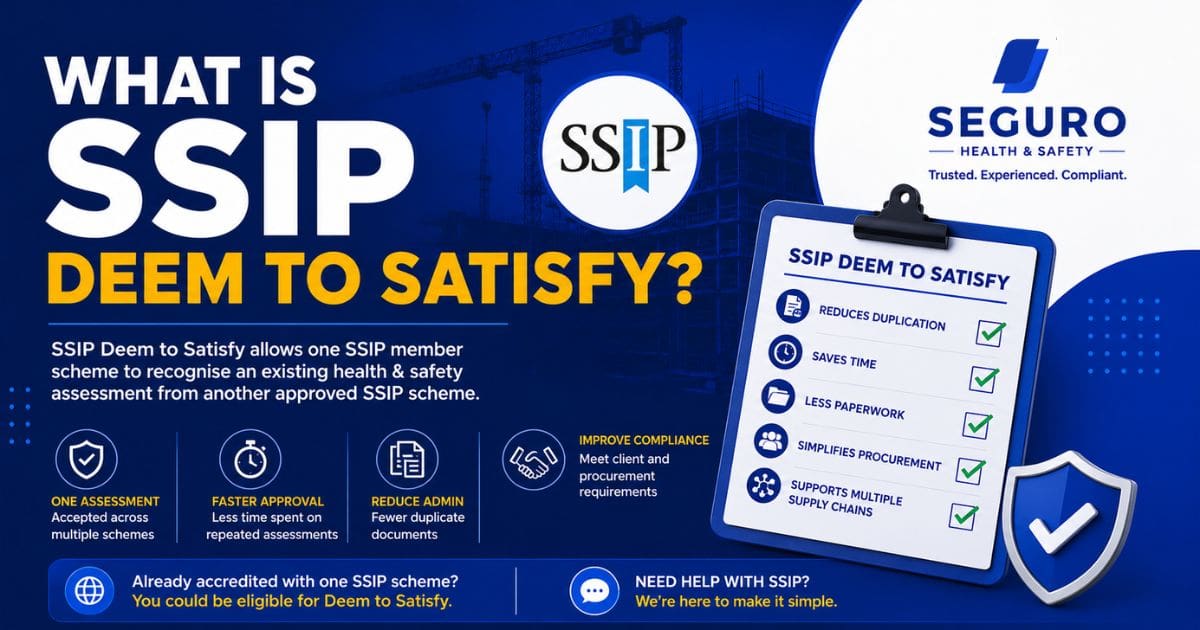
SSIP Deem to Satisfy is a process that allows one SSIP member scheme to recognise an existing valid SSIP assessment from another approved scheme, helping contractors reduce duplicated health and safety assessments and simplify procurement compliance.

In simple terms:

If you already hold a valid SSIP accreditation, you may not need to complete the full assessment process again when applying to another SSIP member scheme.

This helps contractors:

  • Reduce duplication
  • Save time
  • Avoid repeating paperwork
  • Simplify procurement compliance

For many UK contractors, Deem to Satisfy makes it easier to work with multiple clients who request different SSIP schemes.

What Does SSIP Mean?

SSIP stands for Safety Schemes in Procurement.

It is an umbrella organisation that brings together recognised health and safety accreditation schemes including:

  • CHAS
  • Constructionline
  • SafeContractor
  • SMAS
  • CQMS
  • PQS

All SSIP member schemes assess the same core health and safety standards.

What Is SSIP

How Does SSIP Deem to Satisfy Work?

The process works by allowing one SSIP assessment to be recognised by another member scheme.

For example:

  • A contractor holds CHAS accreditation
  • Another client requests SMAS
  • Instead of starting from scratch, SMAS may accept the existing SSIP assessment through Deem to Satisfy

The second scheme may:

  • Reduce the amount of information required
  • Skip duplicated assessment sections
  • Fast-track approval

However, some additional checks may still apply depending on the scheme.

Why Was Deem to Satisfy Created?

Before SSIP Deem to Satisfy, contractors often had to:

  • Complete multiple health and safety applications
  • Submit the same documents repeatedly
  • Pay for repeated assessments
  • Waste time duplicating compliance work

Deem to Satisfy was introduced to:

  • Reduce unnecessary duplication
  • Simplify procurement
  • Improve consistency across schemes
  • Support contractors working across multiple supply chains

Which SSIP Schemes Use Deem to Satisfy?

Many SSIP member schemes participate in the process, including:

  • CHAS
  • SafeContractor
  • SMAS
  • Constructionline
  • CQMS
  • PQS

Acceptance can vary depending on:

  • Accreditation level
  • Scope of work
  • Expiry dates
  • Additional scheme requirements

SSIP Schemes Comparison

Is CHAS Deem to Satisfy?

CHAS itself is an SSIP member scheme and may participate in the Deem to Satisfy process.

This means:

  • Existing SSIP accreditations may support a CHAS application
  • CHAS accreditation may support applications to other SSIP schemes

However, CHAS may still request:

  • Additional evidence
  • Further compliance checks
  • Scheme-specific requirements

This is especially common with:

  • CHAS Advanced
  • CHAS Elite
  • Common Assessment Standard (CAS)

SSIP vs CHAS

What Information Is Usually Required?

Even with Deem to Satisfy, contractors may still need to provide:

  • Existing accreditation details
  • Valid certification
  • Insurance
  • Company information
  • Additional supporting evidence

Some schemes may also review:

  • Environmental policies
  • Quality systems
  • Financial information
  • Modern slavery compliance

Benefits of SSIP Deem to Satisfy

1. Reduces Duplicate Assessments

You avoid repeating the same health and safety assessment multiple times.

2. Saves Time

Applications can often be completed faster.

3. Reduces Administration

Less paperwork and fewer repeated uploads.

4. Supports Procurement Compliance

Makes it easier to work for:

  • Main contractors
  • Local authorities
  • Public sector clients
  • Large commercial organisations

5. Improves Scalability

Helpful for contractors working across multiple frameworks or supply chains.

Does Deem to Satisfy Mean Automatic Approval?

No.

This is one of the biggest misunderstandings.

Deem to Satisfy does NOT guarantee automatic approval.

The receiving scheme may still:

  • Review documents
  • Request updates
  • Ask additional questions
  • Require extra compliance evidence

The process simply reduces duplicated assessment where possible.

Common Problems With Deem to Satisfy Applications

Applications may still fail due to:

  • Expired accreditation
  • Incorrect company information
  • Missing insurance
  • Inconsistent documents
  • Weak RAMS
  • Outdated health & safety policies
  • Scheme-specific requirements not being met

Why SSIP Applications Fail

Is Deem to Satisfy Suitable for Small Contractors?

Yes.

Small contractors often benefit significantly because it:

  • Reduces admin
  • Saves time
  • Simplifies onboarding
  • Helps meet procurement requirements faster

This is particularly useful for:

  • Subcontractors
  • Sole traders
  • Small construction businesses
  • Growing contractors

SSIP for Small Contractors

How to Improve Your Chances of Approval

To improve approval success:

  • Keep documents updated
  • Ensure company information matches across all documents
  • Use tailored RAMS
  • Maintain valid insurance
  • Provide clear evidence of competence
  • Use professional health & safety support if needed

Done for You SSIP Support

Many contractors choose professional support to:

  • Handle applications
  • Prepare documents
  • Upload evidence
  • Manage assessor responses
  • Reduce delays and rejection risk

At Seguro Health and Safety, we support contractors with:

  • CHAS
  • Constructionline
  • SafeContractor
  • SMAS
  • PQS
  • SSIP applications and renewals

Done for You SSIP

Need Help With SSIP Accreditation?

If you need support with:

  • SSIP applications
  • CHAS accreditation
  • RAMS
  • Health & safety documentation
  • Procurement compliance

CALL Amanda on 0800 031 5404 to get started

shape Ask Amanda

Frequently Asked Questions

What is SSIP Deem to Satisfy?

SSIP Deem to Satisfy is a process that allows one SSIP member scheme to recognise an existing valid health and safety assessment completed through another approved SSIP scheme. This can reduce duplication and make procurement compliance easier. For more information, go to SSIP Accreditations: The Complete Guide

Does SSIP Deem to Satisfy mean automatic approval?

No. SSIP Deem to Satisfy does not guarantee automatic approval. The receiving scheme may still check your company details, insurance, accreditation status and any additional scheme-specific requirements.

Which schemes accept SSIP Deem to Satisfy?

Many SSIP member schemes may use the Deem to Satisfy process, including CHAS, Constructionline, SafeContractor, SMAS, CQMS and PQS. Acceptance can depend on the scheme, accreditation level, expiry date and scope of work.

Can CHAS be used for SSIP Deem to Satisfy?

Yes. CHAS is an SSIP member scheme, so a valid CHAS accreditation may help support a Deem to Satisfy application with another SSIP scheme. However, additional checks may still be required.

Can another SSIP accreditation be used to apply for CHAS?

Yes. In some cases, an existing valid SSIP accreditation from another member scheme may support a CHAS application through Deem to Satisfy. CHAS may still request additional evidence depending on the level of accreditation required.

What information is needed for SSIP Deem to Satisfy?

You may need to provide your existing SSIP certificate, accreditation details, company information, insurance documents and any extra evidence requested by the receiving scheme.

What are the benefits of SSIP Deem to Satisfy?

The main benefits are reduced duplication, less paperwork, faster applications, lower administration time and easier compliance with different client procurement requirements.

Why can Deem to Satisfy applications still fail?

Deem to Satisfy applications can still fail if the accreditation has expired, company information is inconsistent, insurance is missing or incorrect, documents are outdated, or additional scheme-specific requirements are not met.

Is SSIP Deem to Satisfy useful for small contractors?

Yes. SSIP Deem to Satisfy can be very useful for small contractors because it reduces repeated paperwork and helps them meet different client or main contractor requirements more efficiently.

Can Seguro help with SSIP Deem to Satisfy applications?

Yes. Seguro Health and Safety can help contractors with SSIP Deem to Satisfy, CHAS, Constructionline, SafeContractor, SMAS, PQS and other SSIP applications by preparing documents, managing submissions and responding to assessor queries.

CHAS and Constructionline Enquiries

Insight by

amanda

Amanda Lambert

Published on

12 February 2024

CHAS

CHAS and Constructionline Enquiries

CHAS and Constructionline Enquiries – Over the last few months we have had a large influx of clients that have been asked for an SSIP accreditation as well as Constructionline. There are a number of ways you can achieve this:

Constructionline

You can start your Constructionline Application as normal but request that you also get assessed for Acclaim. This will mean that your health & Safety will be assessed by Constructionline. The assessor will feedback and further information they need and the process can take up to 3-5 weeks to complete.

CHAS and Constructionline

In order to get both accreditations we would recommend that you start the process for CHAS first, this can take an average of 4 weeks from start to completion. Once you have your CHAS certificate you can then apply to Constructionline when you apply you would tick yes to having an SSIP certificate and upload your CHAS certificate here.

There is then no need to apply for acclaim and you would go ahead with you constructionline application as normal.

If you looking for help with applying for both accreditation’s we can help with that here at Seguro.

CHAS Deem to satisfy process

Insight by

amanda

Amanda Lambert

Published on

25 May 2023

CHAS

CHAS deem to satisfy process

The CHAS Deem to Satisfy process (DtS) scheme allows contractors to apply for CHAS Standard membership without undergoing another health and safety assessment.

All member schemes listed on the SSIP forum adhere to the SSIP Core Criteria, backed by the Health and Safety Executive.

By mutually recognising each other’s schemes, suppliers benefit from only needing to complete one assessment, while buyers enjoy more efficient procurement processes. This approach reduces costs and has saved over £68 million since 2016.

Eligibility

Contractors must have already met the requirements of an assessment through another SSIP member scheme. 

Benefits

Contractors can save time and resources by avoiding a full assessment. They can also avoid paying full price for multiple accreditations. 

Process

Contractors can: 

  1. Check if they have a qualification that CHAS recognises by contacting CHAS or using the e-form. 
  2. Submit their assessment, which will be reviewed within 10 working days. 
  3. Respond to any requests for additional information within the 2-week deadline. 

CHAS deem to satisfy registered members

Two-Way Deem to Satisfy between SSIP Registered Members.

Approval with a Registered Member can only be used to Deem to Satisfy with another Registered Member; it cannot be used to gain a Deem to Satisfy with a Certification Body Member.

Below is the list of registered members you can use for deem to satisfy:

3Core2 Certification Limited Trading As SafeArb SafeArb

Achilles Information Ltd Building Confidence

Alcumus SafeContractor Ltd Alcumus Safecontractor

Altius VA Limited CDMComply

Arboricultural Association ARB Approved Contractor

Association for Project Safety APS Corporate Practice Membership

Avetta Avetta Assessed

CHAS 2013 Ltd Contractors Health & Safety Scheme

Construction Safety Solutions PASS

CQMS Ltd CQMS Safety-Scheme

D W Health & Safety DW Health & Safety Contractor Competency Scheme

Fall Arrest Safety Equipment Training Ltd FASET Membership Audit

Fortius Ltd Acclaim Accreditation

Greenlight Safety Assessment Scheme Ltd Greenlight Safety Assessment Scheme

Hire Association Europe Ltd SafeHire Certification Scheme

International Powered Access Federation [IPAF] IPAF SSIP

MSL Property Care Services Ltd MSL Safepartner

National Access & Scaffolding Confederation Ltd NASC SSIP Audit

National Federation of Demolition Contractors NFDC Membership

PQS Pre-Qualification Scheme PQS Health & Safety Approved

Salus Certification Salus Certification

Safe-T-Cert [NI] {Construction Employers Federation} Safe-T-Cert

Safe-T-Cert [ROI] {Construction Industry Federation} Safe-T-Cert

Safety Management Advisory Services Ltd SMAS Worksafe

SSG Training and Consultancy Ltd SSG Assessed

William Martin Compliance Limited Prosure 360

Learn more about CHAS

We have a series of articles where you can learn more about CHAS. The list of articles is below:

If you have any questions on what is CHAS accreditation please get in touch.


What is SMAS accreditation?

Insight by

amanda

Amanda Lambert

Published on

15 February 2023

Health and safety news

SMAS Accreditation Explained

What is SMAS accreditation? it is a UK health and safety pre-qualification scheme used to assess whether contractors meet recognised standards for managing health and safety. It is widely accepted across construction and related industries and is often required before contractors can tender for work.

What Is SMAS Accreditation?

SMAS stands for Safety Management Advisory Services. SMAS accreditation is SSIP-recognised, meaning it follows the SSIP Core Criteria for assessing health and safety competence.

Achieving SMAS accreditation shows clients and principal contractors that your business manages risk effectively and complies with UK health and safety legislation.

What Does SMAS Accreditation Assess?

A SMAS assessment typically reviews:

  • Health & Safety Policy
  • Risk assessments and method statements (RAMS)
  • Training and competence records
  • Accident and incident reporting procedures
  • Arrangements for managing subcontractors

The assessment is proportionate to your business size and risk profile.

Who Needs SMAS Accreditation?

SMAS accreditation is commonly required for:

  • Construction contractors and subcontractors
  • Electrical and mechanical contractors
  • Facilities management and maintenance companies
  • Businesses working for principal contractors or local authorities

For many buyers, SMAS is a minimum entry requirement.

Is SMAS the Same as SSIP?

No.
SSIP is the umbrella body, while SMAS is one of the accreditation schemes recognised under it. Holding SMAS demonstrates SSIP-aligned health and safety competence.

How Long Does SMAS Accreditation Last?

SMAS accreditation is valid for 12 months and must be renewed annually to keep your compliance status current.

Benefits of SMAS Accreditation

SMAS accreditation helps contractors to:

  • Win more work
  • Reduce repeated PQQ paperwork
  • Demonstrate health and safety competence
  • Meet client and procurement requirements
  • Build credibility with buyers

How much does SMAS cost?

SMAS cost and Seguro Costs
  • Fixed Fee for helping with your accreditation, which will depend on the number of your employees.
  • eLearning may be required
  • Additional RAMS may be required
SMAS Costs
  • Worksafe
  • Worksafe PQQ
The cost of your SMAS accreditation is based on the size of your workforce, so there’s no one-size-fits-all price. The difference between the types is described below.
Rather than guess or overpay, the quickest way to get clarity is to complete our short form. You can find a link in the main menu or on this page.
We’ll ask a few simple questions and provide you with a clear, accurate cost breakdown, so you know exactly what to budget, with no surprises and no obligation.

Get a Price & Support

  • All costs included
  • We will explain the process
  • No Fuss
Get Started Today
shape What is SMAS accreditation?

Why apply for your SMAS accreditation?

When you undertake your SMAS registration, you will be demonstrating that you meet the recognised standards required by any organisation looking to employ you as a contractor. Having your SMAS accreditation is almost certain to open more doors and lead to more opportunities – in turn generating more business and profit for you, ensuring your own workforce is protected by robust health and safety practices.

Submit your SMAS Accreditation with confidence

Getting SMAS approved depends on you satisfying the SMAS assessors on a wide range of compliance issues.

Which ones apply to you will depend on various factors relating to your business, so step one is to ensure you have the right support from the beginning.

  • We support you every step of the way
  • Competitive pricing with no hidden costs
  • A quick, easy and hassle-free process

SMAS Approval Guide: How to Get SMAS Accredited

SMAS accreditation is an SSIP-recognised health and safety assessment used by clients and principal contractors to verify contractor competence. Following the correct steps helps avoid delays, failed assessments, and unnecessary costs.

Step 1: Check Whether SMAS Is Required

Before applying, confirm that SMAS is the scheme requested by your client or tender documents. Many buyers accept any SSIP scheme, while others specifically ask for SMAS.

Step 2: Appoint a Competent Person

Under Regulation 7 of the Management of Health and Safety at Work Regulations 1999, you must have access to competent health and safety advice. This can be:

  • An in-house competent person, or
  • An external health & safety consultant

SMAS will expect clear evidence of this.

Step 3: Prepare Your Core Health & Safety Documents

SMAS approval is evidence-based. You will typically need:

  • A current Health & Safety Policy
  • Risk Assessments and Method Statements (RAMS)
  • Training and competence records
  • Accident and incident reporting procedures
  • Evidence of toolbox talks and inductions

Documents must be relevant to your actual work activities.

Step 4: Gather Company and Insurance Information

You will be asked to provide:

  • Company details and structure
  • Public and Employers’ Liability insurance certificates
  • Business activities and workforce size

Ensure insurance limits meet typical client requirements.

Step 5: Complete the SMAS Application

Submit your application online via the SMAS portal, uploading all required documentation. Accuracy and consistency are critical at this stage.

Incomplete or generic submissions are the most common cause of delays.

Step 6: Respond to Assessor Queries

An assessor will review your submission and may raise clarification queries. Responding promptly and accurately helps keep the process moving and avoids rejection.

Step 7: Achieve SMAS Approval

Once approved, you will receive:

  • SMAS certification
  • Permission to use the SMAS logo
  • Inclusion on the SMAS contractor database
  • You can now reference SMAS in tenders and pre-qualification submissions.

Step 8: Maintain and Renew Annually

SMAS accreditation is valid for 12 months. Keep documents up to date and review your systems regularly to ensure a smooth renewal.

Common Reasons SMAS Applications Fail

  • Out-of-date or generic policies
  • Missing training records
  • Poorly written RAMS
  • No evidence of a competent person

Most failures are avoidable with proper preparation.

Summary

  • SMAS is an SSIP-recognised accreditation
  • Evidence-based health & safety assessment
  • Requires competent person support
  • Valid for 12 months
  • Preparation is key to approval

Get Support