



SSIP Accreditations: Complete Guide for UK Contractors
If you work in construction, facilities management, engineering, or maintenance, you’ve probably been asked whether your business has SSIP accreditation.
For many contractors, SSIP accreditation is no longer optional. It has become a key requirement for winning contracts, passing pre-qualification questionnaires (PQQs), gaining site access, and working for larger organisations.
This guide explains what SSIP accreditations are, why they matter, and how to choose the right scheme for your business.
What Is SSIP Accreditation?
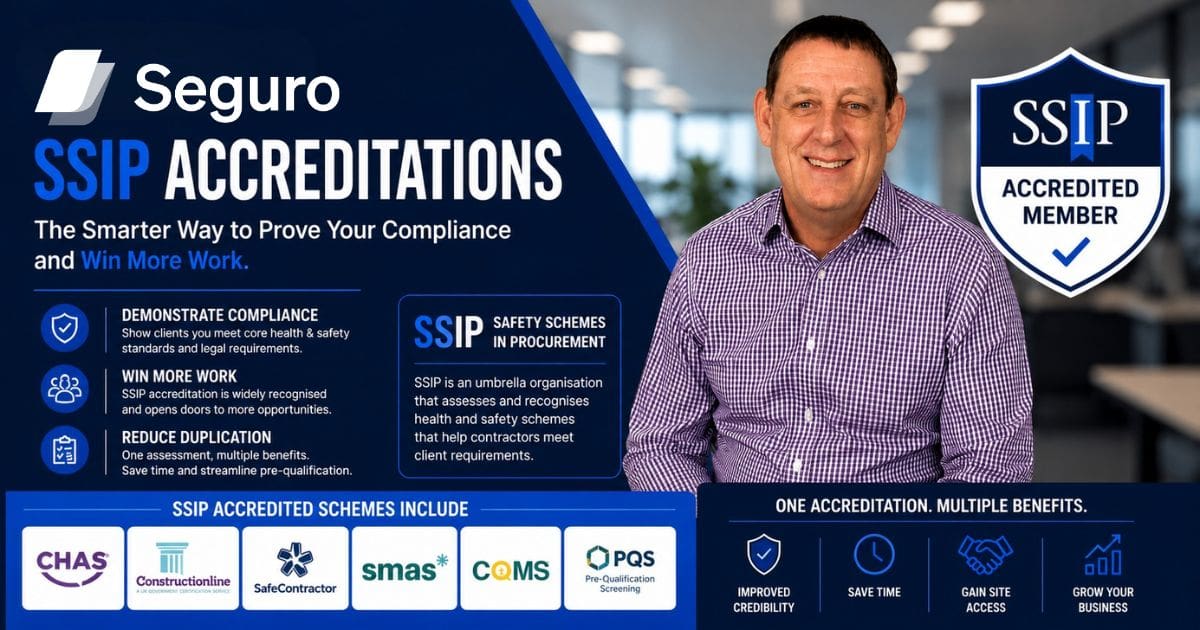
SSIP stands for Safety Schemes in Procurement.
It is an umbrella organisation that assesses and recognises health and safety accreditation schemes operating within the UK.
The purpose of SSIP is to reduce duplication during contractor pre-qualification by ensuring member schemes assess contractors against the same core health and safety standards.
Rather than completing separate health and safety assessments for every client, contractors can demonstrate compliance through a recognised SSIP accreditation.
Why Is SSIP Important?
Many clients use SSIP accreditation as evidence that a contractor has suitable health and safety management arrangements in place.
Benefits include:
- Demonstrates compliance with health and safety legislation
- Improves credibility with clients
- Simplifies contractor pre-qualification
- Reduces repeated health and safety assessments
- Helps win more work
- Improves access to public and private sector contracts
- Supports supply chain approval
For many contractors, SSIP accreditation is now a basic requirement before being invited to tender.
Which Schemes Are SSIP Accredited?
Several popular contractor accreditation schemes are recognised under SSIP.
Common examples include:
CHAS
One of the UK’s most recognised contractor accreditation schemes.
Suitable for:
- Construction contractors
- Facilities management companies
- Engineers
- Maintenance businesses
Benefits:
- Strong brand recognition
- Widely accepted by clients
- Multiple membership levels available
Constructionline
Combines health and safety assessment with contractor verification and supply chain management.
Benefits:
- Contractor database exposure
- Tender opportunities
- Enhanced verification options
SafeContractor
Widely used across multiple industries.
Benefits:
- Recognised by large organisations
- Supports contractor compliance
- Popular with facilities management providers
SMAS
A dedicated SSIP member scheme focused on health and safety assessment.
Benefits:
- Straightforward assessment process
- Good value for SMEs
- Accepted across many sectors
CQMS
Provides health and safety accreditation and compliance support.
Benefits:
- Competitive pricing
- Additional support services
- Suitable for smaller contractors
PQS
Popular among smaller contractors and subcontractors.
Benefits:
- Cost-effective
- Simple application process
- SSIP recognised
What Does SSIP Assess?
All SSIP schemes assess the same core health and safety standards.
Typical requirements include:
Health & Safety Policy
A current and signed policy outlining how health and safety is managed.
Risk Assessments
Evidence that workplace hazards have been identified and controlled.
RAMS
Risk Assessments and Method Statements relevant to work activities.
Training Records
Evidence of competence including:
- CSCS cards
- First Aid
- Asbestos Awareness
- Working at Height
- Plant qualifications
Insurance
Current insurance documentation including:
- Employers’ Liability Insurance
- Public Liability Insurance
Accident Reporting
Procedures for recording and reporting incidents.
Competent Health & Safety Support
Evidence that the business has access to competent health and safety advice.
How Much Does SSIP Accreditation Cost?
Costs vary depending on the scheme selected.
Typical entry-level costs include:
| Scheme | Typical Entry Cost |
| CHAS Standard | From £429 + VAT |
| Constructionline Bronze | From £498 + VAT |
| SafeContractor | From £419 + VAT |
| SMAS | From £317 + VAT |
| CQMS | From £175 + VAT |
| PQS | From £119 + VAT |
The assessment criteria are largely identical because all SSIP member schemes assess the same core requirements.
The differences are usually related to:
- Brand recognition
- Market demand
- Additional services
- Membership benefits
- More on SSIP Cost
Common Reasons Applications Fail
Most SSIP applications fail because the documentation does not adequately demonstrate compliance.
Common issues include:
- Missing documents
- Unsigned policies
- Expired insurance
- Generic RAMS
- Missing training evidence
- Incorrect company details
- Lack of competent person evidence
Most problems can be resolved before submission with a thorough compliance review.
Do Small Contractors Need SSIP Accreditation?
Not every contractor requires SSIP accreditation immediately.
However, accreditation is often beneficial if you:
- Work for principal contractors
- Tender for public sector work
- Apply for framework agreements
- Require site approval
- Want to improve credibility
- Need access to larger contracts
Many small contractors obtain accreditation specifically to unlock growth opportunities.
How to Get SSIP Accreditation
The process is generally straightforward:
Step 1
Gather your health and safety documents.
Step 2
Review policies, RAMS, training records and insurance.
Step 3
Choose an SSIP member scheme.
Step 4
Complete the online application.
Step 5
Respond to any assessor queries.
Step 6
Receive accreditation approval.
Many contractors use professional support to speed up the process and improve approval success.
How Seguro Can Help
Preparing for SSIP accreditation can be time-consuming, especially if documentation needs updating.
Seguro Health & Safety supports contractors with:
- Health & Safety Policies
- Risk Assessments
- RAMS
- Training reviews
- Competent Person services
- CHAS applications
- Constructionline applications
- SMAS applications
- SafeContractor applications
- SSIP compliance reviews
Whether you’re applying for your first accreditation or renewing an existing scheme, professional support can help reduce delays and improve approval success.
Conclusion
SSIP accreditations provide contractors with a recognised way to demonstrate health and safety compliance.
They help simplify contractor approval, improve credibility, and open access to larger contracts and supply chains.
Whether you choose CHAS, Constructionline, SafeContractor, SMAS, CQMS or PQS, the core assessment requirements remain largely the same. The key to success is having organised, accurate, and up-to-date health and safety documentation that clearly demonstrates compliance.
For many UK contractors, SSIP accreditation is one of the most effective investments they can make to win more work and grow their business.
CALL Matt on 0800 031 5404 to get started
Get a price
Frequently Asked Questions
What are SSIP accreditations?
SSIP accreditations are recognised health and safety assessments used in contractor pre-qualification. SSIP stands for Safety Schemes in Procurement and helps contractors demonstrate that they meet core health and safety standards.
What does SSIP stand for?
SSIP stands for Safety Schemes in Procurement. It is used to help reduce duplication in contractor health and safety assessments by recognising member schemes that assess against common core standards.
Which schemes are SSIP accredited?
Common SSIP-accredited schemes include CHAS, Constructionline, SafeContractor, SMAS, CQMS and PQS. Each scheme assesses contractors against core health and safety requirements.
What does SSIP accreditation assess?
SSIP accreditation usually assesses health and safety policies, risk assessments, RAMS, training records, insurance, accident reporting procedures and evidence of competent health and safety support.
Do contractors need SSIP accreditation?
Contractors often need SSIP accreditation when working for principal contractors, tendering for public sector work, applying for framework agreements, gaining site approval or trying to access larger contract opportunities.
How much does SSIP accreditation cost?
SSIP accreditation costs vary depending on the scheme. Typical entry-level costs include CHAS from £429 plus VAT, Constructionline Bronze from £498 plus VAT, SafeContractor from £419 plus VAT, SMAS from £317 plus VAT, CQMS from £175 plus VAT and PQS from £119 plus VAT.
Why do SSIP applications fail?
SSIP applications often fail because of missing documents, unsigned policies, expired insurance, generic RAMS, missing training evidence, incorrect company details or lack of competent health and safety support.
Can small contractors apply for SSIP accreditation?
Yes. Small contractors can apply for SSIP accreditation. Many small businesses use SSIP accreditation to improve credibility, satisfy client requirements, access larger projects and support tender applications.
How do you get SSIP accreditation?
To get SSIP accreditation, gather your health and safety documents, review policies, RAMS, training records and insurance, choose an SSIP member scheme, complete the online application, respond to assessor queries and wait for approval.
Can Seguro help with SSIP accreditation?
Yes. Seguro Health & Safety can support contractors with SSIP accreditation by helping prepare health and safety policies, risk assessments, RAMS, training reviews, competent person evidence and applications for schemes such as CHAS, Constructionline, SafeContractor and SMAS.
More Articles
- SSIP Accreditation Explained
- What is SSIP
- SSIP Schemes Comparison
- How to Get SSIP Accreditation
- SSIP Cost
- SSIP V CHAS
- SSIP Requirements and Deem To Satisfy
- Why SSIP Applications Fail
- SSIP For Small Businesses
- Done For You SSIP Accreditation
- SSIP Assessment and Renewal
- How Can I Check if Someone is SSIP Registered