



SSIP Accreditation Explained
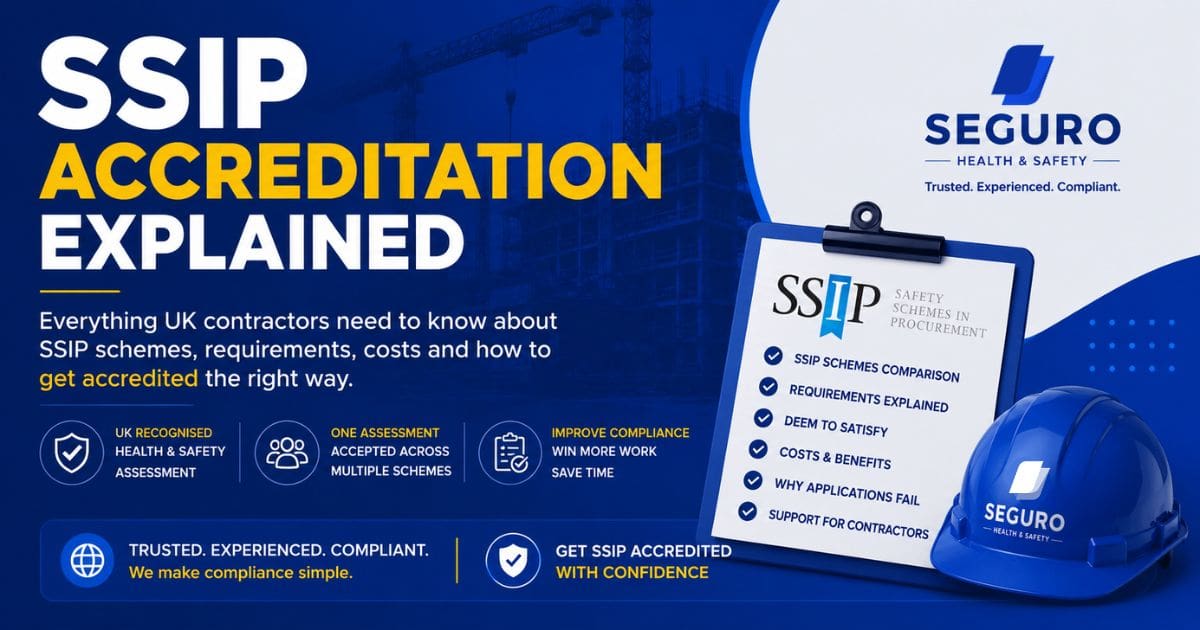
SSIP accreditation is a recognised UK health and safety assessment scheme used by contractors to demonstrate compliance with procurement standards through one recognised assessment accepted across multiple schemes.
For many contractors, SSIP is now a requirement to:
- Win work
- Pass pre qualification
- Work for main contractors
- Meet public sector procurement standards
- Reduce repeated health & safety assessments
This guide explains how SSIP works, what it costs, the most common failure points, and how to choose the right scheme for your business.
What Is SSIP?
SSIP stands for Safety Schemes in Procurement.
It is a UK wide umbrella organisation that allows contractors to demonstrate health and safety compliance through an approved member scheme.
Instead of completing multiple separate health & safety assessments, SSIP allows one recognised assessment to be accepted across many organisations.
Typical SSIP schemes include:
- CHAS
- Constructionline
- SafeContractor
- SMAS
- PQS
- CQMS
How SSIP Accreditation Works
The SSIP process is designed to assess whether your business meets the core health and safety standards expected within UK construction and procurement.
The process normally includes:
- Completing an application
- Submitting supporting evidence
- Assessment by the scheme
- Approval or corrective actions
- Certification
The assessment typically reviews:
- Health & safety policy
- RAMS
- Insurance
- Training records
- Accident procedures
- Competent person support
- Evidence of compliance systems
SSIP Schemes Comparison
All SSIP schemes follow the same core assessment criteria, but there are differences in:
- Brand recognition
- Procurement acceptance
- Cost
- Additional compliance checks
- Speed of assessment
Some schemes are more commonly requested by:
- Main contractors
- Local authorities
- Public sector frameworks
- Commercial clients
Popular schemes include:
- CHAS
- SafeContractor
- SMAS
- Constructionline
- CQMS
- PQS
SSIP Schemes Comparison
How to Get SSIP Accreditation
Most businesses follow the same general route:
Step 1 — Prepare Documents
You will usually need:
- Health & safety policy
- RAMS
- Insurance
- Training records
- Accident procedures
- Evidence of competence
Step 2 — Choose a Scheme
Choose the scheme most relevant to:
- Your clients
- Tender requirements
- Industry sector
- Budget
Step 3 — Submit Evidence
Documents are uploaded for assessment.
Step 4 — Address Corrections
Assessors may request updates or additional evidence.
Step 5 — Gain Approval
Once approved, your certification becomes visible within the SSIP network.
How to Get SSIP Accreditation
SSIP Costs
SSIP costs vary depending on:
- The scheme selected
- Company size
- Turnover
- Number of employees
- Level of accreditation
Typical costs include:
- Scheme fees
- Consultancy support
- Document preparation
- Training updates
- Additional compliance requirements
Many businesses underestimate the hidden costs caused by:
- Failed applications
- Poor RAMS
- Missing evidence
- Incorrect documentation
SSIP Costs
SSIP vs CHAS
CHAS is actually one of the most recognised SSIP member schemes.
The confusion often comes from contractors asking:
“Do I need SSIP or CHAS?”
The answer is:
- CHAS is an SSIP scheme
- SSIP is the umbrella organisation
CHAS may offer:
- Stronger market recognition
- Public sector credibility
- Additional compliance levels
Other schemes may offer:
- Lower entry costs
- Faster assessments
- Simpler requirements for small contractors
SSIP vs CHAS
What Is SSIP Deem to Satisfy?
SSIP “Deem to Satisfy” helps contractors avoid repeating multiple health and safety assessments.
If you already hold one approved SSIP certification, another SSIP member scheme may accept that assessment through the Deem to Satisfy process.
Benefits include:
- Reduced duplication
- Faster onboarding
- Less paperwork
- Easier procurement compliance
However:
- Additional scheme specific checks may still apply
- Higher level schemes may request further evidence
SSIP Deem to Satisfy
SSIP Requirements
Most SSIP schemes assess the same core areas.
Typical requirements include:
- Signed health & safety policy
- Suitable RAMS
- Employer’s liability insurance
- Public liability insurance
- Training records
- Accident procedures
- Competent health & safety advisor
- Evidence of worker communication
- Ongoing review systems
Higher level schemes may also require:
- Environmental policy
- Quality management systems
- Modern slavery policy
- Equality policy
- Financial checks
SSIP Requirements
Why SSIP Applications Fail
Many SSIP applications fail because documents are:
- Missing
- Generic
- Inconsistent
- Outdated
- Not specific to the contractor’s work activities
Common failure reasons include:
- Weak RAMS
- Incorrect insurance
- Missing training records
- No competent person
- Poor accident procedures
- Inconsistent company information
Assessors want evidence of real compliance, not simply paperwork templates.
Why SSIP Applications Fail
SSIP for Small Contractors
Small contractors often assume SSIP is only for larger businesses.
In reality, many SSIP schemes are designed specifically for:
- Sole traders
- Small subcontractors
- Businesses with under 5 employees
- Growing construction companies
SSIP can help small contractors:
- Win larger contracts
- Access supply chains
- Work for principal contractors
- Improve credibility
- Pass procurement checks faster
The key is choosing the right scheme and ensuring the documentation is proportionate to the business.
SSIP for Small Contractors
Done for You SSIP Support
Many contractors choose fully managed SSIP support to avoid delays, failed assessments, and unnecessary stress.
A done for you SSIP service typically includes:
- Document preparation
- RAMS support
- Policy creation
- Portal submission
- Assessor response handling
- Compliance guidance
This helps businesses:
- Save time
- Avoid rejection
- Improve approval speed
- Stay focused on running projects
At Seguro Health and Safety, we support UK contractors with:
- CHAS
- Constructionline
- SafeContractor
- SMAS
- PQS
- SSIP accreditation support
Done for You SSIP
Need Help With SSIP Accreditation?
If you need support with:
- SSIP applications
- CHAS
- Constructionline
- RAMS
- Health & safety documentation
- Compliance systems
Seguro Health and Safety can help you achieve accreditation with confidence.
CALL Amanda on 0800 031 5404 to get started


Frequently Asked Questions
What is SSIP accreditation?
SSIP accreditation is a recognised UK health and safety assessment used in procurement. It allows contractors to demonstrate compliance through one approved assessment accepted across multiple SSIP member schemes such as CHAS, Constructionline, SafeContractor, SMAS, CQMS and PQS. For more information, go to SSIP Accreditations: The Complete Guide
What does SSIP stand for?
SSIP stands for Safety Schemes in Procurement. It is an umbrella organisation for recognised health and safety prequalification schemes used by contractors and clients across the UK.
Which schemes are part of SSIP?
Common SSIP member schemes include CHAS, Constructionline, SafeContractor, SMAS, CQMS and PQS. Each scheme follows the SSIP core health and safety assessment criteria, although costs, recognition and additional checks may vary.
How do you get SSIP accreditation?
To get SSIP accreditation, you choose an approved scheme, prepare your health and safety documents, submit your evidence, respond to any assessor queries and gain approval once the assessment criteria are met.
What documents are needed for SSIP accreditation?
Typical SSIP requirements include a signed health and safety policy, suitable RAMS, insurance certificates, training records, accident procedures, evidence of competent health and safety support and proof that health and safety information is communicated to workers.
How much does SSIP accreditation cost?
SSIP costs vary depending on the scheme, company size, turnover, number of employees and level of accreditation required. Costs may include scheme fees, document preparation, consultancy support, training updates and additional compliance evidence.
Is CHAS the same as SSIP?
CHAS is not the same as SSIP. CHAS is an SSIP member scheme, while SSIP is the umbrella organisation. Holding CHAS accreditation can demonstrate SSIP compliance where the correct level of assessment has been completed.
What is SSIP Deem to Satisfy?
SSIP Deem to Satisfy allows one SSIP member scheme to recognise an existing valid SSIP assessment from another approved scheme. This can reduce duplication, save time and avoid repeating the same health and safety assessment.
Why do SSIP applications fail?
SSIP applications often fail because documents are missing, outdated, generic, inconsistent or not specific to the contractor’s work. Common problems include weak RAMS, incorrect insurance, missing training records, no competent person and poor accident procedures.
Is SSIP suitable for small contractors?
Yes. SSIP accreditation is suitable for small contractors, sole traders and subcontractors. It can help smaller businesses prove health and safety compliance, access supply chains, work for principal contractors and improve their chances of winning work.
Can someone complete my SSIP application for me?
Yes. A done-for-you SSIP support service can help prepare documents, create or review RAMS, complete the application, upload evidence, respond to assessor queries and support the business through to approval.