
Close Navigation

Search

Remote Competent Safety Advisor Vs Onsite Visiting

Insight by

amanda

Amanda Lambert

Published on

5 July 2023

Competent person

Remote Competent Safety Advisor Vs Onsite Visiting

We often get asked the question about our Competent Safety Advisor Service to see what the benefits are compared to having someone employed onsite. The obvious one is cost, it is much more cost effective to have a remote competent person as a service, a service like ours starts from £50 per month compared to a full time salary.

Why use an outsourced service?

  • We supply a comprehensive Health and Safety Management System
  • We develop a bespoke company Health and Safety Policy for your business
  • We work with you to develop a company employee handbook
  • We develop an Environmental Policy specific to you
  • We provide assistance in Accident Reporting to Enforcing Authorities/Accident Investigation
  • We will liaison with Enforcing Authorities on your behalf

Ongoing support

  • Access to telephone advice on an unlimited number of occasions
  • Updates on any changes in Health and Safety legislation
  • Access to over 80 risk assessments and various supporting documentation held on our website
  • Yearly review of all documentation and revised documents issued
  • Monthly newsletters giving you latest Health & Safety News as well as legislation updates.

With over 200 clients we provide a comprehensive service that is affordable and reliable so SME’s can have peace of mind that they are compliant with their legal obligations.

There are no hidden fees and we pride ourselves with having an 95% retention record year on year. You can see testimonials on our website or on Trust pilot which is an independent review platform.

Competent Safety Advisor Support

Here at Seguro, we pride ourselves on being able to support all businesses regardless of their size. We can provide your business with less than five employees a service, ensuring you meet all your Health & Safety needs.

Our service provides you with:

  • Support to implement new documentation into your business
  • Provide support ongoing should you need it for all Health & Safety advice.
  • Provide off-the-shelf risk assessments and method statements should they be needed (bespoke ones are chargeable)
  • Enable you to name us should you need to on PQQ documentation
  • Provide you with General pre-prepared COSHH from our library

We are available throughout the working day by email or telephone, whichever way you prefer to communicate.

This service is available to anyone who needs it, and there is a fixed cost for everyone.

This service is also FREE with any accreditation we submit for you so if you are looking to get CHAS or a similar SSIP we can assist with that and provide this service for FREE.

If you need more information about SSIP, we have lots of blogs to help or you can visit SSIP directly.

Included in our competent safety advisor service

  • Put Seguro down as your named health & safety advisor.
  • Use our name when filling out pre-tender qualification questionnaires.
  • Use a CV from one of our Consultants.
  • We are here as back-up should you require advice and guidance on health & safety issues.

Competent Safety Advisor Support

Complete the form, and we will get in touch and give you free advice and direction on outsourcing your health and safety.

    Manual Handling E-learning

    Insight by

    amanda

    Amanda Lambert

    Published on

    12 June 2023

    Health and safety blog

    Manual Handling E-learning

    In certain industries and workplaces employers have the legal obligation to ensure that their employees have access to knowledge and training for correct manual handling techniques. This is to ensure that employees are protected from the risk of injury through manual handling tasks in the workplace.

    Why should I train my staff?

    Not knowing the correct techniques and carrying out manual handling incorrectly is one of the most common causes of injury at work. It causes work-related musculoskeletal disorders (MSDs) which are responsible for over a third of all workplace injuries.  Manual handling can be for any load such as a person or an animal, or a box or a ladder.

    Workplace analysis

    Manual Handling is not just about putting your employees on a course there also needs to be considerations made within the workplace:

    • Does the lifting have to take place
    • Could the lifting be carried out by machinery instead of a person
    • Can the item be delivered direct to where it is needed
    • Can the item be pushed rather than pulled?

    These are all things that can be looked at a risk assessment should take place to ensure you have thought about how you can help within your working environment.

    Manual Handling E-learning is the easy way to give your staff access to training without having to send them on a course which may disrupt the working day. If you are looking for a online  Manual Handling Training Cource we can help.

    Other training

    We have a large number of H&S online training programs take a look to see if there any others you may find helpful.

    CHAS Deem to satisfy process

    Insight by

    amanda

    Amanda Lambert

    Published on

    25 May 2023

    CHAS

    CHAS deem to satisfy process

    The CHAS Deem to Satisfy process (DtS) scheme allows contractors to apply for CHAS Standard membership without undergoing another health and safety assessment.

    All member schemes listed on the SSIP forum adhere to the SSIP Core Criteria, backed by the Health and Safety Executive.

    By mutually recognising each other’s schemes, suppliers benefit from only needing to complete one assessment, while buyers enjoy more efficient procurement processes. This approach reduces costs and has saved over £68 million since 2016.

    Eligibility

    Contractors must have already met the requirements of an assessment through another SSIP member scheme. 

    Benefits

    Contractors can save time and resources by avoiding a full assessment. They can also avoid paying full price for multiple accreditations. 

    Process

    Contractors can: 

    1. Check if they have a qualification that CHAS recognises by contacting CHAS or using the e-form. 
    2. Submit their assessment, which will be reviewed within 10 working days. 
    3. Respond to any requests for additional information within the 2-week deadline. 

    CHAS deem to satisfy registered members

    Two-Way Deem to Satisfy between SSIP Registered Members.

    Approval with a Registered Member can only be used to Deem to Satisfy with another Registered Member; it cannot be used to gain a Deem to Satisfy with a Certification Body Member.

    Below is the list of registered members you can use for deem to satisfy:

    3Core2 Certification Limited Trading As SafeArb SafeArb

    Achilles Information Ltd Building Confidence

    Alcumus SafeContractor Ltd Alcumus Safecontractor

    Altius VA Limited CDMComply

    Arboricultural Association ARB Approved Contractor

    Association for Project Safety APS Corporate Practice Membership

    Avetta Avetta Assessed

    CHAS 2013 Ltd Contractors Health & Safety Scheme

    Construction Safety Solutions PASS

    CQMS Ltd CQMS Safety-Scheme

    D W Health & Safety DW Health & Safety Contractor Competency Scheme

    Fall Arrest Safety Equipment Training Ltd FASET Membership Audit

    Fortius Ltd Acclaim Accreditation

    Greenlight Safety Assessment Scheme Ltd Greenlight Safety Assessment Scheme

    Hire Association Europe Ltd SafeHire Certification Scheme

    International Powered Access Federation [IPAF] IPAF SSIP

    MSL Property Care Services Ltd MSL Safepartner

    National Access & Scaffolding Confederation Ltd NASC SSIP Audit

    National Federation of Demolition Contractors NFDC Membership

    PQS Pre-Qualification Scheme PQS Health & Safety Approved

    Salus Certification Salus Certification

    Safe-T-Cert [NI] {Construction Employers Federation} Safe-T-Cert

    Safe-T-Cert [ROI] {Construction Industry Federation} Safe-T-Cert

    Safety Management Advisory Services Ltd SMAS Worksafe

    SSG Training and Consultancy Ltd SSG Assessed

    William Martin Compliance Limited Prosure 360

    Learn more about CHAS

    We have a series of articles where you can learn more about CHAS. The list of articles is below:

    If you have any questions on what is CHAS accreditation please get in touch.


    Having trouble with your RE-CHAS?

    Insight by

    amanda

    Amanda Lambert

    Published on

    18 May 2023

    CHAS

    Having trouble with your RE-CHAS?

    Each application for CHAS is treated as a new application, this is so that your paperwork can be assessed on a yearly basis to ensure that you comply with the latest Health & Safety Legislation. We often get calls from companies saying that the paperwork they have submitted last year has not been accepted this time around.

    If you submit documentation that CHAS do not think is up to the standard they need to pass, they will provide you with a list of actions. This will be sent out to you by your appointed CHAS assessor.

    The documentation will go into detail to let you know what you need to provide as additional information, there are a number of actions you can then choose:

    • Compile the documentation yourself
    • Purchase the documents needed and complete it independently
    • Contact a Competent Health & Safety Consultant who can provide you with the information needed as well as advice

    We can do your CHAS with you starting at £300 + vat for less than 5 employees.

    Having trouble with your RE-CHAS? support

    As a Health and Safety Consultant we are happy to look at your documentation and bespoke the responses based on your business please get in touch if you would like our help on 0800 031 5404.

    CHAS v Constructionline how do you decide?

    Insight by

    amanda

    Amanda Lambert

    Published on

    4 May 2023

    CHAS

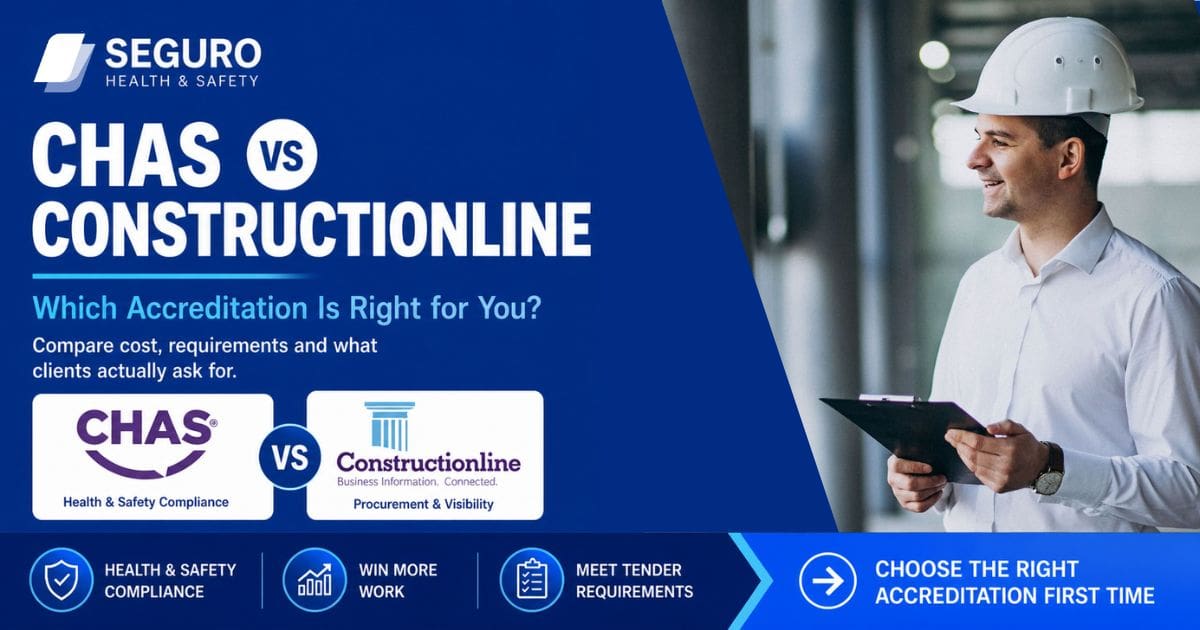
    CHAS vs Constructionline: Which Accreditation Do You Need? (2026 Guide)

    Quick Answer

    CHAS and Constructionline are both UK contractor accreditation schemes used to demonstrate health and safety compliance.

    • CHAS focuses primarily on health & safety and SSIP compliance
    • Constructionline combines health & safety with supplier verification, financial checks, and procurement tools
    • If you’ve decided on CHAS, follow our step-by-step CHAS accreditation guide.

    What is the Difference Between CHAS and Constructionline?

    CHAS (Contractors Health and Safety Assessment Scheme)

    • Health & safety focused
    • SSIP accredited
    • Recognised by public and private sector clients
    • Often required for site access and contractor approval
    • To understand how both schemes align, see our SSIP and CHAS explanation.

    Best for:

    • Contractors needing SSIP compliance
    • Businesses working with main contractors or local authorities

    Constructionline

    • Broader pre-qualification platform
    • Includes:
      • Health & safety (via SSIP at higher levels)
      • Financial checks
      • Company verification
    • Acts as a supplier database for buyers

    Best for:

    • Contractors bidding for larger frameworks and tenders
    • Businesses needing visibility to buyers

    Key Differences (Simple Comparison)

    Feature

    CHAS

    Constructionline

    Focus

    Health & Safety

    Full supplier pre-qualification

    SSIP Accreditation

    Yes

    Yes (Gold level)

    Financial Checks

    No

    Yes

    Procurement Platform

    No

    Yes

    Typical Use

    Compliance & site approval

    Tendering & supply chain access

    Which One Do Clients Prefer?

    It depends on the client:

    • Main contractors / local authorities
      → Often ask for CHAS or SSIP
    • Large frameworks/procurement platforms
      → Often specify Constructionline

    Some clients accept either, as both align with SSIP standards

    Cost Comparison (Overview)

    Costs vary based on:

    • Business size
    • Level of accreditation

    Do You Need Both?

    No one is enough

    BUT:

    • Some contractors choose both to maximise opportunities
    • Certain clients specify one by name

    When to Choose CHAS

    Choose CHAS if you need to:

    Meet SSIP requirements
    Get approved for site work
    Demonstrate health & safety compliance
    Work with public sector or main contractors

    When to Choose Constructionline

    Choose Constructionline if you want to:

    Access procurement platforms
    Pass financial and supplier checks
    Bid for larger contracts
    Increase visibility to buyers

    Pro Tip (Most Contractors Miss This)

    All SSIP schemes (including CHAS and Constructionline )
    follow the same core health & safety criteria

    This means:

    You may not need to duplicate applications.
    You can often use one accreditation to support another

    Final Thought

    CHAS proves you are safe and compliant.
    Constructionline helps you get found and win work

    The best choice depends on:

    • Your clients
    • Your sector
    • Your growth strategy

    Want to Choose the Right Accreditation?

    Choosing the wrong scheme can:

    • Cost you money
    • Delay work
    • Limit opportunities

    The right advice can save you time, cost, and stress. Need help getting approved? Our CHAS support service handles the full process for you.

    CALL Amanda on 0800 031 5404 to get started

    Get a price
    shape Ask Amanda

    Frequently asked questions

    What is the difference between CHAS and Constructionline?

    CHAS focuses mainly on health and safety compliance and SSIP accreditation, while Constructionline is a broader pre-qualification platform that includes financial checks, supplier verification and procurement visibility.

    Is CHAS better than Constructionline?

    Neither CHAS nor Constructionline is better overall. CHAS is better for demonstrating health and safety compliance, while Constructionline is better for accessing procurement opportunities and supplier databases. The right choice depends on your client’s requirements.

    Do I need CHAS or Constructionline?

    You may only need one accreditation, depending on your clients. Many contractors choose CHAS to meet SSIP requirements, while others choose Constructionline for tendering and visibility. Some businesses use both to maximise opportunities.

    Is Constructionline SSIP accredited?

    es. Constructionline Gold includes SSIP accreditation, meaning it meets the same core health and safety criteria as schemes like CHAS.

    “Is CHAS part of SSIP?

    Yes. CHAS is a founding member of SSIP and provides recognised health and safety accreditation that aligns with SSIP standards.

    Which is cheaper, CHAS or Constructionline?

    Costs vary depending on company size and level. CHAS typically costs from around £400 per year, while Constructionline starts from around £498 per year, with higher tiers costing more.

    Can I have both CHAS and Constructionline?

    Yes. Many contractors hold both CHAS and Constructionline to meet different client requirements and increase their chances of winning work.

    Which accreditation do main contractors prefer?

    Main contractors and local authorities often require CHAS or another SSIP scheme for health and safety compliance. Some larger frameworks and procurement systems may specify Constructionline.

    Related CHAS Guides

    Risk Assessments and Method Statements

    Insight by

    amanda

    Amanda Lambert

    Published on

    8 March 2023

    Health and safety blog

    Risk Assessments and Method Statements

    Here at Seguro we know that Risk Assessments & Method Statements (RAMS) can seem a daunting task when you have to start them from scratch. We have developed a library of documents that can be used within your business on a day to day basis.

    We constantly update our shop section with the latest activity based ones we have created.

    Our RAMS can be purchased individually  for only £10 + vat or in a pack depending on what you need.

    If you are unsure if we have the document you need please visit our SHOP and see what you can find.

    Here are some examples listed below:

    RAMS For Screeding
    Plumbing RAMS
    External Painting RAMS
    RAMS for commercial electrical installation

    We also offer a RAMS Pack which contains 65 templates covering a range of subjects.

    Standard RAMS

    We provide a wide range of RAMS in template format on our website. Each can be five to sixteen pages long and contain between 3,000 and 9,000 words.

    The RAMS are within a template and cover all the principal risks and methods to carry out a specific job. The RAM Templates need the client’s involvement as there will be a comprehensive sequence of work that could apply. As the client, you would be responsible for ensuring that this sequence was relevant to yourself and, if not amended to reflect your process.

    Our standard RAMS cost from £6 to £12 per RAM or are provided free as part of our Safety Advisory service or Competent person service.

    Review our standard RAMS

    Risk assessment training

    If the tasks you are carrying out are different and unique to your business a  Bespoke RAMS might be better for you.

    This is where we create a RAMS that is 100% specific to your needs., prices start at £150 + vat

    We would need information from you to create the documents please find the criteria we would need here.

    Pre Qualification Questionnaire Guide

    Insight by

    amanda

    Amanda Lambert

    Published on

    24 February 2023

    Health and safety blog

    Table of contents

    Pre Qualification Questionnaire Guide (PQQ)

    Pre-Qualification Questionnaire, also commonly know as a ‘PQQ’, is a questionnaire that companies (suppliers ) have to fill in when looking to tender for schemes they want to work on. PQQ are used when applying for an approved supplier list or when applying for most accreditation schemes. They are pro-dominantly used in the public sector, but can be used for private sector tenders too.

    Filling out a Pre-Qualification Questionnaire for the public sector, is an important process as they are used as a way to standardise all suppliers and the information needed to make a decisions when appointing new contracts. As all information is standard the PQQ can help to make a short list easier as companies are able to look at information in the same format and detail.

    PQQs are scored according to the answers that you give so you need to ensure they are well thought out and give the best impression you can give of your company and its capabilities.

    What is asked in a PQQ?

    Every PQQ you fill in is effectively your companies marketing tool, filling out the PQQ to the best of your ability will allow you to show that your company is the best choice.

    In general, a PQQ will need information about your:

    • Status
    • Finances
    • Quality Policy
    • Environmental Policy
    • Equal Opportunities Policy
    • Health and Safety Policy

    We provide help if needed to complete any PQQ you may have been given as well as advice in ensuring that you have all the information you may need for further Pre Qualification Questionnaires you get.

    PQQ Support

    Complete the form, and we will get in touch and give you free advice and direction on how to complete or how we can complete your PQQ for you.

      Legislative Calendar

      Insight by

      Avatar photo

      Matthew Weatherston

      Published on

      26 January 2023

      Health and safety blog
      Legislation/Consultation In force/Closes Need to know Applies In Resources
      Health and Safety (Enforcing Authority) Regulations 1998 28/07/2016 Informal consultation on the effectiveness of the division of regulatory responsibility between the HSE and the local authorities GB hse.gov.uk
      Control of Electromagnetic Fields at Work Regulations 2016 01/07/2016 Implements the EU’s EMF directive. Introduces requiremnt to assess levels of EMF exposure against specific thresholds. GB hse.gov.uk
      Explosives Regulations 2014 (amendment) Regulations 2016 20/04/2016 Implements the recast of the Explosives for Civil Uses Directive. Changes include new requirements for the civil use of explosives to be accompanied by instructions and safety information GB hse.gov.uk
      Freight Containers (Safety Convention) (Amendment) Regulations 2016 Feb-16 Amendments to the Freight Containers (Safety Convention) Regulations 1984. Proposals include major changes to the Safety Approval Plates and additional safety tests. GB hse.gov.uk
      Definitive guideline for health and safety offences, corporate manslaughter and food safety and hygiene offences 01/02/2016 Gives judges a framework of tiered penalties based on the offending organisation’s turnover, the level of harm risked and culpability. England/Wales bit.ly
      Construction (Design and Management) Regulations 2015 23/12/2015 Transitional period for projects started before April 2015 ends. Works with more than one contractor must have appointed a principal designer. GB hse.gov.uk
      Transportation of Directive 2013/35/EU on exposure to electromagnetic fields (EMFs) 03/12/2015 Proposed Control of Electromagnetic Fields at Work Regulations will require duty holders to assess exposure to EMFs GB hse.gov.uk
      Deregulation Act 2015 03/12/2015 Turban wearing Sikhs do not have to wear head protection in any industries. GB hse.gov.uk
      The Health and safety at Work ect. Act 1974 (General Duties of Self-Employed Persons ) (Prescribed Undertakings) Regulations 2015 Oct-15 Changes the law to exempt self-employed people whose work activity poses no potential risk to other workers or the public. GB hse.gov.uk
      Offshore Installations (Offshore Safety Directive) (Safety Case ect) Regulations 2015 Jul-15 Applies to offshore oil and gas operators, interoperating additional requirements of directive 2013/30/EU England/Wales hse.gov.uk
      Control of Major Accident Hazards Regulations (COMAH) 2015 Jun-15 Main Duties unchanged from 1999 regs; lower tier operators must provide public information about their site and its hazards for the first time; both upper tier and lower tier operators must provide public information electronically. GB hse.gov.uk
      Control of Asbestos Regulations 2012 May-15 Workers undertaking non-licensed work for the first time must have a medical examination before they start. England/Wales legislation.gov.uk
      Construction (Design and Management) regulations 2015 Apr-15 CDM coordinator replaced with principal designer, prescriptive requirements for duty holders to check contractors’ competence removed, CDM duties extended to domestic clients. GB hse.gov.uk
      Road Traffic Act 1988 Mar-15 Section 5 amended to include an offence of driving under the influence of a controlled drug – including some prescription medications. England/Wales lexisurl.com

      What are Toolbox talks and why do I have to do them?

      Insight by

      amanda

      Amanda Lambert

      Published on

      20 September 2022

      Health and safety blog

      What are Toolbox talks and why do I have to do them?

      Introduction

      The definition of a Toolbox Talk – An informal meeting that focuses on Health & Safety topics related to a specific job that is on site, such as workplace hazards and safe work practices. These meetings are normally less than 10 minutes (kept short) and are normally conducted at the job site prior to the job or shift starting.

      Why do i have to do them? – Toolbox talks are a quick way for you to communicate to all workers on a particular site, safety work practices that are applicable to them.

      Where can you get themYou can download 70 toolbox talks free using this link

      Importance of toolbox talks in the workplace

      Toolbox talks are focused discussions about safety topics that provide valuable insights and practical guidance that can help prevent accidents and injuries on site.

      Toolbox talks can significantly enhance the safety culture onsite when conducted regularly.

      Understanding the purpose of toolbox talks

      The primary purpose of toolbox talks is to enhance workplace safety through education and communication. The talks are designed to inform workers about potential hazards they may encounter while performing their duties.

      Organisations can create a shared understanding of risks and the importance of adhering to safety protocols by engaging the site teams in conversations about safety. This collaborative approach helps to foster a culture where safety is everyone’s responsibility, leading to a more informed and vigilant workforce.

      Key elements of a toolbox talk

      The topics discussed directly relate to the tasks and hazards at the worksite. For example, if drainage trenches are to be excavated on site, the site supervisor can talk about the dangers, hazards, good practice and working close to deep excavations, to keep people safe.

      Save time and download 70 toolbox talks

      How to conduct a tool box talk

      Conducting a tool box talk requires careful planning and execution to maximise its effectiveness.

      Gather necessary materials to support the discussion, such as handouts, visual aids, or tools illustrating the subject matter. Being well-prepared allows the supervisor to engage with the audience confidently.

      Next, choose an appropriate setting and time for the tool box talk. Selecting a location free from distractions is essential, allowing participants to focus on the discussion.

      Creating a comfortable environment where employees feel comfortable sharing their thoughts and experiences will lead to a more productive conversation.

      The supervisor should encourage open communication and interaction among participants during the talk. Start with a brief introduction of the topic, followed by an engaging discussion inviting workers’ input and questions.

      Use real-life examples to illustrate points and encourage employees to share their experiences related to the topic.

      Tips for creating engaging and interactive tool box talks

      Creating engaging and interactive tool box talks is essential for maximising their effectiveness. One key tip is to incorporate multimedia elements into the discussions. Using videos, slideshows, or infographics

      Incorporate real-life case studies, sharing stories of actual incidents, whether from your own experiences or from industry examples,

      Consider incorporating hands-on activities or demonstrations into tool box talks. Engaging employees in practical exercises, such as proper lifting techniques or the correct way to use safety equipment, can reinforce learning and enhance retention.

      Conclusion

      Harnessing the power of tool box talks for a safer and more productive worksite

      In conclusion, tool box talks are an invaluable tool for enhancing safety and productivity on any worksite.

      By fostering open communication and engaging employees in discussions about potential hazards and best practices, organisations can create a culture of safety that resonates throughout the workforce.

      Download your FREE 70 tool box talks today

      Working at Height Training

      Insight by

      amanda

      Amanda Lambert

      Published on

      22 August 2022

      Health and safety blog

      Working at Height Training

      Working at height training is critical as trips and falls within business remains one of the biggest causes of major injuries and fatalities. The most common causes include falls from ladders, roofs and through weak surfaces.

      The definition of ‘Work at height’ is working anywhere; if there were no measures in place, a person could fall a distance liable to cause personal injury (for example, a fall off a ladder when you are working on a roof).

      Your responsibilities?

      As an employer, you are responsible for ensuring that all work carried out by your employees has been carefully planned, looking at the risks involved. These should then be measured using a risk assessment and method statement to ensure that you are doing everything possible to manage the risk by adopting the avoid, prevent and minimise rule.

      Do’s and don’ts of working at height

      Do….

      • Ensure that when working at height, there is a safe route to and from ground level.
      • Try to do as much of the work required from ground level.
      • Ensure all equipment is suitable and maintained.
      • Ensure extra precautions are taken when working near weak surfaces.

      Don’t…

      • Overload ladders refer to all mechanical information that is provided to ensure the machinery is fit for purpose.
      • Overreach on ladders or stepladders
      • Rest a ladder against weak surfaces, e.g. glazing or plastic gutters.
      • Use ladders or stepladders for strenuous or heavy tasks; only use them for light work of short duration (a maximum of 30 minutes at a time)

      Get your people working at height trained.

      Book them onto a  Working At Heights E-Learning training program to protect yourself from prosecution and keep your people safe from trips and falls.

      Our E-learning courses can be taken on-site, which is very easy to do and very economical. You can try one for FREE to see the quality.