Close Navigation

Search

Do i need a Health & Safety Policy

Insight by

amanda

Amanda Lambert

Published on

19 October 2025

Health and safety blog

Do I need a Health & Safety Policy

It is a legal requirement to have a Health & Safety Policy in place in you have more than 5 employees. Employees are defined as someone who you pay through the PAYE system, this does not include anyone who you use as a subcontractor.

Health and Safety at Work etc Act 1974. Often referred to as HASAW or HSW, this Act of Parliament is the main piece of UK health and safety legislation. It places a duty on all employers “to ensure, so far as is reasonably practicable, the health, safety and welfare at work” of all their employees.

Less than 5 employees

There may also be a time when you have less than 5 employees and you are asked for a Health & Safety Policy. This can occur if you want to become a supplier to a large company who expect a policy no matter how many employees you have. If this is their policy they will expect it from every supplier with no exception, we can help you to develop a company policy at a reasonable price.

How to write the policy

A policy is a written statement which has three essential parts:

1) Health & Safety Policy

The health and safety policy details a statement of intent. The statement of intent details your aims and objectives, health and safety policy, processes and systems to prevent accidents, train your employees, supply PPE, etc. The policy is signed and dated by the most senior person, the managing director.

(2) Organisation of Health and Safety – Roles and Responsibilities

The organisation of health and safety is best done by developing an organisation chart, with the most senior person at the top, then detailing the people who are responsible for the day-to-day running of all matters concerning health and safety. An example is:

  • Managing director
  • Health and safety advisor
  • Fire safety manager
  • Health and safety training manager
  • Risk assessments and method statements manager
  • PPE manager
  • Control of substances hazardous to health COSHH manager

In small businesses, one person may have many roles

3) Arrangements for health and safety – How are risks managed?

The arrangements for health and safety should detail how the organisation aims to achieve its aims. For example:

  • Develop risk assessments
  • Training of people
  • Consulting with people
  • Fire and emergency arrangements
  • First aid arrangements
  • Reporting of accidents, injuries and dangerous incidents
  • Arrangements for working at height, manual handling, etc.

Buy a policy

We have written several health and safety policies. Click on the link to review them: Health and safety policies.

We will write a bespoke policy for you if you can’t see your company type above.

Please get in touch if you would like some free advise. Complete out contact form or call 0800 031 5404.

PQS accreditation cost

Insight by

amanda

Amanda Lambert

Published on

18 October 2025

PQS accreditation

How to save money with a PQS accreditation

Following recent client feedback, we would like to share information on PQS accreditation costs and where it stands in the current market.

PQS accreditation is the most competitive method for achieving SSIP accreditation. PQS can be used to obtain the majority of the SSIP umbrella group partners, such as CHAS and Safe Contractor, under their deem to satisfy scheme

We will explain all of the costs of achieving PQS accreditation and compare it to CHAS, one of the more popular alternatives.

Cost Comparison

CHAS have developed a membership-type offering. The cost of each type depends on how many people you employ.

Costs per annum: You must renew the membership each year.

CHAS accreditation costs

Standard CHAS 1 Employee 2-4 Employees 5-15 Employees 16-30 Employees
£409+vat £459+vat £749+vat £1,019+vat
CHAS Advanced 1 Employee 2-4 Employees 5-15 Employees 16-30 Employees
£639+vat £739+vat £1,139+vat £1,569+vat
CHAS Elite 1 Employee 2-4 Employees 5-15 Employees 16-30 Employees
£879+vat £919+vat £1,339+vat £1,979+vat


Save with PQS accreditation costs

The costs for PQS accreditation are:

Standard PQS 1 Employee 2-4 Employees 5-15 Employees Deem to satisfy
£99 + vat £119+vat £149+vat £49 + vat

The fees above are correct as of January 2025.

Training costs

In terms of training that is required to achieve the standard needed for assessment, this can vary depending on your activities.

The assessor will be looking to ensure all members of your workforce are trained for the task they are carrying out.

This can be an industry standard that is needed such as:

  • Gas safe for gas engineers
  • Level 3 NVQ in Electrical Installations
  • CISRS Scaffolding Part 1 & 2 – Scaffolders

They will also look to ensure that refresher training is carried out such as tool box talks and eLearning is often required.

Courses that are often asked for include:

Competent person costs

Ensuring you have the right level of support and advice for your Health & Safety is a bit of a minefield and can be defined simply by the number of employees you have.

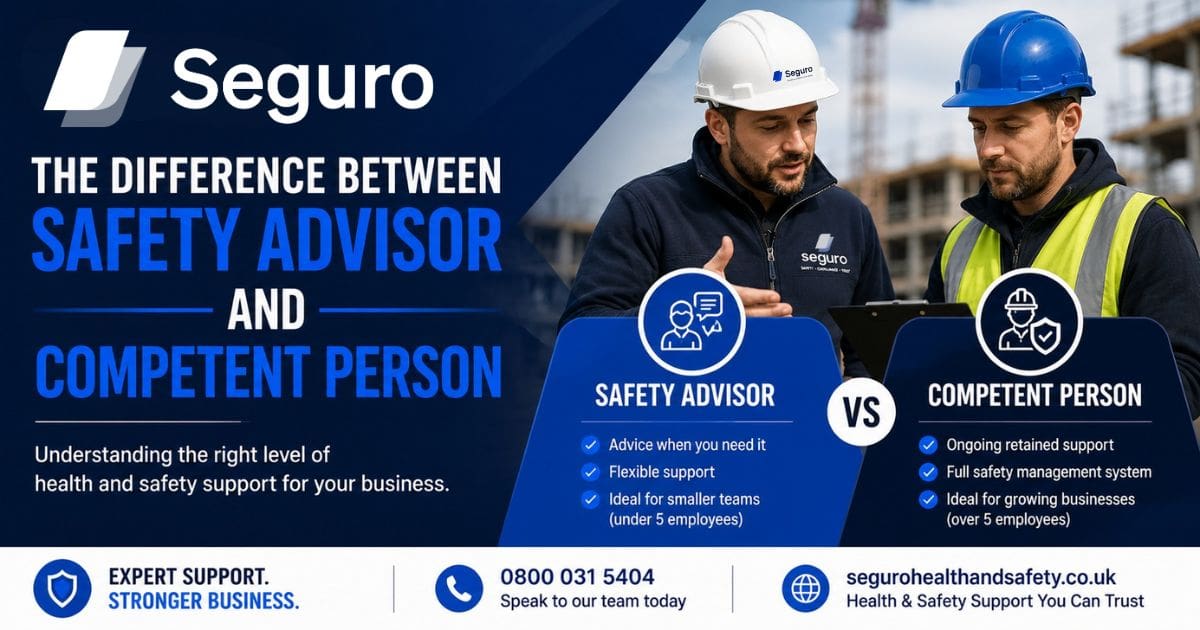
Less than 5 employees = Safety Advisor

This service is where you are offered support and advice when needed, this tends to be a one of payment where you will be given a service agreement, certificate and a CV to show the qualifications of the person who is providing you with the advice. Paperwork such as off the shelf risk assessments and risk assessment and Method statements would be provided on an as and when basis should you need them.

5 or more employees = Competent Person

This service is where you pay a monthly retainer fee for continued support and advice should you need it.  In this service you will be provided with a full Safety Management System including full Health & Safety Policy and Employee Handbook. A consultant will be on hand to provide advice and guidance should this ever be necessary.

Whilst not every company is black and white like this, the rule of thumb tends to be the details above. You may be asked by a client to prove you have a dedicated support for Health & Safety resource as well as a full health & safety policy.

Additional Information

If you still have more questions, don’t hesitate to get in touch, and we will be happy to help you achieve your accreditation.

Expert Advice

Choosing the right PQS scheme, and getting your documentation right first time, can be the difference between winning work and being delayed or rejected at the pre-qualification stage.

The first question most contractors ask is “how much does it cost?”In many cases, PQS accreditation is significantly more cost-effective than other SSIP schemes such as CHAS, while meeting the same SSIP-recognised standards. All SSIP accreditations follow the same core criteria, so you’re not compromising on compliance.

PQS fees can vary, so rather than guessing, complete a short form and we’ll confirm the exact current cost for your business.

Click the button below.

Get started today

How can i check if someone is SSIP registered?

Insight by

amanda

Amanda Lambert

Published on

18 September 2025

Accreditations

Introduction

If you are a construction client looking to check whether the contractor you intend to employ is SSIP (Safety Schemes in Procurement) registered, look no further! We will show you how to determine whether someone is SSIP-registered, giving you the peace of mind you need before starting your project.

Get Accredited and Win More Work!

Contractor

If you are a contractor looking to become SSIP registered, you will need to select an accreditation company. The accreditation companies we work with are:

CHAS
PQS
ConstructionLine
Safe contractor
SMAS
CQMA
Builders profile
Evetta
Other

The most expensive is CHAS, and the least costly is PQS. Due to the Deem to Satisfy system by SSIP, a PQS accreditation is equivalent to a CHAS accreditation, and for a small fee, you can obtain certificates for both.

The driver for selection is normally your customer; if they insist on CHAS, you can get accredited with PQS and request a certificate for CHAS within the process.

Independent Advice

Feel free to call us, and we can advise you on the best selection for your needs. We have completed thousands of applications and understand the market inside out. We don’t mind which company you select; the assessment process is the same, thanks to SSIP.

Get Accredited and Win More Work!

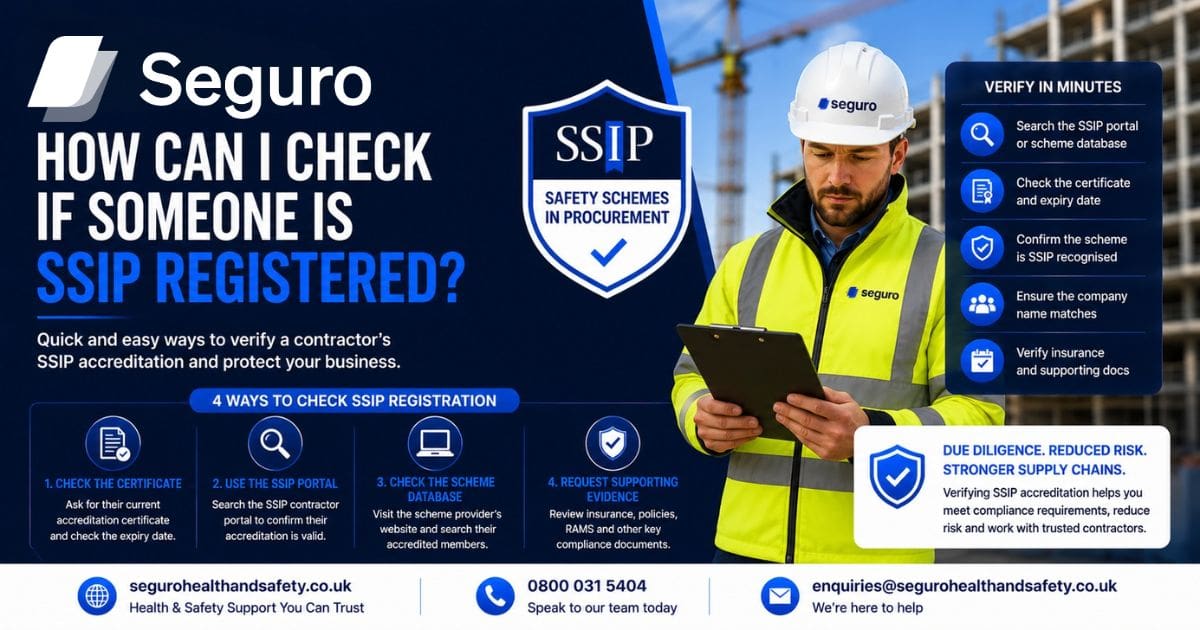
Checking if a contractor is SSIP registered is straightforward

Go to the SSIP website and click onto the SSIP Portal.

In the search section type in the contractor name and press enter. If they are registered, the SSIP website. portal will give you the registration and renewal date details.

In order to find out the details and check it is the correct company you will need:

  • Company full registered
  • Registered address

Contacting the company and requesting a copy of their SSIP certificate and any additional and relevant documentation is also advisable. They should be willing to provide you with this information if they are a reputable company.

If you are not happy with the work someone has done for you this would not fall under SSIP. You would need to go to trading standards if you cannot resolve the issue with the company. Trading standards website

Testimonial

Ash Electrics

We have now received our Gold award, with 100% thanks to yourselves.

I will share our feedback on your service but just to say a huge thank you, you have always been helpful and supportive and that has been very much appreciated.

With very best wishes

Jane

All your Health & Safety requirements in one place

Insight by

amanda

Amanda Lambert

Published on

18 June 2025

Health and safety blog

All your H&S requirements in one place

Here at Seguro we can be a one stop shop for your safety needs. We can help you with one off client requests or by being your competent person providing you with our full Safety package the choice is yours.

All our our clients have different needs so we can tailor a package to fit your Health & Safety requirements.

Competent Person

We provide a full Health & Safety Management System including a policy, employee handbook and an environmental policy. Expert advice is available for you 24/7.

Accreditation

If your looking for an accreditation but not sure which one we can recommend one to suit your individual needs

We can help you to provide the paperwork needed to enable you to show you are capable of working safely. These vary depending on what accreditation you are looking to complete.

We stay with you until the accreditation is achieved.

Risk Assessments & Method Statements

We have a full library of Risk Assessments & Method Statements available for you to purchase from as little as £10. All of our documents are available in word format for you to be able to amend and use as you need in your business.

examples

Safety Advisor

This is a support service for less than 5 employees, this comes with expert advice as well as access to our online documents and Risk assessments. This can be purchased separately or comes free with accreditation applications for less than 5 employees.

We offer many more services including PQQ preparation, Construction Phase Plan preparation. Why not visit our website and see if we can help you with any issues you have now and throughout 2025.

Complete the form below, and we will be happy to provide you with assistance.


    I confirm I have read and agree to the Seguro Health and Safety Consultants Privacy Policy.

    The difference between Safety Advisor and Competent Person

    Insight by

    amanda

    Amanda Lambert

    Published on

    12 June 2025

    Competent person

    The difference between Safety Advisor and Competent Person

    The main difference between a safety advisor and a competent person within your business (eg someone who seems themselves as competent) is that the safety advisor needs to be qualified to at least NEBOSH or IOSH standards.

    A competent person may be competent at running a construction site but not the health and safety management of the site, unless they have the above qualifications.

    When a business has more than five employees, health and safety legislation states the company must employ a competent person who is competent in health and safety. A person who is competent in the health and safety management of the business. This person will hold health and safety qualifications such as NEBOSH or IOSH.

    Ensuring you have the right level of support and advice for your Health & Safety is a bit of a mine field and can be defined simply by the number of employees you have.

    Less than 5 employees = Safety Advisor

    This service is where you are offered support and advice when needed, this tends to be a one of payment where you will be given a service agreement, certificate and a CV to show the qualifications of the person who is providing you with the advice. Paperwork such as off the shelf risk assessments and risk assessments and Method statements would be provided on an as and when basis should you need them.

    More than 5 employees = Safety Competent Person

    This service is where you pay a monthly retainer fee for continued support and advice should you need it. This service is where your consultant becomes part of your business and should be informed of anything that changes within the organisation. In this service you will be provided with a full Safety Management System including full Health & Safety Policy, Equal opportunities policy and Staff handbook. Your consultant will be on hand to be the link between you and the HSE should this ever be necessary.

    Whilst not every company is black and white like this the rule of thumb tends to be the details above. You may be asked by a client to prove you have a dedicated support for Health & Safety resource as well as a policy with less than 5 employees if that is the case you would need fall outside of the rule.

    If you are not sure about your personal circumstances please call 0800 031 5404 during working hours or complete the form using this link. We are happy to go through everything with you.

    Safety Advisor Service

    Insight by

    amanda

    Amanda Lambert

    Published on

    5 June 2025

    Health and safety blog

    Safety Advisor Service

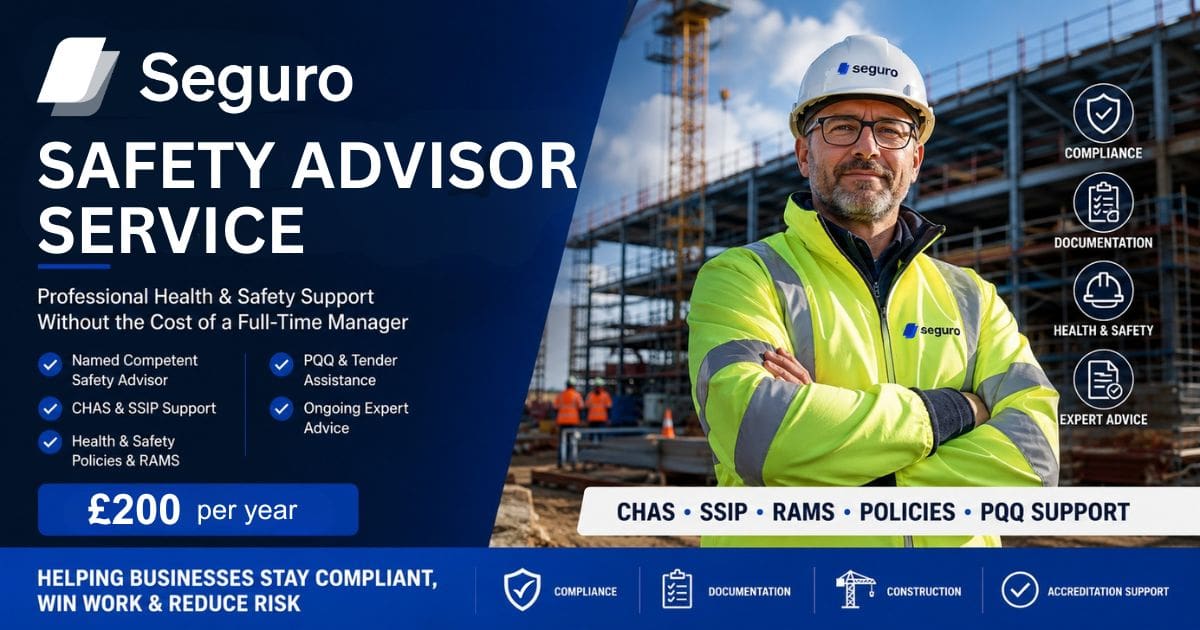
    Discover our Safety Advisor Service that supports clients during their accreditation process and beyond.

    Here at Seguro we pride ourselves on adding value to our services. When we help our clients to achieve an accreditation we also provide them with a Safety Advisory service.

    This is where we remain as their contact throughout the year of their accreditation to help them to:

    • Implement the new documentation into their business
    • Provide support ongoing should they need it.
    • Provide off the shelf risk assessments and method statements should they be needed (bespoke ones are chargeable)
    • Enable our clients to name us should they need to on PQQ documentation

    The following accreditations are eligible (less than 5 employees)

    • CHAS
    • Safe Contractor
    • Constructionline
    • Exor
    • Altius
    • Avetta
    • Builders Profile

    Remote Competent Safety Advisor Vs Onsite Visiting

    We often get asked the question about our Competent Safety Advisor Service to see what the benefits are compared to having someone employed onsite. The obvious one is cost, it is much more cost effective to have a remote competent person as a service, a service like ours starts from £50 per month compared to a full time salary.

    Why use an outsourced service?

    • We supply a comprehensive Health and Safety Management System
    • We develop a bespoke company Health and Safety Policy for your business
    • We work with you to develop a company employee handbook
    • We develop an Environmental Policy specific to you
    • We provide assistance in Accident Reporting to Enforcing Authorities/Accident Investigation
    • We will liaison with Enforcing Authorities on your behalf

    Ongoing support

    • Access to telephone advice on an unlimited number of occasions
    • Updates on any changes in Health and Safety legislation
    • Access to over 80 risk assessments and various supporting documentation held on our website
    • Yearly review of all documentation and revised documents issued
    • Monthly newsletters giving you latest Health & Safety News as well as legislation updates.

    With over 200 clients we provide a comprehensive service that is affordable and reliable so SME’s can have peace of mind that they are compliant with their legal obligations.

    There are no hidden fees and we pride ourselves with having an 95% retention record year on year. You can see testimonials on our website or on Trust pilot which is an independent review platform.

    Competent Safety Advisor Support

    Here at Seguro, we pride ourselves on being able to support all businesses regardless of their size. We can provide your business with less than five employees a service, ensuring you meet all your Health & Safety needs.

    Our service provides you with:

    • Support to implement new documentation into your business
    • Provide support ongoing should you need it for all Health & Safety advice.
    • Provide off-the-shelf risk assessments and method statements should they be needed (bespoke ones are chargeable)
    • Enable you to name us should you need to on PQQ documentation
    • Provide you with General pre-prepared COSHH from our library

    We are available throughout the working day by email or telephone, whichever way you prefer to communicate.

    This service is available to anyone who needs it, and there is a fixed cost for everyone.

    This service is also FREE with any accreditation we submit for you so if you are looking to get CHAS or a similar SSIP we can assist with that and provide this service for FREE.

    If you need more information about SSIP, we have lots of blogs to help or you can visit SSIP directly.

    Included in our competent safety advisor service

    • Put Seguro down as your named health & safety advisor.
    • Use our name when filling out pre-tender qualification questionnaires.
    • Use a CV from one of our Consultants.
    • We are here as back-up should you require advice and guidance on health & safety issues.

    If you are looking for any help in acquiring an accreditation and would like to take advantage of our complimentary service please get in touch on 0800 031 5404 or contact us

    What is SSIP Deem to Satisfy?

    Insight by

    amanda

    Amanda Lambert

    Published on

    14 May 2025

    Health and safety blog

    What Is SSIP Deem to Satisfy?

    Quick Answer: 

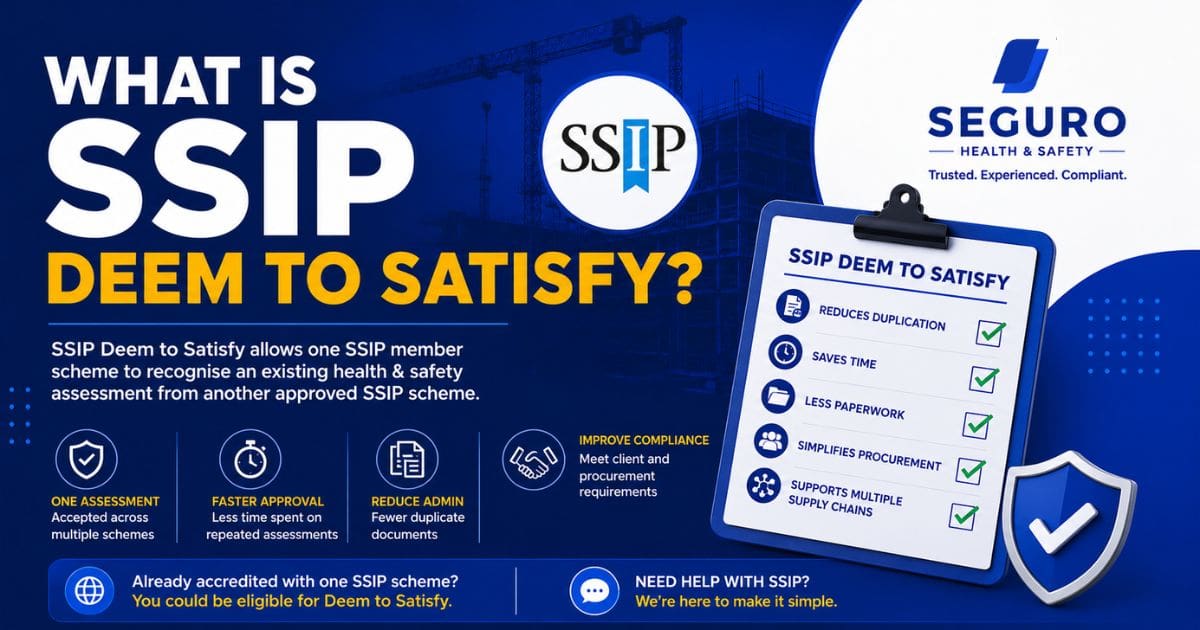
    SSIP Deem to Satisfy is a process that allows one SSIP member scheme to recognise an existing valid SSIP assessment from another approved scheme, helping contractors reduce duplicated health and safety assessments and simplify procurement compliance.

    In simple terms:

    If you already hold a valid SSIP accreditation, you may not need to complete the full assessment process again when applying to another SSIP member scheme.

    This helps contractors:

    • Reduce duplication
    • Save time
    • Avoid repeating paperwork
    • Simplify procurement compliance

    For many UK contractors, Deem to Satisfy makes it easier to work with multiple clients who request different SSIP schemes.

    What Does SSIP Mean?

    SSIP stands for Safety Schemes in Procurement.

    It is an umbrella organisation that brings together recognised health and safety accreditation schemes including:

    • CHAS
    • Constructionline
    • SafeContractor
    • SMAS
    • CQMS
    • PQS

    All SSIP member schemes assess the same core health and safety standards.

    What Is SSIP

    How Does SSIP Deem to Satisfy Work?

    The process works by allowing one SSIP assessment to be recognised by another member scheme.

    For example:

    • A contractor holds CHAS accreditation
    • Another client requests SMAS
    • Instead of starting from scratch, SMAS may accept the existing SSIP assessment through Deem to Satisfy

    The second scheme may:

    • Reduce the amount of information required
    • Skip duplicated assessment sections
    • Fast-track approval

    However, some additional checks may still apply depending on the scheme.

    Why Was Deem to Satisfy Created?

    Before SSIP Deem to Satisfy, contractors often had to:

    • Complete multiple health and safety applications
    • Submit the same documents repeatedly
    • Pay for repeated assessments
    • Waste time duplicating compliance work

    Deem to Satisfy was introduced to:

    • Reduce unnecessary duplication
    • Simplify procurement
    • Improve consistency across schemes
    • Support contractors working across multiple supply chains

    Which SSIP Schemes Use Deem to Satisfy?

    Many SSIP member schemes participate in the process, including:

    • CHAS
    • SafeContractor
    • SMAS
    • Constructionline
    • CQMS
    • PQS

    Acceptance can vary depending on:

    • Accreditation level
    • Scope of work
    • Expiry dates
    • Additional scheme requirements

    SSIP Schemes Comparison

    Is CHAS Deem to Satisfy?

    CHAS itself is an SSIP member scheme and may participate in the Deem to Satisfy process.

    This means:

    • Existing SSIP accreditations may support a CHAS application
    • CHAS accreditation may support applications to other SSIP schemes

    However, CHAS may still request:

    • Additional evidence
    • Further compliance checks
    • Scheme-specific requirements

    This is especially common with:

    • CHAS Advanced
    • CHAS Elite
    • Common Assessment Standard (CAS)

    SSIP vs CHAS

    What Information Is Usually Required?

    Even with Deem to Satisfy, contractors may still need to provide:

    • Existing accreditation details
    • Valid certification
    • Insurance
    • Company information
    • Additional supporting evidence

    Some schemes may also review:

    • Environmental policies
    • Quality systems
    • Financial information
    • Modern slavery compliance

    Benefits of SSIP Deem to Satisfy

    1. Reduces Duplicate Assessments

    You avoid repeating the same health and safety assessment multiple times.

    2. Saves Time

    Applications can often be completed faster.

    3. Reduces Administration

    Less paperwork and fewer repeated uploads.

    4. Supports Procurement Compliance

    Makes it easier to work for:

    • Main contractors
    • Local authorities
    • Public sector clients
    • Large commercial organisations

    5. Improves Scalability

    Helpful for contractors working across multiple frameworks or supply chains.

    Does Deem to Satisfy Mean Automatic Approval?

    No.

    This is one of the biggest misunderstandings.

    Deem to Satisfy does NOT guarantee automatic approval.

    The receiving scheme may still:

    • Review documents
    • Request updates
    • Ask additional questions
    • Require extra compliance evidence

    The process simply reduces duplicated assessment where possible.

    Common Problems With Deem to Satisfy Applications

    Applications may still fail due to:

    • Expired accreditation
    • Incorrect company information
    • Missing insurance
    • Inconsistent documents
    • Weak RAMS
    • Outdated health & safety policies
    • Scheme-specific requirements not being met

    Why SSIP Applications Fail

    Is Deem to Satisfy Suitable for Small Contractors?

    Yes.

    Small contractors often benefit significantly because it:

    • Reduces admin
    • Saves time
    • Simplifies onboarding
    • Helps meet procurement requirements faster

    This is particularly useful for:

    • Subcontractors
    • Sole traders
    • Small construction businesses
    • Growing contractors

    SSIP for Small Contractors

    How to Improve Your Chances of Approval

    To improve approval success:

    • Keep documents updated
    • Ensure company information matches across all documents
    • Use tailored RAMS
    • Maintain valid insurance
    • Provide clear evidence of competence
    • Use professional health & safety support if needed

    Done-for-You SSIP Support

    Many contractors choose professional support to:

    • Handle applications
    • Prepare documents
    • Upload evidence
    • Manage assessor responses
    • Reduce delays and rejection risk

    At Seguro Health and Safety, we support contractors with:

    • CHAS
    • Constructionline
    • SafeContractor
    • SMAS
    • PQS
    • SSIP applications and renewals

    Done for You SSIP

    Need Help With SSIP Accreditation?

    If you need support with:

    • SSIP applications
    • CHAS accreditation
    • RAMS
    • Health & safety documentation
    • Procurement compliance

    CALL Amanda on 0800 031 5404 to get started

    shape Ask Amanda

    Frequently Asked Questions

    What is SSIP Deem to Satisfy?

    SSIP Deem to Satisfy is a process that allows one SSIP member scheme to recognise an existing valid health and safety assessment completed through another approved SSIP scheme. This can reduce duplication and make procurement compliance easier.

    Does SSIP Deem to Satisfy mean automatic approval?

    No. SSIP Deem to Satisfy does not guarantee automatic approval. The receiving scheme may still check your company details, insurance, accreditation status and any additional scheme-specific requirements.

    Which schemes accept SSIP Deem to Satisfy?

    Many SSIP member schemes may use the Deem to Satisfy process, including CHAS, Constructionline, SafeContractor, SMAS, CQMS and PQS. Acceptance can depend on the scheme, accreditation level, expiry date and scope of work.

    Can CHAS be used for SSIP Deem to Satisfy?

    Yes. CHAS is an SSIP member scheme, so a valid CHAS accreditation may help support a Deem to Satisfy application with another SSIP scheme. However, additional checks may still be required.

    Can another SSIP accreditation be used to apply for CHAS?

    Yes. In some cases, an existing valid SSIP accreditation from another member scheme may support a CHAS application through Deem to Satisfy. CHAS may still request additional evidence depending on the level of accreditation required.

    What information is needed for SSIP Deem to Satisfy?

    You may need to provide your existing SSIP certificate, accreditation details, company information, insurance documents and any extra evidence requested by the receiving scheme.

    What are the benefits of SSIP Deem to Satisfy?

    The main benefits are reduced duplication, less paperwork, faster applications, lower administration time and easier compliance with different client procurement requirements.

    Why can Deem to Satisfy applications still fail?

    Deem to Satisfy applications can still fail if the accreditation has expired, company information is inconsistent, insurance is missing or incorrect, documents are outdated, or additional scheme-specific requirements are not met.

    Is SSIP Deem to Satisfy useful for small contractors?

    Yes. SSIP Deem to Satisfy can be very useful for small contractors because it reduces repeated paperwork and helps them meet different client or main contractor requirements more efficiently.

    Can Seguro help with SSIP Deem to Satisfy applications?

    Yes. Seguro Health and Safety can help contractors with SSIP Deem to Satisfy, CHAS, Constructionline, SafeContractor, SMAS, PQS and other SSIP applications by preparing documents, managing submissions and responding to assessor queries.

    Bespoke Risk Assessment & Method Statements

    Insight by

    amanda

    Amanda Lambert

    Published on

    7 October 2024

    Health and safety blog

    Table of contents

    Bespoke risk assessment and method statement

    Get customised risk assessment & method statements for your projects, or select one of our many ready to go templates.

    You can easily tailor the template to meet your specific needs.

    We provide standard and bespoke RAMS (risk and method statements).

    Standard RAMS

    We provide a wide range of risk assessment & method statements in template format on our website. Each can be five to sixteen pages long and contain between 3,000 and 9,000 words.

    The RAMS are within a template and cover all the principal risks and methods to carry out a specific job. The RAM Templates need the client’s involvement as there will be a comprehensive sequence of work that could apply. As the client, you would be responsible for ensuring that this sequence was relevant to yourself and, if not amended to reflect your process.

    Our standard RAMS cost from £6 to £12 per RAM or are provided free as part of our Safety Advisory service or Competent person service.

    Review our standard RAMS

    Bespoke risk assessment and method statements

    Bespoke RAMS are when the client has a very specific request that does not fall into any template we have available. Bespoke RAMS are tailored to include the process you carry out and ensure that all risks are appropriate to the job and site you are working on.

    Writing a bespoke RAMS requires input from one of the consultants, so we will charge a fee. Whatever your requirements, we will have the solution to support you.

    Use the form on this page to tell us about your requirements, and we will give you an economical fee to write it up for you using one of our templates.

    Please complete the form below and give us some details about your requirements.

    Complete the form below and we will get in touch


      I confirm I have read and agree to the Seguro Health and Safety Consultants Privacy Policy.

      Asbestos awareness training – Keep your team safe

      Insight by

      amanda

      Amanda Lambert

      Published on

      10 September 2024

      Asbestos

      Asbestos Awareness Training

      Stay compliant and prioritise safety with asbestos awareness training. Provide your employees with the necessary training to handle asbestos safely. Developed by health and safety training experts.

      It is your employers responsibility to ensure that any employee who may come into contact or disturb asbestos carrying out their normal daily work tasks have been given the correct level of training. Enabling employees to have the knowledge to ensure that they can work safely and competently without risk to themselves or others working around them.

      There are three main levels of information, instruction and training.

      • Asbestos awareness
      • Non-licensable work with asbestos including NNLW
      • Licensable work with asbestos.

      Asbestos Awareness

      Asbestos Awareness Training can be provided in a number of forms but the most common and easiest form is to provide employees with access to Asbestos Awareness Online Training. The training is intended to provide the employees with the the information you need to avoid work that may disturb asbestos during any normal work which could disturb the fabric of a building, or other item which might contain asbestos. The training is not intended for anyone who will be involved in the removal of Asbestos.

      Asbestos Awareness training should cover the following:

      • how to avoid the risk of exposure to asbestos
      • the effects of asbestos on health and its properties, including the increased risk of developing lung cancer for asbestos workers who smoke
      • asbestos materials in buildings and plant, the types, uses and likely hood of it being present
      • the general procedures to deal with an emergency, eg. an uncontrolled release of asbestos dust into the workplace

      We can provide access to an Asbestos Awareness Online Training for any employers looking to ensure their employees are covered.

      All other levels of asbestos and the information and training needed can be found on the HSE website.

      Available health and safety online training courses

      You can also select a course you are interested in and click on the free trial button on the course. Select any courses from the list below:

      The courses available are:

      Health and Safety Policy

      Insight by

      amanda

      Amanda Lambert

      Published on

      7 September 2024

      Health and safety blog

      Do I need a health and safety policy?

      Find out why even small businesses need a health and safety policy. Learn how to write a policy that meets legal requirements and keeps your employees safe.

      If you employ less than five people, you still need a health and safety policy; you can verbally communicate to employees or others who may be affected by your business activities.

      Businesses with more than five people must have a more detailed health and safety policy that includes the organisation and arrangements.

      The Health and Safety at Work etc Act 1974 is the primary piece of legislation covering occupational health and safety in Great Britain. It’s sometimes referred to as HSWA, the HSW Act, the 1974 Act or HASAWA.

      How to write the policy

      A policy is a written statement which has three essential parts:

      1) Health & Safety Policy

      The health and safety policy details a statement of intent. The statement of intent details your aims and objectives, health and safety policy, processes and systems to prevent accidents, train your employees, supply PPE, etc. The policy is signed and dated by the most senior person, the managing director.

      (2) Organisation of Health and Safety – Roles and Responsibilities

      The organisation of health and safety is best done by developing an organisation chart, with the most senior person at the top, then detailing the people who are responsible for the day-to-day running of all matters concerning health and safety. An example is:

      • Managing director
      • Health and safety advisor
      • Fire safety manager
      • Health and safety training manager
      • Risk assessments and method statements manager
      • PPE manager
      • Control of substances hazardous to health COSHH manager

      In small businesses, one person may have many roles

      3) Arrangements for health and safety – How are risks managed?

      The arrangements for health and safety should detail how the organisation aims to achieve its aims. For example:

      • Develop risk assessments
      • Training of people
      • Consulting with people
      • Fire and emergency arrangements
      • First aid arrangements
      • Reporting of accidents, injuries and dangerous incidents
      • Arrangements for working at height, manual handling, etc.

      Tips to write a health and safety policy

      Here are some tips for creating a health and safety policy:

      Be specific – Tailor it to your business and clearly state who is responsible for what. 

      Get buy-in – Involve all stakeholders, especially those with significant safety responsibilities, to ensure the policy is accurate. 

      Review regularly – Update the policy annually or when there are changes to the business, such as a new management structure or expansion. 

      The benefits of having a written policy for businesses of any size including: 

      • Demonstrating a commitment to the health and safety of employees, customers, contractors, and the public
      • Clarifying responsibilities
      • Building confidence when seeking new contracts or tenders

      Buy a policy

      We have written several health and safety policies. Click on the link to review them: Health and safety policies.

      We can write a policy for you if you can’t see your company type above.

      SEGURO Support

      If you would like and advice on a Health & Safety Policy, call us on 0800 031 5404 or complete the form below, and we will contact you.


        I confirm I have read and agree to the Seguro Health and Safety Consultants Privacy Policy.