Close Navigation

Search

CHAS renewal – How to renew your CHAS certificate

Insight by

amanda

Amanda Lambert

Published on

22 February 2024

CHAS

CHAS Renewal & CHAS Login: Complete Guide for UK Contractors

If you’re a contractor or construction business using CHAS for your SSIP accreditation, you’ll need to keep your certification renewed every year. Many businesses lose work because their CHAS accreditation expires, usually because the renewal process isn’t started early enough or login issues delay the submission.

If you’re applying for the first time, follow our CHAS accreditation step-by-step guide.

This guide covers exactly how to:

  • Let Seguro complete the CHAS renewal for you. For a very small fee, we can take the pain away.
  • Log in to the CHAS portal
  • Start your CHAS renewal application
  • Upload required evidence
  • Avoid common renewal failures
  • Stay compliant and win more work

STOP THINK

There is a quick way to renew your CHAS. We renew over 1,000 CHAS applications per year. We can do it for you. CALL 0800 031 5404 during office hours or complete the form on the link below:

Get your CHAS renewal within a few days with zero pain! from £300

CHAS renewal

You have to renew your CHAS accreditation every year.

The CHAS accreditation process reviews your company’s ability to perform your activities complying with Health & Safety every year.

Documentation is provided on recent jobs and processes you are working on at the time of application. As these could change within 12 months, CHAS has a process where each application is seen as new and lasts for 12 months.

CHAS assesses your Health & Safety, which is done remotely; you get access to an online portal once you have paid. Once everything is uploaded to the portal, you can submit it for approval.

The CHAS assessor will take up to 10 working days to reply to your submitted documentation with their findings.

Renewal costs

CHAS offers three membership packages with different levels of accreditation:

CHAS Standard

The entry-level package includes a health and safety assessment and SSIP accreditation. CHAS membership fees

CHAS Advanced

The mid-range package includes all the Standard package benefits, plus helps you achieve SSIP and PAS 91 accreditation. CHAS membership fees

CHAS Elite

The highest level of accreditation includes all the benefits of the other packages, plus access to the Common Assessment Standard. CHAS membership fees

How to renew your CHAS accreditation

To renew your CHAS membership, you can: 

  1. Let Seguro do it for you or:
  2. Log in to your MyCHAS portal
  3. Review your current health and safety practices
  4. Click Renew
  5. Complete the renewal application
  6. Pay the renewal fee
  7. Submit your renewal application
  8. Await the assessment results
  9. Update your company records
  10. Ongoing compliance depends on meeting the CHAS assessment criteria consistently.

If you can’t log in

Common issues:

  • Wrong email linked to your CHAS account

  • Password expired

  • Account locked due to inactivity

  • Renewal overdue

Fixes:

  • Use “Forgot Password”

  • Check the original registration email

  • Contact CHAS support if your account is blocked

CHAS Renewal: What It Means

CHAS accreditation lasts for 12 months, after which you must renew to remain certified and visible to buyers.

A CHAS renewal involves:

  • Updating your insurance documents

  • Refreshing RAMS, policies, and training records

  • Uploading evidence of compliance

  • Completing the online assessment questionnaire

  • Meeting any new CHAS requirements for that year

When to Start Your CHAS Renewal

CHAS recommends starting 6–8 weeks before your expiry date.

Why early renewal is essential:

  • Insurance documents may need updating

  • Training records may be outdated

  • Missing documentation causes delays

  • You risk losing tenders if your certificate lapses

Documents You Need for CHAS Renewal

Most contractors will need:

Mandatory

  • Employers’ Liability Certificate

  • Public Liability Certificate

  • Health & Safety Policy

  • Risk Assessments & Method Statements (RAMS)

  • Training certificates (CSCS, CITB, Asbestos Awareness, etc.)

Depending on your work

  • PUWER / LOLER evidence

  • COSHH assessments

  • SSOW (Safe Systems of Work)

  • Subcontractor approval process

  • First aid training

If anything expired since your last CHAS assessment, you must replace it before renewal.

Common CHAS Renewal Mistakes

Most renewals fail because of:

❌ Outdated insurance
❌ Missing RAMS
❌ No training evidence
❌ No subcontractor vetting system
❌ Outdated policies
❌ Not addressing changes in legislation

Fix these early, and your renewal will be smooth.

How to Make CHAS Renewal Easy

Many contractors outsource CHAS renewals because the documentation can be time-consuming. A consultant can help with:

  • Completing the online assessment

  • Uploading compliant evidence

  • Creating missing documents

  • Fixing non-conformities

  • Managing the entire renewal on your behalf

If you struggle with CHAS, outsourcing saves time and prevents failed submissions.

Why CHAS Renewal Matters

Renewing CHAS accreditation helps you:

  • Stay compliant with UK health & safety law
  • Win more tenders
  • Stay active on buyer platforms
  • Build trust with clients
  • Demonstrate competence and professionalism

If your CHAS expires, many contractors will no longer be eligible to work on certain sites.

Need Help With CHAS Renewal?

If you want fast, stress free CHAS renewal assistance, we can generate:

✔️ CHAS-ready RAMS
✔️ Updated safety policies
✔️ Subcontractor procedures
✔️ Compliance documents
✔️ Renewal checklists
✔️ CHAS explainer videos or PPTs
✔️ Lost your CHAS login

Need help getting approved? Our CHAS support service handles the full process for you.

MyCHAS Portal

You can use the MyCHAS portal to: 

  • Manage your profile
  • Monitor your accreditations
  • Access exclusive benefits
  • Upload supporting documentation
  • Access accreditation documents and assessments
  • Complete assessments and get feedback
  • Update accreditation progress and download certificates

You should receive a renewal invitation email about four weeks before your membership expires. Use your CHAS login detail to start the process.

CALL Amanda on 0800 031 5404 for support

Book a CALL
shape Ask Amanda

Related CHAS Guides

Frequently asked questions

Do you have to renew CHAS every year?

CHAS accreditation lasts for 12 months, so contractors must renew it every year to remain certified and visible to buyers.

When should I start my CHAS renewal?

You should start your CHAS renewal around 6 to 8 weeks before your expiry date. This gives you time to update insurance, training records, RAMS, policies and any other evidence before submission.

How do I renew my CHAS accreditation?

To renew CHAS, log in to your MyCHAS portal, review your current health and safety documents, complete the renewal application, pay the renewal fee, upload your evidence and submit the assessment for review.

What documents do I need for CHAS renewal?

Most contractors need updated insurance certificates, a health and safety policy, risk assessments, method statements, training certificates, accident reporting arrangements and evidence of safe working procedures. CHAS requirement checklist.

How long does CHAS renewal take?

Once your CHAS renewal has been submitted, the assessor can take up to 10 working days to review your documents and provide feedback or approval.

What happens if my CHAS accreditation expires?

If your CHAS accreditation expires, you may no longer be visible to buyers or eligible to work for clients who require current SSIP certification. This can delay tenders, site access and contract awards.

Why do CHAS renewals fail?

CHAS renewals often fail due to expired insurance, missing RAMS, outdated policies, insufficient training evidence, poor subcontractor procedures, or failure to address updated health and safety requirements.

Can someone complete my CHAS renewal for me?

Yes. Seguro can manage the renewal process for you by reviewing your documents, completing the online assessment, uploading evidence and responding to assessor queries.

Having trouble with your RE-CHAS?

Insight by

amanda

Amanda Lambert

Published on

18 May 2023

CHAS

Having trouble with your RE-CHAS?

Each application for CHAS is treated as a new application, this is so that your paperwork can be assessed on a yearly basis to ensure that you comply with the latest Health & Safety Legislation. We often get calls from companies saying that the paperwork they have submitted last year has not been accepted this time around.

If you submit documentation that CHAS do not think is up to the standard they need to pass, they will provide you with a list of actions. This will be sent out to you by your appointed CHAS assessor.

The documentation will go into detail to let you know what you need to provide as additional information, there are a number of actions you can then choose:

  • Compile the documentation yourself
  • Purchase the documents needed and complete it independently
  • Contact a Competent Health & Safety Consultant who can provide you with the information needed as well as advice

We can do your CHAS with you starting at £300 + vat for less than 5 employees.

Having trouble with your RE-CHAS? support

As a Health and Safety Consultant we are happy to look at your documentation and bespoke the responses based on your business please get in touch if you would like our help on 0800 031 5404.

Risk Assessments and Method Statements

Insight by

amanda

Amanda Lambert

Published on

8 March 2023

Health and safety blog

Risk Assessments and Method Statements

Here at Seguro we know that Risk Assessments & Method Statements (RAMS) can seem a daunting task when you have to start them from scratch. We have developed a library of documents that can be used within your business on a day to day basis.

We constantly update our shop section with the latest activity based ones we have created.

Our RAMS can be purchased individually  for only £10 + vat or in a pack depending on what you need.

If you are unsure if we have the document you need please visit our SHOP and see what you can find.

Here are some examples listed below:

RAMS For Screeding
Plumbing RAMS
External Painting RAMS
RAMS for commercial electrical installation

We also offer a RAMS Pack which contains 65 templates covering a range of subjects.

Standard RAMS

We provide a wide range of RAMS in template format on our website. Each can be five to sixteen pages long and contain between 3,000 and 9,000 words.

The RAMS are within a template and cover all the principal risks and methods to carry out a specific job. The RAM Templates need the client’s involvement as there will be a comprehensive sequence of work that could apply. As the client, you would be responsible for ensuring that this sequence was relevant to yourself and, if not amended to reflect your process.

Our standard RAMS cost from £6 to £12 per RAM or are provided free as part of our Safety Advisory service or Competent person service.

Review our standard RAMS

Risk assessment training

If the tasks you are carrying out are different and unique to your business a  Bespoke RAMS might be better for you.

This is where we create a RAMS that is 100% specific to your needs., prices start at £150 + vat

We would need information from you to create the documents please find the criteria we would need here.

The different between a small and a large CHAS application

Insight by

amanda

Amanda Lambert

Published on

18 October 2022

CHAS

The different between a small and a large CHAS application

Understand the difference between a small and a large CHAS application and the impact of employee numbers on requirements. We often get companies asking us what is the difference between having 4 employees or 5 when applying for CHAS. CHAS define an employee as someone who you pay through your PAYE system, there are different assessment fees due depending on the number of employees you declare.

In particular to CHAS there is an increased number of documents you need to provide as well as evidence of your safety arrangements including Health & Safety policy.

Once you have 5 employees or more you have legal requirements under the Health & Safety at Work Regulations 1974, you need to have formal arrangements in place for competent Safety advice as well as a full Heath & Safety Management system.

Learn more about CHAS

We have a series of articles where you can learn more about CHAS. The list of articles is below:

If you are not sure which bracket you fall under, or if you have enough documentation to satisfy the assessment get in touch and we will be able to provide you with advice.

5 Top Tips for Preventing Falls from Height

Insight by

Bob Evans

Bob Evans

Published on

20 June 2022

Health and safety blog

Falls from Height

Learn the strategies preventing falls from height. Falls from height continues to be the largest causes of major injuries and fatalities.  About 4000 working at height-related accidents occur each year at work and the most common cases are falls from ladders and through fragile services. Alarmingly, two thirds of all major injuries at work are caused by ‘low falls’ A low fall is a fall from a height below 2 metres.  A high fall is a fall from a height of more than 2 metres.

Top Tips for Preventing Falls from Height:

  1. As with all work activities, a suitable and sufficient risk assessment is key to preventing falls from height. The planned activity and location should also be assessed immediately before work takes place, in case there have been any changes since the original assessment took place. The above case is a good example, in terms of missing panels that had not been put back following previous works.
  2. All parties involved should be made aware of the findings of the risk assessment, so there needs to be procedures in place to ensure good communication of the hazards, control measures and any changes to the planned works.
  3. In terms of control measures, eliminating the need to work at height is usually the best option. However, in reality, that isn’t always possible. Use suitable work equipment such as a working platform, or an existing safe area with a permanent guardrail, and make sure workers can reach it safely.
  4. All works should be supervised, and the job undertaken by competent staff. Assessing someone’s competency would include looking at their experience, knowledge and skillset, as well as their qualifications.
  5. Consider both personal and collective measures to minimise the distance and consequences of a fall, where some risk does remain, such as fall arrest equipment or safety nets.

Most falls from height can be prevented, by ensuring proper planning of the work and by selecting the right equipment for the job. When equipment is not suitable, it can lead to workers finding other ways to complete the job, which can have fatal consequences.

Working at heights training course

If you are still unsure and would like to look at refreshing your knowledge we offer an working at height e-learning course for you to sit whenever is convenient for you.

You can download HSE’s Working at Height Brief Guide Here

SSIP Accreditation and CHAS

Insight by

amanda

Amanda Lambert

Published on

23 August 2021

CHAS

SSIP Accreditation and CHAS: What UK Contractors Need to Know (2026 Guide)

If you’re a contractor trying to win work in the UK construction sector, you’ve likely come across SSIP accreditation and CHAS.

SSIP is the system. CHAS is one of the most recognised schemes within it.

If you want to work for main contractors, councils, or commercial clients, you’ll almost always need one of them.

If you’re applying through CHAS, follow our CHAS accreditation step-by-step guide.

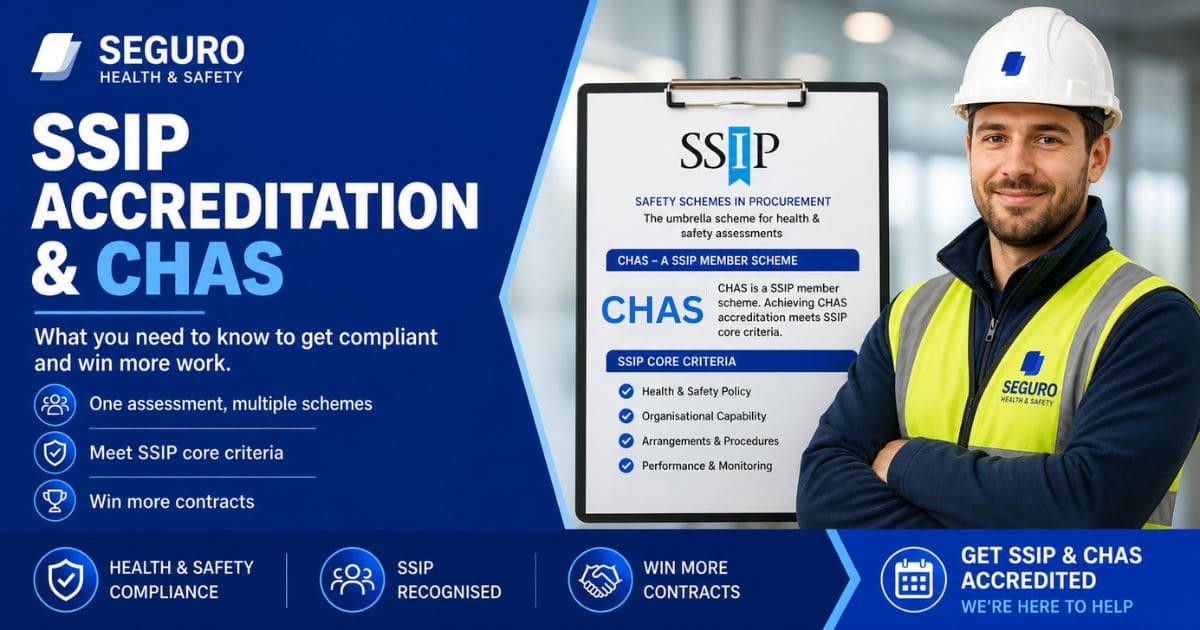
What Is SSIP Accreditation?

Safety Schemes in Procurement (SSIP) is an umbrella organisation that:

  • Standardises health & safety assessments
  • Reduces duplication across multiple schemes
  • Ensures all member schemes assess the same core criteria

In simple terms: SSIP means “one standard, recognised everywhere.”

What Is CHAS?

CHAS (The Contractors Health and Safety Assessment Scheme) is:

  • One of the most widely recognised SSIP schemes
  • Used by main contractors, developers, and local authorities
  • A fast way to prove your business meets health & safety requirements
  • How to get CHAS accreditation step-by-step

Quick Comparison

Feature

SSIP

CHAS

What it is

Umbrella organisation

Accreditation provider

Purpose

Standardise H&S assessments

Certify contractors

Recognition

Industry-wide

Very high

Required for tenders?

Yes (via member schemes)

Commonly specified

What Do SSIP & CHAS Actually Assess?

All SSIP schemes (including CHAS) assess the same core areas:

  • Health & Safety Policy
  • Competent Advice
  • Training & Competence
  • Risk Assessments & RAMS
  • Accident Reporting
  • Workforce Involvement
  • Monitoring & Review
  • Subcontractor Management
  • Welfare & Communication

This is why: If you pass CHAS, you meet the SSIP standard.

Do You Need SSIP or CHAS?

You DO need it if you want to:

You may not need it if:

  • You only work for domestic homeowners
  • You don’t plan to enter commercial construction

But realistically, No SSIP = limited growth in construction

CHAS vs Other SSIP Schemes

CHAS is not the only option. Other SSIP schemes include:

  • Constructionline
  • PQS
  • SMAS Worksafe
  • SafeContractor

All assess the same standards, but:

Choosing the right one depends on:

  • Your target clients
  • Tender requirements
  • Budget

How Much Does SSIP / CHAS Cost?

Typical entry-level costs:

  • CHAS: from ~£429 + VAT
  • PQS – £49 + VAT
  • SMAS: from ~£317 + VAT
  • SafeContractor: from ~£419 + VAT
  • Constructionline Bronze: from ~£498 + VAT
  • To compare options, see our CHAS vs Constructionline guide.

Important: The highest cost is often getting your documents compliant, not the scheme fee.

Why Contractors Fail SSIP / CHAS

Common mistakes include:

  • Outdated health & safety policy
  • Missing RAMS
  • No competent safety advisor
  • Weak or generic documents
  • Expired insurance
  • No training evidence

Fix these early, and approval becomes straightforward. Common reasons CHAS applications fail and how to avoid them

Benefits of CHAS / SSIP Accreditation

  • Win more contracts
  • Meet pre-qualification requirements
  • Build trust with clients
  • Reduce repeated assessments
  • Improve your safety systems

Final Verdict

  • SSIP = the standard
  • CHAS = one of the best-known ways to meet it

If you want to grow in construction, SSIP accreditation isn’t optional; it’s expected.

Need help getting approved? Our CHAS support service handles the full process for you.

CALL Amanda on 0800 031 5404 to get started

Pass first time
shape Ask Amanda

Frequently Asked Questions

What is SSIP accreditation?

SSIP accreditation is a UK health and safety pre-qualification system that assesses contractors against a standard set of criteria. It helps reduce duplication across different schemes and allows contractors to demonstrate compliance to clients and main contractors.

What is CHAS, and how does it relate to SSIP?

CHAS is a health and safety accreditation scheme and a member of SSIP. It assesses contractors against the SSIP core criteria, meaning a CHAS certificate demonstrates compliance with recognised UK construction health and safety standards.

Do I need SSIP or CHAS to work in construction?

Most contractors working for main contractors, local authorities or commercial clients need SSIP accreditation such as CHAS. It is often required for pre-qualification and for accessing construction work opportunities.

Is CHAS the same as SSIP?

No. SSIP is the umbrella organisation that sets the assessment standard, while CHAS is one of the accreditation schemes that assesses contractors against those standards.

Can I use another SSIP scheme instead of CHAS?

Yes. Other SSIP schemes, such as PQS, Constructionline, SMAS, and SafeContractor, assess contractors against the same core criteria. The choice depends on what your clients or tenders require.

How long does SSIP or CHAS accreditation last?

SSIP accreditations, such as CHAS, typically last for 12 months. Contractors must renew annually to remain compliant and visible to clients and buyers. Learn about CHAS renewal.

What does CHAS assess?

CHAS assesses health and safety policies, risk assessments, training records, competent advice, accident reporting, workforce involvement, monitoring systems and subcontractor management to ensure contractors can work safely and meet industry standards. Learn about CHAS assessment criteria.

Why is SSIP accreditation important?

SSIP accreditation is important because it proves your business meets recognised health and safety standards, helps you pass pre-qualification requirements and increases your chances of winning contracts in the construction industry.

Related CHAS Guides

Acclaim Accreditation

Insight by

Bob Evans

Bob Evans

Published on

13 July 2021

CHAS

Acclaim Accreditation

What is a Acclaim Accreditation

Acclaim was created in 2012 and is a member of SSIP (Safety Schemes in Procurement)

SSIP is an umbrella organisation formed in 2009 to reduce the duplication of health and safety assessments.

Acclaim is the accreditation arm of Constructionline. When you join Constructionline, you will be directed to Acclaim to complete the Health and safety accreditation process to obtain the SSIP certificate.

Do I have to apply for an Acclaim at the same time as I do for a construction line?

Yes. Acclaim has been included within all paid Constructionline memberships and is no longer offered as a standalone product.

Constructionline Bronze, Silver, Gold, and Platinum memberships include Acclaim but also offer a ‘Deem to Satisfy’ certificate for those who hold a valid SSIP with an alternative provider.

What will an Acclaim accreditation cover?

All assessments are completed using the SSIP Core Criteria as the threshold standard and cover the following:

  • Health & Safety policy
  • Competent Advice
  • Training arrangements
  • Monitoring, audit and review
  • Workforce involvement
  • Accident reporting and enforcement action
  • Subcontracting/consulting
  • Risk Assessments and Safe Systems of Work
  • Cooperations with others
  • Welfare provision
  • Hazard elimination

How much does an assessment cost?

Fees charged by our members vary and take into account other membership fees. It is essential to recognise that all assessments are equal and all are carried out against the same standard.

If you are not sure feel free to call us for support.

How long will it take to get a certificate?

This varies from scheme to scheme and is dependent on you providing everything needed for the assessment. Typically, schemes will try to complete their initial assessment within ten working days.

Who is Seguro and how can you help me?

Seguro is a health and safety company that specialises in SSIP accreditation. We completed over 500 applications per year. Our success rate is 100%.

We are here to support you through the acclaim accreditation process; we can prepare all the documents, complete the registration forms, and simplify the process. CHAS is expensive, but other providers are very economical. The best thing to do is chat with us and learn more; we can tell you about the costs and the time frame. Our number is 0800 031 5404, or you can request a quote.


The Common Assessment Standard CAS

Insight by

amanda

Amanda Lambert

Published on

14 May 2019

Health and safety blog

The Common Assessment Standard CAS

For pre-qualification in public sector projects exceeding £5,337,000,000, the Common Assessment Standard CAS is now the preferred method.

The new “Common Assessment Standard” is being introduced as a new way to reduce the number of accreditation’s SME suppliers in the construction industry need to gain in order to comply with Health & Safety in the industry.

The Common Assessment Standard CAS will initially be available through CHAS, ConstructionLine and Achilles. The idea is that the other major providers will then join in the scheme.

The assessment process for CAS is likely to require additional and more robust information than the current health and safety requirements already in place for the three providers. There will also be a price increase for assessment fees but will work out more cost effective if you are in the position where you need more than one accreditation to work with your clients.

The new Common Assessment Standard CAS will contain 248 questions, covering your companies’ health and safety, financial health, environmental performance and corporate and social responsibility.

This is in comparison to the 190 questions already being asked at the moment.

We will keep you updated with the latest information on release dates and how we can help you, in the meantime if we can help you with anything please call on 0800 031 5404 during office hours.

Get SSIP Accredited to access the work

If you are looking to access public sector projects you will need to have a SSIP accreditation for example CHAS, Construction line or PQS. There are over thirty SSIP accreditation bodies and it can be tricky to select the right one for your business.

We can help you select the right provider for your sector and budget.

Complete the form on this link or call 0800 031 5404 during office hours.

PQS Accreditation

The most economical SSIP accreditation is PQS. Obtaining a PQS accreditation also gives you access to CHAS and Construction Line through deem to satisfy. We can tell you more about this when we speak.

Completing PQS application takes time and resources, as well as completing lots of forms and health and safety documentation.

We can make it easy for you by doing all the leg work for you. We carry out over 500 applications a year with 100% success.

For a small fee, we can take the pain away for you.

Complete the form, and we will tell you how it works and how much the whole process costs, including the SSIP fee for your circumstances.

    SafeContractor fees

    Insight by

    amanda

    Amanda Lambert

    Published on

    1 November 2016

    Health and safety blog

    SafeContractor Joining Fees: Costs, What’s Included, and What to Expect

    What Are SafeContractor Fees?

    SafeContractor fees are the costs a business pays to apply for and gain SafeContractor accreditation for the first time. The fee covers the assessment of health and safety systems, verification of documents, and access to the SafeContractor platform.

    SafeContractor is an SSIP-recognised accreditation scheme widely used across construction, maintenance, engineering, and facilities management sectors.

    How Much Does SafeContractor Cost to Join?

    SafeContractor joining fees typically vary depending on:

    • Business size
    • Number of employees
    • Type and risk level of work
    • Turnover band

    For most small and medium-sized contractors, fees are usually a few hundred pounds per year. Larger or higher-risk businesses may pay more due to the increased assessment scope.

    SafeContractor fees are normally annual, meaning renewal fees apply each year to maintain accreditation.

    What is Your Joining FEE?

    Joining fees change periodically. To get an accurate, up-to-date price, contact us, and we will calculate the total fee for you, including all unforeseen costs, such as employee training.

    Get a price

    What Does the SafeContractor Joining Fee Include?

    The joining fee usually covers:

    • Initial health and safety assessment
    • Review of policies and procedures
    • Verification of risk assessments and method statements (RAMS)
    • Insurance checks
    • SSIP-aligned assessment outcome
    • Access to the SafeContractor online portal
    • Listing on the SafeContractor database

    The fee does not usually include the creation of documents, which must be provided by the contractor.

    Why SafeContractor Fees Vary

    There is no single fixed joining fee because SafeContractor assesses businesses based on risk and complexity.

    Factors influencing cost include:

    • Trade type (e.g. electrical, construction, maintenance)
    • Site activities and hazards
    • Use of subcontractors
    • Management systems already in place

    Higher-risk activities typically require a more detailed review.

    Is SafeContractor Worth the Cost?

    For many contractors, SafeContractor accreditation is commercially essential rather than optional.

    Benefits include:

    • Meeting client and tender requirements
    • Access to approved contractor lists
    • Reduced duplication of health and safety assessments
    • Improved credibility with clients
    • SSIP recognition

    Many organisations will not engage contractors without a valid SafeContractor accreditation.

    SafeContractor Joining Fees vs Ongoing Costs

    It’s important to understand that the joining fee is only part of the overall commitment.

    Contractors must also:

    • Keep policies and RAMS up to date
    • Maintain valid insurance
    • Renew accreditation annually
    • Respond to periodic review requests

    Failure to maintain documentation can lead to suspension.

    Reducing Delays and Extra Costs

    Joining SafeContractor is quicker and more cost-effective when:

    • Health and safety documents are current
    • RAMS are trade-specific
    • Insurance certificates are valid
    • Business details are accurate

    Using professional compliance support can reduce resubmissions and delays.

    Summary

    SafeContractor joining fees cover the assessment and verification of a contractor’s health and safety management systems. Costs vary based on business size and risk profile, but accreditation provides significant commercial and compliance benefits. Understanding what the fee includes and preparing documents in advance helps streamline the process.

    Get Started TODAY

    • Documents completed in 5 days
    • Fixed Fee
    • No fuss
    Get Started Today
    shape SafeContractor fees

    5 Key Points for Managing Asbestos

    Insight by

    Bob Evans

    Bob Evans

    Published on

    28 September 2015

    Asbestos

    Mesothelioma -Do You Know Enough About this Deadly Disease?

    Managing Asbestos is a legal duty. Asbestos contains tiny fibres which are too small for the eye to see, yet they can do great damage to the lungs if breathed in. Mesothelioma is a cancer of the lining of the lung and is just one of the diseases associated with the material. The latency period for symptoms of the disease can be long – often 10 or more years – and there is currently no cure.

    5 Key Points for Managing Asbestos

    1. Asbestos could be present in any building either built or refurbished before the year 2000. Check building and renovation plans if you are unsure, as well as any asbestos surveys undertaken. Ceiling and floor tiles, older boilers, lagging and asbestos cement are often key areas to look at.
    2. The material only poses a significant risk to health if it is accessible and in a poor or damaged condition. It is therefore important that you know what type of asbestos you have and the condition it is in.
    3. Those most at risk are people who work on the fabric of the building – carpenters, plumbers, electricians and builders, for example, as well as any maintenance staff on site. There is therefore a duty to tell those who may be on your premises about any asbestos in the building before they undertake work. You should do this before they carry out a risk assessment/method statement so that all risks and control measures are factored in.
    4. Some work with asbestos – either removing it or working with it – may require a licensed asbestos contractor. Check that any contractors you use have the correct licence to do the work.
    5. Making others aware of the existence of asbestos is vital. As a visual prompt, label your asbestos with industry-recognised stickers so that it is clear that asbestos is in the vicinity should anyone be undertaking work in the area.

    Asbestos is a killer and any amount of exposure can be dangerous – preventing exposure is therefore the key to limiting the number who develop asbestos-related diseases. Protect your staff, contractors and visitors so they never have to suffer.

    The Differences Between Mesothelioma and Asbestosis

    Both mesothelioma and asbestosis occur most often in people who were exposed to asbestos on the job. Second-hand asbestos exposure can also result in a diagnosis of either disease.

    Asbestosis only affects the lungs and respiratory tract and cannot spread or develop elsewhere like mesothelioma cancer. The disease does not typically affect life expectancy. However, an asbestosis diagnosis can increase the risk of developing mesothelioma or another disease.

    Although both caused by asbestos, mesothelioma and asbestosis develop differently from one another. Mesothelioma develops after asbestos fibers become lodged in the mesothelium lining of the chest, abdomen, or thoracic cavity rather than in various body cavities, asbestosis only develops in the air sacs of the lungs.

    Managing asbestos online training

    Our asbestos awareness online training is designed for your employees to be able to complete it when it is most convenient for them at work or home. The training is multiple choice and lasts for approx. 1 hour.

    Why our Asbestos Online Training is different

    • Our course is priced for all businesses at £25 + vat per delegate
    • Mobile friendly
    • We have an online platform that businesses can create an account and allocate employees training purchased
    • Managers are able to see each employees progress
    • We allow up to two resets before the course is considered as a fail
    • Try our asbestos training for FREE 

    Managing Asbestos RAMS

    A comprehensive risk assessment and method statement template for removal asbestos floor tiles risk assessment, developed by qualified health and safety professionals.

    Our removal asbestos floor tiles risk assessment risk assessment and method statement document proactively identify, evaluate, and mitigate potential risks.

    The document covers all the appropriate Control Procedures and Hazards for a typical job but can be easily edited to your needs. This is a ready-to-use document that can be implemented in your business straight away.

    You can add your brand and adjust the content to fit your site constraints.

    Includes:

    • 12 pages of content
    • 3,251 words

    Additional Information:

    • The document covers all the appropriate Hazards and Control Procedures for a typical job
    • In “MS Word” format
    • Fully editable – include your company logo and details
    • The template should be changed to suit the specific job you are performing

    Buy our asbestos risk assessment and method statements