Close Navigation

Search

Health & Safety Consultancy Services | Expert Safety Support for UK Contractors

Insight by

amanda

Amanda Lambert

Published on

10 March 2026

Competent person

What Does a Health & Safety Consultancy Do?

Many people assume a safety advisor simply quotes legislation and fills out forms. In reality, a skilled advisor from a health & safety consultancy goes far beyond that. They can:

  • Translate legal requirements into practical measures: Regulations are often written in complex legal language. A consultancy turns these into clear, actionable steps that your team can implement.

  • Identify hazards before they cause harm: By assessing processes, equipment, and work habits, they spot risks that could lead to incidents, injuries, or downtime.

  • Support managers to make informed decisions: Safety isn’t about slowing work, it’s about making sure work is done smartly and safely. Consultants advise managers so they can act confidently.

  • Foster a positive safety culture: A good consultancy helps embed safety into your company’s DNA, so it’s not an afterthought but a standard part of how work is done.

By partnering with a professional health & safety consultancy, businesses gain more than compliance,  they gain proactive protection for their teams and operations.

Why Timing and Engagement Matter

The real impact of a health & safety consultancy depends on how and when it is used. If an advisor is brought in too late, ignored, or only asked to “sign off” paperwork, the benefits are limited.

When consulted early, empowered to challenge unsafe practices, and listened to by leadership, the results are clear:

Fewer workplace incidents – catching risks before they escalate reduces injuries and claims.
Reduced downtime – safer operations mean fewer stoppages caused by accidents.
Improved compliance – staying ahead of regulations protects your business from fines and legal issues.
More confident teams – employees trust a workplace that actively prioritises safety, boosting morale and productivity.

Early engagement ensures that safety isn’t just a reactive process but an active, integrated part of your business strategy.

Safety as an Enabler, Not a Roadblock

One common misconception is that safety slows down work. The opposite is true. By partnering with a health & safety consultancy, businesses can:

  • Enable smoother operations: Safe processes are more efficient processes.

  • Reduce risk without slowing production: Proper planning prevents accidents that cause major delays.

  • Meet legal obligations confidently: Staying compliant is no longer a burden, it becomes part of your operational standard.

In short, safety isn’t about stopping work, it’s about enabling work to be done well, safely, and legally.

Partnering With the Right Health & Safety Consultancy

Choosing the right consultancy is key.

A professional consultancy offers tailored advice, practical solutions, and ongoing support to ensure safety isn’t a one-time fix but a continuous improvement process.

The right consultancy helps businesses:

  • Protect employees and visitors

  • Reduce operational risk

  • Improve regulatory compliance

  • Build a culture of proactive safety

When leadership actively applies the expertise of a health & safety  consultancy, safety becomes an asset, not just a requirement. For more information, go to Construction Health and Safety Consultant: Complete Guide for UK Contractors

Conclusion

A safety consultant doesn’t make your business safer by merely existing. Its real value comes from early involvement, practical guidance, and being empowered to influence operations.

Safety isn’t about stopping work, it’s about enabling it to be done efficiently, confidently, and without risk.

If your business wants fewer incidents, reduced downtime, better compliance, and more confident teams, partnering with a professional  is the step that transforms workplace safety from a tick box exercise into a core part of your business success.

CALL Colin today on 0800 031 5404 and see how we can support you

Colin is our H&S consultant

Call Direct now
shape Health & Safety Consultancy, Safety Advisor, Safety Consultant

Frequently Asked Questions

What does a health and safety consultant do?

A health and safety consultant helps businesses identify risks, meet legal duties, improve safety systems, prepare documents, support audits, advise on training and provide practical compliance guidance. For contractors, this can include RAMS, policies, risk assessments, CHAS support and competent person advice.

Does my business need a health and safety consultant?

Your business may need a health and safety consultant if you need help meeting legal duties, managing workplace risks, preparing for CHAS or SSIP accreditation, improving documents, responding to client requirements or accessing competent health and safety advice.

What is the difference between a health and safety consultant and a competent person?

A health and safety consultant provides professional advice and support. A competent person is someone appointed to help the business meet its health and safety duties. In many cases, an external health and safety consultant can act as the business’s competent person if they have suitable knowledge, experience and qualifications.

Can a health and safety consultant help with CHAS accreditation?

Yes. A health and safety consultant can help prepare the documents and evidence needed for CHAS accreditation, including health and safety policies, RAMS, risk assessments, training records, insurance evidence, accident procedures and proof of competent health and safety support.

How much does health and safety consultancy cost?

The cost of health and safety consultancy depends on the level of support required, business size, risk level and whether you need one-off advice, document support, accreditation help or ongoing retained competent person support.

When should a small business hire a health and safety consultant?

A small business should consider hiring a health and safety consultant when taking on employees, working for larger clients, applying for CHAS or SSIP, carrying out higher-risk work, needing RAMS, improving policies or requiring competent health and safety advice.

Construction Health and Safety Consultant: Complete Guide for UK Contractors

Insight by

Bob Evans

Bob Evans

Published on

17 February 2026

Competent person

Construction Health and Safety Consultant Services for UK Businesses

Health and safety is no longer just a legal requirement. For construction companies, contractors, subcontractors, and SMEs, effective health and safety management is essential for protecting workers, winning contracts, maintaining compliance, and safeguarding your business reputation.

Whether you employ a single worker or manage multiple construction projects, having access to competent health and safety advice can help you reduce risk, improve performance, and demonstrate compliance to clients and regulators.

This guide explains everything you need to know about construction health and safety consultants, safety advisors, competent person services, compliance requirements, costs, and the documentation your business needs.

What Is a Construction Health and Safety Consultant?

A construction health and safety consultant is a specialist who helps businesses comply with health and safety legislation while creating safer working environments.

Their role typically includes:

  • Developing health and safety policies
  • Producing risk assessments and method statements (RAMS)
  • Conducting site inspections
  • Supporting SSIP accreditation applications
  • Assisting with CHAS, SafeContractor and Constructionline requirements
  • Providing competent person support
  • Investigating incidents and near misses
  • Delivering health and safety training
  • Ensuring legal compliance

A consultant serves as an expert resource, enabling businesses to access professional health and safety support without employing a full-time health and safety manager. H&S Consultant or Advisor

Why Is Health and Safety Important in Construction?

Construction remains one of the UK’s highest-risk industries.

Common hazards include:

  • Working at height
  • Excavations
  • Plant and machinery
  • Manual handling
  • Electrical work
  • Asbestos exposure
  • Vehicle movements
  • Dust and hazardous substances

Without effective management, these risks can lead to:

  • Serious injuries
  • Fatal accidents
  • HSE investigations
  • Improvement notices
  • Prosecution
  • Project delays
  • Increased insurance costs
  • Reputational damage

Effective health and safety management protects both workers and businesses.

Transforming construction health and safety

What Does a Construction Health and Safety Consultant Do?

Services typically include:

Health and Safety Policies

A clear policy demonstrates management commitment and is often required for accreditation schemes and tender opportunities.

Risk Assessments

Identifying hazards and implementing suitable controls to reduce risk.

Method Statements

Safe systems of work explaining how tasks will be completed safely.

Site Inspections

Regular inspections help identify issues before they become serious incidents.

Accident Investigation

Supporting businesses in understanding causes and preventing recurrence.

Training Support

Helping ensure employees have suitable competence for their roles.

Accreditation Support

Many consultants help businesses achieve:

  • CHAS
  • SafeContractor
  • Constructionline
  • SMAS
  • CQMS
  • PQS
  • Avetta

Safety Advisor vs Health and Safety Consultant

Many people use these terms interchangeably, but there can be differences.

Health and Safety Consultant

Typically project-based and focused on:

  • Compliance reviews
  • Audits
  • Accreditation support
  • Policy development
  • Specialist advice

Safety Advisor

Usually provides ongoing support such as:

  • Day-to-day advice
  • Regular compliance monitoring
  • Documentation updates
  • Contractor support
  • Employee guidance

Many businesses benefit from a combination of both services. Consultant or Advisor – Your Guide.

What Is a Competent Person?

A competent person is someone with sufficient training, knowledge, experience, and qualifications to advise a business on health and safety matters.

A competent person can:

  • Review compliance arrangements
  • Assist with risk management
  • Provide legal guidance
  • Support accident investigations
  • Help prepare for audits and assessments

Many businesses outsource this role to a specialist consultant. Do You Need a Safety Consultant?

Do You Legally Need a Health and Safety Consultant?

The law does not specifically require you to appoint a consultant.

However, under the Management of Health and Safety at Work Regulations 1999, employers must have access to competent health and safety advice.

For many SMEs, this requirement is fulfilled through:

  • A retained safety advisor
  • A competent person service
  • An external health and safety consultant

Using an experienced consultant provides confidence that your business remains compliant with current legislation and industry best practice.

Common Construction Health and Safety Mistakes

Many contractors encounter similar problems:

Outdated Policies

Documents that have not been reviewed.

Generic Risk Assessments

Templates that do not reflect actual activities.

Missing Training Records

Unable to demonstrate workforce competence.

Lack of Monitoring

No evidence of site inspections or audits.

Poor Incident Reporting

Near misses and accidents not investigated properly.

Addressing these issues can significantly improve compliance performance. Your complete guide on Common Health and Safety Mistakes

What Happens If  You Ignore Health and Safety?

Ignoring health and safety can result in:

  • HSE enforcement action
  • Improvement notices
  • Prohibition notices
  • Unlimited fines
  • Criminal prosecution
  • Increased insurance costs
  • Contract termination
  • Reputational damage

The cost of prevention is usually far lower than the cost of non-compliance. Learn more Health and Safety Legislation You Cannot Ignore

How Health and Safety Compliance Helps Win Contracts

Health and safety compliance is often a commercial requirement.

Many clients require:

  • SSIP accreditation
  • Competent person support
  • Suitable policies
  • Risk assessments
  • Insurance evidence
  • Training records

Businesses with strong compliance systems often:

  • Win more tenders
  • Access larger projects
  • Improve client confidence
  • Reduce procurement barriers

Health and safety can become a competitive advantage.

Health and Safety Documents Contractors Need

Most construction businesses require:

Health and Safety Policy

Defines the company’s commitment to safety.

Risk Assessments

Documents workplace hazards and control measures.

Method Statements

Explains safe working procedures.

COSHH Assessments

Required where hazardous substances are used.

Training Records

Evidence employee competence.

Accident Reporting Procedures

Required to manage incidents effectively.

First Aid Arrangements

Ensures suitable emergency response.

Monitoring Records

Demonstrates ongoing management of safety performance.

How Much Does a Construction Health and Safety Consultant Cost?

Costs vary depending on the level of support required.

Typical services include:

Service Typical Cost
Safety Advisor Retainer £50–£250+ per month
Competent Person Service £50–£300+ per month
Policy Development £150–£500
RAMS Preparation £75–£500+
Site Inspection £150–£500+
Accreditation Support Variable

Many businesses find outsourced support significantly more cost-effective than employing an in-house safety professional. For more detailed information on cost go to: How Much Does Health and Safety Services Cost

Health and Safety Requirements for Small Businesses

If your business has fewer than five employees, you still have legal duties.

You must:

  • Assess risks
  • Provide suitable training
  • Maintain safe systems of work
  • Control hazards
  • Consult employees
  • Report incidents where required

Smaller businesses often benefit from outsourced competent person support because it provides professional advice at a fraction of the cost of employing a full-time specialist. To learn more go to: Health and Safety Requirements  for Small Businesses

Choosing the Right Health and Safety Consultant

When selecting a consultant, look for:

  • Construction industry experience
  • Practical advice
  • Accreditation expertise
  • Responsive support
  • Transparent pricing
  • Positive client feedback

The best consultants help businesses remain compliant while supporting commercial growth.

Why Work With Seguro?

At Seguro, we help construction businesses achieve compliance with confidence.

Our services include:

  • Competent Person Support
  • Safety Advisor Services
  • Health and Safety Documentation
  • RAMS Preparation
  • Site Inspections
  • CHAS Support
  • Constructionline Support
  • SafeContractor Support
  • SSIP Accreditation Assistance

We work with sole traders, SMEs, subcontractors, and principal contractors throughout the UK.

Our aim is simple: make health and safety straightforward, practical, and effective.

Need Help With Construction Health and Safety?

Whether you need a competent person, safety advisor, accreditation support, or help developing your compliance systems, professional guidance can save time, reduce risk, and help your business win more work. Some services we offer are below:

Get in touch today to discuss your health and safety requirements and discover how expert support can help your business stay compliant and grow with confidence.

Got a question? Call Colin on 0800 0315404 for an answer

Colin is our H&S consultant

NEED SUPPORT
shape Health & Safety Consultancy, Safety Advisor, Safety Consultant

Frequently Asked Questions

What does a construction health and safety consultant do?

A construction health and safety consultant helps businesses comply with health and safety legislation, manage workplace risks, develop safety documentation, conduct site inspections, support accreditations, and improve overall safety performance. Their role is to help contractors create safer workplaces while meeting legal and client requirements.

Do I legally need a health and safety consultant?

There is no legal requirement to employ a health and safety consultant. However, UK employers must have access to competent health and safety advice under the Management of Health and Safety at Work Regulations 1999. Many businesses satisfy this requirement through an external consultant or competent person service.

What is the difference between a safety advisor and a health and safety consultant?

A health and safety consultant typically provides specialist advice, audits, and project-based support. A safety advisor usually offers ongoing day-to-day assistance, helping businesses maintain compliance, update documentation, and manage health and safety responsibilities on a continual basis.

What is a competent person in health and safety?

A competent person is someone with the necessary training, knowledge, experience, and skills to provide health and safety advice. Employers are required to have access to competent advice to help them meet their legal health and safety duties.

Can a health and safety consultant act as my competent person?

Yes. Many construction businesses appoint an external health and safety consultant to act as their competent person. This provides access to professional advice without the cost of employing an in-house health and safety manager.

What health and safety documents does a contractor need?

Most contractors require a health and safety policy, risk assessments, method statements, COSHH assessments, training records, accident reporting procedures, first aid arrangements, and evidence of ongoing monitoring and inspections.

How can a health and safety consultant help me win more contracts?

Many clients and principal contractors require evidence of health and safety compliance before awarding work. A consultant can help prepare the necessary documentation, achieve accreditation schemes such as CHAS and SafeContractor, and demonstrate competence during pre-qualification processes.

What is the difference between a competent person and a safety advisor?

A competent person fulfils a legal requirement by providing professional health and safety advice. A safety advisor often performs a broader support role, helping businesses manage compliance, update documentation, conduct inspections, and provide ongoing guidance.

How much does a construction health and safety consultant cost?

Costs vary depending on the level of support required. Retained safety advisor services typically start from around £50 per month, while project-based consultancy, site inspections, accreditation support, and documentation preparation are usually priced separately.

Do small businesses need health and safety support?

Yes. Even businesses with fewer than five employees have legal health and safety responsibilities. Small businesses must assess risks, provide suitable training, maintain safe systems of work, and ensure employees are protected from harm.

What are the consequences of poor health and safety management?

Poor health and safety management can lead to accidents, injuries, HSE enforcement action, fines, project delays, increased insurance premiums, reputational damage, and lost contract opportunities.

Can a consultant help with CHAS accreditation?

Yes. Health and safety consultants regularly assist businesses with CHAS applications, helping prepare policies, risk assessments, training records, and supporting evidence required to achieve accreditation successfully.

Can a consultant help with SafeContractor and Constructionline?

Yes. Most construction health and safety consultants support SafeContractor, Constructionline, SMAS, CQMS, PQS, and other SSIP accreditation schemes by preparing documentation and managing the assessment process.

How often should health and safety documents be reviewed?

Health and safety policies are typically reviewed annually. Risk assessments, method statements, and procedures should also be reviewed whenever there are significant changes to work activities, legislation, equipment, or personnel.

What industries can benefit from a health and safety consultant?

Health and safety consultants support a wide range of industries, including construction, facilities management, manufacturing, engineering, property maintenance, housing associations, education, healthcare, and logistics.

What should I look for when choosing a health and safety consultant?

Look for industry experience, practical advice, accreditation expertise, construction knowledge, transparent pricing, positive client feedback, and a proven track record of helping businesses remain compliant and win work.

Can a health and safety consultant provide site inspections?

Yes. Site inspections are a common service provided by health and safety consultants. Inspections help identify hazards, verify compliance, improve safety standards, and provide evidence of ongoing monitoring.

Is outsourced health and safety support better than employing someone in-house?

For many SMEs, outsourced support is more cost-effective than employing a full-time health and safety manager. It provides access to specialist expertise, ongoing advice, and compliance support at a fraction of the cost.

How quickly can a health and safety consultant help my business become compliant?

This depends on the size of the business and existing documentation. Many contractors can achieve a compliant health and safety management system within a few days or weeks when supported by an experienced consultant.

Why choose Seguro for health and safety support?

Seguro provides practical, construction-focused health and safety support, including competent person services, safety advisor support, documentation preparation, site inspections, and accreditation assistance. Our goal is to help businesses stay compliant, reduce risk, and win more work.

More Articles


Small business health and safety – Essential hints and tips

Insight by

Bob Evans

Bob Evans

Published on

7 October 2025

Competent person

Small business health and safety

Small business health and safety is essential to keep your people safe and is required by law, but it comes at a price of time and money.

A simple approach that allows you to get on with your job of running the business is to let a third party worry about all health and safety requirements within your company. We offer a competent safety advisor service that is very economical, but before we go into the details, let’s look at the essential health and safety requirements.

Small business health and safety checklist

There are some fundamental requirements that you must have in place by law.

  1. Health and safety policy (over 5 employees)
  2. Risk assessments and method statements (RAMS)
  3. Employee health and safety training with documented proof of delivery

Health and safety audit checklist

A quick health and safety audit will tell you if you have everything for an HSE inspection. A health and safety audit will check all your essential documents and then look at your arrangements to ensure the following areas are all covered.

  1. Personal Protective Equipment (PPE)
  2. Tools and Machinery
  3. Electrical
  4. Fire
  5. Heavy Loading/Unloading
  6. Chemical/Hazardous Substance Storage
  7. Working from Height

Health and safety legislation

As a director, it is essential to know and understand your responsibilities regarding health and safety. Below are the main health and safety legislation, laws, and requirements.

The Health and Safety at Work, etc Act 1974

If a health and safety offence is committed and the cause is the neglect of a director, the person and the organisation can be prosecuted.

Directors can appoint an independent third party to carry out their health and safety duties. The third-party must be fully qualified and competent to carry out the tasks. Delegating does not absolve the responsibility of a director; for example, if the safety advisor required employees to be trained and the director refused and an accident happened, then the director will held to account.

Read the health and safety at work act 1974 To ensure you understand your full health and safety executive responsibilities

The Management of Health and Safety at Work Regulations 1999

All work activities are to manage risk. Once the risk or risks have been identified, the organisation must make arrangements to reduce or mitigate the risks.

This work takes the form of RAMS (Risk and Method Statements). The risk assessment identifies risks and examines ways to reduce them.

The method statement describes how the work is to be carried out and ensures that all PPE and other means to reduce the safety risk are included.

Please visit our risk and method statement shop. We have over 150 RAMS, some of which include 18 pages and 9,000 words, that you can buy very reasonably. The documents are in Word format, so you can adjust them to suit your project.

Corporate Manslaughter and Corporate Homicide Act 2007

Corporate manslaughter and corporate homicide are when an employee is killed at work, and the HSE find the responsibility for the death is due to failure to carry out the work by all H&S laws.

It is very difficult to defend a death at work. The courts tend to side with the employee rather than the employer.

Learn more about the corporate manslaughter and corporate homicide act 2007

https://webarchive.nationalarchives.gov.uk/ukgwa/+/http:/www.justice.gov.uk/docs/manslaughterhomicideact07.pdf

Failing to fulfil director health and safety responsibilities

When a director breaches health and safety legislation and causes harm, the sentences can lead to prison and unlimited fines. Over the past few years, post-COVID, many companies have gone into administration or liquidation due to directors failing to carry out their lawful duties. The HSE is increasingly looking at individuals rather than just the company.

Competent safety advisor

One way to help yourself is to have your own health and safety advisor. You can delegate all health and safety responsibilities to this third-party person. Your safety advisor will educate you on what you need to do to keep your business safe.

If an accident does occur on-site, and the company has all health and safety requirements up to date, the safety advisor will deal with HSE for you.

A safety advisor can save you time and money for a basic monthly fee.

Request a chat and find out more about our safety advisor service

The Difference Between Safety Advisor and Competent Person

Insight by

amanda

Amanda Lambert

Published on

12 June 2025

Competent person

The Difference Between a Safety Advisor and a Safety Consultant

Many contractors hear the terms “Safety Advisor” and “Safety Consultant” used interchangeably, but they are not always the same thing.

Understanding the difference is important because choosing the wrong level of support can affect your legal compliance, accreditation success, and ability to win contracts.

What Is a Safety Advisor?

A Safety Advisor is typically an external consultant who provides health and safety support and advice when needed.

This service is often suited to:

  • Sole traders
  • Small contractors
  • Businesses with 4 employees or less
  • Companies with lower-risk activities

The key point is that a professional Safety Advisor should hold recognised health and safety qualifications such as:

  • NEBOSH
  • IOSH

These qualifications demonstrate competence in health and safety management, not just practical construction experience.

A Safety Advisor service usually includes:

  • Health & safety advice
  • Support with risk assessments
  • RAMS preparation
  • Basic compliance guidance
  • Assistance with contractor requirements
  • A service agreement
  • A competency certificate
  • Consultant CV and qualifications

For smaller businesses, this is often a flexible and cost effective way to access competent advice without employing a full time health and safety professional.

In many cases, support is provided on an as needed basis rather than through a monthly retainer.

What Is a Safety Consultant?

A Safety Consultant has a more formal legal role within a business.

Under UK health and safety legislation, businesses with more than five employees are generally expected to appoint someone who is competent in health and safety management.

Importantly, this does not simply mean someone who is experienced on site.

A site manager or supervisor may be highly competent at running construction work but may not be competent in managing the company’s health and safety systems unless they also hold recognised qualifications such as NEBOSH or IOSH.

A Safety Consultant service is usually more comprehensive and ongoing.

This type of support commonly includes:

  • Monthly retained support
  • Full Health & Safety Management System
  • Health & Safety Policy
  • Staff handbook
  • Equal opportunities policy
  • Ongoing compliance advice
  • Accident and incident support
  • Updates to documentation
  • Liaison with the HSE if required
  • Ongoing business support as the company grows

In many cases, the consultant effectively becomes an extension of the business and should be informed about changes within the organisation, including:

  • New work activities
  • Additional employees
  • New equipment
  • New premises
  • Higher-risk projects

The Main Difference

The main difference between the two services is the level of ongoing involvement and legal responsibility. To keep this simple, think of it like this:

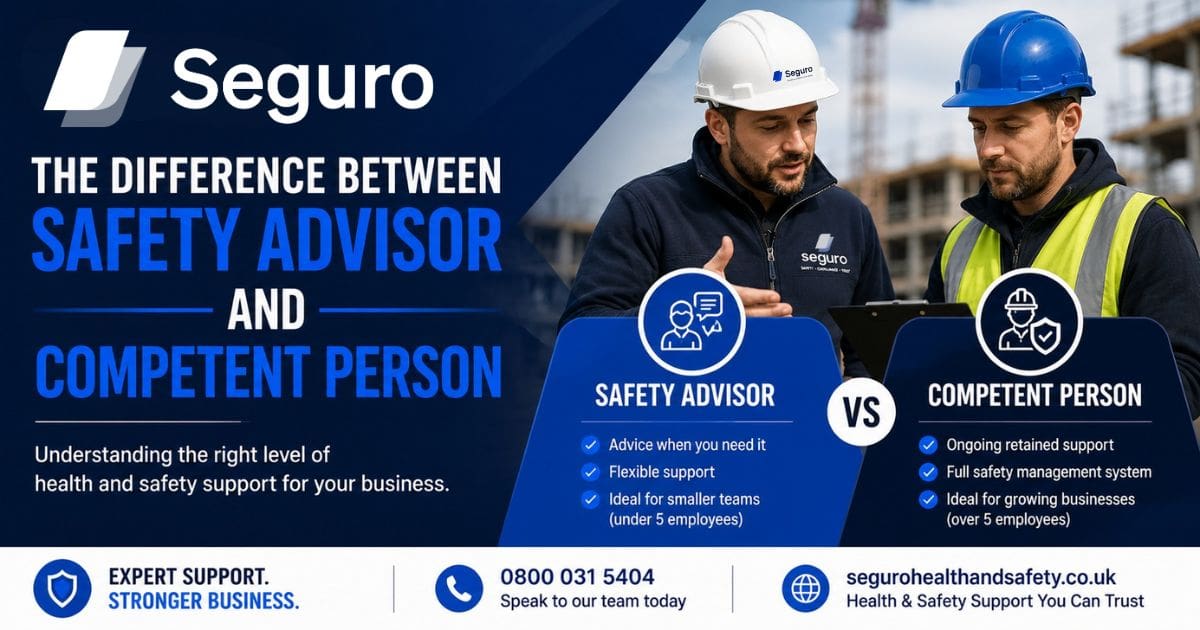
4 employees or less = Safety Advisor

Typically:

  • Flexible support
  • Lower-cost option
  • Suitable for smaller businesses
  • Advice when needed
  • Less ongoing involvement

More than 5 employees = Competent Person 

Typically:

  • Ongoing retained support
  • More comprehensive compliance management
  • Suitable for growing businesses
  • Full management systems
  • Regular involvement in company operations

Why This Matters

Clients, principal contractors, and accreditation schemes increasingly ask contractors to demonstrate they have competent health and safety support in place.

Even businesses with fewer than five employees may still need:

  • A formal Health & Safety Policy
  • Professional advice
  • Dedicated support arrangements, especially when working for larger contractors or public sector clients.

This is why there is no absolute “one size fits all” rule.

Some small businesses need only occasional support, while others require a more structured compliance system to meet client expectations.

Choosing the Right Support

The right level of support depends on:

  • Number of employees
  • Type of work carried out
  • Risk profile
  • Client requirements
  • Accreditation goals
  • Business growth plans

For many contractors, getting the right support early helps:

  • Improve compliance
  • Reduce stress
  • Strengthen accreditation applications
  • Improve organisation
  • Win more work

If you are unsure which level of support your business requires, professional advice can help clarify your legal duties and ensure your systems are appropriate for your business size and activities.

For guidance on your specific circumstances, Seguro Health & Safety can help review your requirements and recommend the most suitable level of support.

CALL Colin on 0800 031 5404 to ask a question

Colin is our safety consultant.

Book a CALL
shape Health & Safety Consultancy, Safety Advisor, Safety Consultant

Frequently Asked Questions

What is the difference between a Safety Advisor and a Competent Person?

A Safety Advisor usually provides health and safety advice and support when needed, often for smaller businesses. A Competent Person has a more formal role in helping the business manage health and safety duties and should have suitable health and safety knowledge, experience and qualifications such as NEBOSH or IOSH.” For more information, go to Construction Health and Safety Consultant: Complete Guide for UK Contractors

Do I legally need a Competent Person for health and safety?

Employers must have access to competent health and safety assistance. This may be provided by someone inside the business with suitable competence or by an external Safety Advisor or health and safety consultant.

Can a site manager be the Competent Person?

A site manager may be competent at running construction work, but this does not automatically mean they are competent in health and safety management. To act as the Competent Person, they should have suitable health and safety knowledge, experience and recognised qualifications.

What qualifications should a Safety Advisor have?

A professional Safety Advisor should normally hold recognised health and safety qualifications such as NEBOSH or IOSH. These qualifications help demonstrate competence in health and safety management and compliance support.

Do businesses with fewer than 5 employees need a Safety Advisor?

Businesses with fewer than 5 employees may still need health and safety advice, especially if clients request proof of competent support, RAMS, policies or accreditation evidence. A Safety Advisor service can provide flexible support when required.

What health and safety support is needed for businesses with more than 5 employees?

Businesses with more than 5 employees generally need more structured health and safety support, including a written Health and Safety Policy, risk assessments, ongoing competent advice and a suitable safety management system.

What does a Competent Person service include?

A Competent Person service may include ongoing retained support, a full health and safety management system, health and safety policy, staff handbook, risk assessment support, RAMS guidance, accident support, legal updates and liaison with the HSE if required.

What does a Safety Advisor service include?

A Safety Advisor service may include health and safety advice, a service agreement, certificate of support, consultant CV and qualifications, and assistance with documents such as risk assessments, RAMS and contractor compliance paperwork when needed.

Can a client ask for proof of competent health and safety support?

Yes. Clients, main contractors and accreditation schemes may ask for evidence that your business has access to competent health and safety support, even if you have fewer than 5 employees.

How do I know whether I need a Safety Advisor or a Competent Person?

The right support depends on the number of employees, the type of work, the risk level, the client requirements and accreditation goals. Smaller businesses may need flexible Safety Advisor support, while growing businesses or those with more than 5 employees may need ongoing Competent Person support.

Directors health and safety executive responsibilities

Insight by

Bob Evans

Bob Evans

Published on

28 March 2025

Competent person

Directors health and safety responsibilities

Health and safety executive responsibilities are very important to understand as soon as you become a director

As a company director, you are responsible for the health, safety, and welfare of your employees and yourself.

Your company health and safety policy will detail your responsibilities.

As a director, your first job should be to review your company’s health and safety policy document and ensure you are happy with it.

If your company does not have one, don’t worry; we have pre-written health and safety policy documents you can buy, or we can write a bespoke one for you.


Legislation that covers the responsibilities of a director

The Health and Safety at Work, etc Act 1974

If a health and safety offence is committed and the cause is the neglect of a director, the person and the organisation can be prosecuted.

Directors can appoint an independent third party to carry out their health and safety duties. The third-party must be fully qualified and competent to carry out the tasks. Delegating does not absolve the responsibility of a director; for example, if the safety advisor required employees to be trained and the director refused and an accident happened, then the director will held to account.

Read the health and safety at work act 1974 To ensure you understand your full health and safety executive responsibilities

The Management of Health and Safety at Work Regulations 1999

All work activities are to manage risk. Once the risk or risks have been identified, the organisation must make arrangements to reduce or mitigate the risks.

This work takes the form of RAMS (Risk and Method Statements). The risk assessment identifies risks and examines ways to reduce them.

The method statement describes how the work is to be carried out and ensures that all PPE and other means to reduce the safety risk are included.

Please visit our risk and method statement shop. We have over 150 RAMS, some of which include 18 pages and 9,000 words, that you can buy very reasonably. The documents are in Word format, so you can adjust them to suit your project.

Corporate Manslaughter and Corporate Homicide Act 2007

Corporate manslaughter and corporate homicide are when an employee is killed at work, and the HSE find the responsibility for the death is due to failure to carry out the work by all H&S laws.

It is very difficult to defend a death at work. The courts tend to side with the employee rather than the employer.

Learn more about the corporate manslaughter and corporate homicide act 2007

https://webarchive.nationalarchives.gov.uk/ukgwa/+/http:/www.justice.gov.uk/docs/manslaughterhomicideact07.pdf

Failing to fulfil director health and safety responsibilities

When a director breaches health and safety legislation and causes harm, the sentences can lead to prison and unlimited fines. Over the past few years, post-COVID, many companies have gone into administration or liquidation due to directors failing to carry out their lawful duties. The HSE is increasingly looking at individuals rather than just the company.

Competent safety advisor

One way to help yourself is to have your own health and safety advisor. You can delegate all health and safety responsibilities to this third-party person. Your safety advisor will educate you on what you need to do to keep your business safe.

If an accident does occur on-site, and the company has all health and safety requirements up to date, the safety advisor will deal with HSE for you.

A safety advisor can save you time and money for a basic monthly fee.

Request a chat and find out more about our safety advisor service

Remote Competent Safety Advisor Vs Onsite Visiting

Insight by

amanda

Amanda Lambert

Published on

5 July 2023

Competent person

Remote Competent Safety Advisor Vs Onsite Visiting

We often get asked the question about our Competent Safety Advisor Service to see what the benefits are compared to having someone employed onsite. The obvious one is cost, it is much more cost effective to have a remote competent person as a service, a service like ours starts from £50 per month compared to a full time salary.

Why use an outsourced service?

  • We supply a comprehensive Health and Safety Management System
  • We develop a bespoke company Health and Safety Policy for your business
  • We work with you to develop a company employee handbook
  • We develop an Environmental Policy specific to you
  • We provide assistance in Accident Reporting to Enforcing Authorities/Accident Investigation
  • We will liaison with Enforcing Authorities on your behalf

Ongoing support

  • Access to telephone advice on an unlimited number of occasions
  • Updates on any changes in Health and Safety legislation
  • Access to over 80 risk assessments and various supporting documentation held on our website
  • Yearly review of all documentation and revised documents issued
  • Monthly newsletters giving you latest Health & Safety News as well as legislation updates.

With over 200 clients we provide a comprehensive service that is affordable and reliable so SME’s can have peace of mind that they are compliant with their legal obligations.

There are no hidden fees and we pride ourselves with having an 95% retention record year on year. You can see testimonials on our website or on Trust pilot which is an independent review platform.

Competent Safety Advisor Support

Here at Seguro, we pride ourselves on being able to support all businesses regardless of their size. We can provide your business with less than five employees a service, ensuring you meet all your Health & Safety needs.

Our service provides you with:

  • Support to implement new documentation into your business
  • Provide support ongoing should you need it for all Health & Safety advice.
  • Provide off-the-shelf risk assessments and method statements should they be needed (bespoke ones are chargeable)
  • Enable you to name us should you need to on PQQ documentation
  • Provide you with General pre-prepared COSHH from our library

We are available throughout the working day by email or telephone, whichever way you prefer to communicate.

This service is available to anyone who needs it, and there is a fixed cost for everyone.

This service is also FREE with any accreditation we submit for you so if you are looking to get CHAS or a similar SSIP we can assist with that and provide this service for FREE.

If you need more information about SSIP, we have lots of blogs to help or you can visit SSIP directly.

Included in our competent safety advisor service

  • Put Seguro down as your named health & safety advisor.
  • Use our name when filling out pre-tender qualification questionnaires.
  • Use a CV from one of our Consultants.
  • We are here as back-up should you require advice and guidance on health & safety issues.

Competent Safety Advisor Support

Complete the form, and we will get in touch and give you free advice and direction on outsourcing your health and safety.

    Outsource Health and Safety

    Insight by

    amanda

    Amanda Lambert

    Published on

    19 April 2023

    Competent person

    Outsource Health and Safety

    Outsource health and safety and make your life a lot easier.

    The pros of outsourcing definitely outweigh the cons, but before you form a partnership with a Health & Safety consultant, you must learn all you can about outsourcing. Once you are fully informed, you can decide if outsourcing is right for your business and how it can help you.

    Following is a list of pros and cons of outsourcing:

    Pros of Outsourcing

    • Up-to-date professional advice when you need it
    • Gives you access to skilled professionals at a low cost
    • The confidence in knowing your legal duties are covered
    • Reduces your cost of doing business, as you save on infrastructure, workforce, hiring costs, training costs, and technology and software investments
    • Allows you to focus more on your core business functions

    Cons of Outsourcing

    • You will have to rely on the expertise of another company without fully understanding all the detail yourself
    • You need to ensure that your outsource partner is available for your working hours, not just theirs
    • You need to understand turn around times and accept them
    • You may not be able to get what you want when you want it
    • You have to trust the information they provide is accurate and up-to-date

    Outsourcing your Health & Safety resources can give your business the competitive edge it requires to win work and be successful on tenders.

    If anything, the disadvantages of outsourcing give you the opportunity to think before-hand about the things you need to keep in mind when selecting an outsourcing partner.

    Seguro Health and Safety Advisor Service

    Here at Seguro, we pride ourselves on being able to support all businesses regardless of their size. We can provide your business with less than five employees a service, ensuring you meet all your Health & Safety needs.

    Our service provides you with:

    • Support to implement new documentation into your business
    • Provide support ongoing should you need it for all Health & Safety advice.
    • Provide off-the-shelf risk assessments and method statements should they be needed (bespoke ones are chargeable)
    • Enable you to name us should you need to on PQQ documentation
    • Provide you with General pre-prepared COSHH from our library

    We are available throughout the working day by email or telephone, whichever way you prefer to communicate.

    This service is available to anyone who needs it, and there is a fixed cost for everyone.

    This service is also FREE with any accreditation we submit for you so if you are looking to get CHAS or a similar SSIP we can assist with that and provide this service for FREE.

    If you need more information about SSIP, we have lots of blogs to help or you can visit SSIP directly.

    Included in our safety advisor service

    • Put Seguro down as your named health & safety advisor.
    • Use our name when filling out pre-tender qualification questionnaires.
    • Use a CV from one of our Consultants.
    • We are here as back-up should you require advice and guidance on health & safety issues.

    Outsource Health and Safety Support

    Complete the form, and we will get in touch and give you free advice and direction on outsourcing your health and safety.

      How to make sure you are compliant in 2016

      Insight by

      amanda

      Amanda Lambert

      Published on

      22 December 2015

      Competent person

      How to make sure you are compliant in 2016 – Health & Safety Legislation

      Throughout the year the HSE release various updates to existing legislation in order to ensure that the legislation stay current and suitable for the changing workplaces we all work in.

      There are various ways for you find this information out:

      • Periodically visit the HSE website to see if there are any changes posted.
      • Search online to see if you can find anything.
      • Become a member of a professional body
      • Sign up to various magazines.
      • Outsource your Competent Safety Advisor resource.

      As part of our Competent Safety Advisor service we ensure that on a monthly basis you are provided with all changes should they affect you or not. That way you are fully informed and up to date on all changes and can make the business decision yourselves if you need to be aware.

      There are additional benefits to our service that can ensure that going into 2016 Health & Safety isnt something yo need to worry about you can concentrate on your business.

      • A comprehensive Health and Safety Management System – complete with policies, procedures, forms, checklists, etc to ensure compliance with legislation
      • Development of your company Health and Safety Policy
      • Development of a company employee handbook
      • Development of an Environmental Policy
      • Assistance in Accident Reporting to Enforcing Authorities/Accident Investigation
      • Liaison with Enforcing Authorities on your behalf
      • Access to telephone advice on an unlimited number of occasions
      • Updates on any changes in Health and Safety legislation

      Below is a copy of our latest legislation updates, if you think we may be able to help you on a monthly basis please get in touch.

      Legislation/Consultation In Force/
      Closes
      Need to Know Applies In Resource
      Construction (Design and Management) Regulations 2015 23rd Dec 15 Transitional period for projects started before April 2015 ends. Works with more than one contractor must have appointed a principal designer. GB hse.gov.uk
      Transportation of Directive 2013/35/EU on exposure to electromagnetic fields (EMFs) 3rd Dec 15 Proposed Control of Electromagnetic Fields at Work Regulations will require duty holders to assess exposure to EMFs GB hse.gov.uk
      Deregulation Act 2015 3rd Dec 15 Turban wearing Sikhs do not have to wear head protection in any industries. GB hse.gov.uk
      The Health and safety at Work ect. Act 1974 (General Duties of Self-Employed Persons ) (Prescribed Undertakings) Regulations 2015 Oct-15 Changes the law to exempt self-employed people whose work activity poses no potential risk to other workers or the public. GB hse.gov.uk
      Offshore Installations (Offshore Safety Directive) (Safety Case ect) Regulations 2015 Jul- 15 Applies to offshore oil and gas operators, interoperating additional requirements of directive 2013/30/EU GB External Waters hse.gov.uk
      Control of Major Accident Hazards Regulations (COMAH) 2015 Jun-15 Main Duties unchanged from 1999 regs; lower tier operators must provide public information about their site and its hazards for the first time; both upper tier and lower tier operators must provide public information electronically. GB hse.gov.uk
      Control of Asbestos Regulations 2012 May-15 Workers undertaking non-licensed work for the first time must have a medical examination before they start. England and Wales legislation.gov.uk
      Construction (Design and Management) regulations 2015 Apr-15 CDM coordinator replaced with principal designer, prescriptive requirements for duty holders to check contractors’ competence removed, CDM duties extended to domestic clients. GB hse.gov.uk
      Road Traffic Act 1988 Mar-15 Section 5 amended to include an offence of driving under the influence of a controlled drug – including some prescription medications. England and Wales lexisurl.com