



Health & Safety Requirements for Small Businesses with 4 employees or less
If you have 4 employees or less in the UK, your health and safety duties are simpler than those of larger businesses, but you still have legal responsibilities under the Health and Safety Executive and the Health and Safety at Work etc. Act.
You are not exempt from health and safety law just because the business is small.
If you have just started your business and have 4 employees or less, you do have Health & Safety legal responsibilities.
To help you comply with the law, we can offer you two options.
Safety Advisor service
You get
- Put Seguro down as your named health & safety advisor.
- Use our name when filling out pre-tender qualification questionnaires.
- Use a CV from one of our Consultants.
- We are here as a backup should you require advice and guidance on health & safety issues.
Investment £200 per year + VAT
Competent Safety Advisor Service
You get:
- All safety advisor services above
- A comprehensive Health and Safety Management System
- Your own bespoke company Health and Safety Policy for your business
- Company employee handbook
- Environmental Policy specific to you
- We provide support in Accident Reporting to Enforcing Authorities/Accident Investigation
- We will liaise with the Enforcing Authorities on your behalf
- Access to telephone advice on an unlimited number of occasions
- Updates on any changes in Health and Safety legislation
- Access to over 200 risk assessments and various supporting documentation held on our website
- Annual review of all documentation and revised documents issued
- Monthly newsletters giving you the latest Health & Safety News as well as legislation updates.
Investment £50 per month + VAT
Minimum Health & Safety Responsibilities
Even with 4 employees or less, you should still:
- Provide a safe place of work
- Control risks to employees and others affected by your work
- Provide suitable information, instruction, and supervision
- Ensure employees are competent for the work they carry out
- Maintain safe equipment and systems of work
- Have suitable welfare facilities
- Hold the correct insurance
- Report certain accidents/incidents (RIDDOR)
If you work in construction, you also need to comply with the Health and Safety Executive construction regulations, including CDM requirements.
Minimum Documents You Should Have
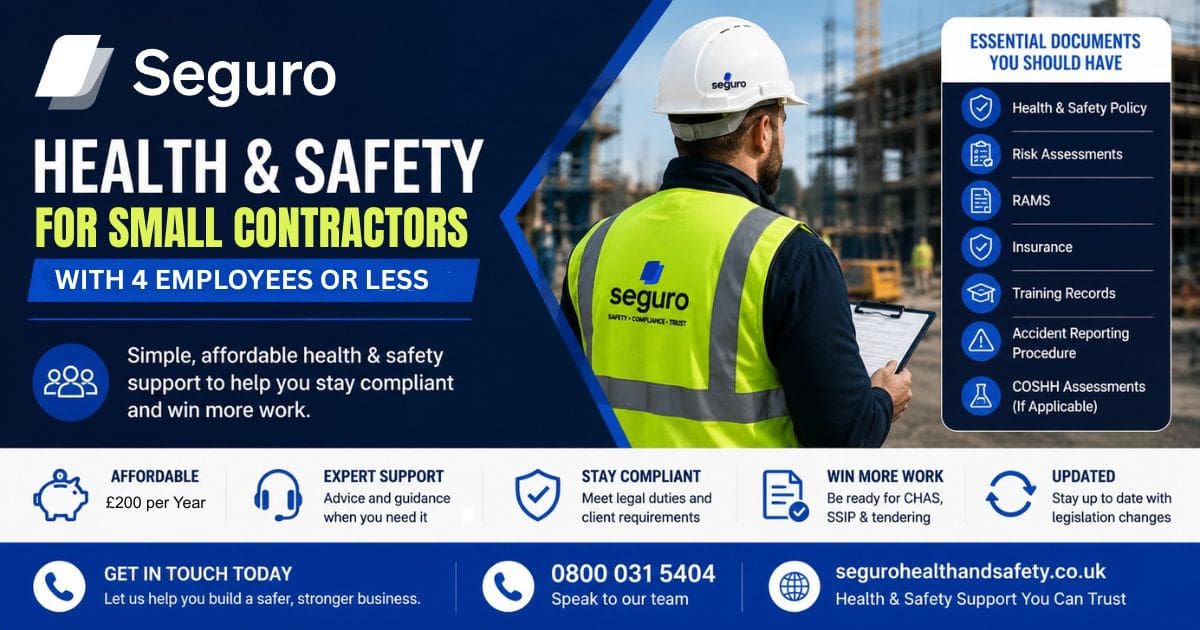
Although businesses with 4 employees or less are not legally required to have a written health and safety policy, most contractors, clients, insurers, and SSIP schemes still expect documentation.
Essential Documents for Health and Safety Requirements for Small Businesses
- Health & Safety Policy
Not legally required in writing for 4 employees or less, but strongly recommended.
Should include:
- Company responsibilities
- Employee responsibilities
- Arrangements for managing safety
- Risk Assessments
You must assess risks even if they are not formally written down by law.
Typical examples:
- Manual handling
- Working at height
- Electrical work
- Slips, trips, and falls
- Use of tools and equipment
- RAMS (Risk Assessments & Method Statements)
Usually required for construction work and contractor approval. Needed when:
- Working on commercial sites
- Working for principal contractors
- Carrying out higher-risk tasks
- Employer’s Liability Insurance
Legally required if you employ anyone.
Minimum cover:
- Usually £5 million
- Training Records
You should be able to demonstrate competence. Examples:
- CSCS cards
- IPAF
- PASMA
- Asbestos awareness
- Manual handling
- First aid
- Accident Reporting Procedure
Simple process explaining:
- How incidents are recorded
- Who reports them
- When RIDDOR applies
- COSHH Assessments (If Applicable)
Needed if using hazardous substances such as:
- Paints
- Solvents
- Adhesives
- Cleaning chemicals
- Silica-producing products
What Most Small Contractors Actually Need
For many UK subcontractors with 4 employees or less, the practical minimum is:
- Health & Safety Policy
- Basic Risk Assessments
- RAMS
- Insurance
- Training evidence
- Accident procedure
- COSHH assessments (if applicable)
This is normally enough to:
- Start working safely
- Pass site onboarding
- Apply for SSIP/CHAS
- Work for larger contractors
Common Mistakes Small Businesses Make
- Using generic downloaded templates
- Policies not signed or dated
- RAMS copied from another company
- Expired insurance
- No training evidence
- Missing COSHH assessments
- Assuming “small company” means exempt
When You Usually Need Extra Support
You may need a qualified safety advisor or competent person when:
- Applying for CHAS or other SSIP schemes
- Taking on employees
- Carrying out higher-risk construction work
- Working for councils or principal contractors
- Managing multiple sites
Small Businesses can often keep compliance simple, but the documents still need to demonstrate that risks are properly managed.
More support for Health and Safety Requirements for Small Businesses


Frequently Asked Questions
What health and safety requirements apply to businesses with fewer than 5 employees?
Businesses with fewer than 5 employees still have legal health and safety responsibilities. They must provide a safe place of work, control risks, provide information and supervision, ensure workers are competent, maintain safe equipment, hold suitable insurance and report certain incidents where required. For more information, go to Construction Health and Safety Consultant: Complete Guide for UK Contractors
Do I need a written health and safety policy if I have fewer than 5 employees?
Businesses with fewer than 5 employees are not usually legally required to have a written health and safety policy. However, most contractors, clients, insurers and SSIP schemes still expect one, so having a signed and dated policy is strongly recommended.
Do small businesses need risk assessments?
Yes. Small businesses must assess risks even if they are not legally required to record them in writing. For contractors, written risk assessments are strongly recommended because clients and principal contractors often request evidence that risks are being managed.
Do small contractors need RAMS?
Small contractors often need RAMS when working on commercial sites, working for principal contractors or carrying out higher-risk construction tasks. RAMS help show how the work will be carried out safely and how risks will be controlled.
What health and safety documents should a small contractor have?
A small contractor should usually have a health and safety policy, basic risk assessments, RAMS, insurance certificates, training evidence, an accident reporting procedure and COSHH assessments where hazardous substances are used.
Do I need Employer’s Liability Insurance if I employ someone?
Yes. If you employ anyone, Employer’s Liability Insurance is generally required. Contractors are also often asked to provide proof of insurance during client onboarding, site approval, CHAS applications or SSIP assessments.
What training records should small contractors keep?
Small contractors should keep evidence of worker competence such as CSCS cards, IPAF, PASMA, asbestos awareness, manual handling, first aid, toolbox talks and any task-specific training relevant to the work being carried out.
Do small contractors need COSHH assessments?
COSHH assessments are needed where hazardous substances are used or created. This can include paints, solvents, adhesives, cleaning chemicals, dusts, fumes and silica-producing materials.
Do small businesses need a Safety Advisor?
Small businesses may need a Safety Advisor when applying for CHAS or SSIP accreditation, taking on employees, working for principal contractors, carrying out higher-risk work or needing proof of competent health and safety support.
What is the difference between a Safety Advisor service and a Competent Safety Advisor service?
A Safety Advisor service usually provides flexible advice and support when needed. A Competent Safety Advisor service usually provides more comprehensive ongoing support, including a health and safety management system, company policy, employee handbook, environmental policy, accident reporting support, legal updates and regular document reviews.
Can a small contractor apply for CHAS or SSIP?
Yes. Small contractors can apply for CHAS or SSIP accreditation, but they will usually need suitable documents such as a health and safety policy, RAMS, risk assessments, insurance, training records and evidence of competent health and safety support.
What common health and safety mistakes do small contractors make?
Common mistakes include using generic downloaded templates, having unsigned or outdated policies, copying RAMS from another company, using expired insurance documents, failing to keep training evidence, missing COSHH assessments and assuming small businesses are exempt from health and safety law.