



Health & Safety Legislation You Can’t Ignore
For many contractors and small businesses, health & safety legislation only becomes a priority when something goes wrong.
- A failed CHAS application.
- A site audit issue.
- An accident at work.
- An HSE inspection.
- Or a client refusing access to the site because the correct documents are missing.
The problem is that many businesses do not fully understand their legal health and safety responsibilities until they face commercial or legal pressure.
The reality is simple: if you employ people, manage contractors, or carry out construction work, you have legal duties you cannot ignore.
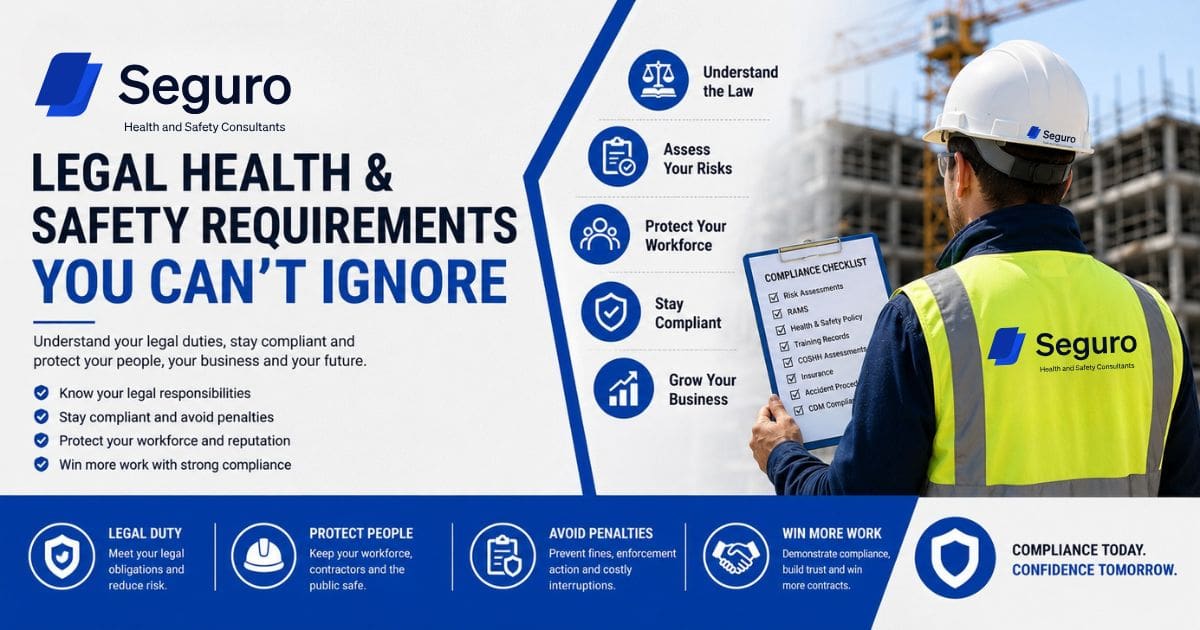
Understanding these responsibilities is not just about avoiding fines. Proper compliance helps protect your workforce, reduce risk, improve professionalism, and increase your ability to win contracts.
Why Health & Safety Law Matters
Health and safety laws exist to protect:
- Employees
- Contractors
- Visitors
- Members of the public
- Anyone affected by work activities
For construction businesses, the health & safety legislation expectations are even higher because construction remains one of the UK’s highest-risk industries.
Clients, principal contractors, local authorities, and accreditation schemes increasingly expect businesses to demonstrate strong compliance systems before work even begins.
The Main Health & Safety Laws Contractors Should Know
Health and Safety at Work Act 1974
This is the foundation of UK health and safety law. It places duties on employers to ensure, so far as reasonably practicable:
- Employee safety
- Safe systems of work
- Safe equipment
- Safe workplaces
- Adequate training and supervision
It also requires businesses to protect anyone affected by their activities, including subcontractors and members of the public.
Management of Health and Safety at Work Regulations
These regulations require businesses to properly manage health and safety risks.
Key duties include:
- Carrying out risk assessments
- Appointing competent health and safety assistance
- Providing training and information
- Establishing emergency procedures
- Reviewing safety arrangements regularly
This is where many businesses discover they need a Safety Consultant.
CDM Regulations (Construction Design and Management)
The CDM Regulations apply to construction work and place responsibilities on:
- Clients
- Principal Designers
- Principal Contractors
- Contractors
These regulations require construction work to be:
- Properly planned
- Properly managed
- Properly monitored
- Carried out safely
Contractors must:
- Have suitable skills and experience
- Produce construction phase documentation
- Coordinate safely with others
- Control site risks
Failure to comply with CDM requirements is a major issue during HSE inspections and contractor audits.
Risk Assessments Are a Health & Safety legislation Requirement
Employers must identify hazards and implement suitable control measures.
Risk assessments help businesses:
- Identify dangers
- Reduce accidents
- Demonstrate compliance
- Improve planning
- Protect workers
If your business has 5 or more employees, significant findings must be recorded in writing.
RAMS: Risk Assessments and Method Statements
In construction, RAMS are one of the most requested compliance documents.
Clients and principal contractors commonly ask contractors to provide RAMS before work begins. Good RAMS should:
- Reflect the actual work being carried out
- Identify site-specific risks
- Explain control measures clearly
- Be communicated to workers
One of the biggest compliance problems is contractors relying on generic copied templates that do not reflect real site conditions.
Do You Need a Health & Safety Policy?
Yes. If you employ 5 or more people, you must have a written health and safety policy.
The policy should explain:
- Your safety arrangements
- Responsibilities within the business
- How risks are managed
Even smaller businesses often require a policy because:
- CHAS applications request one
- Main contractors ask for one
- Public sector tenders expect one
Policies should normally be reviewed annually.
COSHH Assessments
COSHH stands for Control of Substances Hazardous to Health.
Many contractors underestimate how often COSHH applies. You may need COSHH assessments for:
- Dust
- Paints
- Adhesives
- Solvents
- Chemicals
- Cleaning products
- Sealants
- Fumes
COSHH assessments help businesses:
- Identify exposure risks
- Reduce worker health issues
- Demonstrate compliance
- Improve safe handling procedures
Training and Competence Requirements
Businesses must ensure workers are properly trained and competent for the tasks they carry out. This includes:
- Site inductions
- Tool and equipment training
- Manual handling
- Working at height
- Asbestos awareness
- Face fit testing
- Plant operation training
Many accreditation failures happen because businesses cannot provide evidence of workforce competence.
Accident Reporting and RIDDOR
Some workplace incidents must legally be reported under RIDDOR regulations.This can include:
- Serious injuries
- Dangerous occurrences
- Certain occupational illnesses
- Fatalities
Businesses should also have:
- Accident reporting procedures
- Investigation processes
- First aid arrangements
Poor accident management often becomes a major issue after incidents occur.
Employers’ Liability Insurance
Most businesses employing staff must have Employers’ Liability Insurance. Contractors commonly also require:
- Public Liability Insurance
- Professional Indemnity Insurance (in some sectors)
Insurance documents are one of the most commonly requested items during:
- CHAS applications
- Site onboarding
- Tender submissions
Expired or incorrect insurance details are one of the biggest reasons contractors fail compliance checks.
Why Contractors Fail Compliance Checks
Most businesses do not fail because they are unsafe.
They fail because they cannot properly demonstrate compliance. Common problems include:
- Missing documents
- Poor RAMS
- Expired policies
- Outdated insurance
- Missing training records
- Weak COSHH assessments
- No competent safety advisor
- Lack of worker communication evidence
These issues frequently lead to:
- Failed accreditations
- Lost contracts
- Delayed site access
- Increased commercial risk
What Happens If You Ignore Legal Health & Safety Requirements?
Ignoring compliance responsibilities can have serious consequences.
Potential risks include:
HSE Enforcement: Improvement notices, prohibition notices, and prosecutions can be issued where serious failings occur.
Fines and Legal Costs: Health and safety breaches can result in significant financial penalties.
Lost Contracts: Many principal contractors will not work with non-compliant businesses.
Failed CHAS or SSIP Applications: Missing evidence is a major reason applications fail.
Increased Accident Risk: Poor systems increase the likelihood of incidents and injuries.
Reputational Damage: Poor compliance records can damage long-term business growth.
Why Compliance Helps Businesses Grow
Good health and safety management is no longer just about avoiding problems.
It is increasingly part of winning work. Strong compliance systems help businesses:
- Pass pre-qualification checks
- Achieve CHAS or SSIP accreditation
- Improve tender success
- Gain access to larger projects
- Build client confidence
- Reduce operational disruption
For many contractors, health and safety has become a commercial advantage as well as a legal requirement.
Do Small Contractors Need Professional Support?
Many small contractors attempt to manage compliance themselves.
However, growing compliance demands often make this difficult. Professional support can help businesses:
- Stay legally compliant
- Keep documents updated
- Produce suitable RAMS
- Pass accreditations
- Respond to client requests quickly
- Reduce management pressure
This is why many SMEs use outsourced Safety Advisor services or choose to have the more comprehensive retained Safety Consultant service that 5 or more employee businesses must have in place.
Final Thoughts
Legal health and safety requirements are not optional.
Whether you are a subcontractor, principal contractor, facilities management company, or growing construction business, compliance responsibilities continue to increase.
The businesses that succeed long term are usually those that:
- Take compliance seriously
- Build proper systems
- Keep documents updated
- Demonstrate competence
- Proactively manage risk
Health and safety is no longer simply about avoiding enforcement.
It is now closely linked to professionalism, reputation, and business growth.
Looking for more advice, give us a call on 0800 031 4504


Frequently Asked Questions
What legal health and safety requirements must contractors follow?
Contractors must manage health and safety risks, carry out risk assessments, provide safe systems of work, train and supervise workers, comply with CDM Regulations where applicable, maintain suitable insurance, and appoint competent health and safety assistance. For more information, go to Construction Health and Safety Consultant: Complete Guide for UK Contractors
Do I legally need a written health and safety policy?
Yes. If your business has 5 or more employees, you must have a written health and safety policy. The policy should explain responsibilities, arrangements and how health and safety is managed within the business.
Are risk assessments a legal requirement?
Yes. Employers must identify workplace hazards, assess risks and put suitable control measures in place. If the business has 5 or more employees, significant findings must be recorded in writing.
Do contractors need RAMS?
Many contractors need RAMS before starting work, especially in construction. RAMS show how risks will be controlled and how the work will be carried out safely. Clients and principal contractors often request RAMS during site onboarding.
What are the CDM Regulations?
CDM stands for Construction Design and Management Regulations. These regulations apply to construction work and require projects to be properly planned, managed and monitored so that work is carried out safely.
Do I need a competent person for health and safety?
Yes. Employers must have access to competent health and safety assistance. This can be someone inside the business with suitable knowledge and experience, or an outsourced health and safety consultant.
When do I need COSHH assessments?
You need COSHH assessments when your business uses or creates substances that could be hazardous to health. This may include dust, fumes, paints, adhesives, solvents, chemicals, cleaning products and other harmful substances.
What health and safety documents do contractors usually need?
Contractors commonly need a health and safety policy, risk assessments, method statements, COSHH assessments, training records, insurance certificates, accident procedures, toolbox talk records and evidence of competent health and safety advice.
What happens if you ignore health and safety requirements?
Ignoring health and safety requirements can lead to accidents, HSE enforcement, fines, prosecution, failed CHAS or SSIP applications, delayed site access, lost contracts and damage to your business reputation.
Can poor health and safety compliance affect winning contracts?
Yes. Many clients, principal contractors and public sector organisations require evidence of strong health and safety compliance before allowing contractors onto site or awarding work.