Close Navigation

Search

CHAS accreditation requirements

CHAS accreditation requirements

CHAS accreditation requirements – CHAS has several requirements that must be met during the application process. We outline the basic requirements for CHAS standards, Advanced, and Elite CHAS accreditations.

Here are the minimum requirements for a CHAS application.

You will need:

• A signed, up-to-date Health and Safety Policy.
• RAMS — Risk Assessments and Method Statements — relevant to your trade.
• Training records for your workforce.
• Valid insurance documents.
• A first aid and accident reporting procedure.
• COSHH assessments, if you use hazardous substances.
• Evidence of supervision and competence across your organisation.

For CHAS Advanced or CHAS Elite, additional requirements apply.

These include:

• An Environmental Policy.
• A Quality Management System.
• Equality, Anti-Bribery, and Modern Slavery policies.
• Suitable financial standing checks.

If you’re considering CHAS, we can help.

  • We provide a fast turnaround, with documents completed in just five working days.
  • We offer a fixed fee, with no hidden charges.
  • And our team is responsive, friendly, and highly efficient.
Get CHAS Accredited - Start Today

Is CHAS accreditation worth it?

Is CHAS accreditation worth it?

The benefits of CHAS is worth the investment, especially if: You are a small/medium businesses aiming to grow or work with larger clients.

  • You have been told to get CHAS accredited by your client.
  • You want to work for local authorities, large blue- chip companies and principal contractors.
  • You want to save time and reduce admin burden by streamlining pre-qualifications when tendering
  • You don’t already have a strong health & safety compliance system
  • You want to present a professional, safety-first image to clients.

If you are looking for the above, then yes CHAS accreditation is a wise investment.

Here’s a balanced breakdown of the value and considerations

Why CHAS Accreditation Is Valuable

1. It Shows Robust Health & Safety Compliance

CHAS is a recognised third-party assessment that verifies your health & safety management system meets current legislation and SSIP criteria. That gives you credible proof of compliance rather than just internal paperwork.

2. Improved Tendering and Contract Access

Many clients — especially in construction and public sector procurement — require CHAS (or equivalent SSIP) accreditation before inviting bids. Some councils and major contractors automatically reject bids from non-accredited firms.

3. Saves Time on Pre-Qualification

Once you’re CHAS-accredited, your health & safety compliance is pre-qualified — meaning fewer repeated forms and PQQ questions for each tender. This streamlines procurement admin.

4. Reputation & Trust

It’s a widely recognised badge of competence. Clients see it as a signal that you take safety seriously, which helps differentiate you from competitors. Beacon Risk

5. Other Member Benefits

CHAS membership often includes extras like legal helplines, discounts on training and services, and business resources — which can add indirect value.

Considerations & Drawbacks

1. Cost Can Be Significant

Accreditation fees vary by company size and level (Standard/Advanced/Elite), and they’re annual — not one-offs. For smaller businesses, lower-cost SSIP options may be more cost-effective.

2. Time & Documentation Burden

Preparing policies, risk assessments, method statements, insurance docs, training records, etc., takes effort — and many first-time applicants struggle to get it right without support.

3. Other SSIP Members Can Do the Same Job

CHAS is a member of SSIP alongside other schemes. Technically, any SSIP member accreditation should meet the same basic compliance standard, although some clients specifically ask for CHAS.

Practical Tips for Deciding if It’s Worth It

✔️ It’s likely worth it if:

  • Your target clients or frameworks explicitly require or favour CHAS.

  • You’re tendering regularly and want to cut down repeated PQQ work.

  • You want a strong industry-recognised compliance badge.

❓ Think twice if:

  • You rarely tender or clients don’t mandate CHAS.

  • Cost is a tight constraint and you could use a more affordable SSIP route.

  • You already hold a recognised SSIP accreditation that clients accept.

Bottom Line

CHAS accreditation is generally worth it for UK contractors and consultants — especially in construction and procurement-driven sectors — because it can unlock opportunities, save time, and improve credibility. However, it does come with costs and admin effort, and alternative SSIP accreditations may sometimes be a better value depending on your clients and business size.

Get CHAS Accredited Today

PUWER regulations – Provision and Use of Work Equipment Regulations 1998

Insight by

Bob Evans

Bob Evans

Published on

14 April 2025

Health and safety management

Introduction to PUWER regulations

The PUWER regulations were developed to ensure that any equipment, plant and machinery in the workplace environment are safe, and pose no significant, risk to the health & safety of employees, employers.

PUWER regulations place responsibilities on people, companies and organisations who own, operate, or control plant and equipment in the work environment.

Legal duties

  • Lifting Operations and Lifting Equipment Regulations 1998
  • Management of Health and Safety at Work Regulations 1999 (MHSW)
  • Provision and Use of Work Equipment Regulations 1998 (PUWER).
  • Section 6 of the Health and Safety at Work etc. Act 1974
  • Supply of Machinery (Safety) Regulations 2008.

Work Equipment

Work equipment can cover almost any equipment a worker uses, including circular saws and drilling machines, hand tools such as screwdrivers and knives, lifting equipment like lifting slings, and other equipment such as ladders and water pressure cleaners. Office equipment is also included in the definition.

The safe operation of plant and machinery requires competence, a combination of training, skills, and experience.

Recommendations for employers

Ensure:

  • All work equipment is suitable for the task. Consider job, location, conditions of use, etc.
  • Clear instructions are available, preferably in writing.
  • Work equipment is maintained in efficient working order and good repair by competent staff or contractors.
  • Work equipment is stable and adequately lit.
  • Equipment can be isolated from its power source.
  • Effective liaison with other owners of equipment.
  • Records of maintenance are kept.
  • Mobile equipment is provided with roll-over protection, as required.

Provide:

  • Information, instruction, and training for employees and managers on the safe use and maintenance of equipment and who is authorised to use it.
  • A planned preventative maintenance programme.
  • Suitable guarding to prevent access to dangerous parts or to stop hazardous parts before a person can reach them.
  • Relevant markings and warnings.
  • Safe systems of work and isolation procedures, particularly for maintenance activities.
  • Visible and identifiable control devices that are safe and easily accessible.
  • A written agreement or internal procedures for the maintenance of hired equipment.

Guidelines to employers

Ensure that the work equipment you provide meets the requirements of (PUWER) and is:

  • Suitable for use and for the purpose and conditions it uses.
  • Maintained in a safe condition.
  • Inspected regularly by a competent person and records are kept.
  • CE or UKCA marked by the supplier.

Eliminate risks where possible using risk assessment and method statements or, if not possible, control them by:

  • Taking appropriate ‘hardware’ measures, e.g. providing suitable guards, protection devices, markings and warning devices, system control devices (such as emergency stop buttons) and personal protective equipment.
  • Taking appropriate ‘software’ measures such as following safe systems of work (e.g. ensuring maintenance is only performed when equipment is shut down, etc.) and providing adequate information, instruction and training.

Train, instruct and inform for each piece of equipment.

Where mobile work equipment is used for carrying people, check it is suitable for this purpose. Measures should be taken to reduce operation risks (e.g., rolling over)

Case law

A maintenance engineer slipped and caught his hand in machinery whilst attempting to steady himself. He put his hand on the rack and pinion gearing of a machine, and the pinion rolled over it. His right index finger had to be amputated. The company was fined £40,000 plus £13,000 costs for contravening PUWER relating to the dangerous parts of machinery and Regulation 3(1)(a) of MHSW for not having adequate risk assessments in place.

Manufacturing company Hanson Packed Products Ltd was prosecuted after a 26-year-old worker was fatally crushed when his arm was caught in a powered roller. There should have been fixed guards around the roller, but they were missing. The company was fined £750,000 and ordered to pay costs of £29,511.

Questions & Answers

Can anyone do a PUWER assessment?

Anyone who has the knowledge and expertise to carry out the PUWER inspection correctly and at the right time is considered a competent person. This usually is someone who has received PUWER training.

Do employees have no specific duties under PUWER?

If you are an employee you do not have any specific duties under PUWER, but you do have general legal duties to take reasonable care of yourself and others who could be affected by your actions, and to co-operate with your employer so that your employer can comply with their health and safety duties and requirements

Who carries out PUWER inspections?

This usually is someone who has received PUWER training.

How often should PUWER checks be done?

When recommended by the manufacturer, inspections may be carried out weekly. It may be deemed that monthly inspections would be sufficient. Performing PUWER inspections outside of the recommended timescales could lead to equipment failing unexpectedly and a waste of valuable resources.

Directors health and safety executive responsibilities

Insight by

Bob Evans

Bob Evans

Published on

28 March 2025

Competent person

Directors health and safety responsibilities

Health and safety executive responsibilities are very important to understand as soon as you become a director

As a company director, you are responsible for the health, safety, and welfare of your employees and yourself.

Your company health and safety policy will detail your responsibilities.

As a director, your first job should be to review your company’s health and safety policy document and ensure you are happy with it.

If your company does not have one, don’t worry; we have pre-written health and safety policy documents you can buy, or we can write a bespoke one for you.


Legislation that covers the responsibilities of a director

The Health and Safety at Work, etc Act 1974

If a health and safety offence is committed and the cause is the neglect of a director, the person and the organisation can be prosecuted.

Directors can appoint an independent third party to carry out their health and safety duties. The third-party must be fully qualified and competent to carry out the tasks. Delegating does not absolve the responsibility of a director; for example, if the safety advisor required employees to be trained and the director refused and an accident happened, then the director will held to account.

Read the health and safety at work act 1974 To ensure you understand your full health and safety executive responsibilities

The Management of Health and Safety at Work Regulations 1999

All work activities are to manage risk. Once the risk or risks have been identified, the organisation must make arrangements to reduce or mitigate the risks.

This work takes the form of RAMS (Risk and Method Statements). The risk assessment identifies risks and examines ways to reduce them.

The method statement describes how the work is to be carried out and ensures that all PPE and other means to reduce the safety risk are included.

Please visit our risk and method statement shop. We have over 150 RAMS, some of which include 18 pages and 9,000 words, that you can buy very reasonably. The documents are in Word format, so you can adjust them to suit your project.

Corporate Manslaughter and Corporate Homicide Act 2007

Corporate manslaughter and corporate homicide are when an employee is killed at work, and the HSE find the responsibility for the death is due to failure to carry out the work by all H&S laws.

It is very difficult to defend a death at work. The courts tend to side with the employee rather than the employer.

Learn more about the corporate manslaughter and corporate homicide act 2007

https://webarchive.nationalarchives.gov.uk/ukgwa/+/http:/www.justice.gov.uk/docs/manslaughterhomicideact07.pdf

Failing to fulfil director health and safety responsibilities

When a director breaches health and safety legislation and causes harm, the sentences can lead to prison and unlimited fines. Over the past few years, post-COVID, many companies have gone into administration or liquidation due to directors failing to carry out their lawful duties. The HSE is increasingly looking at individuals rather than just the company.

Competent safety advisor

One way to help yourself is to have your own health and safety advisor. You can delegate all health and safety responsibilities to this third-party person. Your safety advisor will educate you on what you need to do to keep your business safe.

If an accident does occur on-site, and the company has all health and safety requirements up to date, the safety advisor will deal with HSE for you.

A safety advisor can save you time and money for a basic monthly fee.

Request a chat and find out more about our safety advisor service

Try Our Online Training for FREE

Insight by

Bob Evans

Bob Evans

Published on

14 December 2024

Health and safety blog

Introduction

Our fully approved, health and safety online training courses are perfect for gaining qualifications for you and your employees. We can deliver all the training you need for an SSIP assessment and all essential health and safety awareness.

Our engaging courses can be taken at any time, in any place and on any device. All courses are approved and priced to offer the best possible value to your business.

FREE Trial

You can sign up here for a free trial of our health and safety online training courses.

A trial account gives you free access to the first module of all our available courses.

Any progress you make will be saved, so if you decide to buy, you can continue from where you left off.

So complete the form on this page to get instant access, and let’s get started.

Start your FREE trial

Available health and safety online training courses

You can also select a course you are interested in and click on the FREE trial button on the course. Select any courses from the list below:

The courses available are:

Need support

Once you have seen what we offer, don’t hesitate to get in touch, and we will be happy to set you up with your health and safety online training solution.

If you get stuck or need some help feel free to get in touch.

Testimonial

Hyperion

I just wanted to send you a quick email about the amazing staff you have on your team.

Natasha has been dealing with Hyperion for a couple of years now, and we have received nothing but exceptional service from this young lady. I get the quickest responses, with as much help as possible provided every single time. She has gone above and beyond for myself and Mark every time I have spoken to her.

I thought I would just share this with you as I feel her remarkable customer service and attitude towards the job should most definitely be recognised, and she’s an absolute credit to yourself and the rest of the team.

Thanks to all at Seguro

Kind Regards

Saskia

CHAS support

Insight by

Bob Evans

Bob Evans

Published on

27 June 2024

CHAS

CHAS Support

A CHAS application can be daunting if you are not a health and safety advisor or have had no formal training in health and safety such as NEBOSH or similar.

What Is CHAS?

CHAS stands for (the Contractors Health and Safety Assessment Scheme) and is underneath the umbrella of SSIP.

The CHAS assessment criteria are the same as those of all SSIP suppliers. SSIP (Safety Schemes in Procurement) is an umbrella organisation formed in 2009 to reduce the duplication of health and safety assessments.

Many companies and government bodies require an SSIP accreditation before they allow you to tender.

The CHAS assessment standards and requirements are listed below.

  • Policy
  • Arrangements
  • Occupational Health
  • Behavioural Management
  • Enforcement Actions
  • Accident Reporting and Investigation
  • Fleet Operations / Management Scheme
  • Competent Advice – Corporate and Construction
  • Drug and Alcohol Policy
  • Training and Information
  • Individual Qualifications and Experience
  • Monitoring, Audit and Review
  • Risk Assessment Leading to a Safe System of Work
  • Workforce Involvement
  • Co-operation and Co-ordination
  • Welfare Provision
  • Subcontractors and Sub-consultants
  • Contractor
  • Principal Contractor
  • Designer

Our CHAS application process

Step 1. Register for an account with CHAS and choose the membership level you require.

Step 2. Purchase the associated Support Package via our website or by calling us.

Step 3. We will contact you to request specific documentation. The information we require varies depending on the type of CHAS application selected.

Step 4. We review your documents and implement anything missing, then upload all evidence to your CHAS portal and submit for assessment.

Step 5. You will receive your CHAS-compliant certificate and enjoy all the benefits of demonstrating compliance.

WHY select Seguro to support you with your CHAS application

We have over 20 years of industry experience and complete over 500 applications yearly.

As part of our hassle-free and in-depth service, we’ll complete the CHAS registration form on your behalf and prepare supporting documents as and when necessary.

CHAS registration requires you to have a recognised health and safety management standard and covers compliance issues regarding your field of work.

Once we have received the information we require from you, we aim to have your CHAS application submitted for assessment within five business days, although this is often even sooner.

Our fees are the most cost-effective available. We will do the work while you get on with your job, saving you time and money.

We will assign you a dedicated health and safety professional offering CHAS support throughout the process. We can implement policies, arrangements and procedures, assist with assessments like RAMS and provide training to your workforce. When we have completed the application, you will have everything you need to pass the CHAS accreditation.

Testimonials

Spinney Electrical

I would just like to thank you for all your help patients & time.

Finally!! Feeling relieved.

Vicky

13th February 2023


City Dispense

We’ve passed again, thank you for your help

Regards

Andy  | Director

9th February 2023


Hyperion

I just wanted to send you a quick email about the amazing staff you have on your team.

Natasha has been dealing with Hyperion for a couple of years now, and we have received nothing but exceptional service from this young lady. I get the quickest responses, with as much help as possible provided every single time. She has gone above and beyond for myself and Mark every time I have spoken to her.

I thought I would just share this with you as I feel her remarkable customer service and attitude towards the job should most definitely be recognised, and she’s an absolute credit to yourself and the rest of the team.

Thanks to all at Seguro

Kind Regards

Saskia

26th February 2020

Learn more about CHAS

We have a series of articles where you can learn more about CHAS. The list of articles is below:

Get CHAS Support

Complete the form, and we will tell you how it works and how much the whole process costs, including the CHAS fee for your circumstances.

    Toolbox talk alcohol and drugs

    Insight by

    Bob Evans

    Bob Evans

    Published on

    14 February 2024

    Health and safety training

    Toolbox talk alcohol and drugs

    This toolbox talk alcohol and drugs cover the effects of alcohol and drugs on your safety and others at work.


    Alcohol

    1. In a high-risk industry like ours, alcohol and work are not compatible.
    2. Alcohol is a depressant drug, which depresses parts of the brain function. When working on-site, you require all of your brain functions to save you from injury.
    3. If you’re found to be intoxicated with alcohol, you won’t be allowed on site. You may end up losing your job.
    4. Don’t get drunk the night before and expect to work safely on site the next day. Alcohol takes time to work out of your system (1 pint of beer takes approximately 2 hours).
    5. 50% of all drivers killed are over the legal limit.
    6. If you drink, don’t drive.
    7.  Some workplace fatal accidents are alcohol-related.
    8. Keep your head clear – leave your drinking sessions to social events, where you can’t cause injury to yourself or others.
    9. Get a bad reputation for drinking, and you may not get another job as you’ll be seen as a liability.

    Drugs

    1. You are far more likely to have an accident on site when you are under the influence of drugs.
    2. Drugs prescribed by your doctor could make you unfit for work, as can illegal drugs.
    3. You may feel you don’t have a drug problem – it’s got nothing to do with you.  But if you get hurt, it’s a bit late to wonder what the other person was on.
    4. If you know somebody is on drugs, tell your supervisor – help to stamp it out.
    5. Signs to look for, watery eyes, pinpoint or dilated pupils, running nose, constant sniffing, tight lips, sores, ulcers, trembling, fatigue and irritability. If you see it, report it.
    6. All drugs can affect your ability to work safely.
    7. Some effects of drugs: slow reaction times, clumsiness, poor decision-making and distorted vision.
    8. Don’t take ‘E’s – ‘E’ stands for ‘Ex-employee’.
    9.  If you get offered drugs, say no, you’d rather work safely!
    10. Drugs and work don’t mix.  Don’t let it become a problem.

    Note to supervisor:  Now inform your workforce of the company policy regarding alcohol and drug abuse.

    Do you have any questions for me?

    More toolbox talks

    Download 70 toolbox talks FREE

    What are toolbox talks

    Toolbox talk alcohol and drugs

    Acclaim Accreditation

    Insight by

    Bob Evans

    Bob Evans

    Published on

    13 July 2021

    CHAS

    Acclaim Accreditation

    What is a Acclaim Accreditation

    Acclaim was created in 2012 and is a member of SSIP (Safety Schemes in Procurement)

    SSIP is an umbrella organisation formed in 2009 to reduce the duplication of health and safety assessments.

    Acclaim is the accreditation arm of Constructionline. When you join Constructionline, you will be directed to Acclaim to complete the Health and safety accreditation process to obtain the SSIP certificate.

    Do I have to apply for an Acclaim at the same time as I do for a construction line?

    Yes. Acclaim has been included within all paid Constructionline memberships and is no longer offered as a standalone product.

    Constructionline Bronze, Silver, Gold, and Platinum memberships include Acclaim but also offer a ‘Deem to Satisfy’ certificate for those who hold a valid SSIP with an alternative provider.

    What will an Acclaim accreditation cover?

    All assessments are completed using the SSIP Core Criteria as the threshold standard and cover the following:

    • Health & Safety policy
    • Competent Advice
    • Training arrangements
    • Monitoring, audit and review
    • Workforce involvement
    • Accident reporting and enforcement action
    • Subcontracting/consulting
    • Risk Assessments and Safe Systems of Work
    • Cooperations with others
    • Welfare provision
    • Hazard elimination

    How much does an assessment cost?

    Fees charged by our members vary and take into account other membership fees. It is essential to recognise that all assessments are equal and all are carried out against the same standard.

    If you are not sure feel free to call us for support.

    How long will it take to get a certificate?

    This varies from scheme to scheme and is dependent on you providing everything needed for the assessment. Typically, schemes will try to complete their initial assessment within ten working days.

    Who is Seguro and how can you help me?

    Seguro is a health and safety company that specialises in SSIP accreditation. We completed over 500 applications per year. Our success rate is 100%.

    We are here to support you through the acclaim accreditation process; we can prepare all the documents, complete the registration forms, and simplify the process. CHAS is expensive, but other providers are very economical. The best thing to do is chat with us and learn more; we can tell you about the costs and the time frame. Our number is 0800 031 5404, or you can request a quote.


    Domestic Construction Phase Plan CDM

    Insight by

    Bob Evans

    Bob Evans

    Published on

    19 January 2016

    Construction phase plan

    Domestic Construction Phase Plan CDM

    In this article we will explain the domestic construction phase plan CDM. Does your project require a CDM plan?

    Domestic projects involving only you as a contractor

    On these projects, the client duties are transferred to you, who must carry out the client’s duties as well as your own. In practice, this will involve you doing no more than they have done in the past to comply with health and safety legislation. Compliance with your own duties as a contractor will be taken as compliance with the relevant client duties to the extent necessary given the risks involved in the project. As a result of you taking on the client duties, any designers involved in the project will work with you in their role as the ‘client’.

    Domestic projects involving more than one contractor

    For projects involving more than one contractor the Principal Contractor will normally assume the Client duties. The domestic Client can choose to appoint the Principal Designer for the project. If, however, they do not make this appointment, the first Designer appointed during the preconstruction phase is the Principal Designer for the project. If so, the Principal Designer will be answerable to the Principal Contractor in their role as ‘Client’ for the project and will be responsible for liaising with them.

    CDM rules

    CDM applies to all construction projects, including domestic projects, regardless of size or duration. Domestic DIY projects are exempt from CDM, but significant work may require building control approval. Even if a project is not notifiable (see below), CDM still applies. 

    HSE Notifiable Projects

    If the project takes more than 30 days to complete and/or involves more than 20 people, the project then needs to conform to CDM regulations and is a notifiable project. You don’t need to notify HSE for non-notifiable projects, but CDM rules still apply.

    Buy a construction phase CDM template

    Key CDM Requirements

    • Construction phase plan: A written document describing how the health, safety and welfare will be managed throughout the project.
    • Competent people: Ensure that all those involved in the project, including the client, designers, and contractors, are competent. 
    • Risk management: Encourage clear and effective communication and cooperation among all parties involved. 
    • Communication: Encourage clear and effective communication and cooperation among all parties involved. 
    • Health and Safety file: Keep a record of health and safety information for the project, to be maintained throughout the project lifecycle. 
    • Domestic clients: For domestic clients, the client’s duties normally pass to the contractor if it is a single-contractor project or to the principal contractor for projects with more than one contractor. 
    • Welfare facilities: Ensure adequate welfare facilities are provided, such as toilet and washing facilities, a place for preparing and consuming refreshments, and somewhere for storing and drying clothing and personal protective equipment. 
    • Site inductions: Provide site inductions to keep people aware of any site danger.
    • Prevent unauthorised access: Take reasonable steps to prevent unauthorised access to the construction site. 
    • Worker consultation: Consult and engage workers in securing their health and safety.


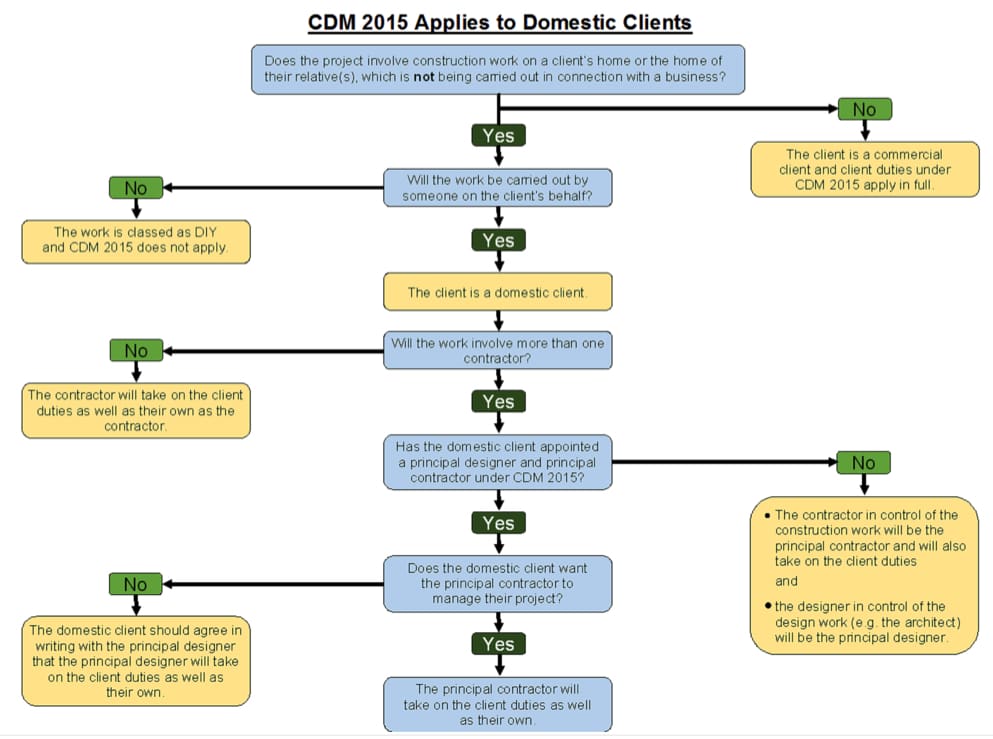
    Refer to the following flow diagram for further details of CDM domestic projects.

    CDM 2015 Applies to Domestic Clients

    image source

    Domestic Construction Phase Plan

    Buy a completed construction phase CDM plan

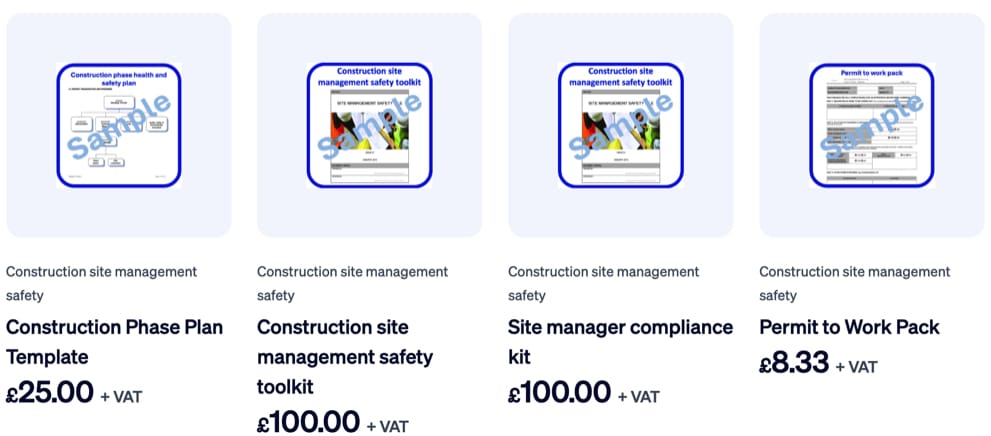
    You can buy a completed construction phase CDM plan that is full editable, together with other site management documents, systems and tool.

    Click on the link or image to buy.

    Construction management products