No spam. Just the latest market insights by Seguro in your inbox each week.
If you’re a contractor, you may have been asked to provide an SSIP certificate to demonstrate your health and safety competence. But if you already hold an accreditation, do you need to complete another assessment?
This is where Deem to Satisfy can help.
What Is Deem to Satisfy?
Deem to Satisfy (DTS) is a process within the Safety Schemes in Procurement (SSIP) framework that allows an existing, recognised health and safety assessment to be considered by another participating scheme.
Rather than repeating an equivalent assessment, contractors may be able to use their existing SSIP accreditation to meet the relevant requirements.
This can reduce duplicated paperwork, save time and simplify health and safety compliance.
How Does SSIP Deem to Satisfy Work?
SSIP member schemes assess businesses against common core health and safety requirements, including:
Health and safety policies and procedures
Risk assessments and safe working practices
Employee training and competence
Workplace risk management
Because participating schemes share core assessment standards, an existing accreditation may be recognised by another scheme.
However, Deem to Satisfy does not guarantee automatic approval. Your existing certificate must be valid and meet the receiving scheme’s requirements. Additional client or project specific conditions may still apply.
Deem to Satisfy can help contractors:
Save time by reducing duplicate assessments.
Reduce administration by avoiding unnecessary paperwork.
Support tender applications by demonstrating assessed health and safety competence.
Simplify compliance when working with clients who recognise their existing accreditation.
Before applying for another SSIP certificate, check whether your current accreditation meets your client’s requirements.
An appropriate SSIP accreditation can help demonstrate your business’s health and safety arrangements when working with clients and principal contractors.
If you’re unsure which accreditation you need, or whether your existing assessment may be recognised through Deem to Satisfy, it’s worth checking your options before starting another assessment.
Need help with SSIP accreditation?
What does Deem to Satisfy mean in SSIP?
It means an existing, recognised health and safety assessment may be accepted by another participating scheme against equivalent requirements.
Does Deem to Satisfy guarantee approval?
No. Acceptance depends on the validity and scope of your existing accreditation and the receiving scheme’s requirements.
Can I use one SSIP certificate for multiple clients?
Potentially. Acceptance depends on the client’s requirements and whether the relevant scheme recognises your existing assessment.
Disclaimer: SSIP recognition and acceptance depend on the participating schemes and applicable assessment criteria. Always confirm requirements with the relevant scheme.
No spam. Just the latest market insights by Seguro in your inbox each week.
SSIP for Small Contractors: A Complete Guide to Getting Accredited and Sourcing New Opportunities
For many small contractors, winning work is becoming increasingly difficult without recognised health and safety accreditation.
Whether you’re a sole trader, a subcontractor, or a growing construction business with a small team, clients increasingly expect contractors to demonstrate compliance before they can tender, gain site access, or join approved supplier lists.
This is where SSIP accreditation can help.
In this guide, we explain what SSIP means for small contractors, what documents are required, how much it costs, and how accreditation can help you win more work.
What Is SSIP?
SSIP stands for Safety Schemes in Procurement.
It is a recognised health and safety assessment framework used throughout the UK construction industry.
The purpose of SSIP is to provide a standard method of assessing contractors’ health and safety competence.
Instead of completing multiple questionnaires for different clients, contractors can achieve accreditation through an SSIP member scheme and demonstrate compliance across a wide range of organisations.
Popular SSIP schemes include:
CHAS
SafeContractor
SMAS
Constructionline
CQMS
PQS
Do Small Contractors Need SSIP Accreditation?
Not every contractor legally requires SSIP accreditation.
However, many clients now make accreditation a condition of:
Tendering for projects
Working for principal contractors
Joining approved supplier lists
Public sector contracts
Framework agreements
Commercial construction projects
Without accreditation, some opportunities may simply be unavailable.
For many small businesses, SSIP accreditation is no longer optional, it is a commercial requirement.
Benefits of SSIP for Small Contractors
Win More Work
Many clients require SSIP accreditation as part of their contractor selection process.
Being accredited can increase access to:
Main contractor work
Local authority contracts
Housing projects
Education sector work
Healthcare projects
Commercial developments
Improve Credibility
Accreditation demonstrates that your business takes health and safety seriously.
This can help build trust with:
Clients
Principal contractors
Procurement teams
Site managers
Simplify Pre Qualification
Instead of repeatedly completing health and safety questionnaires, accreditation provides recognised evidence of compliance.
Improve Documentation
Many contractors use the accreditation process as an opportunity to improve:
Health & Safety Policies
Risk Assessments
RAMS
Training records
Accident procedures
Stay Compliant
Maintaining accreditation encourages regular reviews of health and safety management arrangements.
Which SSIP Scheme Is Best for Small Contractors?
The best scheme depends on your clients and business objectives.
CHAS
One of the most recognised contractor accreditation schemes in the UK.
Suitable for businesses working with larger contractors and public sector clients.
SMAS
A popular option for SMEs looking for straightforward accreditation.
SafeContractor
Widely recognised across facilities management and commercial sectors.
Constructionline
Combines health and safety assessment with contractor visibility and procurement opportunities.
CQMS
Often chosen by smaller businesses seeking compliance support.
PQS
A cost-effective accreditation route for micro-businesses and sole traders.
All schemes assess broadly the same SSIP core criteria.
What Documents Do Small Contractors Need for SSIP?
The exact requirements vary slightly between schemes, but most applications require:
Health & Safety Policy
A document explaining how your business manages health and safety.
Risk Assessments
Evidence that hazards have been identified and controlled.
RAMS
Risk Assessments and Method Statements relevant to the work undertaken.
Insurance
Typically:
Employers’ Liability Insurance
Public Liability Insurance
Training Records
Evidence of workforce competence.
Examples include:
CSCS cards
First Aid certificates
IPAF
PASMA
Asbestos awareness training
Accident Reporting Procedure
A documented process for recording and investigating incidents.
Competent Health & Safety Support
Evidence that your business has access to qualified health and safety advice.
Can Sole Traders Get SSIP Accreditation?
Yes.
Many SSIP schemes accept applications from:
Sole traders
Self-employed contractors
Small partnerships
Micro-businesses
Although legal requirements may be simpler for very small businesses, accreditation providers still expect evidence that risks are managed appropriately.
How Much Does SSIP Cost for Small Contractors?
Typical entry-level accreditation fees include:
Scheme
Typical Fee*
CHAS Standard
£429 + VAT
Constructionline Bronze
£498 + VAT
SafeContractor Standard
£419 + VAT
SMAS Entry Level
£317 + VAT
CQMS H&S (0–4 employees)
£175 + VAT
PQS (2–4 employees)
£119 + VAT
*Fees may change and may vary depending on company size.
Additional costs may apply if documentation requires updating or specialist support is needed.
Common Challenges for Small Contractors
Many small businesses struggle because they:
Have no written Health & Safety Policy
Use generic RAMS
Have incomplete training records
Lack competent person support
Are unfamiliar with accreditation requirements
Have limited time to prepare documentation
These challenges often lead to delays or failed applications.
Why Small Contractors Use Accreditation Support
Professional support can help:
Save Time
Avoid spending hours preparing documents and completing applications.
Improve Approval Rates
Applications can be reviewed before submission to reduce assessor queries.
Provide Missing Documentation
Policies, RAMS, risk assessments and supporting evidence can be developed where needed.
Reduce Stress
Many contractors prefer to focus on their projects while compliance experts manage the accreditation process.
Common Reasons Small Contractors Fail SSIP Assessments
The most common issues include:
Missing policies
Generic RAMS
Expired insurance
Missing training certificates
No competent person evidence
Missing COSHH assessments
Incomplete applications
Inconsistent company details
Most of these issues can be resolved before submission with a proper compliance review.
How Seguro Helps Small Contractors Achieve SSIP Accreditation
Seguro Health & Safety supports small contractors throughout the accreditation process.
Services include:
CHAS Applications
Constructionline Accreditation
SafeContractor Applications
SMAS Accreditation
CQMS Applications
PQS Accreditation
Health & Safety Policies
RAMS
Risk Assessments
COSHH Assessments
Competent Person Support
Accreditation Renewals
Whether you are applying for the first time or renewing existing accreditation, Seguro can help make the process faster and simpler.
Conclusion
SSIP accreditation can provide significant benefits for small contractors, helping them demonstrate compliance, improve credibility, satisfy client requirements, and access more work opportunities.
Although the process can seem daunting initially, most contractors find that having the correct documentation, competent support, and a clear application process makes accreditation much easier.
For businesses looking to grow, win larger contracts, and strengthen their health and safety credentials, SSIP accreditation is often one of the most valuable investments they can make.
Request a call back for more information or call 0800 031 5404
SSIP accreditation is a recognised health and safety assessment that helps small contractors demonstrate compliance with industry standards. It is commonly required by clients, principal contractors and public sector organisations before awarding work. For more information, go to SSIP Accreditations: The Complete Guide
Do small contractors need SSIP accreditation?
While SSIP accreditation is not a legal requirement, many clients and principal contractors require it as part of their pre-qualification process. Without accreditation, small contractors may miss opportunities to tender for certain projects.
Can a sole trader get SSIP accreditation?
Yes. Sole traders, self-employed contractors and micro-businesses can apply for SSIP accreditation provided they can demonstrate suitable health and safety management arrangements and provide the required supporting documentation.
What documents do small contractors need for SSIP accreditation?
Most SSIP schemes require a health and safety policy, risk assessments, RAMS, insurance certificates, training records, accident reporting procedures and evidence of competent health and safety support.
Which SSIP scheme is best for small contractors?
The best SSIP scheme depends on your clients and business goals. Popular options include CHAS, SMAS, SafeContractor, Constructionline, CQMS and PQS. All assess contractors against broadly the same SSIP core health and safety criteria.
How much does SSIP accreditation cost for a small contractor?
Costs vary by scheme and company size. Entry-level fees can range from around £119 plus VAT for PQS to over £400 plus VAT for schemes such as CHAS, SafeContractor and Constructionline.
How long does it take for a small contractor to get SSIP accredited?
The timescale depends on how quickly documentation can be prepared and reviewed. Contractors with compliant policies, RAMS, training records and insurance often achieve accreditation faster than businesses starting from scratch.
What are the most common reasons small contractors fail SSIP assessments?
Common reasons include missing health and safety policies, generic RAMS, expired insurance, missing training records, lack of competent person evidence, missing COSHH assessments and incomplete applications.
Can SSIP accreditation help small contractors win more work?
Yes. SSIP accreditation can improve credibility, satisfy client compliance requirements, support tender applications and provide access to projects that require recognised health and safety accreditation.
Can Seguro help small contractors achieve SSIP accreditation?
Yes. Seguro Health & Safety helps small contractors obtain and maintain SSIP accreditation through support with CHAS, SafeContractor, SMAS, Constructionline, CQMS and PQS applications, as well as health and safety policies, RAMS, risk assessments, competent person support and renewals.
No spam. Just the latest market insights by Seguro in your inbox each week.
SSIP Schemes Comparison: Which Accreditation Is Right for Your Business?
If you’re looking to become SSIP accredited, one of the first questions you’ll ask is:
Which SSIP scheme should I choose?
With options including CHAS, Constructionline, SafeContractor, SMAS, CQMS, and PQS, it can be difficult to understand the differences.
The good news is that all SSIP member schemes assess contractors against the same core health and safety standards. The differences usually come down to cost, brand recognition, additional services, and market perception.
This guide compares the major SSIP schemes to help contractors choose the right accreditation for their business.
What is an SSIP Scheme?
SSIP stands for Safety Schemes in Procurement.
SSIP is an umbrella organisation that recognises contractor accreditation schemes that assess businesses against a common set of health and safety criteria.
The aim is to reduce duplication and make contractor pre-qualification simpler for both contractors and clients.
Once accredited through an SSIP member scheme, contractors can demonstrate compliance with recognised health and safety standards.
Why Compare SSIP Schemes?
Although the assessment criteria are largely identical, choosing the right scheme can affect:
Client acceptance
Tender opportunities
Brand recognition
Cost
Additional membership benefits
Supply chain visibility
For many contractors, selecting the right scheme helps maximise return on investment.
SSIP Schemes Comparison Table
Scheme
Typical Entry Cost*
Brand Recognition
Additional Benefits
Best For
CHAS Standard
From £429 + VAT
Excellent
Widely recognised, multiple membership levels
Contractors seeking strong market recognition
Constructionline Bronze
From £498 + VAT
Excellent
Contractor database, tender opportunities
Businesses seeking visibility and opportunities
SafeContractor
From £419 + VAT
Very High
Strong corporate recognition
Facilities management and larger supply chains
SMAS
From £317 + VAT
High
Simple assessment process
SMEs and contractors
CQMS
From £175 + VAT
Moderate
Additional compliance support
Smaller businesses and start-ups
PQS
From £119 + VAT
Moderate
Cost-effective accreditation
Small contractors and subcontractors
*Prices may vary depending on company size and services selected.
Do All SSIP Schemes Assess the Same Standards?
Yes.
This is one of the biggest misconceptions about SSIP accreditation.
All SSIP member schemes assess broadly the same health and safety requirements including:
Health & Safety Policy
A current and signed policy explaining how health and safety is managed.
Risk Assessments
Evidence that workplace risks have been identified and controlled.
RAMS
Risk Assessments and Method Statements relevant to the work carried out.
Training Records
Evidence of employee competence including:
CSCS cards
First Aid
IPAF
PASMA
Asbestos Awareness
Insurance
Current Employers’ Liability and Public Liability Insurance.
Accident Reporting
Systems for recording and managing incidents.
Competent Health & Safety Support
Access to suitable health and safety advice.
The assessment standards remain fundamentally the same regardless of which SSIP scheme you choose.
CHAS vs Other SSIP Schemes
CHAS is often considered the most recognised contractor accreditation scheme in the UK construction sector.
Advantages of CHAS
Strong brand recognition
Accepted by thousands of organisations
Popular among public sector clients
Multiple accreditation levels available
Widely recognised across construction
Considerations
Typically one of the more expensive options
Documentation requirements remain similar to other schemes
For many contractors, CHAS is chosen because clients specifically request it.
Constructionline vs Other SSIP Schemes
Constructionline combines SSIP health and safety assessment with contractor verification and supplier visibility.
Advantages
Access to buyer networks
Increased exposure to procurement teams
Additional verification services
Enhanced supply chain opportunities
Considerations
Higher cost than some alternatives
May offer benefits beyond basic compliance
Businesses actively seeking tender opportunities often favour Constructionline.
SafeContractor vs Other SSIP Schemes
SafeContractor is particularly popular with larger organisations and facilities management providers.
Advantages
Strong corporate recognition
Accepted by major organisations
Good reputation within supply chains
Considerations
Similar assessment criteria to other schemes
Higher fees than some SME-focused options
SMAS vs Other SSIP Schemes
SMAS is often chosen by SMEs looking for a straightforward accreditation process.
Advantages
Competitive pricing
Widely accepted
Simple assessment structure
Considerations
Less brand recognition than CHAS in some sectors
CQMS vs Other SSIP Schemes
CQMS offers accreditation alongside compliance support services.
Advantages
Lower entry costs
Additional compliance assistance
Suitable for growing businesses
Considerations
Less widely recognised than CHAS or Constructionline
PQS vs Other SSIP Schemes
PQS is often one of the most affordable routes into SSIP accreditation.
Advantages
Cost-effective
Suitable for micro-businesses
Recognised by SSIP
Considerations
Lower brand recognition in some markets
Which SSIP Scheme Is Best?
There is no single “best” scheme for every contractor.
The right choice depends on:
Your Clients
If clients specifically ask for CHAS, that may be the best option.
Budget
Smaller businesses may prefer SMAS, CQMS or PQS due to lower costs.
Growth Objectives
Businesses actively pursuing tenders may benefit from Constructionline.
Market Sector
Facilities management businesses may find SafeContractor particularly valuable.
Common Mistakes When Choosing an SSIP Scheme
Many contractors assume:
More expensive schemes assess higher standards
One scheme is significantly harder than another
Accreditation automatically wins contracts
In reality:
Core assessment criteria are largely identical
Good documentation is more important than scheme selection
Accreditation supports opportunities but does not replace competence
How to Pass Any SSIP Assessment
Regardless of scheme, successful applications usually require:
Updated Policies
Current and signed health and safety policies.
Site-Specific RAMS
Avoid generic templates wherever possible.
Complete Training Records
Evidence of employee competence.
Current Insurance
Valid insurance certificates.
Competent Support
Access to qualified health and safety advice.
Preparation is often the key factor determining success.
How Seguro Can Help
Seguro Health & Safety supports contractors with:
CHAS applications
Constructionline accreditation
SafeContractor applications
SMAS applications
CQMS accreditation
PQS accreditation
Health & Safety Policies
RAMS
Risk Assessments
Competent Person services
Accreditation renewals
Whether you are applying for the first time or renewing an existing scheme, professional support can help reduce delays and improve approval rates.
Conclusion
All SSIP schemes assess broadly the same health and safety standards, but they differ in cost, recognition, and additional benefits.
For many contractors:
CHAS offers strong market recognition
Constructionline offers supply chain visibility
SafeContractor provides corporate recognition
SMAS offers simplicity and value
CQMS provides additional support
PQS delivers a low-cost entry point
The best scheme is the one that aligns with your clients, budget, and business objectives.
Most importantly, whichever scheme you choose, success depends on having organised, up-to-date health and safety documentation that clearly demonstrates compliance.
CALL Amanda today on 0800 031 5404 and see how we can support you
SSIP schemes are health and safety accreditation programmes recognised under Safety Schemes in Procurement (SSIP). They assess contractors against common health and safety standards to help simplify contractor pre-qualification and demonstrate compliance. For more information, go to SSIP Accreditations: The Complete Guide
What is the difference between SSIP schemes?
The core health and safety assessment criteria are largely the same across SSIP schemes. The main differences are cost, brand recognition, additional services, contractor visibility and market acceptance within specific sectors.
Which SSIP scheme is best for contractors?
The best SSIP scheme depends on your clients, budget and business objectives. CHAS is often chosen for strong brand recognition, Constructionline for procurement visibility, SafeContractor for corporate recognition, SMAS for simplicity and value, and CQMS or PQS for cost-effective compliance.
Are all SSIP schemes assessed against the same standards?
Yes. All SSIP member schemes assess contractors against the same core health and safety standards, including policies, risk assessments, RAMS, training records, insurance and competent health and safety support.
Is CHAS better than other SSIP schemes?
CHAS is one of the most recognised SSIP schemes in the UK and is widely requested by clients. However, the assessment standards are similar across all SSIP member schemes, so the best choice depends on client requirements and business goals.
What is the cheapest SSIP accreditation?
PQS and CQMS are often among the lowest-cost SSIP accreditation options for small businesses and subcontractors. Prices vary depending on company size and the services included.
What documents are required for SSIP accreditation?
Most SSIP schemes require a current health and safety policy, risk assessments, RAMS, training records, insurance certificates, accident reporting procedures and evidence of competent health and safety advice.
Can small contractors apply for SSIP accreditation?
Yes. Small contractors can apply for any SSIP scheme provided they can demonstrate suitable health and safety management arrangements and provide the required supporting documentation.
Does SSIP accreditation help win more contracts?
SSIP accreditation can help contractors pass pre-qualification checks, gain site access, improve credibility and satisfy client compliance requirements, making it easier to compete for larger contracts and framework opportunities.
Can I switch from one SSIP scheme to another?
Yes. Contractors can move between SSIP member schemes if they choose. Many businesses change schemes based on client requirements, cost considerations, membership benefits or business growth objectives.
What is the difference between CHAS and Constructionline?
CHAS focuses primarily on health and safety accreditation, while Constructionline combines health and safety assessment with contractor verification, supplier visibility and procurement opportunities through its contractor database.
Can Seguro help with any SSIP scheme?
Yes. Seguro Health & Safety supports contractors with CHAS, Constructionline, SafeContractor, SMAS, CQMS and PQS applications, including health and safety policies, RAMS, risk assessments, competent person support and accreditation renewals.
No spam. Just the latest market insights by Seguro in your inbox each week.
SSIP Accreditation Explained
SSIP accreditation is a recognised UK health and safety assessment scheme used by contractors to demonstrate compliance with procurement standards through one recognised assessment accepted across multiple schemes.
For many contractors, SSIP is now a requirement to:
Win work
Pass pre qualification
Work for main contractors
Meet public sector procurement standards
Reduce repeated health & safety assessments
This guide explains how SSIP works, what it costs, the most common failure points, and how to choose the right scheme for your business.
What Is SSIP?
SSIP stands for Safety Schemes in Procurement.
It is a UK wide umbrella organisation that allows contractors to demonstrate health and safety compliance through an approved member scheme.
Instead of completing multiple separate health & safety assessments, SSIP allows one recognised assessment to be accepted across many organisations.
Typical SSIP schemes include:
CHAS
Constructionline
SafeContractor
SMAS
PQS
CQMS
How SSIP Accreditation Works
The SSIP process is designed to assess whether your business meets the core health and safety standards expected within UK construction and procurement.
The process normally includes:
Completing an application
Submitting supporting evidence
Assessment by the scheme
Approval or corrective actions
Certification
The assessment typically reviews:
Health & safety policy
RAMS
Insurance
Training records
Accident procedures
Competent person support
Evidence of compliance systems
SSIP Schemes Comparison
All SSIP schemes follow the same core assessment criteria, but there are differences in:
Brand recognition
Procurement acceptance
Cost
Additional compliance checks
Speed of assessment
Some schemes are more commonly requested by:
Main contractors
Local authorities
Public sector frameworks
Commercial clients
Popular schemes include:
CHAS
SafeContractor
SMAS
Constructionline
CQMS
PQS
SSIP Schemes Comparison
How to Get SSIP Accreditation
Most businesses follow the same general route:
Step 1 — Prepare Documents
You will usually need:
Health & safety policy
RAMS
Insurance
Training records
Accident procedures
Evidence of competence
Step 2 — Choose a Scheme
Choose the scheme most relevant to:
Your clients
Tender requirements
Industry sector
Budget
Step 3 — Submit Evidence
Documents are uploaded for assessment.
Step 4 — Address Corrections
Assessors may request updates or additional evidence.
Step 5 — Gain Approval
Once approved, your certification becomes visible within the SSIP network.
How to Get SSIP Accreditation
SSIP Costs
SSIP costs vary depending on:
The scheme selected
Company size
Turnover
Number of employees
Level of accreditation
Typical costs include:
Scheme fees
Consultancy support
Document preparation
Training updates
Additional compliance requirements
Many businesses underestimate the hidden costs caused by:
Failed applications
Poor RAMS
Missing evidence
Incorrect documentation
SSIP Costs
SSIP vs CHAS
CHAS is actually one of the most recognised SSIP member schemes.
The confusion often comes from contractors asking:
“Do I need SSIP or CHAS?”
The answer is:
CHAS is an SSIP scheme
SSIP is the umbrella organisation
CHAS may offer:
Stronger market recognition
Public sector credibility
Additional compliance levels
Other schemes may offer:
Lower entry costs
Faster assessments
Simpler requirements for small contractors
SSIP vs CHAS
What Is SSIP Deem to Satisfy?
SSIP “Deem to Satisfy” helps contractors avoid repeating multiple health and safety assessments.
If you already hold one approved SSIP certification, another SSIP member scheme may accept that assessment through the Deem to Satisfy process.
Benefits include:
Reduced duplication
Faster onboarding
Less paperwork
Easier procurement compliance
However:
Additional scheme specific checks may still apply
Higher level schemes may request further evidence
SSIP Deem to Satisfy
SSIP Requirements
Most SSIP schemes assess the same core areas.
Typical requirements include:
Signed health & safety policy
Suitable RAMS
Employer’s liability insurance
Public liability insurance
Training records
Accident procedures
Competent health & safety advisor
Evidence of worker communication
Ongoing review systems
Higher level schemes may also require:
Environmental policy
Quality management systems
Modern slavery policy
Equality policy
Financial checks
SSIP Requirements
Why SSIP Applications Fail
Many SSIP applications fail because documents are:
Missing
Generic
Inconsistent
Outdated
Not specific to the contractor’s work activities
Common failure reasons include:
Weak RAMS
Incorrect insurance
Missing training records
No competent person
Poor accident procedures
Inconsistent company information
Assessors want evidence of real compliance, not simply paperwork templates.
Why SSIP Applications Fail
SSIP for Small Contractors
Small contractors often assume SSIP is only for larger businesses.
In reality, many SSIP schemes are designed specifically for:
Sole traders
Small subcontractors
Businesses with under 5 employees
Growing construction companies
SSIP can help small contractors:
Win larger contracts
Access supply chains
Work for principal contractors
Improve credibility
Pass procurement checks faster
The key is choosing the right scheme and ensuring the documentation is proportionate to the business.
SSIP for Small Contractors
Done for You SSIP Support
Many contractors choose fully managed SSIP support to avoid delays, failed assessments, and unnecessary stress.
SSIP accreditation is a recognised UK health and safety assessment used in procurement. It allows contractors to demonstrate compliance through one approved assessment accepted across multiple SSIP member schemes such as CHAS, Constructionline, SafeContractor, SMAS, CQMS and PQS. For more information, go to SSIP Accreditations: The Complete Guide
What does SSIP stand for?
SSIP stands for Safety Schemes in Procurement. It is an umbrella organisation for recognised health and safety prequalification schemes used by contractors and clients across the UK.
Which schemes are part of SSIP?
Common SSIP member schemes include CHAS, Constructionline, SafeContractor, SMAS, CQMS and PQS. Each scheme follows the SSIP core health and safety assessment criteria, although costs, recognition and additional checks may vary.
How do you get SSIP accreditation?
To get SSIP accreditation, you choose an approved scheme, prepare your health and safety documents, submit your evidence, respond to any assessor queries and gain approval once the assessment criteria are met.
What documents are needed for SSIP accreditation?
Typical SSIP requirements include a signed health and safety policy, suitable RAMS, insurance certificates, training records, accident procedures, evidence of competent health and safety support and proof that health and safety information is communicated to workers.
How much does SSIP accreditation cost?
SSIP costs vary depending on the scheme, company size, turnover, number of employees and level of accreditation required. Costs may include scheme fees, document preparation, consultancy support, training updates and additional compliance evidence.
Is CHAS the same as SSIP?
CHAS is not the same as SSIP. CHAS is an SSIP member scheme, while SSIP is the umbrella organisation. Holding CHAS accreditation can demonstrate SSIP compliance where the correct level of assessment has been completed.
What is SSIP Deem to Satisfy?
SSIP Deem to Satisfy allows one SSIP member scheme to recognise an existing valid SSIP assessment from another approved scheme. This can reduce duplication, save time and avoid repeating the same health and safety assessment.
Why do SSIP applications fail?
SSIP applications often fail because documents are missing, outdated, generic, inconsistent or not specific to the contractor’s work. Common problems include weak RAMS, incorrect insurance, missing training records, no competent person and poor accident procedures.
Is SSIP suitable for small contractors?
Yes. SSIP accreditation is suitable for small contractors, sole traders and subcontractors. It can help smaller businesses prove health and safety compliance, access supply chains, work for principal contractors and improve their chances of winning work.
Can someone complete my SSIP application for me?
Yes. A done-for-you SSIP support service can help prepare documents, create or review RAMS, complete the application, upload evidence, respond to assessor queries and support the business through to approval.
No spam. Just the latest market insights by Seguro in your inbox each week.
How to Get CHAS Accreditation: Step-by-Step Guide for 2026
If you need CHAS accreditation for a new contract, tender or client, the application process can seem complicated, particularly if you’ve never completed one before.
The good news is that getting CHAS accredited is relatively straightforward once you understand what CHAS requires, which documents you need and how the assessment process works.
In this guide, we explain how to get CHAS accreditation step by step, including the evidence you’ll need, common problems that delay applications and what happens if the CHAS assessor asks for additional information.
And if you don’t have the time or documents to complete the application yourself, Seguro can help with the entire CHAS application process.
Respond to any questions or actions raised by the assessor.
Receive approval and your CHAS accreditation.
The application itself isn’t necessarily difficult. The part that causes businesses the most problems is making sure their health and safety documentation meets the required standard.
How Much Does CHAS Accreditation Cost in 2026?
CHAS Accreditation Costs at a Glance
CHAS Standard
CHAS Advanced
CHAS Elite
Starting CHAS fee
£409 + VAT
£639 + VAT
£879 + VAT
SSIP
✓
✓
✓
Wider compliance
—
✓
✓
Common Assessment Standard
—
—
✓
Best for
Smaller contractors
Tendering contractors
Major supply chains
CHAS prices vary according to company size and package. Check current CHAS pricing before applying.
CHAS Standard, Advanced & Elite: Which Level Do I Need?
1. CHAS Standard (Core H&S)
Covers:
Health & safety policy
Risk assessments & method statements
Training & competence
Accident reporting
First aid
Basic legal compliance
Suitable for small contractors or sole traders.
2. CHAS Advanced (PAS 91 Compliant)
Includes everything in Basic PLUS:
Environmental management
Quality management
Equal opportunities
Anti-bribery & corruption
Financial standing
Often required in public-sector tenders.
3. CHAS Elite (SSIP + Common Assessment Standard)
Highest level covers:
Health & safety
Quality
Environmental
Financial
Sustainability
GDPR/data protection
Modern slavery & corporate responsibility
Often required for major contractors, councils, and housing associations.
How to Get CHAS Accreditation Step by Step
Step 1: Choose the Right CHAS Membership Level
The first step is deciding which CHAS accreditation level your business needs.
CHAS offers different membership packages designed to meet different procurement and compliance requirements.
The right option usually depends on what your client or principal contractor has requested.
Before paying for an assessment, check the exact CHAS accreditation level required for the contracts you’re tendering for.
If you’re unsure, our CHAS consultants can help you identify the appropriate level before you apply. CHAS criteria requirements.
Step 2: Register With CHAS
Once you’ve established the appropriate membership level, you’ll need to register your business with CHAS and create an account.
You’ll normally be asked for basic information about your company, including:
Company name and address
Number of employees
Type of work undertaken
Turnover
Insurance information
Contact details
Once registered, you’ll be able to access the CHAS assessment portal and begin your application.
Step 3: Gather the Documents Required for CHAS Accreditation
This is where many businesses discover that completing a CHAS application involves more than simply filling in an online form.
CHAS requires evidence showing that your business has appropriate health and safety arrangements in place.
Depending on your business and the level of accreditation, you may need documents such as:
Health and Safety Policy
Risk Assessments
Method Statements
COSHH Assessments
Training records
Competence records
Toolbox Talk records
Employers’ Liability Insurance
Public Liability Insurance
Accident records
Subcontractor management procedures
Equipment inspection records
Environmental policies
Quality procedures
Your documents must also be relevant to your business, current, and suitable for the work you undertake.
Simply uploading generic documents doesn’t guarantee that they’ll satisfy the CHAS assessor.
Missing Some of the Documents You Need?
This is one of the most common reasons businesses struggle with CHAS applications.
You don’t necessarily need to spend hours writing policies, risk assessments and procedures yourself.
Seguro can prepare the health and safety documentation required for your CHAS application and help make sure the evidence is suitable before it’s submitted.
Once your documents are ready, you can begin completing the online assessment.
You’ll be asked a series of questions about how your company manages health and safety.
These can cover areas such as:
Health and safety responsibilities
Risk management
Employee training
Accident reporting
Subcontractor management
Workplace inspections
Equipment
COSHH
Consultation with employees
Monitoring and review
Your answers should be supported by appropriate evidence.
One of the biggest mistakes applicants make is answering a question correctly but failing to provide sufficient supporting documentation.
Step 5: Upload Your Supporting Evidence
You’ll then need to upload the documents requested as evidence.
Before uploading anything, check that:
Documents are current.
Company details are correct.
Policies have been signed where necessary.
Review dates haven’t expired.
Risk assessments relate to your actual activities.
Insurance certificates remain valid.
Training records are up to date.
Taking time to check the evidence before submission can prevent unnecessary assessor actions later.
Step 6: Submit Your CHAS Application for Assessment
When you’re satisfied that you’ve answered all questions and have the supporting evidence in place, you can submit the application.
A CHAS assessor will then review the information you’ve provided.
If everything meets the required standard, your application can proceed to approval.
However, the assessor may request further evidence or clarification.
This is normal and doesn’t necessarily mean your application has failed.
Step 7: Respond to CHAS Action Requests
If the assessor identifies missing or insufficient information, they may raise an action asking you to provide additional evidence.
Typical issues can include:
Missing documentation
Out-of-date policies
Insufficient risk assessments
Missing training records
Expired insurance documents
Incomplete procedures
Answers that don’t match the supporting evidence
The important thing is to understand exactly what the assessor is requesting and provide suitable evidence in response.
Already Started Your CHAS Application and Got Stuck?
You don’t have to start again.
If you’ve received CHAS assessor actions, aren’t sure what evidence they’re requesting, or simply don’t have time to finish the application, Seguro can step in and help.
We can review what’s outstanding, prepare missing documentation and help respond to the assessor.
How long CHAS accreditation takes will depend on several factors, particularly:
Whether your documentation is already prepared
Whether the evidence meets the assessment requirements
Whether additional information is requested
The complexity of your business
Assessor processing times
Applications tend to progress more smoothly when the documentation has been checked and prepared before submission.
If you need CHAS accreditation for an upcoming tender or contract, it’s sensible to start the process as early as possible.
What Are the Most Common CHAS Application Problems?
Many delays stem from relatively simple documentation issues.
Common problems include:
Out-of-date documents
Policies and procedures may no longer reflect the business or may have passed their review date.
Generic risk assessments
Documents need to reflect the work your company actually carries out.
Missing evidence
Providing an answer without suitable supporting evidence can result in an assessor action.
Inconsistent information
Company information, employee numbers, activities and responsibilities should remain consistent throughout the application and documentation.
Missing training or competence records
You may need to demonstrate that employees carrying out particular activities are appropriately trained and competent.
Leaving the application until a tender deadline
Trying to complete CHAS at the last minute creates unnecessary pressure, particularly if documents need preparing or the assessor requests additional evidence. Common reasons CHAS applications fail
Can You Complete CHAS Accreditation Yourself?
Yes.
Businesses can complete their own CHAS applications, and this guide should help you understand the process.
For companies with good health and safety systems and up-to-date documentation, completing the assessment internally may be perfectly practical.
The difficulty arises when:
You don’t have all the required documents.
You’re unsure what the questions mean.
You’re unfamiliar with SSIP assessments.
An assessor raises actions.
You’re working to a tender deadline.
You simply don’t have time to deal with the application.
That’s where using a CHAS accreditation consultant can help.
CHAS Accreditation Support From Seguro
Want Us to Handle Your CHAS Application?
You’ve now seen what’s involved in getting CHAS accredited.
If you’d rather concentrate on running your business, Seguro can help manage the CHAS application process for you.
Our CHAS support can include:
✓ Identifying the appropriate CHAS membership level
✓ Reviewing your existing documentation
✓ Preparing missing health and safety documents
✓ Completing the CHAS application
✓ Uploading supporting evidence
✓ Responding to assessor queries
✓ Helping you through the assessment process
Instead of trying to work out what the assessor wants yourself, you can have an experienced CHAS consultant guide you through the process.
Client Feedback
AMS Contracting – Thank you for your assistance to date. We have received our certificate. Your help has been very much appreciated. Many thanks, Chris. 24th February 2026
Spinney Electrical – I would just like to thank you for all your help, patience & time. Finally!! Feeling relieved. Vicky 13th February 2025
Why Choose Seguro?
✔ 25+ years of industry experience ✔ 100% success rate on CHAS applications (15+ years) ✔ 500+ applications completed every year ✔ Fixed fee — no hidden costs ✔ Fast turnaround
To get CHAS accreditation, you need to choose the correct CHAS level, complete the online application, upload your health and safety evidence, respond to any assessor queries and wait for approval. Alternatively, Seguro can do it for you.
What documents do I need for CHAS accreditation?
Typical documents needed for CHAS accreditation include a health and safety policy, RAMS, training records, insurance certificates, accident reporting procedures, first aid arrangements and evidence of competent health and safety advice.
How long does CHAS accreditation take?
CHAS accreditation timescales depend on how complete and accurate your documents are. Applications can be delayed if information is missing, policies are outdated, RAMS are too generic or insurance details do not match the application.
What is the difference between CHAS Standard, Advanced and Elite?
CHAS Standard focuses on core health and safety compliance. CHAS Advanced includes broader checks, including environmental, quality, and financial information. CHAS Elite is aligned with the Common Assessment Standard and is the most comprehensive level.
Why do CHAS applications get delayed?
CHAS applications are often delayed because documents are missing, policies are unsigned or out of date, RAMS are not suitable, training records are incomplete, insurance documents are incorrect, or assessor queries are not answered quickly.
How can I pass CHAS the first time?
To improve your chances of passing CHAS the first time, make sure all documents are complete, current, consistent and relevant to your work. Check RAMS, training evidence, insurance, accident procedures and competent person details before submitting.
Can Seguro help me get CHAS accredited?
Yes. Seguro Health and Safety can help contractors get CHAS accredited by preparing documents, checking evidence, completing the application, uploading information to the CHAS portal and responding to assessor queries. Learn more about how Seguro can support you with the complete service.
No spam. Just the latest market insights by Seguro in your inbox each week.
SSIP requirements – The SSIP core criteria to pass the accreditation process
If you want to win more construction work, gain site approval, or pass contractor pre-qualification checks, you may be asked to provide SSIP accreditation.
But before applying, it is important to understand the key SSIP requirements and SSIP core criteria.
SSIP schemes such as CHAS, Constructionline, SafeContractor, SMAS, CQMS, and PQS all assess contractors against core health and safety standards. Although each scheme has its own branding and process, the main requirements are very similar.
This guide explains what documents and evidence contractors usually need to pass an SSIP assessment.
What Does SSIP Mean?
SSIP stands for Safety Schemes in Procurement.
It is a recognised framework designed to simplify contractor health and safety assessments during procurement. Instead of completing different health and safety questionnaires for every client, contractors can use an SSIP member scheme to demonstrate compliance.
Common SSIP schemes include:
CHAS
Constructionline
SafeContractor
SMAS
CQMS
PQS
What Are The SSIP Requirements?
The SSIP core criteria include the health and safety documents, policies, records, and evidence needed to demonstrate that your business manages risk effectively.
Most SSIP schemes will assess whether your business has suitable arrangements for:
Health and safety management
Risk assessment
Training and competence
Insurance
Accident reporting
Communication with workers
Competent health and safety advice
The goal is to prove that your company can work safely and meet client expectations.
1. Health & Safety Policy
A current Health & Safety Policy is one of the most important SSIP requirements.
Your policy should show:
Who is responsible for health and safety
How risks are managed
What arrangements are in place
How workers are informed and supervised
When the policy was reviewed
For businesses with five or more employees, the policy should be written, signed, and dated.
Even if you have fewer than five employees, many clients and SSIP schemes still expect a written policy as evidence of good management.
2. Risk Assessments
Risk assessments are a core requirement for SSIP accreditation.
They show that your business has identified hazards and introduced controls to reduce risk.
Typical construction risk assessments may cover:
Working at height
Manual handling
Electrical work
Use of tools and equipment
Slips, trips, and falls
Excavations
Dust and fumes
Vehicle movements
Risk assessments should be relevant to the work your business actually carries out.
Generic documents may lead to assessor questions or delays.
3. RAMS
RAMS stands for Risk Assessments and Method Statements.
For contractors, RAMS are usually essential.
They explain:
What work will be carried out
What hazards are present
What controls will be used
What equipment is required
Who is responsible
How the work will be completed safely
SSIP assessors and principal contractors often reject RAMS that look copied, outdated, or unrelated to the work being assessed.
Good RAMS should be task-specific and easy to follow.
4. Training and Competence Records
SSIP schemes usually require evidence that workers are competent for their roles.
This may include:
CSCS cards
First aid training
Asbestos awareness
Working at height training
Manual handling training
IPAF
PASMA
Plant and equipment training
Toolbox talks
A simple training matrix can help show:
Who has completed training
When training expires
What refresher training is needed
Missing or expired training records are a common cause of SSIP delays.
5. Insurance Documents
Most SSIP applications require current insurance evidence.
This usually includes:
Employers’ Liability Insurance
Public Liability Insurance
Professional Indemnity Insurance, where applicable
Check that your insurance documents:
Are in date
Match your company name
Reflect your business activities
Provide suitable cover levels
Expired insurance is one of the easiest issues for assessors to identify.
6. Accident Reporting Procedure
SSIP schemes normally expect contractors to have a clear accident and incident reporting process.
This should explain:
How accidents are recorded
Who is responsible for reporting
When RIDDOR applies
How incidents are investigated
How lessons are communicated
Even if your business has had no accidents, you should still have a procedure in place.
7. COSHH Assessments
COSHH assessments may be required if your business uses or creates hazardous substances.
This can include:
Paints
Solvents
Adhesives
Cleaning chemicals
Dusts
Silica
Fumes
COSHH assessments should identify the substance, risks, exposure routes, control measures, PPE, storage, and emergency arrangements.
8. Competent Health & Safety Support
SSIP schemes often ask how your business receives competent health and safety advice.
This may be provided by:
An internal competent person
An external safety advisor
A health and safety consultant
A retained competent person service
Evidence may include:
Consultant CV
Qualifications such as NEBOSH or IOSH
Service agreement
Certificate of support
This helps demonstrate that your business has access to suitable health and safety knowledge.
9. Worker Communication and Supervision
Assessors may also look for evidence that health and safety information is communicated to workers.
This may include:
Toolbox talk records
Site induction records
Safety briefings
RAMS sign-off sheets
Supervision arrangements
It is not enough to have documents. You should be able to show that workers understand them.
10. Environmental, Quality and Additional Requirements
Depending on the scheme or accreditation level, you may also be asked for:
Environmental policy
Quality policy
Equal opportunities policy
Modern slavery policy
Anti-bribery policy
Financial information
Sustainability evidence
These are more common at higher accreditation levels, such as CHAS Advanced or Elite, Constructionline Gold, or Common Assessment Standard routes.
Common Reasons SSIP Applications Fail
Many SSIP applications fail or become delayed because of avoidable issues such as:
Missing documents
Unsigned or outdated policies
Generic RAMS
Expired insurance
Training records not provided
No competent person evidence
Incorrect company details
COSHH missing where substances are used
Documents not matching business activities
Most problems can be resolved before submission with a proper compliance review to check the SSIP core criteria.
How to Prepare for SSIP Requirements
Before submitting your application, check:
Is your Health & Safety Policy current?
Are your RAMS specific to your work?
Are your insurance documents valid?
Can you prove worker competence?
Do you have risk assessments for your main activities?
Do you have accident reporting arrangements?
Can you show competent health and safety support?
Are your documents organised and easy to upload?
Good preparation can reduce delays and improve approval success.
How Seguro Can Help
Seguro Health & Safety helps contractors meet SSIP requirements and the SSIP core criteria by preparing, reviewing, and improving the documents needed for accreditation.
Support includes:
Health & Safety Policies
Risk Assessments
RAMS
COSHH Assessments
Training reviews
Competent Person evidence
CHAS support
Constructionline support
SafeContractor support
SMAS, CQMS, and PQS applications
Renewal support
Whether you are applying for the first time or renewing an existing accreditation, Seguro can help make the process clearer, faster, and less stressful.
Conclusion
The SSIP core criteria are designed to show that your business manages health and safety properly.
Most schemes ask for similar evidence, including policies, risk assessments, RAMS, training records, insurance, accident procedures, COSHH assessments, and competent support.
The key to passing is not just having documents, but having documents that are current, relevant, accurate, and organised.
For contractors, meeting SSIP requirements can help improve credibility, gain site access, satisfy client expectations, and win more work.
CALL Amanda today on 0800 031 5404 and see how we can support you
SSIP accreditation requirements usually include a current health and safety policy, risk assessments, RAMS, insurance certificates, training records, accident reporting procedures, COSHH assessments where applicable and evidence of competent health and safety support. For more information, go to SSIP Accreditations: The Complete Guide
What documents are needed for SSIP?
The documents needed for SSIP usually include a health and safety policy, risk assessments, RAMS, training evidence, insurance documents, accident reporting procedure, COSHH assessments where relevant and competent person or safety advisor evidence.
Does SSIP require a health and safety policy?
Yes. Most SSIP schemes require a current health and safety policy. For businesses with five or more employees, the policy should be written, signed and dated. Smaller businesses may not legally need a written policy, but SSIP schemes and clients often still expect one.
Do I need RAMS for SSIP accreditation?
Contractors usually need RAMS for SSIP accreditation because they show how work activities are assessed and controlled. RAMS should be relevant to the contractor’s actual work and should not be generic templates copied from unrelated projects.
What insurance is required for SSIP?
SSIP schemes commonly request current insurance evidence, including Employers’ Liability Insurance and Public Liability Insurance. Professional Indemnity Insurance may also be required where relevant to the services provided.
Does SSIP require a competent person?
Yes. SSIP schemes usually ask how your business receives competent health and safety advice. This may be through an internal competent person, an external safety advisor or a retained health and safety consultant.
What training records are required for SSIP?
SSIP training evidence may include CSCS cards, first aid training, asbestos awareness, working at height training, manual handling, IPAF, PASMA, plant training, toolbox talks and other task-specific competence records.
Why do SSIP applications fail?
SSIP applications often fail or become delayed because of missing documents, unsigned or outdated policies, expired insurance, generic RAMS, incomplete training records, missing COSHH assessments, no competent person evidence or inconsistent company details.
Are SSIP requirements the same for CHAS, SMAS and SafeContractor?
Yes. CHAS, SMAS, SafeContractor, Constructionline, CQMS and PQS are all SSIP member schemes and assess contractors against broadly the same core health and safety requirements.
Can Seguro help contractors meet SSIP requirements?
Yes. Seguro Health & Safety helps contractors meet SSIP requirements by preparing and reviewing health and safety policies, risk assessments, RAMS, COSHH assessments, training evidence, competent person support and applications for schemes such as CHAS, Constructionline, SafeContractor, SMAS, CQMS and PQS.
You do not normally need CHAS accreditation if you only work directly for domestic homeowners. However, if you want to work for main contractors, commercial clients, housing providers, developers or local authorities, CHAS or another SSIP accreditation is often required before you can start work.
Is CHAS a legal requirement?
CHAS accreditation itself is not a legal requirement. However, UK contractors still have legal duties to manage health and safety. CHAS helps demonstrate that your business has suitable health and safety arrangements in place.
Do domestic contractors need CHAS accreditation?
Domestic contractors are rarely asked by private homeowners for CHAS accreditation. However, they still have a duty of care to protect themselves, workers, subcontractors and members of the public from harm.
Do small contractors need CHAS accreditation?
Small contractors often need CHAS accreditation to work in the commercial construction market. Main contractors, local authorities and larger clients commonly require CHAS or another SSIP certificate before allowing subcontractors onto the site.
Can I use another SSIP scheme instead of CHAS?
Yes. CHAS is one SSIP accreditation provider, but other schemes, such as Constructionline, SafeContractor, SMAS, CQMS, and PQS, can also assess contractors against the same SSIP core criteria. The right choice depends on what your client or tender requires.
Do I need a competent health and safety advisor for CHAS?
If you employ five or more people, including subcontractors or self-employed workers under your control, you must have access to competent health and safety advice. Many small contractors meet this requirement by using an outsourced competent person service.
What does CHAS check?
CHAS checks whether your business has suitable health and safety arrangements. This includes your health and safety policy, competent advice, training records, risk assessments, method statements, accident reporting, workforce involvement, subcontractor management and welfare arrangements. Review the CHAS assessment criteria.
Why do main contractors ask for CHAS?
Main contractors use CHAS because they must control health and safety risks across their supply chains. CHAS gives them evidence that a subcontractor has been assessed against recognised SSIP health and safety standards.
No spam. Just the latest market insights by Seguro in your inbox each week.
Done For You SSIP Accreditation – The Fastest Way to Get Compliant and Get New Opportunities
If you’re a contractor looking to secure more work, pass pre qualification checks, and satisfy client health and safety requirements, SSIP accreditation is often essential.
The challenge is that many contractors simply don’t have the time to prepare policies, create RAMS, gather training records, review insurance documents, and complete lengthy application forms.
That’s where a Done For You SSIP Accreditation Service can help.
Instead of spending days or weeks trying to understand the requirements, a specialist consultant manages the process on your behalf, helping you achieve accreditation quickly and with minimal disruption to your business.
What Is a Done For You SSIP Service?
A Done For You SSIP service is a fully managed accreditation solution where an experienced health and safety consultant prepares, reviews, and submits the documents required for accreditation.
Rather than providing generic templates, the service is tailored to your business activities and the specific SSIP scheme you are applying for.
This allows contractors to focus on running projects while compliance professionals handle the paperwork.
What Does SSIP Mean?
SSIP stands for Safety Schemes in Procurement.
It is a recognised framework used throughout the UK construction industry to assess contractor health and safety competence.
SSIP member schemes include:
CHAS
SafeContractor
SMAS
Constructionline
CQMS
PQS
All schemes assess contractors against similar core health and safety standards.
Why Contractors Choose a Done For You SSIP Service
Many contractors start an application only to discover they are missing important documentation.
Common issues include:
No Health & Safety Policy
Missing RAMS
Outdated Risk Assessments
Expired Insurance
Missing Training Records
No Competent Person Evidence
Missing COSHH Assessments
Unclear Accident Reporting Procedures
A Done For You service helps identify and resolve these issues before submission.
What Is Included in a Done For You SSIP Package?
The exact service varies depending on your business and accreditation scheme, but typically includes:
Health & Safety Policy Preparation
Creation or review of a compliant Health & Safety Policy tailored to your business.
Risk Assessments
Preparation of suitable risk assessments relevant to your activities.
RAMS Development
Task-specific Risk Assessments and Method Statements that demonstrate safe systems of work.
Training Review
Assessment of workforce competence and identification of missing training evidence.
Insurance Review
Checking that insurance documents are current and suitable for accreditation.
Competent Person Support
Provision of competent health and safety advice and supporting evidence where required.
Application Submission
Completion and submission of accreditation forms and supporting documentation.
Assessor Queries
Management of any questions or requests from the accreditation assessor.
Which SSIP Schemes Can Be Managed?
A professional Done For You service can support applications for:
CHAS Accreditation
One of the UK’s most recognised contractor accreditation schemes.
Constructionline
Popular with contractors seeking procurement opportunities and supply chain visibility.
SafeContractor
Widely recognised across construction, facilities management and engineering sectors.
SMAS
A straightforward and cost-effective SSIP accreditation option.
CQMS
Often chosen by smaller contractors seeking compliance support.
PQS
A popular entry-level accreditation route for smaller businesses.
Benefits of a Done For You SSIP Application
Save Time
Avoid spending hours understanding assessment requirements and completing forms.
Reduce Stress
Let experienced consultants handle the compliance process.
Improve Approval Rates
Applications are reviewed before submission to minimise errors and omissions.
Faster Accreditation
Having documentation prepared correctly from the start can significantly reduce delays.
Professional Documentation
Receive high-quality policies, RAMS and supporting documents that can be used beyond the accreditation process.
Ongoing Support
Many providers offer continued health and safety assistance after accreditation is achieved.
Who Needs SSIP Accreditation?
SSIP accreditation is commonly required by:
Construction contractors
Subcontractors
Civil engineering companies
Facilities management businesses
Electrical contractors
Mechanical contractors
Roofing contractors
Groundworks contractors
Property maintenance companies
Specialist trades
Many principal contractors and public sector clients require accredited suppliers before work can commence.
Our Done For You Process
Step 1 – Initial Review
We review your business activities and existing documentation.
Step 2 – Gap Analysis
We identify missing documents and compliance requirements.
Step 3 – Document Preparation
We prepare or update policies, RAMS, risk assessments and supporting evidence.
Step 4 – Application Submission
We complete and submit the accreditation application.
Common Reasons SSIP Applications Fail
Most applications fail because documentation does not properly demonstrate compliance.
Typical issues include:
Missing policies
Generic RAMS
Expired insurance
Missing training certificates
Lack of competent person evidence
Incomplete submissions
Poor document control
Missing signatures or review dates
A Done For You service helps eliminate these common mistakes.
How Long Does SSIP Accreditation Take?
The timescale depends on:
The accreditation scheme
Document readiness
Business complexity
Assessor response times
Businesses with existing documentation can often progress quickly.
Where documentation needs creating from scratch, a consultant can normally accelerate the process significantly compared to a self-managed application.
Is a Done For You SSIP Service Worth It?
For many contractors, the answer is yes.
The cost of professional support is often small compared with:
Lost tender opportunities
Delayed project starts
Failed applications
Time spent preparing documentation internally
Many contractors find that expert support saves time, improves confidence and delivers a smoother accreditation experience.
Why Choose Seguro for Done For You SSIP Accreditation?
Seguro Health & Safety provides fully managed SSIP accreditation support for contractors across the UK.
Services include:
CHAS Applications
Constructionline Accreditation
SafeContractor Applications
SMAS Accreditation
CQMS Applications
PQS Accreditation
Health & Safety Policies
RAMS
Risk Assessments
COSHH Assessments
Competent Person Support
Accreditation Renewals
With extensive experience supporting construction businesses, Seguro helps contractors achieve compliance quickly and efficiently.
Conclusion
A Done For You SSIP service removes the complexity from contractor accreditation.
Instead of struggling with policies, RAMS, training records and application forms, you can rely on experienced professionals to manage the process for you.
Whether you’re applying for CHAS, SafeContractor, SMAS, Constructionline, CQMS or PQS, professional support can help you achieve accreditation faster, avoid costly mistakes and focus on what matters most—running your business and winning more work.
CALL Amanda today on 0800 031 5404 and see how we can support you
A Done For You SSIP service is a fully managed accreditation service in which a health and safety consultant prepares, reviews, and supports the documents and application required for SSIP accreditation. For more information, go to SSIP Accreditations: The Complete Guide
Who needs Done For You SSIP accreditation support?
Done For You SSIP support is useful for contractors, subcontractors, construction companies and small businesses that need SSIP accreditation but do not have the time, confidence or internal expertise to manage the application themselves.
What documents are needed for a Done For You SSIP application?
Typical documents include a health and safety policy, risk assessments, RAMS, insurance certificates, training records, accident reporting procedures, COSHH assessments where applicable and evidence of competent health and safety support.
Which SSIP schemes can be managed for contractors?
A Done For You SSIP service can support applications for schemes such as CHAS, SafeContractor, SMAS, Constructionline, CQMS and PQS.
Can a consultant submit my SSIP application for me?
Yes. A consultant can help prepare your evidence, complete the application, upload supporting documents and respond to assessor queries on your behalf, depending on the service agreed.
How long does Done For You SSIP accreditation take?
Timescales depend on the scheme, document readiness, business complexity and assessor response times. Applications can often progress faster when the required documents are prepared correctly before submission.
Why do SSIP applications fail?
SSIP applications often fail or become delayed because of missing policies, generic RAMS, expired insurance, missing training evidence, lack of competent person support, incomplete submissions or poor document control.
Is a Done For You SSIP service worth it?
For many contractors, a Done For You SSIP service is worth it because it can save time, reduce stress, improve document quality, minimise assessor queries and help avoid delays that may affect site access or tender opportunities.
Can Done For You SSIP support help me win more work?
SSIP accreditation can help contractors meet client requirements, pass pre-qualification checks, gain site access and improve credibility, which may support access to more tender and contract opportunities.
Can Seguro manage my SSIP accreditation application?
Yes. Seguro Health & Safety supports contractors with Done-for-you SSIP accreditation, including CHAS, Constructionline, SafeContractor, SMAS, CQMS, and PQS applications, as well as policies, RAMS, risk assessments, COSHH assessments, competent person support, and renewals.
No spam. Just the latest market insights by Seguro in your inbox each week.
SSIP vs CHAS: What’s the Difference and Which Should You Choose?
If you’re researching contractor accreditations, you’ve probably come across both SSIP and CHAS. One of the most common questions contractors ask is:
“What is the difference between SSIP and CHAS?”
The short answer is that CHAS is an SSIP member scheme. In other words, CHAS sits under the SSIP umbrella and assesses contractors against the SSIP core health and safety criteria.
Understanding how they relate can help you choose the right accreditation for your business and avoid unnecessary costs or confusion.
What Is SSIP?
SSIP stands for Safety Schemes in Procurement.
It is an umbrella organisation that promotes a common standard for health and safety assessment across contractor accreditation schemes.
The purpose of SSIP is to:
Reduce duplication in contractor pre-qualification
Simplify health and safety assessments
Improve consistency across procurement processes
Help contractors demonstrate compliance
Rather than being an accreditation itself, SSIP recognises member schemes that assess contractors against common health and safety standards.
What Is CHAS?
CHAS stands for The Contractors Health and Safety Assessment Scheme.
CHAS is one of the UK’s most recognised contractor accreditation providers and is an approved SSIP member scheme.
A CHAS assessment reviews a contractor’s health and safety management arrangements, including:
Health & Safety Policy
Risk Assessments
RAMS
Training Records
Insurance
Accident Reporting Procedures
Competent Health & Safety Support
Successfully passing the assessment results in CHAS accreditation.
SSIP vs CHAS Explained Simply
The easiest way to understand the relationship is:
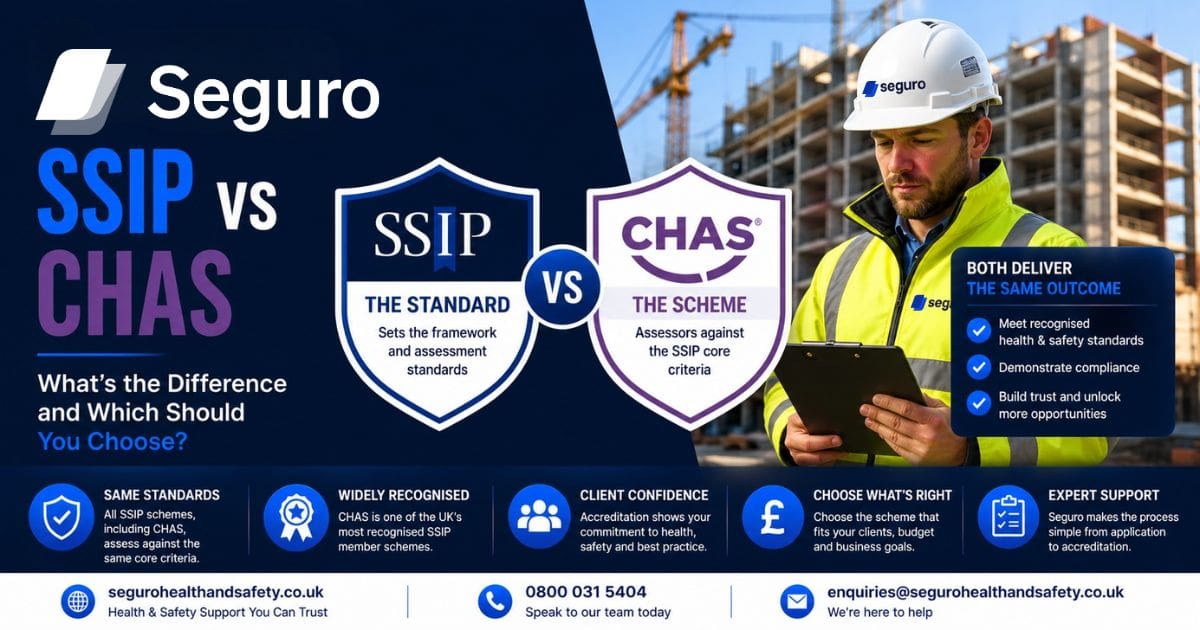
SSIP = The Standard
SSIP sets the framework and core assessment requirements.
CHAS = One of the Accredited Schemes
CHAS is a provider that assesses contractors against those standards.
Think of SSIP as the rulebook and CHAS as one of the organisations that applies those rules.
Is CHAS an SSIP Accreditation?
Yes.
CHAS is an SSIP member scheme and its accreditation is recognised under the SSIP framework.
This means a CHAS accredited contractor has demonstrated compliance with the SSIP core criteria.
SSIP vs CHAS Comparison Table
Feature
SSIP
CHAS
Type
Umbrella organisation
Accreditation scheme
Health & Safety Assessment
Sets standards
Conducts assessments
Contractor Accreditation
No
Yes
SSIP Recognition
Governing framework
Approved SSIP member
Used by Clients
Indirectly
Directly
Brand Recognition
Industry-wide framework
One of the UK’s best-known schemes
Do CHAS and Other SSIP Schemes Assess the Same Standards?
Yes.
All SSIP member schemes assess broadly the same core health and safety requirements.
Typical assessment areas include:
Health & Safety Policy
A signed and current policy document.
Risk Assessments
Evidence of hazard identification and control measures.
RAMS
Suitable Risk Assessments and Method Statements.
Training Records
Evidence of workforce competence.
Insurance
Current Employers’ Liability and Public Liability Insurance.
Accident Procedures
Systems for recording and managing incidents.
Competent Person Support
Access to competent health and safety advice.
Because the standards are largely identical, many contractors are surprised to learn that different SSIP schemes assess very similar information.
Why Do Some Contractors Choose CHAS?
CHAS is often selected because of its strong market recognition.
Benefits include:
Strong Client Recognition
Many principal contractors, local authorities and organisations recognise CHAS.
Widely Accepted
CHAS is accepted throughout construction, facilities management and engineering sectors.
Multiple Accreditation Levels
Businesses can access additional compliance modules and enhanced accreditation options.
Trusted Brand
CHAS has been operating for many years and has developed a strong reputation within the industry.
Why Might a Contractor Choose Another SSIP Scheme?
Some contractors select alternative SSIP schemes for reasons such as:
Lower Cost
Schemes such as SMAS, CQMS or PQS may offer lower entry fees.
Specific Client Requirements
Some clients request a particular accreditation scheme.
Additional Benefits
Constructionline, for example, offers contractor visibility and procurement opportunities alongside health and safety assessment.
Simplicity
Some smaller businesses prefer schemes with straightforward application processes.
Which Is Better: SSIP or CHAS?
Technically, this isn’t a direct comparison because CHAS is part of SSIP.
A better question is:
“Should I choose CHAS or another SSIP member scheme?”
The answer depends on:
Your clients
Your budget
Industry expectations
Business objectives
Tender requirements
If clients specifically request CHAS, that is usually the most sensible choice.
If cost is the main consideration, another SSIP member scheme may provide the same health and safety assessment at a lower price.
Does CHAS Help Win More Work?
CHAS accreditation can help contractors:
Pass pre-qualification questionnaires
Gain site access approval
Demonstrate compliance
Improve credibility
Meet supply chain requirements
Qualify for tender opportunities
However, accreditation alone does not guarantee contracts. It is one part of a wider compliance and competency strategy.
Common Misconceptions About SSIP and CHAS
“CHAS Has Higher Standards”
Not necessarily.
CHAS assesses against the same core SSIP criteria used by other member schemes.
“Only CHAS Is Accepted”
Many clients accept any recognised SSIP member accreditation.
“The Most Expensive Scheme Is Best”
Cost and assessment quality are not necessarily linked.
The best accreditation is often the one recognised by your target clients.
How to Pass a CHAS or SSIP Assessment
Regardless of scheme, contractors should ensure they have:
Seguro Health & Safety helps contractors prepare for:
CHAS Accreditation
Constructionline Accreditation
SafeContractor Applications
SMAS Accreditation
CQMS Applications
PQS Accreditation
SSIP Renewals
Support includes:
Health & Safety Policies
RAMS
Risk Assessments
Competent Person Services
Training Reviews
Compliance Audits
Conclusion
SSIP and CHAS are closely linked, but they are not the same thing.
SSIP is the framework that sets the assessment criteria, while CHAS is one of the accreditation schemes that assesses contractors against those standards.
For many businesses, CHAS is chosen because of its strong recognition and market reputation. However, other SSIP member schemes assess broadly the same health and safety standards and may offer advantages in terms of cost or additional services.
The most important factor is choosing the accreditation that aligns with your clients’ requirements and ensuring your health and safety documentation demonstrates full compliance
CALL Amanda today on 0800 031 5404 and see how we can support you
No. SSIP is the umbrella framework for Safety Schemes in Procurement, while CHAS is one of the accreditation schemes recognised under SSIP. CHAS assesses contractors against SSIP core health and safety criteria. For more information, go to SSIP Accreditations: The Complete Guide
What is the difference between SSIP and CHAS?
SSIP sets the common health and safety assessment standards used by recognised member schemes. CHAS is an SSIP member scheme that carries out contractor assessments and awards CHAS accreditation.
Is CHAS an SSIP scheme?
Yes. CHAS is an approved SSIP member scheme. Contractors who pass CHAS can demonstrate that they have met the SSIP core health and safety assessment requirements
Which is better, SSIP or CHAS?
This is not a direct comparison because SSIP is the framework and CHAS is one of the schemes within that framework. A better question is whether CHAS or another SSIP member scheme is right for your business, which depends on client requirements, budget and tender goals.
Do I need CHAS if I already have SSIP?
If you already hold accreditation from another recognised SSIP member scheme, some clients may accept it. However, if a client specifically asks for CHAS, you may still need CHAS accreditation to meet their requirements.
Are all SSIP schemes assessed against the same standards?
Yes. SSIP member schemes assess contractors against the same core health and safety standards, including policies, risk assessments, RAMS, insurance, training records, accident procedures and competent health and safety support.
Does CHAS meet SSIP requirements?
Yes. CHAS is recognised by SSIP and assesses contractors against SSIP core criteria. Passing CHAS demonstrates that your business meets recognised health and safety assessment standards.
Why do contractors choose CHAS?
Many contractors choose CHAS because it has strong brand recognition, is widely requested by clients and principal contractors, and is commonly used across construction, facilities management and public sector supply chains.
Can I choose another SSIP scheme instead of CHAS?
Yes. Contractors can choose other SSIP member schemes such as SMAS, SafeContractor, Constructionline, CQMS or PQS. The right scheme depends on client requirements, cost, recognition and business objectives.
Can Seguro help with CHAS and SSIP accreditation?
Yes. Seguro Health & Safety can help contractors prepare for CHAS and other SSIP accreditations by supporting health and safety policies, RAMS, risk assessments, training reviews, competent person evidence, applications and renewals.
No spam. Just the latest market insights by Seguro in your inbox each week.
Why SSIP Applications Fail – The Most Common Mistakes Contractors Make
Applying for SSIP accreditation should be straightforward. Yet every year, contractors experience delays, assessor queries, and failed applications because their documentation does not properly demonstrate compliance.
The reality is that most SSIP applications do not fail because contractors are unsafe. They fail because the paperwork submitted does not meet the assessment requirements.
Understanding the common reasons applications fail can help contractors avoid costly delays, achieve accreditation faster, and improve their chances of winning more work.
What Is SSIP Accreditation?
SSIP stands for Safety Schemes in Procurement.
It is a recognised framework used across the UK construction industry to assess contractor health and safety competence.
Popular SSIP member schemes include:
CHAS
SafeContractor
SMAS
Constructionline
CQMS
PQS
All schemes assess contractors against broadly the same health and safety criteria.
Why Do SSIP Applications Fail?
Most failed applications are caused by documentation issues rather than genuine health and safety problems.
Assessors can only evaluate the evidence submitted. If documents are missing, incomplete, outdated, or inconsistent, the application may be rejected or delayed until corrections are made.
1. Missing Health & Safety Policy
One of the most common reasons applications fail is the absence of a suitable Health & Safety Policy.
Typical issues include:
No policy provided
Unsigned policy
Undated policy
Policy not reviewed
Policy copied from another business
Policy not relevant to company activities
The policy should clearly explain how health and safety is managed within the business and identify responsibilities.
2. Generic Risk Assessments
Many contractors submit generic risk assessments downloaded from the internet.
Assessors frequently reject these because they:
Do not reflect actual work activities
Contain irrelevant hazards
Lack suitable control measures
Appear copied without review
Risk assessments should be specific to the work your business carries out.
3. Poor Quality RAMS
RAMS (Risk Assessments and Method Statements) are a critical part of most SSIP applications.
Common mistakes include:
Generic templates
Missing control measures
No sequence of work
No emergency arrangements
Activities not matching company services
Poorly written documentation
Good RAMS demonstrate that hazards have been identified and controlled appropriately.
4. Expired Insurance Documents
Insurance issues are among the easiest reasons for assessors to identify problems.
Common examples include:
Expired insurance certificates
Missing Employers’ Liability Insurance
Missing Public Liability Insurance
Incorrect company name
Insufficient cover levels
Always check insurance dates before submitting an application.
5. Missing Training Records
Assessors need evidence that employees are competent to perform their duties safely.
Missing evidence may include:
CSCS cards
First Aid certificates
IPAF training
PASMA certificates
Asbestos awareness training
Manual handling training
Toolbox talks
A training matrix is often helpful for demonstrating competence across the workforce.
6. No Competent Health & Safety Support
Many contractors overlook the requirement to demonstrate access to competent health and safety advice.
Assessors may request:
Competent Person evidence
Consultant qualifications
NEBOSH certificates
IOSH qualifications
Service agreements
Competent Person certificates
Without suitable evidence, the application may not satisfy assessment requirements.
7. Missing COSHH Assessments
If hazardous substances are used, COSHH assessments are often required.
Examples include:
Paints
Adhesives
Solvents
Cleaning chemicals
Dust-producing activities
Silica exposure
Fumes
Failure to provide COSHH assessments where substances are used commonly results in assessor queries.
8. Company Information Does Not Match
A surprisingly common issue occurs when company information differs across documents.
Examples include:
Different company names
Different addresses
Different trading names
Different insurance details
Incorrect registration information
Consistency across all submitted documentation is essential.
9. Missing Accident Reporting Procedures
SSIP assessors expect businesses to have a process for recording and investigating accidents.
Common issues include:
No procedure provided
Incomplete reporting arrangements
No RIDDOR reference
No investigation process
Even businesses with no accident history should have a documented procedure.
10. Outdated Documentation
Many contractors continue using documents that have not been reviewed for years.
Common examples include:
Policies with old review dates
Expired training certificates
Outdated legislation references
Old company details
Obsolete procedures
Documentation should be reviewed regularly and updated whenever business activities change.
11. Submitting Incomplete Applications
Some contractors rush through the application process and miss key questions or supporting evidence.
Typical problems include:
Blank sections
Missing uploads
Incomplete answers
Incorrect supporting documents
Lack of explanations
Taking time to review submissions before sending them can prevent avoidable delays.
12. Failure to Respond to Assessor Queries
Even strong applications may generate follow up questions.
Problems arise when:
Queries are ignored
Responses are delayed
Additional evidence is not provided
Documents remain incomplete
Quick responses often help applications progress smoothly.
How to Improve Your Chances of Approval
Before submitting your SSIP application, ask yourself:
Is my Health & Safety Policy current and signed?
Are my RAMS relevant to my work?
Are all insurance documents valid?
Can I demonstrate workforce competence?
Have I included COSHH assessments where required?
Do I have evidence of competent health and safety support?
Does all company information match?
Have I checked every uploaded document?
A simple review can prevent most common application failures.
How a Done For You SSIP Service Helps
Many contractors choose professional support because it removes uncertainty from the process.
A specialist consultant can:
Review documentation
Identify compliance gaps
Prepare policies
Create RAMS
Review training evidence
Check insurance documents
Submit applications
Manage assessor queries
This significantly reduces the likelihood of rejection.
How Seguro Can Help
Seguro Health & Safety helps contractors achieve accreditation through:
CHAS Applications
Constructionline Accreditation
SafeContractor Applications
SMAS Accreditation
CQMS Applications
PQS Accreditation
Health & Safety Policies
RAMS
Risk Assessments
COSHH Assessments
Competent Person Support
Accreditation Renewals
With extensive experience supporting UK contractors, Seguro helps businesses avoid common mistakes and achieve accreditation more efficiently.
Conclusion
Most SSIP applications fail because the supporting documentation does not properly demonstrate compliance.
The most common issues include:
Missing policies
Generic RAMS
Expired insurance
Missing training records
Lack of competent person evidence
Missing COSHH assessments
Inconsistent company information
Incomplete applications
By preparing accurate, up to date documentation and reviewing everything before submission, contractors can significantly improve their chances of achieving accreditation first time.
Request a call back for more information or call 0800 031 5404
SSIP applications usually fail because the supporting documents do not properly demonstrate compliance. Common reasons include missing policies, generic RAMS, expired insurance, missing training records, no competent person evidence, missing COSHH assessments and inconsistent company information. For more information, go to SSIP Accreditations: The Complete Guide
What are the most common SSIP application mistakes?
The most common SSIP application mistakes include submitting unsigned or outdated policies, using generic risk assessments or RAMS, uploading expired insurance certificates, failing to provide training evidence, missing accident procedures and not showing access to competent health and safety advice.
Can generic RAMS cause an SSIP application to fail?
Yes. Generic RAMS can cause an SSIP application to fail or become delayed because they may not reflect the contractor’s actual work activities, hazards, control measures, equipment or safe system of work.
Can expired insurance delay SSIP approval?
Yes. Expired insurance is one of the easiest issues for assessors to identify. Contractors should check that Employers’ Liability Insurance and Public Liability Insurance are current, correctly named and suitable for the work being assessed.
Do I need training records for SSIP accreditation?
Yes. SSIP assessors usually need evidence that workers are competent for their roles. This may include CSCS cards, first aid certificates, IPAF, PASMA, asbestos awareness, manual handling, toolbox talks and other relevant training records.
Does SSIP require competent person evidence?
Yes. SSIP schemes often ask contractors to show how they access competent health and safety advice. Evidence may include a competent person certificate, consultant CV, NEBOSH or IOSH qualifications, or a health and safety support agreement.
Will missing COSHH assessments affect my SSIP application?
Missing COSHH assessments can affect an SSIP application if your business uses or creates hazardous substances such as paints, adhesives, solvents, cleaning chemicals, dust, silica or fumes. COSHH assessments should identify the risks and control measures.
How can I avoid SSIP application failure?
You can reduce the risk of SSIP application failure by reviewing all documents before submission, ensuring policies are signed and current, checking insurance dates, using task-specific RAMS, providing training records, including COSHH assessments where needed and showing competent health and safety support.
What happens if my SSIP application is rejected?
If an SSIP application is rejected or delayed, the assessor will usually request further evidence or corrected documents. You may need to update policies, improve RAMS, provide missing certificates or clarify how health and safety is managed before approval can be granted.
Can Seguro help if my SSIP application has failed?
Yes. Seguro Health & Safety can help review failed or delayed SSIP applications, identify missing evidence, update policies, improve RAMS, check training records, provide competent person support and help prepare a stronger resubmission.