



SSIP requirements – The SSIP core criteria to pass the accreditation process
If you want to win more construction work, gain site approval, or pass contractor pre-qualification checks, you may be asked to provide SSIP accreditation.
But before applying, it is important to understand the key SSIP requirements and SSIP core criteria.
SSIP schemes such as CHAS, Constructionline, SafeContractor, SMAS, CQMS, and PQS all assess contractors against core health and safety standards. Although each scheme has its own branding and process, the main requirements are very similar.
This guide explains what documents and evidence contractors usually need to pass an SSIP assessment.
What Does SSIP Mean?
SSIP stands for Safety Schemes in Procurement.
It is a recognised framework designed to simplify contractor health and safety assessments during procurement. Instead of completing different health and safety questionnaires for every client, contractors can use an SSIP member scheme to demonstrate compliance.
Common SSIP schemes include:
- CHAS
- Constructionline
- SafeContractor
- SMAS
- CQMS
- PQS
What Are The SSIP Requirements?
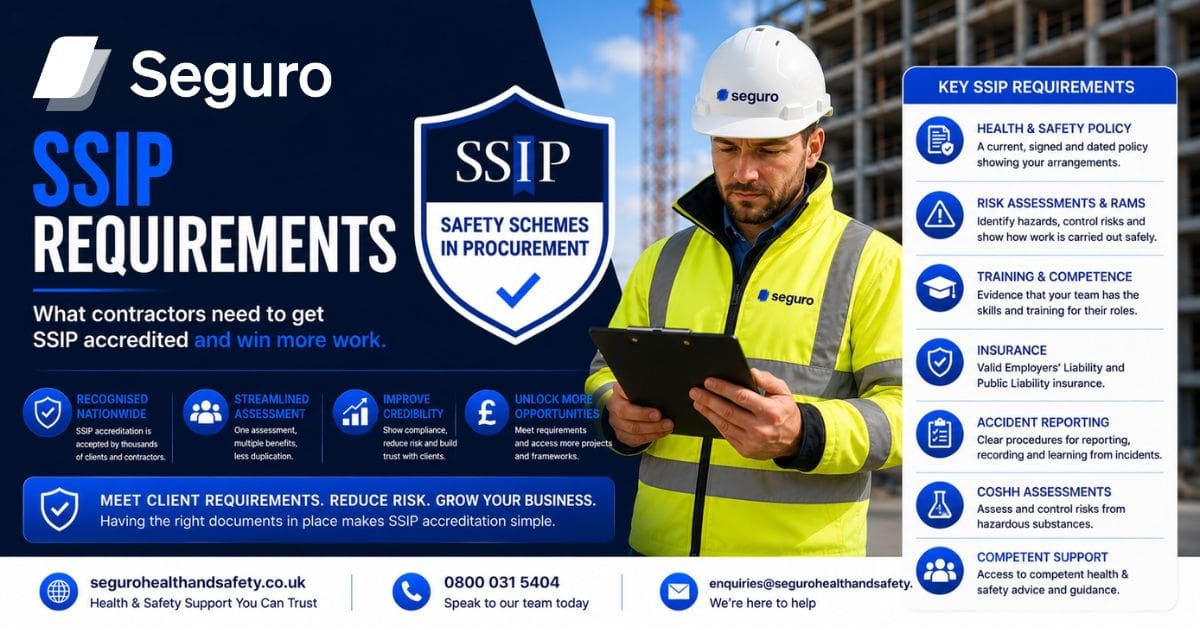
The SSIP core criteria include the health and safety documents, policies, records, and evidence needed to demonstrate that your business manages risk effectively.
Most SSIP schemes will assess whether your business has suitable arrangements for:
- Health and safety management
- Risk assessment
- Training and competence
- Insurance
- Accident reporting
- Communication with workers
- Competent health and safety advice
The goal is to prove that your company can work safely and meet client expectations.
1. Health & Safety Policy
A current Health & Safety Policy is one of the most important SSIP requirements.
Your policy should show:
- Who is responsible for health and safety
- How risks are managed
- What arrangements are in place
- How workers are informed and supervised
- When the policy was reviewed
For businesses with five or more employees, the policy should be written, signed, and dated.
Even if you have fewer than five employees, many clients and SSIP schemes still expect a written policy as evidence of good management.
2. Risk Assessments
Risk assessments are a core requirement for SSIP accreditation.
They show that your business has identified hazards and introduced controls to reduce risk.
Typical construction risk assessments may cover:
- Working at height
- Manual handling
- Electrical work
- Use of tools and equipment
- Slips, trips, and falls
- Excavations
- Dust and fumes
- Vehicle movements
Risk assessments should be relevant to the work your business actually carries out.
Generic documents may lead to assessor questions or delays.
3. RAMS
RAMS stands for Risk Assessments and Method Statements.
For contractors, RAMS are usually essential.
They explain:
- What work will be carried out
- What hazards are present
- What controls will be used
- What equipment is required
- Who is responsible
- How the work will be completed safely
SSIP assessors and principal contractors often reject RAMS that look copied, outdated, or unrelated to the work being assessed.
Good RAMS should be task-specific and easy to follow.
4. Training and Competence Records
SSIP schemes usually require evidence that workers are competent for their roles.
This may include:
- CSCS cards
- First aid training
- Asbestos awareness
- Working at height training
- Manual handling training
- IPAF
- PASMA
- Plant and equipment training
- Toolbox talks
A simple training matrix can help show:
- Who has completed training
- When training expires
- What refresher training is needed
Missing or expired training records are a common cause of SSIP delays.
5. Insurance Documents
Most SSIP applications require current insurance evidence.
This usually includes:
- Employers’ Liability Insurance
- Public Liability Insurance
- Professional Indemnity Insurance, where applicable
Check that your insurance documents:
- Are in date
- Match your company name
- Reflect your business activities
- Provide suitable cover levels
Expired insurance is one of the easiest issues for assessors to identify.
6. Accident Reporting Procedure
SSIP schemes normally expect contractors to have a clear accident and incident reporting process.
This should explain:
- How accidents are recorded
- Who is responsible for reporting
- When RIDDOR applies
- How incidents are investigated
- How lessons are communicated
Even if your business has had no accidents, you should still have a procedure in place.
7. COSHH Assessments
COSHH assessments may be required if your business uses or creates hazardous substances.
This can include:
- Paints
- Solvents
- Adhesives
- Cleaning chemicals
- Dusts
- Silica
- Fumes
COSHH assessments should identify the substance, risks, exposure routes, control measures, PPE, storage, and emergency arrangements.
8. Competent Health & Safety Support
SSIP schemes often ask how your business receives competent health and safety advice.
This may be provided by:
- An internal competent person
- An external safety advisor
- A health and safety consultant
- A retained competent person service
Evidence may include:
- Consultant CV
- Qualifications such as NEBOSH or IOSH
- Service agreement
- Certificate of support
This helps demonstrate that your business has access to suitable health and safety knowledge.
9. Worker Communication and Supervision
Assessors may also look for evidence that health and safety information is communicated to workers.
This may include:
- Toolbox talk records
- Site induction records
- Safety briefings
- RAMS sign-off sheets
- Supervision arrangements
It is not enough to have documents. You should be able to show that workers understand them.
10. Environmental, Quality and Additional Requirements
Depending on the scheme or accreditation level, you may also be asked for:
- Environmental policy
- Quality policy
- Equal opportunities policy
- Modern slavery policy
- Anti-bribery policy
- Financial information
- Sustainability evidence
These are more common at higher accreditation levels, such as CHAS Advanced or Elite, Constructionline Gold, or Common Assessment Standard routes.
Common Reasons SSIP Applications Fail
Many SSIP applications fail or become delayed because of avoidable issues such as:
- Missing documents
- Unsigned or outdated policies
- Generic RAMS
- Expired insurance
- Training records not provided
- No competent person evidence
- Incorrect company details
- COSHH missing where substances are used
- Documents not matching business activities
Most problems can be resolved before submission with a proper compliance review to check the SSIP core criteria.
CALL Amanda today on 0800 031 5404 and see how we can support you
Amanda is our technical sales advisor
Get Started Today

Frequently Asked Questions
What are the requirements for SSIP accreditation?
SSIP accreditation requirements usually include a current health and safety policy, risk assessments, RAMS, insurance certificates, training records, accident reporting procedures, COSHH assessments where applicable and evidence of competent health and safety support. For more information, go to SSIP Accreditations: The Complete Guide
What documents are needed for SSIP?
The documents needed for SSIP usually include a health and safety policy, risk assessments, RAMS, training evidence, insurance documents, accident reporting procedure, COSHH assessments where relevant and competent person or safety advisor evidence.
Does SSIP require a health and safety policy?
Yes. Most SSIP schemes require a current health and safety policy. For businesses with five or more employees, the policy should be written, signed and dated. Smaller businesses may not legally need a written policy, but SSIP schemes and clients often still expect one.
Do I need RAMS for SSIP accreditation?
Contractors usually need RAMS for SSIP accreditation because they show how work activities are assessed and controlled. RAMS should be relevant to the contractor’s actual work and should not be generic templates copied from unrelated projects.
What insurance is required for SSIP?
SSIP schemes commonly request current insurance evidence, including Employers’ Liability Insurance and Public Liability Insurance. Professional Indemnity Insurance may also be required where relevant to the services provided.
Does SSIP require a competent person?
Yes. SSIP schemes usually ask how your business receives competent health and safety advice. This may be through an internal competent person, an external safety advisor or a retained health and safety consultant.
What training records are required for SSIP?
SSIP training evidence may include CSCS cards, first aid training, asbestos awareness, working at height training, manual handling, IPAF, PASMA, plant training, toolbox talks and other task-specific competence records.
Why do SSIP applications fail?
SSIP applications often fail or become delayed because of missing documents, unsigned or outdated policies, expired insurance, generic RAMS, incomplete training records, missing COSHH assessments, no competent person evidence or inconsistent company details.
Are SSIP requirements the same for CHAS, SMAS and SafeContractor?
Yes. CHAS, SMAS, SafeContractor, Constructionline, CQMS and PQS are all SSIP member schemes and assess contractors against broadly the same core health and safety requirements.
Can Seguro help contractors meet SSIP requirements?
Yes. Seguro Health & Safety helps contractors meet SSIP requirements by preparing and reviewing health and safety policies, risk assessments, RAMS, COSHH assessments, training evidence, competent person support and applications for schemes such as CHAS, Constructionline, SafeContractor, SMAS, CQMS and PQS.