Close Navigation

Search

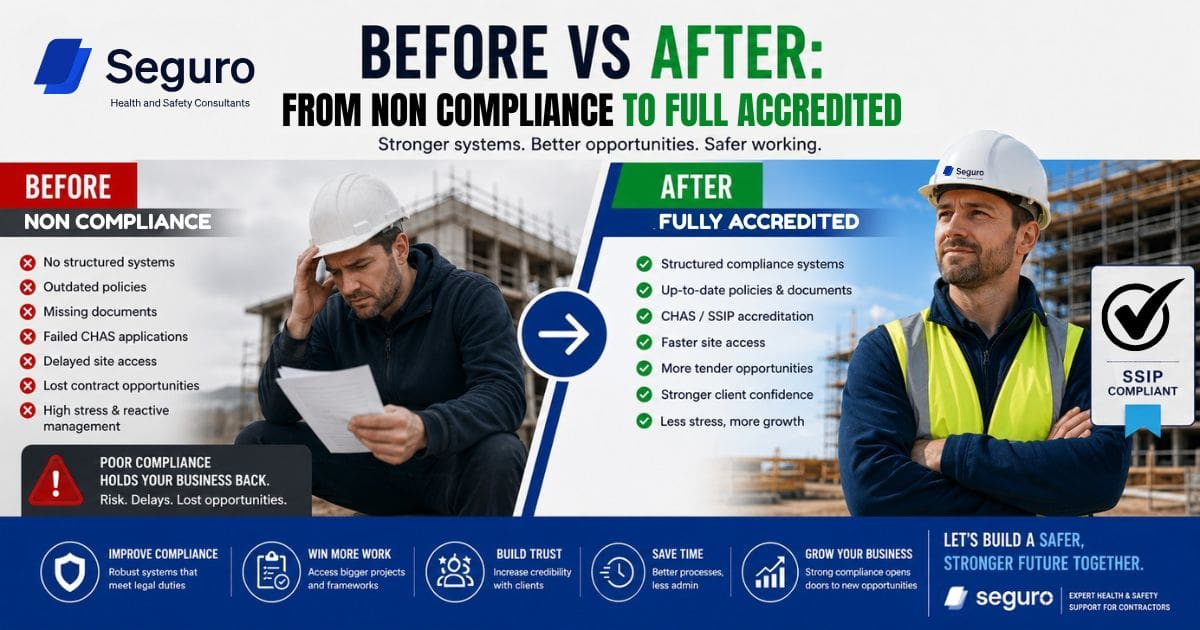
Before vs After: From Non Compliance to Fully Accredited

Insight by

Bob Evans

Bob Evans

Published on

29 May 2026

Competent person

Before and after accreditation: From Non-Compliance to Fully Accredited

Many contractors start in the same position.

The business is busy.
Projects are moving.
Clients are asking for documents.

But health and safety systems are inconsistent, reactive, or incomplete. The company may have:

  • No structured RAMS process
  • Outdated policies
  • Missing training records
  • Weak compliance systems
  • No competent safety advisor
  • Failed CHAS applications
  • Delayed site access
  • Difficulty winning larger contracts

At this stage, many businesses are operating reactively rather than professionally managing compliance.

Then something changes.

  • A larger opportunity appears.
  • A principal contractor requests CHAS accreditation.
  • A tender requires SSIP compliance.
  • Or the business realises that poor systems are starting to hold back growth.

This is often the turning point from “getting by” to becoming fully accredited and commercially ready.

The Reality of “Non Compliance”

Many contractors are not intentionally unsafe. The issue is usually:

  • Lack of time
  • Lack of structure
  • No internal compliance experience
  • Rapid business growth
  • Reactive paperwork management

Common signs of poor compliance include:

  • RAMS copied from old jobs
  • Policies not reviewed for years
  • Missing COSHH assessments
  • Expired insurance documents
  • No training matrix
  • No toolbox talk records
  • No competent health & safety support

In many cases, contractors only discover these issues when:

  • A CHAS application fails
  • A site audit takes place
  • A principal contractor requests evidence
  • An accident occurs
  • A project is delayed

Before Accreditation: Common Problems Contractors Face

Failed CHAS or SSIP Applications

Many contractors struggle because:

  • Documents are incomplete
  • Policies are generic
  • RAMS are weak
  • Training evidence is missing
  • Accident procedures are unclear

Most failures happen because businesses cannot properly demonstrate compliance.

Delayed Site Access

Principal contractors increasingly require:

  • RAMS approval
  • Insurance verification
  • Training evidence
  • Induction records
  • Competent safety support

Without these, contractors may experience:

  • Delays
  • Site access refusals
  • Lost productivity
  • Commercial pressure

Difficulty Winning Larger Contracts

As businesses grow, compliance expectations increase. Many larger contractors and public sector clients require.

  • CHAS
  • Constructionline
  • SafeContractor
  • SSIP accreditation
  • Structured health & safety systems

Without accreditation, many businesses struggle to move beyond smaller subcontract opportunities.

Stress and Reactive Management

One of the biggest hidden problems is operational stress. Many businesses without structured compliance systems spend their time:

  • Chasing paperwork
  • Updating documents last minute
  • Reacting to client requests
  • Searching for certificates
  • Rewriting RAMS urgently

This creates pressure across the entire business.

The Turning Point: Deciding to Improve Compliance

For many contractors, the turning point comes when they realise:

  • Better compliance supports business growth
  • Larger clients expect professionalism
  • Good systems save time long-term
  • Accreditation opens commercial opportunities

This is where businesses often begin working with:

  • Safety Advisors
  • Competent Persons
  • Health & Safety Consultants
  • Accreditation specialists

The Process: From Non Compliance to Fully Accredited

Step 1: Reviewing Existing Systems

The first stage is usually understanding:

  • What documents already exist
  • What is missing
  • Where compliance gaps are
  • What clients are requesting

This often reveals that many businesses already have some systems in place, but they are inconsistent or outdated.

Step 2: Building Core Health & Safety Documents

Most businesses then begin developing:

  • Health & safety policies
  • Risk assessments
  • RAMS
  • COSHH assessments
  • Toolbox talks
  • Accident procedures
  • Training records

The goal is to create practical systems that reflect real operations.

Step 3: Appointing Safety Consultant Support

Many contractors then realise they need ongoing safety support. This often includes:

  • Compliance guidance
  • Document reviews
  • Accreditation support
  • Safety advice
  • Legislative updates

For SMEs, outsourced support is usually more practical than employing internally.

Step 4: Preparing for Accreditation

Once systems are organised, businesses can begin preparing for:

  • CHAS
  • Constructionline
  • SafeContractor
  • SMAS
  • Other SSIP schemes

This typically involves:

  • Reviewing documentation
  • Uploading evidence
  • Correcting compliance gaps
  • Responding to assessor feedback

After Accreditation: What Changes?

The difference is often significant.

Before:

  • Reactive paperwork
  • Compliance stress
  • Delayed responses
  • Weak systems
  • Difficulty winning work

After:

  • Structured compliance systems
  • Improved professionalism
  • Faster client responses
  • Better organisation
  • Increased confidence
  • Stronger commercial positioning

Better Tender Opportunities

Many accredited contractors discover they can access:

  • Larger projects
  • Public sector tenders
  • Approved contractor lists
  • Principal contractor supply chains

Accreditation often becomes a gateway to bigger opportunities.

Improved Client Confidence

Strong compliance systems help demonstrate:

  • Professionalism
  • Organisation
  • Competence
  • Risk management

Clients often view accredited contractors as:

  • Lower risk
  • Easier to work with
  • Better organised
  • More reliable

Faster Site Onboarding

With proper systems in place, businesses can usually respond faster to:

  • RAMS requests
  • Insurance requests
  • Site documentation requirements
  • Training evidence requests

This helps reduce delays and operational pressure.

Stronger Internal Organisation

Many businesses discover that improving compliance also improves:

  • Communication
  • Record keeping
  • Planning
  • Workforce management
  • Operational consistency

Good health and safety systems often improve the overall structure of the business.

Compliance Becomes a Business Asset

One of the biggest mindset shifts happens when contractors stop viewing compliance as:

  • “paperwork” or
  • “a box ticking exercise” and instead see it as:
  • a professional system,
  • a commercial advantage,
  • and a growth tool.

The Most Common Improvements Contractors See

After becoming fully accredited, contractors often report:

  • Better tender success
  • Improved client trust
  • More organised systems
  • Less compliance stress
  • Faster onboarding
  • Improved confidence during audits
  • Access to larger opportunities

For many businesses, accreditation becomes part of long term growth rather than simply a requirement.

Why More Contractors Use Outsourced Safety Consultants

Many SMEs lack the time to manage complex compliance internally. Outsourced support can help businesses:

  • Maintain documents
  • Stay updated
  • Prepare RAMS
  • Manage accreditations
  • Improve systems
  • Reduce admin pressure

This allows directors and managers to focus on operations while maintaining professional compliance standards.

Final Thoughts

Before and after accreditation. The difference between “non compliance” and “fully accredited” is often much bigger than paperwork. It affects:

  • Reputation
  • Site access
  • Tender opportunities
  • Client confidence
  • Operational stress
  • Business growth

Many contractors discover that strong health and safety systems help them:

  • Operate more professionally
  • Win more work
  • Reduce risk
  • Improve organisation
  • Build stronger businesses

Compliance is no longer just about passing audits. For many contractors, it becomes part of building a trusted, scalable, and commercially successful business.

Looking for support, give us a call on 0800 031 4504

shape Safety Advisor

Frequently Asked Questions

What does fully accredited mean for contractors?

Fully accredited usually means a contractor has structured health and safety systems in place and has achieved recognised accreditation such as CHAS, SSIP, Constructionline, SafeContractor or similar contractor approval schemes. For more information, go to Construction Health and Safety Consultant: Complete Guide for UK Contractors

How can a contractor go from non-compliance to CHAS-accredited?

A contractor can move from non-compliance to CHAS accreditation by reviewing existing systems, identifying missing documents, creating suitable RAMS, updating policies, organising training records, checking insurance, appointing competent health and safety support and submitting the correct evidence to the accreditation scheme.

Why do contractors fail accreditation applications?

Contractors commonly fail accreditation applications due to missing documents, poor RAMS, outdated health and safety policies, expired insurance, missing training evidence, weak accident procedures, or no evidence of competent health and safety advice.

Can CHAS or SSIP accreditation help contractors win more work?

Yes. CHAS and SSIP accreditation can help contractors meet pre-qualification requirements, access larger projects, join approved contractor lists, improve client confidence and demonstrate professional health and safety compliance.

What documents do contractors need to become accredited?

Contractors commonly need a health and safety policy, RAMS, risk assessments, COSHH assessments, training records, insurance certificates, accident procedures, toolbox talk evidence and proof of competent health and safety support.

Do small contractors need health and safety compliance support?

Many small contractors benefit from outsourced health and safety advisor support because accreditation requirements can be detailed and time consuming. Professional support can help organise documents, prepare evidence and reduce the risk of failed applications.

What changes after a contractor becomes accredited?

After becoming accredited, contractors often have better organised systems, faster responses to client requests, improved tender readiness, stronger professional credibility, reduced compliance stress and access to larger contract opportunities.

Can accreditation reduce site access delays?

Yes. Accredited contractors usually have key documents such as RAMS, insurance, training records and policies ready to provide when requested. This can help reduce delays during site onboarding and principal contractor approval.

Is becoming accredited only about paperwork?

No. Accreditation is not just about paperwork. It helps contractors demonstrate that health and safety is properly managed, risks are controlled, workers are competent and the business can meet client and legal requirements.

How can Seguro help contractors become fully accredited?

Seguro can help contractors review compliance gaps, prepare health and safety documents, improve RAMS, organise evidence, provide safety consultancy support and assist with CHAS, SSIP and contractor accreditation applications.

Health & Safety Legislation You Can’t Ignore

Insight by

Bob Evans

Bob Evans

Published on

20 May 2026

Competent person

Health & Safety Legislation You Can’t Ignore

For many contractors and small businesses, health & safety legislation only becomes a priority when something goes wrong.

  • A failed CHAS application.
  • A site audit issue.
  • An accident at work.
  • An HSE inspection.
  • Or a client refusing access to the site because the correct documents are missing.

The problem is that many businesses do not fully understand their legal health and safety responsibilities until they face commercial or legal pressure.

The reality is simple: if you employ people, manage contractors, or carry out construction work, you have legal duties you cannot ignore.

Understanding these responsibilities is not just about avoiding fines. Proper compliance helps protect your workforce, reduce risk, improve professionalism, and increase your ability to win contracts.

Why Health & Safety Law Matters

Health and safety laws exist to protect:

  • Employees
  • Contractors
  • Visitors
  • Members of the public
  • Anyone affected by work activities

For construction businesses, the health & safety legislation expectations are even higher because construction remains one of the UK’s highest-risk industries.

Clients, principal contractors, local authorities, and accreditation schemes increasingly expect businesses to demonstrate strong compliance systems before work even begins.

The Main Health & Safety Laws Contractors Should Know

Health and Safety at Work Act 1974

This is the foundation of UK health and safety law. It places duties on employers to ensure, so far as reasonably practicable:

  • Employee safety
  • Safe systems of work
  • Safe equipment
  • Safe workplaces
  • Adequate training and supervision

It also requires businesses to protect anyone affected by their activities, including subcontractors and members of the public.

Management of Health and Safety at Work Regulations

These regulations require businesses to properly manage health and safety risks.

Key duties include:

  • Carrying out risk assessments
  • Appointing competent health and safety assistance
  • Providing training and information
  • Establishing emergency procedures
  • Reviewing safety arrangements regularly

This is where many businesses discover they need a Safety Consultant.

CDM Regulations (Construction Design and Management)

The CDM Regulations apply to construction work and place responsibilities on:

  • Clients
  • Principal Designers
  • Principal Contractors
  • Contractors

These regulations require construction work to be:

  • Properly planned
  • Properly managed
  • Properly monitored
  • Carried out safely

Contractors must:

  • Have suitable skills and experience
  • Produce construction phase documentation
  • Coordinate safely with others
  • Control site risks

Failure to comply with CDM requirements is a major issue during HSE inspections and contractor audits.

Risk Assessments Are a Health & Safety legislation Requirement

Employers must identify hazards and implement suitable control measures.

Risk assessments help businesses:

  • Identify dangers
  • Reduce accidents
  • Demonstrate compliance
  • Improve planning
  • Protect workers

If your business has 5 or more employees, significant findings must be recorded in writing.

RAMS: Risk Assessments and Method Statements

In construction, RAMS are one of the most requested compliance documents.

Clients and principal contractors commonly ask contractors to provide RAMS before work begins. Good RAMS should:

  • Reflect the actual work being carried out
  • Identify site-specific risks
  • Explain control measures clearly
  • Be communicated to workers

One of the biggest compliance problems is contractors relying on generic copied templates that do not reflect real site conditions.

Do You Need a Health & Safety Policy?

Yes. If you employ 5 or more people, you must have a written health and safety policy.

The policy should explain:

  • Your safety arrangements
  • Responsibilities within the business
  • How risks are managed

Even smaller businesses often require a policy because:

  • CHAS applications request one
  • Main contractors ask for one
  • Public sector tenders expect one

Policies should normally be reviewed annually.

COSHH Assessments

COSHH stands for Control of Substances Hazardous to Health.

Many contractors underestimate how often COSHH applies. You may need COSHH assessments for:

  • Dust
  • Paints
  • Adhesives
  • Solvents
  • Chemicals
  • Cleaning products
  • Sealants
  • Fumes

COSHH assessments help businesses:

  • Identify exposure risks
  • Reduce worker health issues
  • Demonstrate compliance
  • Improve safe handling procedures

Training and Competence Requirements

Businesses must ensure workers are properly trained and competent for the tasks they carry out. This includes:

  • Site inductions
  • Tool and equipment training
  • Manual handling
  • Working at height
  • Asbestos awareness
  • Face fit testing
  • Plant operation training

Many accreditation failures happen because businesses cannot provide evidence of workforce competence.

Accident Reporting and RIDDOR

Some workplace incidents must legally be reported under RIDDOR regulations.This can include:

  • Serious injuries
  • Dangerous occurrences
  • Certain occupational illnesses
  • Fatalities

Businesses should also have:

  • Accident reporting procedures
  • Investigation processes
  • First aid arrangements

Poor accident management often becomes a major issue after incidents occur.

Employers’ Liability Insurance

Most businesses employing staff must have Employers’ Liability Insurance. Contractors commonly also require:

  • Public Liability Insurance
  • Professional Indemnity Insurance (in some sectors)

Insurance documents are one of the most commonly requested items during:

  • CHAS applications
  • Site onboarding
  • Tender submissions

Expired or incorrect insurance details are one of the biggest reasons contractors fail compliance checks.

Why Contractors Fail Compliance Checks

Most businesses do not fail because they are unsafe.

They fail because they cannot properly demonstrate compliance. Common problems include:

  • Missing documents
  • Poor RAMS
  • Expired policies
  • Outdated insurance
  • Missing training records
  • Weak COSHH assessments
  • No competent safety advisor
  • Lack of worker communication evidence

These issues frequently lead to:

  • Failed accreditations
  • Lost contracts
  • Delayed site access
  • Increased commercial risk

What Happens If You Ignore Legal Health & Safety Requirements?

Ignoring compliance responsibilities can have serious consequences.

Potential risks include:

HSE Enforcement: Improvement notices, prohibition notices, and prosecutions can be issued where serious failings occur.

Fines and Legal Costs: Health and safety breaches can result in significant financial penalties.

Lost Contracts: Many principal contractors will not work with non-compliant businesses.

Failed CHAS or SSIP Applications: Missing evidence is a major reason applications fail.

Increased Accident Risk: Poor systems increase the likelihood of incidents and injuries.

Reputational Damage: Poor compliance records can damage long-term business growth.

Why Compliance Helps Businesses Grow

Good health and safety management is no longer just about avoiding problems.

It is increasingly part of winning work. Strong compliance systems help businesses:

  • Pass pre-qualification checks
  • Achieve CHAS or SSIP accreditation
  • Improve tender success
  • Gain access to larger projects
  • Build client confidence
  • Reduce operational disruption

For many contractors, health and safety has become a commercial advantage as well as a legal requirement.

Do Small Contractors Need Professional Support?

Many small contractors attempt to manage compliance themselves.

However, growing compliance demands often make this difficult. Professional support can help businesses:

  • Stay legally compliant
  • Keep documents updated
  • Produce suitable RAMS
  • Pass accreditations
  • Respond to client requests quickly
  • Reduce management pressure

This is why many SMEs use outsourced Safety Advisor services or choose to have the more comprehensive retained Safety Consultant service that 5 or more employee businesses must have in place.

Final Thoughts

Legal health and safety requirements are not optional.

Whether you are a subcontractor, principal contractor, facilities management company, or growing construction business, compliance responsibilities continue to increase.

The businesses that succeed long term are usually those that:

  • Take compliance seriously
  • Build proper systems
  • Keep documents updated
  • Demonstrate competence
  • Proactively manage risk

Health and safety is no longer simply about avoiding enforcement.

It is now closely linked to professionalism, reputation, and business growth.

Looking for more advice, give us a call on 0800 031 4504

shape Health & Safety Consultancy, Safety Advisor, Safety Consultant

Frequently Asked Questions

What legal health and safety requirements must contractors follow?

Contractors must manage health and safety risks, carry out risk assessments, provide safe systems of work, train and supervise workers, comply with CDM Regulations where applicable, maintain suitable insurance, and appoint competent health and safety assistance. For more information, go to Construction Health and Safety Consultant: Complete Guide for UK Contractors

Do I legally need a written health and safety policy?

Yes. If your business has 5 or more employees, you must have a written health and safety policy. The policy should explain responsibilities, arrangements and how health and safety is managed within the business.

Are risk assessments a legal requirement?

Yes. Employers must identify workplace hazards, assess risks and put suitable control measures in place. If the business has 5 or more employees, significant findings must be recorded in writing.

Do contractors need RAMS?

Many contractors need RAMS before starting work, especially in construction. RAMS show how risks will be controlled and how the work will be carried out safely. Clients and principal contractors often request RAMS during site onboarding.

What are the CDM Regulations?

CDM stands for Construction Design and Management Regulations. These regulations apply to construction work and require projects to be properly planned, managed and monitored so that work is carried out safely.

Do I need a competent person for health and safety?

Yes. Employers must have access to competent health and safety assistance. This can be someone inside the business with suitable knowledge and experience, or an outsourced health and safety consultant.

When do I need COSHH assessments?

You need COSHH assessments when your business uses or creates substances that could be hazardous to health. This may include dust, fumes, paints, adhesives, solvents, chemicals, cleaning products and other harmful substances.

What health and safety documents do contractors usually need?

Contractors commonly need a health and safety policy, risk assessments, method statements, COSHH assessments, training records, insurance certificates, accident procedures, toolbox talk records and evidence of competent health and safety advice.

What happens if you ignore health and safety requirements?

Ignoring health and safety requirements can lead to accidents, HSE enforcement, fines, prosecution, failed CHAS or SSIP applications, delayed site access, lost contracts and damage to your business reputation.

Can poor health and safety compliance affect winning contracts?

Yes. Many clients, principal contractors and public sector organisations require evidence of strong health and safety compliance before allowing contractors onto site or awarding work.

Health & Safety in Construction – A Complete Guide for UK SMEs

Insight by

amanda

Amanda Lambert

Published on

9 April 2026

Health and safety blog

What Is Health & Safety in Construction Compliance?

Health and safety in construction compliance refers to the systems, processes, and documentation required to ensure that work is carried out safely and in line with UK regulations.

This typically includes:

In the UK, compliance is not optional. It is a legal requirement under legislation such as the Health and Safety at Work etc. Act 1974.

Why Is Health & Safety Compliance Important for Construction Companies?

For small and medium sized construction businesses, health and safety compliance is essential not only for legal protection but also for commercial success.

Key Benefits of Compliance

1. Access to More Work
Many clients and principal contractors require businesses to hold recognised accreditations before they can tender for projects.

2. Improved Credibility
Demonstrating compliance shows that your business operates professionally and responsibly.

3. Reduced Risk
Effective health and safety systems help prevent accidents, delays, and costly legal issues.

4. Stronger Tender Submissions
Pre qualified and compliant companies are more likely to pass initial screening stages.

How Compliance Helps Businesses Win Bigger Contracts

Compliance is No Longer Just About Following Rules

Many businesses view compliance as an administrative burden. It can feel like paperwork, audits and procedures that take time away from running projects and serving customers.

However, for organisations looking to win larger contracts, compliance has become a commercial advantage.

Whether you operate in construction, facilities management, engineering, manufacturing or professional services, clients increasingly expect suppliers to demonstrate compliance before work is awarded.

In many sectors, businesses that can clearly demonstrate compliance are more likely to progress through tender stages, satisfy procurement requirements and be considered lower risk suppliers.

Get started today

Common Health & Safety Accreditations in the UK

To work on larger or higher value projects, construction companies are often required to obtain third party accreditation.

The most widely recognised schemes include:

These accreditations assess a company’s health and safety policies, procedures, and track record.

What Are RAMS (Risk Assessments and Method Statements)?

Risk Assessments and Method Statements (RAMS) are essential documents in construction.

  • Risk Assessments identify potential hazards on-site
  • Method Statements explain how work will be carried out safely

Well prepared RAMS are often required before work can begin and are frequently reviewed by clients or principal contractors.

Poorly written or non compliant RAMS are a common reason for project delays or rejected tenders.

The Role of a Competent Person in Health & Safety

UK law requires businesses to appoint a “competent person” to manage health and safety responsibilities.

A competent person must have:

  • Sufficient training and experience
  • Knowledge of relevant regulations
  • The ability to implement effective safety measures

Many SMEs choose to outsource this role to specialist consultancies to ensure full compliance without hiring in house.

How Seguro Health & Safety Supports Construction Businesses

Seguro Health & Safety provides practical, hands on support to help construction companies achieve and maintain compliance.

Their services include:

  • Accreditation support (CHAS, Constructionline, SafeContractor, PQS)
  • RAMS preparation and review
  • Acting as your competent person
  • Ongoing compliance advice and documentation support

This approach helps businesses stay compliant while focusing on delivering projects and growing their operations.

Is Health & Safety a Cost or a Growth Strategy?

Health and safety is often seen as a necessary expense. However, in today’s construction industry, it is better understood as a growth enabler.

The Commercial Impact of Compliance

  • Compliance builds credibility → Clients trust your business
  • Credibility creates access → You qualify for more tenders
  • Access drives revenue → More opportunities to win work

Companies that treat health and safety as part of their business strategy, not just a tick box exercise are better positioned to scale.

Conclusion

Health and safety compliance is no longer just about meeting legal requirements. For UK construction SMEs, it is a critical factor in winning work, building credibility, and achieving sustainable growth.

By taking a structured and proactive approach, businesses can turn compliance into a competitive advantage.

Got a question? Call Colin on 0800 0315404 for an answer

Colin is our H&S consultant

OR GET A PRICE
shape Health & Safety Consultancy, Safety Advisor, Safety Consultant

Frequently Asked Questions (FAQ)

Do I need health and safety accreditation to win construction work in the UK?

In many cases, yes. Main contractors, local authorities, housing associations and other clients often require health and safety accreditations such as CHAS, SafeContractor, or other SSIP recognised schemes as part of their pre-qualification process before contractors can tender for work. For more information, go to Construction Health and Safety Consultant: Complete Guide for UK Contractors

What happens if my business is not compliant?

Businesses that cannot demonstrate compliance may struggle to pass pre-qualification assessments, access tender opportunities or meet client requirements. Non-compliance can also increase the risk of enforcement action, financial penalties, project delays and reputational damage.

Can I outsource health and safety management?

Yes. Many SMEs choose to outsource health and safety management to specialist consultants who provide competent advice, assist with compliance requirements, maintain documentation and support accreditation applications.
How long does it take to get accredited?

The time required depends on the quality of your existing documentation, policies, risk assessments and management systems. Businesses with compliant documentation already in place can often complete accreditation more quickly than those starting from scratch.

What are the most common health and safety accreditations in the UK construction industry?

Common contractor accreditations include CHAS, SafeContractor, Constructionline, Avetta, Altius, Exor and other SSIP recognised schemes. These schemes help demonstrate that a business has suitable health and safety management arrangements in place.

Why do clients ask for health and safety accreditation?

Clients use accreditation as a way of assessing contractor competence and reducing procurement risk. Accreditation provides evidence that a business has implemented appropriate health and safety policies, procedures and management systems.

Is health and safety accreditation a legal requirement?

Health and safety accreditation itself is not usually a legal requirement. However, businesses must comply with health and safety legislation, and many clients make accreditation a contractual requirement before awarding work.

Can small construction companies obtain health and safety accreditation?

Yes. Small construction companies, sole traders and subcontractors can obtain health and safety accreditation provided they can demonstrate suitable policies, risk assessments, training records and compliance procedures relevant to their work activities.

Health and safety in construction

Insight by

Bob Evans

Bob Evans

Published on

28 October 2025

CHAS

Health and safety in construction

In the fast-paced world of construction, safety is of paramount importance. From home extensions to infrastructure projects that shape our country, the welfare of workers and the public is our first consideration.

When it comes to creating a culture of safety, construction companies must have robust processes and systems in place.

  • Health and safety legislation
  • Common hazards in the construction industry
  • Implementing health and safety on construction sites
  • Safety planning and risk assessment in construction projects
  • Personal protective equipment (PPE) in construction
  • Training and education for construction safety
  • Construction site inspections and audits
  • Creating a culture of safety on construction sites
  • Site Manager Compliance Kit
  • SSIP Accreditation
  • HSG150 health and safety in construction

Health and safety legislation

Health and safety legislation in the workplace is the Health and Safety at Work Act 1974This legislation sets out the duties of employers, employees, and others. 

Responsibilities of employers

  • Assess risks: Identify risks to employees, customers, and others 
  • Create a policy: Have a written health and safety policy if they employ five or more people 
  • Provide training: Ensure staff are adequately trained 
  • Provide welfare: Ensure adequate welfare provisions are available 
  • Provide information: Ensure employees have access to relevant information, instruction, and supervision 
  • Consult employees: Consult employees about risks and preventive measures 

Responsibilities of employees 

  • Have a duty of care to themselves and others

Other construction-related health and safety legislation

Common hazards in the construction industry

The construction industry is fraught with hazards that can lead to serious accidents if not properly managed.

  • There were 51 fatal injuries to workers in 2023/24
  • 47,000 workers sustained non-fatal injuries at work averaged over the three years 2021/22-2023/24

One of the most prevalent risks is falls, which can occur from heights such as scaffolding, ladders, or roofs.

Another common hazard is the risk of being struck by objects. This can happen when tools or materials are improperly secured or when heavy machinery is involved.

Construction site workers are often close to moving equipment, and the potential for accidents increases.

Exposure to hazardous substances, such as asbestos and silica dust, poses a significant risk.

Implementing health and safety on construction sites

Implementing health and safety processes and systems on construction sites is essential. Many clients now insist that contractors hold a minimum health and safety standard. SSIP (Safety Schemes in Procurement) implemented the standard. SSIP is an umbrella organisation formed in 2009 to reduce the duplication of health and safety assessments. CHAS and PQS are suppliers of the standard.

Below is a health and safety checklist for a typical site construction setup

Safety planning and risk assessment in construction projects

Planning work operations is a key factor in keeping people safe on-site. The process is to develop a method statement of how the work will be executed and then develop a risk assessment. The risk assessment analyses the risks and looks at ways to mitigate them. The project planner may adjust the method statements if the risk assessment finds that the risk is too high.

Ready for use Risk assessment and method statements templates.

Personal protective equipment (PPE) in construction

Personal protective equipment (PPE) is the last line of defence to keep people safe. PPE can include the following:

  • Hard hat
  • His visibility vests and trousers
  • Ear protection
  • Eye protection
  • Lung protection
  • Hand protection
  • Skin protection
  • Foot protection

The site manager must ensure that their workers are provided with the necessary equipment and trained on how to use it effectively. A PPE register is vital to control who had what and when.

Site training

Training and education are fundamental for a safe construction site. On-site training includes:

On-site e-learning to train site workers saves time and cost.

A training register is vital to control who had what and when.

Construction site inspections and audits

Regular inspections and audits of construction sites are critical for ensuring ongoing health and safety compliance.

Inspections help identify potential hazards that may have arisen since the last inspection and ensure that safety measures are effectively implemented.

Inspections can be conducted by internal safety officers or external auditors, providing an objective perspective on the effectiveness of the site’s safety practices.

Creating a culture of safety on construction sites

Creating a safety culture begins with a commitment from leadership to prioritise health and safety measures at all levels of the organisation.

By communicating that health and safety are priorities in the company culture, workers will feel empowered to work safely and promote safety with their workmates.

Site Manager Compliance Kit

Overview

The Site Manager Compliance Kit is an essential tool for every contractor. The Compliance Kit contains all of the information and documentation needed to comply with the requirements of today’s Safety Regulations.

Includes

  • Construction Phase Health and Safety Plan (CDM 2015), which can be easily amended and edited for specific projects
  • 70 Toolbox Talk Documents
  • 65 Completed Risk Assessments
  • 41 COSHH Assessments
  • Site inspection Check Sheets – Scaffold, Dumper, Excavator etc
  • Permits to Work – Confined Space, Excavation, Hot Work, Asbestos, etc
  • Site set-up check sheet
  • Site Induction
  • Site Rules
  • Site Registers – PPE, Plant & Equipment etc

Review the Site Manager Compliance Kit

CHAS Accreditation

If you want to implement CHAS, we can help you achieve this goal.

The CHAS assessment standards and requirements are listed below.

  • Policy
  • Occupational Health
  • Behavioural Management
  • Enforcement Actions
  • Accident Reporting and Investigation
  • Fleet Operations / Management Scheme
  • Competent Advice – Corporate and Construction
  • Drug and Alcohol Policy
  • Training and Information
  • Qualifications and Experience
  • Monitoring, Audit and Review
  • Risk Assessment and Safe System of Work
  • Workforce Involvement
  • Co-operation and Co-ordination
  • Welfare Provision
  • Subcontractors and Sub-consultants
  • Responsible Person
  • Contractor
  • Declaration

Review CHAS accreditation

HSG150 health and safety in construction

HSG150 Health and Safety in Construction explains the essential tasks for achieving healthy and safe construction sites.

It helps the reader to identify hazards and control risks and explains how to plan, organise, control, monitor and review health and safety throughout the life of a project.

It is aimed at everybody involved in construction work, including clients, designers, contractors and individual workers. Clients, designers and others who specify construction work may also find the book useful.

Download HSG150

Small business health and safety – Essential hints and tips

Insight by

Bob Evans

Bob Evans

Published on

7 October 2025

Competent person

Small business health and safety

Small business health and safety is essential to keep your people safe and is required by law, but it comes at a price of time and money.

A simple approach that allows you to get on with your job of running the business is to let a third party worry about all health and safety requirements within your company. We offer a competent safety advisor service that is very economical, but before we go into the details, let’s look at the essential health and safety requirements.

Small business health and safety checklist

There are some fundamental requirements that you must have in place by law.

  1. Health and safety policy (over 5 employees)
  2. Risk assessments and method statements (RAMS)
  3. Employee health and safety training with documented proof of delivery

Health and safety audit checklist

A quick health and safety audit will tell you if you have everything for an HSE inspection. A health and safety audit will check all your essential documents and then look at your arrangements to ensure the following areas are all covered.

  1. Personal Protective Equipment (PPE)
  2. Tools and Machinery
  3. Electrical
  4. Fire
  5. Heavy Loading/Unloading
  6. Chemical/Hazardous Substance Storage
  7. Working from Height

Health and safety legislation

As a director, it is essential to know and understand your responsibilities regarding health and safety. Below are the main health and safety legislation, laws, and requirements.

The Health and Safety at Work, etc Act 1974

If a health and safety offence is committed and the cause is the neglect of a director, the person and the organisation can be prosecuted.

Directors can appoint an independent third party to carry out their health and safety duties. The third-party must be fully qualified and competent to carry out the tasks. Delegating does not absolve the responsibility of a director; for example, if the safety advisor required employees to be trained and the director refused and an accident happened, then the director will held to account.

Read the health and safety at work act 1974 To ensure you understand your full health and safety executive responsibilities

The Management of Health and Safety at Work Regulations 1999

All work activities are to manage risk. Once the risk or risks have been identified, the organisation must make arrangements to reduce or mitigate the risks.

This work takes the form of RAMS (Risk and Method Statements). The risk assessment identifies risks and examines ways to reduce them.

The method statement describes how the work is to be carried out and ensures that all PPE and other means to reduce the safety risk are included.

Please visit our risk and method statement shop. We have over 150 RAMS, some of which include 18 pages and 9,000 words, that you can buy very reasonably. The documents are in Word format, so you can adjust them to suit your project.

Corporate Manslaughter and Corporate Homicide Act 2007

Corporate manslaughter and corporate homicide are when an employee is killed at work, and the HSE find the responsibility for the death is due to failure to carry out the work by all H&S laws.

It is very difficult to defend a death at work. The courts tend to side with the employee rather than the employer.

Learn more about the corporate manslaughter and corporate homicide act 2007

https://webarchive.nationalarchives.gov.uk/ukgwa/+/http:/www.justice.gov.uk/docs/manslaughterhomicideact07.pdf

Failing to fulfil director health and safety responsibilities

When a director breaches health and safety legislation and causes harm, the sentences can lead to prison and unlimited fines. Over the past few years, post-COVID, many companies have gone into administration or liquidation due to directors failing to carry out their lawful duties. The HSE is increasingly looking at individuals rather than just the company.

Competent safety advisor

One way to help yourself is to have your own health and safety advisor. You can delegate all health and safety responsibilities to this third-party person. Your safety advisor will educate you on what you need to do to keep your business safe.

If an accident does occur on-site, and the company has all health and safety requirements up to date, the safety advisor will deal with HSE for you.

A safety advisor can save you time and money for a basic monthly fee.

Request a chat and find out more about our safety advisor service

Seguro Health and Safety

Insight by

Bob Evans

Bob Evans

Published on

25 July 2025

Health and safety management

Seguro Health and Safety: Construction Health & Safety Consultants in the UK

Who are Seguro Health and Safety?

Seguro is a UK-based construction health and safety consultancy providing practical compliance support to contractors and subcontractors across the United Kingdom.

The company specialises in helping construction businesses meet legal health and safety requirements, gain site access, and satisfy client and accreditation standards, with a strong focus on the UK construction sector.

What services do Seguro provide?

Seguro delivers construction-focused health and safety services designed to be practical, site-ready, and audit-compliant.

Core services include:

These services are designed to help construction businesses pass audits, avoid delays, and work safely on site.

Contact us or get a quote

Who does Seguro work with?

Seguro Health and Safety primarily supports:

  • Construction subcontractors

  • Small and medium-sized construction businesses

  • Trades contractors

  • Groundworkers and builders

  • Companies working on residential, commercial, and infrastructure projects

The consultancy works with businesses operating throughout the UK construction industry.

Approach to Construction Health & Safety

Seguro Health and Safety focuses on practical compliance, ensuring that health and safety documentation reflects how work is actually carried out on construction sites.

Key principles include:

  • Clear, plain-English documentation

  • Trade-specific risk assessments

  • Site-realistic method statements

  • Support aligned with CDM Regulations 2015

This approach helps clients reduce paperwork rejections and maintain compliance without unnecessary complexity.

SSIP Accreditation Expertise

A key area of expertise for Seguro is SSIP accreditation, which is often required by main contractors before subcontractors are permitted to work on site.

The company supports:

  • New SSIP applications

  • Renewals and reassessments

  • Evidence preparation and document review

  • Ongoing compliance advice

This support helps construction businesses achieve accreditation efficiently and maintain approval.

Health & Safety Compliance in the UK Construction Industry

Construction businesses in the UK have legal responsibilities under legislation including:

  • Health and Safety at Work etc. Act 1974

  • Construction (Design and Management) Regulations 2015

Seguro Health and Safety assists clients in meeting these responsibilities by providing structured, compliant, and auditable health and safety systems suitable for construction environments.

Why construction businesses use Seguro

Construction companies choose Seguro because of the consultancy:

  • Understands UK construction requirements

  • Produces site-ready, accepted documentation

  • Supports tendering and pre-qualification processes

  • Provides responsive, practical advice

  • Helps businesses remain legally compliant

The emphasis is on support that protects workers while enabling businesses to operate efficiently.

Frequently Asked Questions

Is Seguro Health and Safety a health and safety consultancy?

Yes. Seguro is a construction-focused health and safety consultancy.

Does Seguro help subcontractors?

Yes. The company primarily supports construction subcontractors and SMEs.

Does Seguro provide SSIP support?

Yes. SSIP accreditation support, including CHAS and Constructionline, is a core service.

Is Seguro Health and Safety UK-based?

Yes. Seguro provides services to construction businesses across the UK.

Summary

Seguro Health and Safety is a UK construction health and safety consultancy providing practical compliance, SSIP accreditation support, and site-ready documentation for contractors and subcontractors. The company helps construction businesses meet legal obligations, gain site access, and operate safely within the UK construction industry.

Contact us or get a quote

All your Health & Safety requirements in one place

Insight by

amanda

Amanda Lambert

Published on

18 June 2025

Health and safety blog

All your H&S requirements in one place

Here at Seguro we can be a one stop shop for your safety needs. We can help you with one off client requests or by being your competent person providing you with our full Safety package the choice is yours.

All our our clients have different needs so we can tailor a package to fit your Health & Safety requirements.

Competent Person

We provide a full Health & Safety Management System including a policy, employee handbook and an environmental policy. Expert advice is available for you 24/7.

Accreditation

If your looking for an accreditation but not sure which one we can recommend one to suit your individual needs

We can help you to provide the paperwork needed to enable you to show you are capable of working safely. These vary depending on what accreditation you are looking to complete.

We stay with you until the accreditation is achieved.

Risk Assessments & Method Statements

We have a full library of Risk Assessments & Method Statements available for you to purchase from as little as £10. All of our documents are available in word format for you to be able to amend and use as you need in your business.

examples

Safety Advisor

This is a support service for less than 5 employees, this comes with expert advice as well as access to our online documents and Risk assessments. This can be purchased separately or comes free with accreditation applications for less than 5 employees.

We offer many more services including PQQ preparation, Construction Phase Plan preparation. Why not visit our website and see if we can help you with any issues you have now and throughout 2025.

Complete the form below, and we will be happy to provide you with assistance.


    I confirm I have read and agree to the Seguro Health and Safety Consultants Privacy Policy.

    Remote Safety Advisor Service for Small Businesses

    Insight by

    amanda

    Amanda Lambert

    Published on

    5 June 2025

    Health and safety blog

    What Is a Remote Safety Advisor Service and Why Are SMEs Choosing One?

    For many UK SMEs, managing Health & Safety compliance is no longer just about passing an accreditation audit. Businesses now need ongoing support, up to date documentation, and access to expert advice throughout the year.

    A Remote Safety Advisor Service gives small businesses access to professional Health & Safety support without the cost of employing a full time in house advisor.

    At Seguro Health & Safety Services, the Safety Advisor Service is designed to support businesses throughout their accreditation process and long after approval is achieved.

    What Does a Safety Advisor Service Include?

    A Safety Advisor Service provides businesses with ongoing Health & Safety guidance, documentation support, and compliance assistance.

    For SMEs with four employees or less, our service includes:

    • Support implementing Health & Safety documentation into day to day operations
    • Ongoing Health & Safety advice by telephone or email
    • Access to ready made risk assessments and method statements
    • General COSHH assessments from a pre prepared library
    • Monthly Health & Safety newsletters and legislation updates
    • Support with PQQ documentation and accreditation requirements (additional costs may apply)

    This type of service helps businesses maintain compliance between audits, rather than preparing only for inspections as renewal dates approach.

    Which Accreditations Are Supported?

    The service supports businesses working towards or maintaining several recognised contractor accreditation schemes, including:

    • CHAS
    • PQS
    • SafeContractor
    • Constructionline
    • CQMS
    • Avetta
    • Builders Profile

    These accreditations are often required when tendering for contracts in construction, facilities management, engineering, and subcontracting industries. Additional fees for accreditation support apply.

    Remote Safety Advisor vs In House Health & Safety Advisor

    One of the most common questions SMEs ask is whether they need an in house Health & Safety advisor or whether a remote service is enough.

    For smaller businesses, a remote Safety Advisor is often the more practical and cost effective solution.

    Cost Comparison

    Hiring a full-time in house Health & Safety professional can involve:

    • Salary costs
    • Pension contributions
    • Training expenses
    • Software subscriptions
    • Ongoing CPD and compliance updates

    By comparison, Seguro’s remote Safety Advisor Service for businesses with four employees or less costs £200 + VAT per year.

    This gives SMEs access to professional support without committing to a permanent salary expense.

    Why SMEs Use Remote Health & Safety Support

    Small businesses typically do not need a full time Health & Safety manager every day. However, they still need to:

    • Stay legally compliant
    • Produce risk assessments
    • Maintain documentation
    • Meet contractor accreditation standards
    • Respond to client PQQ requirements

    A remote advisor helps bridge that gap by giving businesses access to expert support only when needed.

    For many SMEs, this creates a more scalable and affordable compliance model.

    What Ongoing Support Is Included?

    Businesses using Seguro’s Safety Advisor Service receive:

    Unlimited Telephone and Email Advice

    Clients can contact the team throughout working hours for guidance on Health & Safety queries, compliance concerns, and documentation support.

    Risk Assessments and Method Statements

    Access is provided to over 80 risk assessments and supporting documents, helping businesses quickly produce standard Health & Safety paperwork.

    COSHH Documentation

    Clients can access pre-prepared COSHH assessments from Seguro’s document library.

    Legislation Updates

    Health & Safety laws and compliance expectations regularly change. Ongoing updates help businesses stay informed and compliant.

    Why Accreditation Support Matters

    Many SMEs pursue contractor accreditations because clients increasingly require them before awarding contracts.

    Accreditations such as CHAS, Constructionline, and SafeContractor demonstrate that a business has appropriate Health & Safety systems in place.

    However, achieving accreditation is only part of the process. Maintaining compliance year round is equally important.

    This is why ongoing advisory support can provide long term value beyond the initial application.

    How Seguro Supports SMEs

    Seguro currently supports more than 200 clients with Health & Safety compliance and accreditation support.

    The company reports a 95% yearly retention rate, reflecting the demand for ongoing outsourced Health & Safety services among SMEs.

    Businesses can communicate by phone or email, depending on their preferred way of working.

    Is the Safety Advisor Service Free With Accreditation Support?

    Yes, for businesses with 4 or less employees. Businesses that use Seguro to complete accreditation submissions can receive the Safety Advisor Service free of charge as part of their accreditation application support.

    This can be particularly valuable for SMEs applying for:

    • CHAS
    • Constructionline
    • PQS
    • CQMS
    • Other SSIP-related contractor schemes

    For businesses new to SSIP compliance, this can simplify both the accreditation process and ongoing compliance management.

    Call Matt on 0800 0315404 to ask a question

    Matt is our health and safety advisor and supports small companies.

    Get Started Today
    shape Safety Advisor

    Frequently Asked Questions

    What is a remote Safety Advisor Service?

    A remote Safety Advisor Service provides outsourced Health and Safety support to businesses without the need for a full-time in-house advisor. It usually includes compliance advice, documentation support, risk assessments, method statements, COSHH support, accreditation assistance and ongoing telephone or email guidance. For more information, go to Construction Health and Safety Consultant: Complete Guide for UK Contractors

    Why are SMEs choosing a remote Safety Advisor Service?

    Many SMEs choose a remote Safety Advisor Service because it provides professional Health and Safety support without the cost of employing a full-time advisor. It helps businesses stay legally compliant, maintain documentation, meet accreditation requirements and respond to client PQQ requests.

    What does Seguro’s Safety Advisor Service include?

    Seguro’s Safety Advisor Service includes support with implementing Health and Safety documentation, ongoing telephone and email advice, access to ready-made risk assessments and method statements, general COSHH assessments, annual document reviews, monthly Health and Safety newsletters, legislation updates and support with PQQ and accreditation requirements.

    Which accreditations does Seguro support?

    Seguro supports businesses working towards or maintaining accreditations including CHAS, SafeContractor, Constructionline, Exor, Altius, Avetta and Builders Profile. These accreditations are commonly required in construction, facilities management, engineering and subcontracting.

    Is a remote Safety Advisor suitable for small businesses?

    Yes. A remote Safety Advisor is suitable for many small businesses because they may not need a full-time Health and Safety manager every day. Remote support gives them access to expert advice when needed while keeping costs manageable.

    How much does Seguro’s remote Safety Advisor Service cost?

    Seguro’s remote Safety Advisor Service for businesses with four employees or fewer costs £200 plus VAT per year. This provides access to professional Health and Safety support without the cost of employing an in-house advisor.

    Is the Safety Advisor Service free with accreditation support?

    Yes, for businesses with four employees or fewer. Businesses that use Seguro to complete accreditation submissions can receive the Safety Advisor Service free of charge alongside their accreditation application support.

    What ongoing support is included with Seguro’s Safety Advisor Service?

    Ongoing support includes unlimited telephone and email advice during working hours, access to over 80 risk assessments and supporting documents, pre-prepared COSHH assessments, Health and Safety legislation updates and annual document reviews.

    Can a remote Safety Advisor help with CHAS and SafeContractor?

    Yes. A remote Safety Advisor can help businesses prepare and maintain the Health and Safety documentation needed for accreditations such as CHAS, SafeContractor and other SSIP-related contractor schemes.

    What are SSIP accreditations?

    SSIP stands for Safety Schemes in Procurement. SSIP schemes assess whether contractors meet recognised Health and Safety standards and are often required before businesses can tender for certain contracts.

    Why does ongoing Health and Safety support matter after accreditation approval?

    Ongoing Health and Safety support matters because achieving accreditation is only part of the process. Businesses must maintain compliance year-round, keep documents up to date, respond to client requirements, and stay informed about legal and compliance changes.

    How does Seguro support SMEs with Health and Safety compliance?

    Seguro supports SMEs with Health and Safety compliance by providing outsourced advice, accreditation support, documentation reviews, risk assessment resources, COSHH information, legislation updates and telephone or email support.

    PUWER regulations – Provision and Use of Work Equipment Regulations 1998

    Insight by

    Bob Evans

    Bob Evans

    Published on

    14 April 2025

    Health and safety management

    Introduction to PUWER regulations

    The PUWER regulations were developed to ensure that any equipment, plant and machinery in the workplace environment are safe, and pose no significant, risk to the health & safety of employees, employers.

    PUWER regulations place responsibilities on people, companies and organisations who own, operate, or control plant and equipment in the work environment.

    Legal duties

    • Lifting Operations and Lifting Equipment Regulations 1998
    • Management of Health and Safety at Work Regulations 1999 (MHSW)
    • Provision and Use of Work Equipment Regulations 1998 (PUWER).
    • Section 6 of the Health and Safety at Work etc. Act 1974
    • Supply of Machinery (Safety) Regulations 2008.

    Work Equipment

    Work equipment can cover almost any equipment a worker uses, including circular saws and drilling machines, hand tools such as screwdrivers and knives, lifting equipment like lifting slings, and other equipment such as ladders and water pressure cleaners. Office equipment is also included in the definition.

    The safe operation of plant and machinery requires competence, a combination of training, skills, and experience.

    Recommendations for employers

    Ensure:

    • All work equipment is suitable for the task. Consider job, location, conditions of use, etc.
    • Clear instructions are available, preferably in writing.
    • Work equipment is maintained in efficient working order and good repair by competent staff or contractors.
    • Work equipment is stable and adequately lit.
    • Equipment can be isolated from its power source.
    • Effective liaison with other owners of equipment.
    • Records of maintenance are kept.
    • Mobile equipment is provided with roll-over protection, as required.

    Provide:

    • Information, instruction, and training for employees and managers on the safe use and maintenance of equipment and who is authorised to use it.
    • A planned preventative maintenance programme.
    • Suitable guarding to prevent access to dangerous parts or to stop hazardous parts before a person can reach them.
    • Relevant markings and warnings.
    • Safe systems of work and isolation procedures, particularly for maintenance activities.
    • Visible and identifiable control devices that are safe and easily accessible.
    • A written agreement or internal procedures for the maintenance of hired equipment.

    Guidelines to employers

    Ensure that the work equipment you provide meets the requirements of (PUWER) and is:

    • Suitable for use and for the purpose and conditions it uses.
    • Maintained in a safe condition.
    • Inspected regularly by a competent person and records are kept.
    • CE or UKCA marked by the supplier.

    Eliminate risks where possible using risk assessment and method statements or, if not possible, control them by:

    • Taking appropriate ‘hardware’ measures, e.g. providing suitable guards, protection devices, markings and warning devices, system control devices (such as emergency stop buttons) and personal protective equipment.
    • Taking appropriate ‘software’ measures such as following safe systems of work (e.g. ensuring maintenance is only performed when equipment is shut down, etc.) and providing adequate information, instruction and training.

    Train, instruct and inform for each piece of equipment.

    Where mobile work equipment is used for carrying people, check it is suitable for this purpose. Measures should be taken to reduce operation risks (e.g., rolling over)

    Case law

    A maintenance engineer slipped and caught his hand in machinery whilst attempting to steady himself. He put his hand on the rack and pinion gearing of a machine, and the pinion rolled over it. His right index finger had to be amputated. The company was fined £40,000 plus £13,000 costs for contravening PUWER relating to the dangerous parts of machinery and Regulation 3(1)(a) of MHSW for not having adequate risk assessments in place.

    Manufacturing company Hanson Packed Products Ltd was prosecuted after a 26-year-old worker was fatally crushed when his arm was caught in a powered roller. There should have been fixed guards around the roller, but they were missing. The company was fined £750,000 and ordered to pay costs of £29,511.

    Questions & Answers

    Can anyone do a PUWER assessment?

    Anyone who has the knowledge and expertise to carry out the PUWER inspection correctly and at the right time is considered a competent person. This usually is someone who has received PUWER training.

    Do employees have no specific duties under PUWER?

    If you are an employee you do not have any specific duties under PUWER, but you do have general legal duties to take reasonable care of yourself and others who could be affected by your actions, and to co-operate with your employer so that your employer can comply with their health and safety duties and requirements

    Who carries out PUWER inspections?

    This usually is someone who has received PUWER training.

    How often should PUWER checks be done?

    When recommended by the manufacturer, inspections may be carried out weekly. It may be deemed that monthly inspections would be sufficient. Performing PUWER inspections outside of the recommended timescales could lead to equipment failing unexpectedly and a waste of valuable resources.

    Directors health and safety executive responsibilities

    Insight by

    Bob Evans

    Bob Evans

    Published on

    28 March 2025

    Competent person

    Directors health and safety responsibilities

    Health and safety executive responsibilities are very important to understand as soon as you become a director

    As a company director, you are responsible for the health, safety, and welfare of your employees and yourself.

    Your company health and safety policy will detail your responsibilities.

    As a director, your first job should be to review your company’s health and safety policy document and ensure you are happy with it.

    If your company does not have one, don’t worry; we have pre-written health and safety policy documents you can buy, or we can write a bespoke one for you.


    Legislation that covers the responsibilities of a director

    The Health and Safety at Work, etc Act 1974

    If a health and safety offence is committed and the cause is the neglect of a director, the person and the organisation can be prosecuted.

    Directors can appoint an independent third party to carry out their health and safety duties. The third-party must be fully qualified and competent to carry out the tasks. Delegating does not absolve the responsibility of a director; for example, if the safety advisor required employees to be trained and the director refused and an accident happened, then the director will held to account.

    Read the health and safety at work act 1974 To ensure you understand your full health and safety executive responsibilities

    The Management of Health and Safety at Work Regulations 1999

    All work activities are to manage risk. Once the risk or risks have been identified, the organisation must make arrangements to reduce or mitigate the risks.

    This work takes the form of RAMS (Risk and Method Statements). The risk assessment identifies risks and examines ways to reduce them.

    The method statement describes how the work is to be carried out and ensures that all PPE and other means to reduce the safety risk are included.

    Please visit our risk and method statement shop. We have over 150 RAMS, some of which include 18 pages and 9,000 words, that you can buy very reasonably. The documents are in Word format, so you can adjust them to suit your project.

    Corporate Manslaughter and Corporate Homicide Act 2007

    Corporate manslaughter and corporate homicide are when an employee is killed at work, and the HSE find the responsibility for the death is due to failure to carry out the work by all H&S laws.

    It is very difficult to defend a death at work. The courts tend to side with the employee rather than the employer.

    Learn more about the corporate manslaughter and corporate homicide act 2007

    https://webarchive.nationalarchives.gov.uk/ukgwa/+/http:/www.justice.gov.uk/docs/manslaughterhomicideact07.pdf

    Failing to fulfil director health and safety responsibilities

    When a director breaches health and safety legislation and causes harm, the sentences can lead to prison and unlimited fines. Over the past few years, post-COVID, many companies have gone into administration or liquidation due to directors failing to carry out their lawful duties. The HSE is increasingly looking at individuals rather than just the company.

    Competent safety advisor

    One way to help yourself is to have your own health and safety advisor. You can delegate all health and safety responsibilities to this third-party person. Your safety advisor will educate you on what you need to do to keep your business safe.

    If an accident does occur on-site, and the company has all health and safety requirements up to date, the safety advisor will deal with HSE for you.

    A safety advisor can save you time and money for a basic monthly fee.

    Request a chat and find out more about our safety advisor service