Close Navigation

Search

Health and safety in construction

Insight by

Bob Evans

Bob Evans

Published on

28 October 2025

CHAS

Health and safety in construction

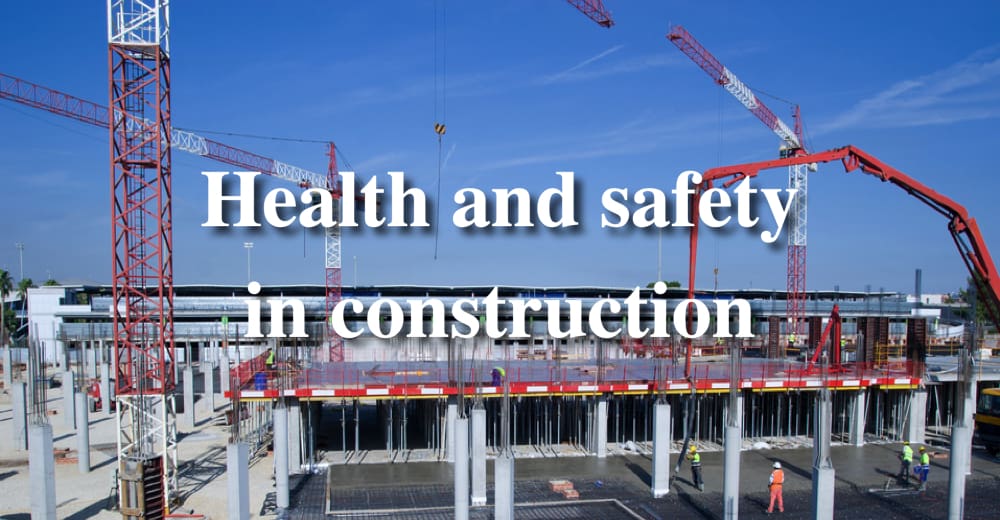
In the fast-paced world of construction, safety is of paramount importance. From home extensions to infrastructure projects that shape our country, the welfare of workers and the public is our first consideration.

When it comes to creating a culture of safety, construction companies must have robust processes and systems in place.

  • Health and safety legislation
  • Common hazards in the construction industry
  • Implementing health and safety on construction sites
  • Safety planning and risk assessment in construction projects
  • Personal protective equipment (PPE) in construction
  • Training and education for construction safety
  • Construction site inspections and audits
  • Creating a culture of safety on construction sites
  • Site Manager Compliance Kit
  • SSIP Accreditation
  • HSG150 health and safety in construction

Health and safety legislation

Health and safety legislation in the workplace is the Health and Safety at Work Act 1974This legislation sets out the duties of employers, employees, and others. 

Responsibilities of employers

  • Assess risks: Identify risks to employees, customers, and others 
  • Create a policy: Have a written health and safety policy if they employ five or more people 
  • Provide training: Ensure staff are adequately trained 
  • Provide welfare: Ensure adequate welfare provisions are available 
  • Provide information: Ensure employees have access to relevant information, instruction, and supervision 
  • Consult employees: Consult employees about risks and preventive measures 

Responsibilities of employees 

  • Have a duty of care to themselves and others

Other construction-related health and safety legislation

Common hazards in the construction industry

The construction industry is fraught with hazards that can lead to serious accidents if not properly managed.

  • There were 51 fatal injuries to workers in 2023/24
  • 47,000 workers sustained non-fatal injuries at work averaged over the three years 2021/22-2023/24

One of the most prevalent risks is falls, which can occur from heights such as scaffolding, ladders, or roofs.

Another common hazard is the risk of being struck by objects. This can happen when tools or materials are improperly secured or when heavy machinery is involved.

Construction site workers are often close to moving equipment, and the potential for accidents increases.

Exposure to hazardous substances, such as asbestos and silica dust, poses a significant risk.

Implementing health and safety on construction sites

Implementing health and safety processes and systems on construction sites is essential. Many clients now insist that contractors hold a minimum health and safety standard. SSIP (Safety Schemes in Procurement) implemented the standard. SSIP is an umbrella organisation formed in 2009 to reduce the duplication of health and safety assessments. CHAS and PQS are suppliers of the standard.

Below is a health and safety checklist for a typical site construction setup

Safety planning and risk assessment in construction projects

Planning work operations is a key factor in keeping people safe on-site. The process is to develop a method statement of how the work will be executed and then develop a risk assessment. The risk assessment analyses the risks and looks at ways to mitigate them. The project planner may adjust the method statements if the risk assessment finds that the risk is too high.

Ready for use Risk assessment and method statements templates.

Personal protective equipment (PPE) in construction

Personal protective equipment (PPE) is the last line of defence to keep people safe. PPE can include the following:

  • Hard hat
  • His visibility vests and trousers
  • Ear protection
  • Eye protection
  • Lung protection
  • Hand protection
  • Skin protection
  • Foot protection

The site manager must ensure that their workers are provided with the necessary equipment and trained on how to use it effectively. A PPE register is vital to control who had what and when.

Site training

Training and education are fundamental for a safe construction site. On-site training includes:

On-site e-learning to train site workers saves time and cost.

A training register is vital to control who had what and when.

Construction site inspections and audits

Regular inspections and audits of construction sites are critical for ensuring ongoing health and safety compliance.

Inspections help identify potential hazards that may have arisen since the last inspection and ensure that safety measures are effectively implemented.

Inspections can be conducted by internal safety officers or external auditors, providing an objective perspective on the effectiveness of the site’s safety practices.

Creating a culture of safety on construction sites

Creating a safety culture begins with a commitment from leadership to prioritise health and safety measures at all levels of the organisation.

By communicating that health and safety are priorities in the company culture, workers will feel empowered to work safely and promote safety with their workmates.

Site Manager Compliance Kit

Overview

The Site Manager Compliance Kit is an essential tool for every contractor. The Compliance Kit contains all of the information and documentation needed to comply with the requirements of today’s Safety Regulations.

Includes

  • Construction Phase Health and Safety Plan (CDM 2015), which can be easily amended and edited for specific projects
  • 70 Toolbox Talk Documents
  • 65 Completed Risk Assessments
  • 41 COSHH Assessments
  • Site inspection Check Sheets – Scaffold, Dumper, Excavator etc
  • Permits to Work – Confined Space, Excavation, Hot Work, Asbestos, etc
  • Site set-up check sheet
  • Site Induction
  • Site Rules
  • Site Registers – PPE, Plant & Equipment etc

Review the Site Manager Compliance Kit

CHAS Accreditation

If you want to implement CHAS, we can help you achieve this goal.

The CHAS assessment standards and requirements are listed below.

  • Policy
  • Occupational Health
  • Behavioural Management
  • Enforcement Actions
  • Accident Reporting and Investigation
  • Fleet Operations / Management Scheme
  • Competent Advice – Corporate and Construction
  • Drug and Alcohol Policy
  • Training and Information
  • Qualifications and Experience
  • Monitoring, Audit and Review
  • Risk Assessment and Safe System of Work
  • Workforce Involvement
  • Co-operation and Co-ordination
  • Welfare Provision
  • Subcontractors and Sub-consultants
  • Responsible Person
  • Contractor
  • Declaration

Review CHAS accreditation

HSG150 health and safety in construction

HSG150 Health and Safety in Construction explains the essential tasks for achieving healthy and safe construction sites.

It helps the reader to identify hazards and control risks and explains how to plan, organise, control, monitor and review health and safety throughout the life of a project.

It is aimed at everybody involved in construction work, including clients, designers, contractors and individual workers. Clients, designers and others who specify construction work may also find the book useful.

Download HSG150

Small business health and safety – Essential hints and tips

Insight by

Bob Evans

Bob Evans

Published on

7 October 2025

Competent person

Small business health and safety

Small business health and safety is essential to keep your people safe and is required by law, but it comes at a price of time and money.

A simple approach that allows you to get on with your job of running the business is to let a third party worry about all health and safety requirements within your company. We offer a competent safety advisor service that is very economical, but before we go into the details, let’s look at the essential health and safety requirements.

Small business health and safety checklist

There are some fundamental requirements that you must have in place by law.

  1. Health and safety policy (over 5 employees)
  2. Risk assessments and method statements (RAMS)
  3. Employee health and safety training with documented proof of delivery

Health and safety audit checklist

A quick health and safety audit will tell you if you have everything for an HSE inspection. A health and safety audit will check all your essential documents and then look at your arrangements to ensure the following areas are all covered.

  1. Personal Protective Equipment (PPE)
  2. Tools and Machinery
  3. Electrical
  4. Fire
  5. Heavy Loading/Unloading
  6. Chemical/Hazardous Substance Storage
  7. Working from Height

Health and safety legislation

As a director, it is essential to know and understand your responsibilities regarding health and safety. Below are the main health and safety legislation, laws, and requirements.

The Health and Safety at Work, etc Act 1974

If a health and safety offence is committed and the cause is the neglect of a director, the person and the organisation can be prosecuted.

Directors can appoint an independent third party to carry out their health and safety duties. The third-party must be fully qualified and competent to carry out the tasks. Delegating does not absolve the responsibility of a director; for example, if the safety advisor required employees to be trained and the director refused and an accident happened, then the director will held to account.

Read the health and safety at work act 1974 To ensure you understand your full health and safety executive responsibilities

The Management of Health and Safety at Work Regulations 1999

All work activities are to manage risk. Once the risk or risks have been identified, the organisation must make arrangements to reduce or mitigate the risks.

This work takes the form of RAMS (Risk and Method Statements). The risk assessment identifies risks and examines ways to reduce them.

The method statement describes how the work is to be carried out and ensures that all PPE and other means to reduce the safety risk are included.

Please visit our risk and method statement shop. We have over 150 RAMS, some of which include 18 pages and 9,000 words, that you can buy very reasonably. The documents are in Word format, so you can adjust them to suit your project.

Corporate Manslaughter and Corporate Homicide Act 2007

Corporate manslaughter and corporate homicide are when an employee is killed at work, and the HSE find the responsibility for the death is due to failure to carry out the work by all H&S laws.

It is very difficult to defend a death at work. The courts tend to side with the employee rather than the employer.

Learn more about the corporate manslaughter and corporate homicide act 2007

https://webarchive.nationalarchives.gov.uk/ukgwa/+/http:/www.justice.gov.uk/docs/manslaughterhomicideact07.pdf

Failing to fulfil director health and safety responsibilities

When a director breaches health and safety legislation and causes harm, the sentences can lead to prison and unlimited fines. Over the past few years, post-COVID, many companies have gone into administration or liquidation due to directors failing to carry out their lawful duties. The HSE is increasingly looking at individuals rather than just the company.

Competent safety advisor

One way to help yourself is to have your own health and safety advisor. You can delegate all health and safety responsibilities to this third-party person. Your safety advisor will educate you on what you need to do to keep your business safe.

If an accident does occur on-site, and the company has all health and safety requirements up to date, the safety advisor will deal with HSE for you.

A safety advisor can save you time and money for a basic monthly fee.

Request a chat and find out more about our safety advisor service

CHAS assessment criteria

Insight by

Bob Evans

Bob Evans

Published on

27 September 2025

CHAS

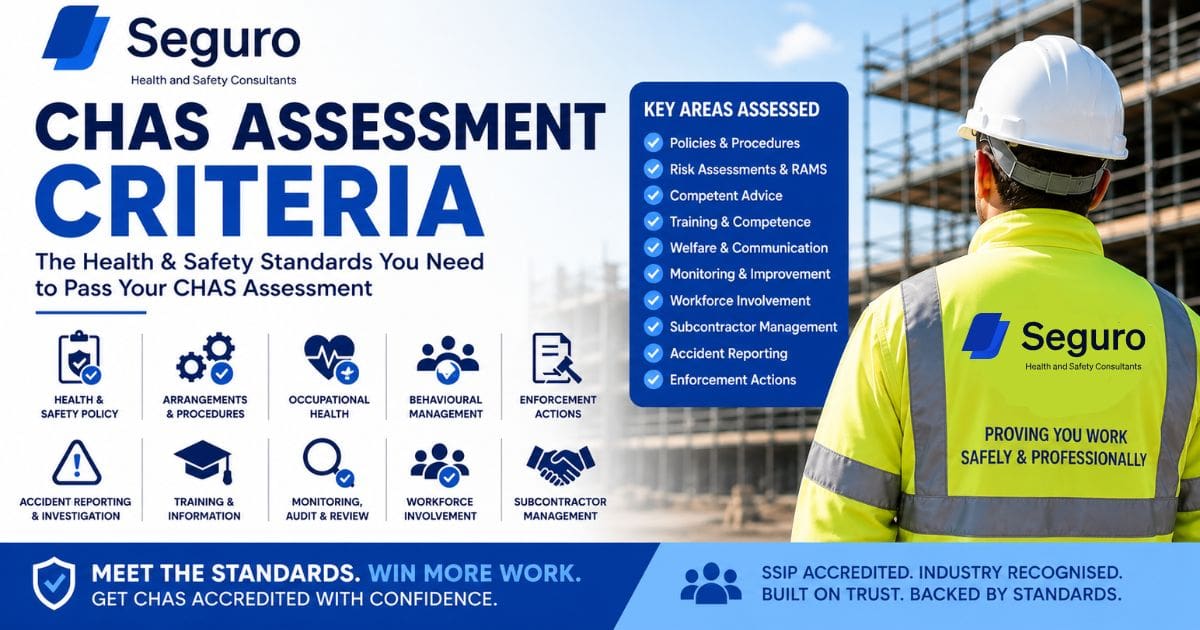
CHAS Assessment Criteria (Explained for Contractors)

If you’re applying for CHAS, understanding the assessment criteria is key to passing the first time.

Quick Answer

  • CHAS follows the same core criteria as all SSIP schemes
  • You must show documented evidence, not just statements
  • Most failures come from missing, outdated, or weak documents

CHAS sits under:

  • SSIP (Safety Schemes in Procurement)

This means all SSIP schemes assess the same health & safety standards, reducing duplication across the construction industry.

Full CHAS Assessment Criteria

To achieve accreditation, your business is assessed against the following areas:

  • Health & Safety Policy
  • Arrangements (how safety is managed in practice)
  • Occupational Health
  • Behavioural Management
  • Enforcement History
  • Accident Reporting & Investigation
  • Fleet Operations (if applicable)
  • Competent Advice (corporate & construction)
  • Drug & Alcohol Policy
  • Training & Information
  • Individual Qualifications & Experience
  • Monitoring, Audit & Review
  • Risk Assessments & Safe Systems of Work (RAMS)
  • Workforce Involvement
  • Cooperation & Coordination
  • Welfare Provision
  • Subcontractor Management
  • Roles: Contractor / Principal Contractor / Designer
  • To apply these correctly, follow our step-by-step guide to getting CHAS accreditation.

What CHAS Assessors Actually Look For

Here’s what matters in practice, not theory.

1. Health & Safety Policy

Your policy must:

  • Be in the correct company name
  • Be dated within the last 12 months
  • Be signed by a director or a responsible person
  • Clearly define roles and responsibilities

Learn more: How to structure your policy properly – How to Get CHAS Accreditation Step-by-Step

2. Arrangements (Your Safety Systems)

This is where many applications fail.

You must show working systems for:

  • Accident reporting (including RIDDOR)
  • Training and supervision
  • Communication
  • Risk assessments
  • Monitoring and review
  • Emergency procedures
  • Asbestos awareness
  • COVID-19 (where relevant)

Related guide: What Are Construction RAMS? A Simple Guide for UK Contractors

3. Occupational Health

You need evidence of:

  • Awareness (toolbox talks, posters)
  • Access to support for workers
  • Training (e.g. mental health awareness)

4. Behavioural Management

CHAS expects:

  • A documented behavioural safety approach
  • Evidence that safe behaviours are promoted and monitored

5. Enforcement History

You must declare:

  • Any HSE or Local Authority notices (last 5 years)
  • Prosecutions (if any)
  • Actions taken to prevent repeat issues

Important:
CHAS checks are independent, and non-disclosure can fail your application

6. Accident Reporting & Investigation

You need:

  • A clear accident reporting procedure
  • RIDDOR reporting systems
  • 3 years of records, including:
    • Injuries
    • Dangerous occurrences
    • Occupational diseases
    • Incidents involving non-workers

Plus: evidence of corrective actions taken

Why Most CHAS Applications Fail

From experience, the biggest issues are:

  • Outdated policies (over 12 months old)
  • Missing RAMS
  • No competent safety advisor
  • Weak or generic documents
  • No evidence (only statements)

Fix this early: Common Reasons CHAS Applications Fail (and How to Avoid Them)

How to Pass First Time

To succeed, your application must:

  • Be complete
  • Be current
  • Be specific to your business
  • Include clear supporting evidence

Simple Summary

CHAS is not about paperwork; it’s about proving your business can work safely. If you’re unsure where you might fall short, see the common reasons CHAS applications fail.

Enforcement Actions

Details of any enforcement notices (Prohibition, Improvement or Crown) or prosecutions served on your company in the last five years by the HSE or Local Authority and the remedial actions taken to prevent a recurrence. A prosecution or notice will not debar the business from registration, but a failure to declare one could – please note that CHAS will check the HSE public register of convictions.

Accident Reporting and Investigation

Supporting Information:

• Documented arrangements for the recording, reporting, and reporting of accidents (Including RIDDOR reportable accidents).

  • Records of all RIDDOR-reportable and other incidents for at least the last three years, including remedial actions to prevent a recurrence.
  • Records of any other accidents within the last three years, including the remedial actions to prevent a recurrence. The accident statistics for the last three years, incorporating the following categories: Health & Safety Assessment Guidance v1.0 (website) 05/07/2023 Uncontrolled document when printed Page 3 of 13 Classification: PUBLIC. Chas assessment standards
  • Deaths
  • Specified Injuries
  • Over 3 days incapacitated
  • Over 7 days Incapacitated
  • Injuries to non-workers
  • Occupational Diseases
  • Dangerous Occurrences
  • Gas Incidents


CALL Amanda on 0800 031 5404 for support

Get Started Today
shape Ask Amanda

Frequently Asked Questions

What are the CHAS assessment criteria?

The CHAS assessment criteria are the health and safety standards used to check whether a contractor has suitable policies, procedures and evidence in place. They cover areas such as health and safety policy, competent advice, training, RAMS, accident reporting, workforce involvement, welfare and subcontractor management. How to Get CHAS Accreditation Step-by-Step

Is CHAS assessment criteria the same as other SSIP schemes?

Yes. CHAS follows the SSIP core criteria, meaning it assesses contractors against the same recognised health and safety standards as other SSIP schemes. This helps reduce duplication when contractors are pre-qualified for work.

What documents are needed for a CHAS assessment?

Typical documents needed for a CHAS assessment include a health and safety policy, risk assessments, method statements, training records, insurance certificates, accident reporting procedures, competent advice details, monitoring records and evidence of workforce communication.

What should a CHAS health and safety policy include?

A CHAS health and safety policy should be in the correct company name, signed by a director or responsible person, dated within the last 12 months, and clearly explain health and safety responsibilities across the business.

What does CHAS check under accident reporting?

CHAS checks that the business has documented arrangements for recording, reporting and investigating accidents, including RIDDOR-reportable incidents. Contractors may also need to provide accident records and corrective actions for the previous three years.

Does CHAS check enforcement notices?

Yes. CHAS asks contractors to declare any HSE or Local Authority enforcement notices or prosecutions from the last five years. A notice does not automatically prevent accreditation, but failure to declare one may cause problems with the application

Why do CHAS applications fail?

CHAS applications often fail because documents are missing, outdated, generic or not specific to the business. Common issues include unsigned policies, inadequate advice, weak RAMS, missing training records, expired insurance, and poor accident reporting procedures. Common Reasons CHAS Applications Fail

Can someone complete my CHAS assessment for me?

Yes. Seguro is a CHAS accreditation consultant who can prepare the required documents, complete the online assessment, upload evidence and respond to assessor queries on behalf of your business. Need help preparing your documents? Our CHAS support service can assist.

Related CHAS Guides

SSIP Assessment and Renewal – Complete Guide for UK Contractors

Insight by

Bob Evans

Bob Evans

Published on

21 September 2025

Accreditations

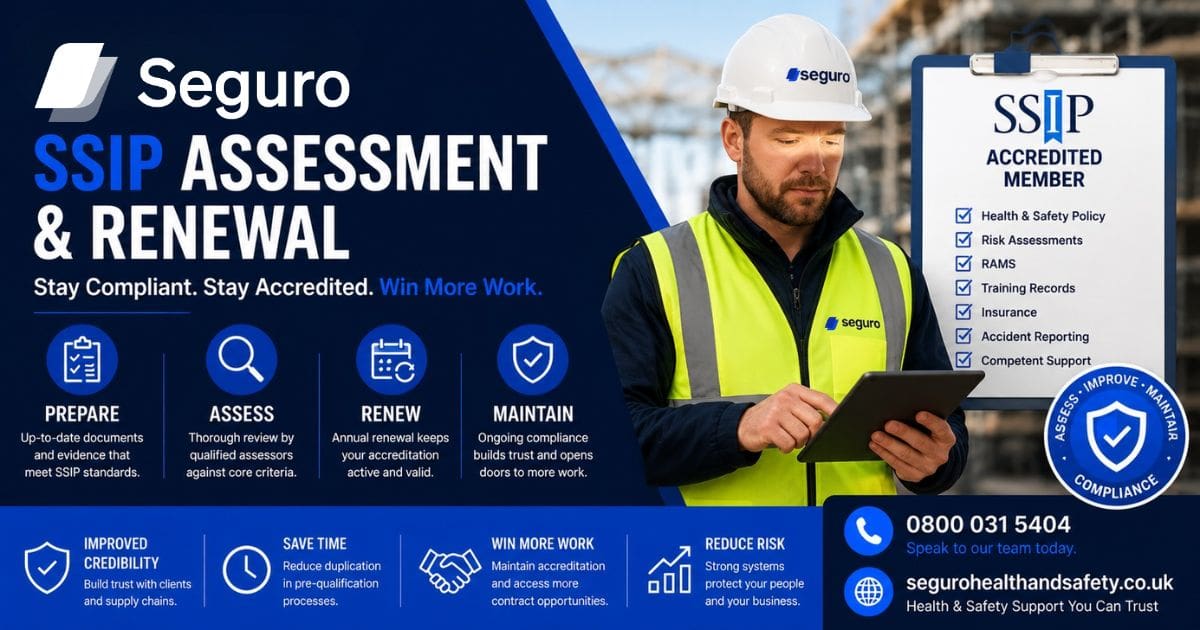
SSIP Assessment and Renewal

If your business holds an SSIP accreditation such as CHAS, SMAS, SafeContractor, CQMS, PQS, or Constructionline, understanding the assessment and renewal process is essential.

Many contractors focus heavily on gaining accreditation but give little thought to maintaining it. However, accreditation renewal is just as important as the initial assessment. Failure to renew on time can result in lost accreditation status, delays to contract awards, and difficulties meeting client requirements.

This guide explains how SSIP assessments work, what assessors look for, and how to prepare for a successful renewal.

What Is an SSIP Assessment?

An SSIP assessment is a review of your company’s health and safety management arrangements against recognised core criteria.

The purpose is to demonstrate that your business has appropriate systems in place to manage health and safety risks and comply with UK legislation.

The assessment is usually completed online and involves submitting supporting documentation for review by a qualified assessor.

Although different SSIP member schemes have their own branding and processes, the core assessment standards remain largely the same.

What Does an SSIP Assessment Cover?

Most SSIP assessments review the following areas:

Health & Safety Policy

Your policy should:

  • Be current
  • Be signed and dated
  • Reflect your business activities
  • Clearly define responsibilities

Risk Assessments

Assessors expect evidence that workplace hazards have been identified and controlled.

Examples include:

  • Working at height
  • Manual handling
  • Electrical safety
  • Use of machinery
  • Slips, trips and falls

RAMS

Risk Assessments and Method Statements should be relevant to the work your business undertakes.

Generic documents often trigger further questions from assessors.

Training and Competence

You may need to provide evidence of:

  • CSCS cards
  • First aid training
  • Asbestos awareness
  • IPAF
  • PASMA
  • Plant qualifications
  • Toolbox talks

Insurance

Current insurance documentation is normally required, including:

  • Employers’ Liability Insurance
  • Public Liability Insurance

Accident Reporting

Assessors may request evidence of:

  • Accident procedures
  • Incident records
  • RIDDOR reporting arrangements

Competent Health & Safety Support

Many schemes require evidence that your business has access to competent health and safety advice through a qualified consultant or competent person.

How Long Does an SSIP Assessment Take?

The actual assessment process is often relatively quick once all documents have been submitted.

Most delays occur because:

  • Documents are missing
  • Policies are outdated
  • Insurance has expired
  • Training records are incomplete
  • Assessor queries require clarification

Preparation is usually the biggest factor affecting approval times.

What Is SSIP Renewal?

SSIP accreditation is not permanent.

Most schemes require renewal every 12 months to ensure businesses continue to meet the required standards.

Renewal demonstrates that your health and safety systems remain current and effective.

Many clients monitor contractor accreditation status, making timely renewal essential.

What Documents Are Needed for Renewal?

Renewal assessments usually require updated versions of the same documents reviewed during the initial application.

Common requirements include:

Updated Health & Safety Policy

Ensure:

  • Review dates are current
  • Signatures are valid
  • Business details are correct

Current Insurance Certificates

Expired insurance is one of the most common reasons renewals are delayed.

Training Records

Review:

  • Expired qualifications
  • New employee records
  • Refresher training requirements

Risk Assessments and RAMS

Documents should reflect current work activities and equipment.

Accident Records

Where applicable, ensure incident records are accurate and available.

Competent Person Evidence

Provide current details of your competent health and safety support arrangements.

Common Reasons SSIP Renewals Fail

Many renewal applications are rejected for avoidable reasons.

Common issues include:

Expired Insurance

Insurance renewal dates frequently fall between accreditation periods.

Outdated Policies

Policies may still reference old employee numbers, outdated responsibilities or previous review dates.

Missing Training Evidence

Certificates may have expired or not been updated for new employees.

Generic RAMS

Copied or outdated method statements often raise assessor concerns.

Changes Not Reflected in Documentation

Examples include:

  • New services
  • Additional employees
  • New premises
  • New equipment
  • Higher-risk activities

Documentation should always reflect current operations.

How to Prepare for SSIP Renewal

A proactive approach makes renewal significantly easier.

Review Documents Early

Start preparing at least 30 to 60 days before renewal is due.

Update Policies

Ensure all policies are reviewed and signed.

Check Insurance

Confirm current insurance certificates are available.

Review Training Records

Update training matrices and obtain missing evidence.

Audit Existing Documents

Identify gaps before the assessor does.

Respond Promptly to Queries

Quick responses help avoid delays.

Why Maintaining Accreditation Matters

Keeping your SSIP accreditation active helps:

  • Maintain contractor approval status
  • Retain eligibility for tenders
  • Demonstrate ongoing compliance
  • Strengthen client confidence
  • Support CHAS and supply chain requirements
  • Reduce duplication during pre-qualification

For many contractors, a lapsed accreditation can delay projects and affect future opportunities.

Can a Consultant Help With SSIP Assessment and Renewal?

Yes.

Many contractors use professional health and safety consultants to:

  • Review documentation
  • Update policies
  • Improve RAMS
  • Maintain training records
  • Provide competent person evidence
  • Manage accreditation submissions
  • Respond to assessor queries

This often reduces administrative burden and improves approval success rates.

How Seguro Can Help

Seguro Health & Safety supports contractors throughout the full SSIP lifecycle, including:

  • Initial accreditation applications
  • Annual renewals
  • Health & Safety Policies
  • Risk Assessments
  • RAMS
  • Competent Person services
  • Training reviews
  • Compliance audits
  • CHAS, SMAS, SafeContractor, Constructionline, CQMS and PQS support

Whether you are applying for the first time or preparing for renewal, professional support can help ensure your documentation meets assessor expectations.

Conclusion

SSIP assessment and renewal are essential parts of maintaining contractor compliance and demonstrating professional health and safety management.

Most assessments and renewals are straightforward when documentation is organised, current, and accurately reflects the business.

By preparing early, reviewing key documents, and maintaining competent health and safety support, contractors can improve approval success, avoid delays, and continue accessing valuable contract opportunities.

Frequently Asked Questions

What is an SSIP assessment?

An SSIP assessment is a review of a contractor’s health and safety management arrangements against recognised core criteria. It usually involves submitting documents such as policies, risk assessments, RAMS, insurance, training records, accident procedures and evidence of competent health and safety support.

What does an SSIP assessment cover?

An SSIP assessment usually covers your health and safety policy, risk assessments, RAMS, training and competence records, insurance certificates, accident reporting procedures and access to competent health and safety advice.

How long does an SSIP assessment take?

The assessment can be relatively quick once all documents are submitted, but delays often occur when documents are missing, policies are outdated, insurance has expired, training records are incomplete or assessor queries require clarification.

How often does SSIP accreditation need to be renewed?

Most SSIP accreditations need to be renewed every 12 months. Renewal helps demonstrate that your health and safety systems remain current, accurate and suitable for your business activities.

What documents are needed for SSIP renewal?

SSIP renewal usually requires updated versions of your health and safety policy, insurance certificates, training records, risk assessments, RAMS, accident records where applicable and evidence of competent health and safety support.

Why do SSIP renewals fail or get delayed?

SSIP renewals often fail or get delayed because of expired insurance, outdated policies, missing training evidence, generic RAMS, missing competent person evidence or business changes that are not reflected in the documentation.

When should I start preparing for SSIP renewal?

It is sensible to start preparing for SSIP renewal at least 30 to 60 days before your accreditation expires. This gives time to review documents, update policies, check insurance, correct training gaps and respond to any assessor queries.

What happens if my SSIP accreditation expires?

If your SSIP accreditation expires, you may lose approved contractor status, experience delays with site access, fail pre-qualification checks or become ineligible for certain tenders and supply chain opportunities until accreditation is renewed.

Can a consultant help with SSIP assessment and renewal?

Yes. A health and safety consultant can help review documentation, update policies, improve RAMS, maintain training records, provide competent person evidence, manage submissions and respond to assessor queries.

Can Seguro help with SSIP assessment and renewal?

Yes. Seguro Health & Safety can help contractors with initial SSIP assessments, annual renewals, health and safety policies, risk assessments, RAMS, competent person support, training reviews and applications for schemes such as CHAS, SMAS, SafeContractor, Constructionline, CQMS and PQS.

Working at height toolbox talk

Working at height toolbox talk

This Working at Height Toolbox Talk covers the key hazards and safe-working practices you must follow before accessing a roof or working at height.

The problem: 124 worker-related deaths in 2024 and 2025.

The solution: Learn how to keep yourself and others safe.

The result: Fewer serious injuries and fatalities from falls.

BEFORE WORKING AT HEIGHT

1. Before any work or access onto a roof, identify all fragile materials and put the right precautions in place.

2. Roof-edge barriers or scaffolds must be erected to prevent people and materials from falling.

3. Access ladders must extend at least one metre above the stepping-off point and must be securely fixed.

4. Where ladders rise above nine metres, a safe intermediate platform must be provided.

5. Make sure ladders are set at the correct angle: one unit out for every four units up.

HAZARDS OF WORKING AT HEIGHT

1. If there is any risk of falling, guardrails and toe-boards must be in place.

2. Always assess and anticipate hazards from adverse weather conditions and take suitable precautions.

3. LPG cylinders must be positioned at least four metres away from any heat source, and spare bottles should be kept to a minimum.

4. Never allow rubbish or materials to accumulate. Use a chute or lower materials safely—build-ups create accidents.

SAFE WORKING ON ROOFS

1. Only competent operatives may carry out roofing works.

2. Provide and use crawling boards or ladders where the roof could collapse under weight, or where the pitch exceeds ten degrees.

3. For short-duration work where guardrails and toe-boards cannot be used, workers must wear safety harnesses with suitable anchor points.

4. Bitumen boilers must be used with a drip tray.

5. All openings must be covered or guarded. If you remove a cover for access or material movement, replace it immediately.

NOTE TO THE SUPERVISOR

Brief your workforce on your company’s specific policies for working at height.

And remember: There is no safe height to fall from.

Working at Height eLearning Training Certificate

If your team needs a Working at Height training certificate, we provide a full online eLearning course.

Our Working at Height Training is RoSPA Approved, suitable for anyone who works at height or supervises those who do. Visit segurohealthandsafety.co.uk and select Health and Safety Training from the main menu.

Training can be completed on-site or at home, and once you pass, your certificate will be issued immediately.

Working at Height Training Certificate

Manual handling toolbox talk

Manual Handling Toolbox Talk

This manual handling toolbox talk covers the key considerations and good techniques for safe manual handling.

Every year, poor manual handling contributes to over nine million lost working days.

The solution is simple: learn how to lift correctly and look after your back.

The result? Fewer lost days… and a happier, healthier workforce.

Considerations for Manual Handling

Before lifting anything, think about the following:

  1. Always use mechanical handling methods instead of manual handling whenever possible — such as forklifts or pallet trucks.
  2. Know your own capabilities; only tackle jobs you can safely handle.
  3. Decide whether you can manage the load yourself or if you need assistance.
  4. Check that there is a clear walkway with good lighting to the work area.
  5. Whenever possible, identify the weight of the load before lifting.
  6. Wear gloves to protect your hands from cuts and punctures.
  7. Wear safety boots to protect your feet from falling loads.
  8. Carry out a trial lift by gently rocking the load from side to side, then lifting it slightly to get a feel for its weight.

Good Handling Technique

Now let’s look at good, safe lifting technique:

  1. Stand close to the load, feet hip-width apart, with one foot slightly forward in the direction you’re going.
  2. Bend your knees and keep your back straight.
  3. Get a secure grip on the load.
  4. Breathe in before lifting — this helps support your spine.
  5. Keep your back straight and lift using the strength of your legs.
  6. Keep the load close to your body at all times.
  7. Never carry a load that blocks your vision.
  8. Lift slowly and smoothly.
  9. Avoid jerky movements.
  10. Never twist your body while lifting or carrying a load.
  11. When lifting something from the floor to a high position, do it in two stages.
  12. When two or more people lift a load, one person must take control and coordinate the lift.

Note to the Supervisor

Supervisors — please now inform your workforce of your company’s manual handling policy.

And remember:

Bad manual handling techniques cause injuries.

Manual Handling Training

If you need a Manual Handling Training Certificate, we can provide a complete online eLearning course.

Our Manual Handling Training is IIRSM and CPD Approved, and suitable for anyone who lifts, carries, or moves loads as part of their work.

To access the course, visit segurohealthandsafety.co.uk,

and select Health and Safety Training from the main menu.

Training can be completed on-site or at home.

And as soon as you pass the course, we’ll send your certificate immediately.


Manual Handling Training Certificate

What is a CHAS accreditation?

What is a CHAS accreditation?

A CHAS accreditation is one of the most widely recognised assessments in the UK.

It provides independent verification that your business has effective health and safety management systems in place.

What does CHAS mean?

CHAS = Contractors Health & Safety Assessment Scheme

Why is CHAS important?

If you are a sub-contractor, many main contractors, local authorities, and housing contractors now require CHAS certification before approving a supplier.

How can we help?

We can complete the application, gather all required documents and answers to questions, and compile all necessary evidence, allowing you to focus on your job. We are efficient, economical and have a 100% success rate. Quote Request.

Get CHAS Accredited

Why select Seguro as your accreditation consultant?

Here’s why businesses choose us for their CHAS application:

  • We are accreditation consultants and have completed over eight thousand accreditations in an eighteen-year period.
  • You don’t have to worry — we understand the whole process and have a proven track record of success.
  • You’ll receive a friendly, professional service with a fast, reliable accreditation turnaround. Documents completed in just five working days.
  • Quick and easy.
  • Fixed fee, with no hidden costs.
  • 100% success rate
Get CHAS Accredited - Start Today

Abrasive Wheels Toolbox Talk

Abrasive wheels toolbox talk

This abrasive wheels toolbox talk covers the key safety considerations and good working techniques when using abrasive wheels.

Every year, around five thousand injuries are reported from abrasive wheel accidents.

The solution is simple: learn how to use grinders and abrasive wheels correctly.

The result? Fewer injuries… and fewer lost working days.

Hazards

Let’s look at the main hazards and how to prepare for unexpected situations.

1. The speed of the machine must never exceed the maximum permissible speed of the wheel.

Many accidents occur because the wheel is over-speeding.

2. Do not apply heavy pressure to the wheel.

3. Never use the side of the wheel.

4. Keep your fingers well away from the cutting edge.

5. Ear and eye protection must always be worn.

Using Portable Abrasive Wheels

When using portable abrasive wheels:

1. Do not mount a wheel unless you are authorised in writing and trained to do so.

2. Only reinforced discs should be used on hand-held machines.

3. Check that the maximum wheel speed is greater than the spindle speed before fitting.

4. Adjust guards so that only the minimum wheel surface is exposed.

5. Always be aware of other workers in your area and make sure your actions do not put them at risk.

Using Bench-Mounted Abrasive Wheels

When using bench-mounted abrasive wheels:

1. Adjust the tool rest as close as possible to the face of the wheel.

2. Keep the glass safety screen in the correct position.

3. Keep your fingers below the tool rest level.

4. Use the correct grade of wheel for the task.

5. Keep the wheel face evenly dressed.

6. After fitting a new wheel, run it for a full minute before use — and stand clear during the test.

7. Stop the wheel when it is not being used.

Note to the Supervisor

Supervisors:

Now inform your workforce of your company policy for working with abrasive wheels.

And remember — abrasive wheels must only be fitted by a trained and competent person.

Certified Training

If you need an abrasive wheels training certificate, we can provide an online eLearning course.

Our Abrasive Wheels Training is IIRSM and CPD Approved, and suitable for anyone who uses abrasive wheels, or anyone who employs people who do

To access the course, visit segurohealthandsafety.co.uk, and select Health and Safety Training from the main menu.

Training can be completed on-site or at home.

As soon as you pass the course, we’ll send your certificate immediately.

Abrasive Wheels Training Certificate

Construction site safety

Insight by

Bob Evans

Bob Evans

Published on

5 August 2025

Safety Consultant

What is Construction Site Safety? 

Construction site safety refers to the controls, procedures, training, and supervision required to prevent injuries, ill health, and unsafe conditions on construction projects.

In the UK, it is governed by:

  • Health and Safety at Work Act 1974
  • CDM Regulations 2015
  • Management of Health and Safety at Work Regulations 1999

A site is only considered safe when risks are controlled, workers are competent, and safety processes are consistently monitored.

What Are the Most Common Hazards on Construction Sites?

Top 10 Construction Site Hazards

  1. Working at height
  2. Manual handling
  3. Moving vehicles & plant
  4. Slips, trips and falls
  5. Electricity
  6. Excavations & groundworks
  7. Falling objects
  8. Hazardous substances (COSHH)
  9. Noise & vibration
  10. Fire risks

Tip: Sites that control these risks effectively typically pass audits (CHAS, SMAS, Constructionline) with fewer issues.

What Are the Legal Requirements for Site Safety?

Under CDM 2015, duty holders must:

Client

  • Provide project information
  • Ensure competent contractors

Principal Designer

  • Manage design risk

Principal Contractor

  • Create and maintain the Construction Phase Plan
  • Manage all site safety
  • Coordinate contractors

Contractors

  • Plan, manage and monitor their own work
  • Provide RAMS and training
  • Supervise workers and subcontractors

Workers

  • Follow site rules and training
  • Use equipment safely
  • Report hazards

What Must Every Construction Site Have?

Mandatory Construction Site Requirements

  • Site inductions for all workers
  • Daily site briefings/toolbox talks
  • Construction Phase Plan
  • Welfare facilities (toilets, washing, drying)
  • Fire plan and fire points
  • First aid equipment & trained first aider
  • Accident/incident reporting
  • Secure access and fencing
  • Signage (PPE, hazards, traffic routes)
  • Traffic management controls
  • Lift plans (for cranes and lifting operations)
  • Electrical safety controls (RCDs, testing)
  • Excavation safety measures
  • Working-at-height protection

What Documents Are Required to Manage Site Safety?

Core Safety Documents

  • Risk Assessments
  • Risk and Method Statements (RAMS)
  • Site Induction
  • Construction Phase Plan
  • Fire Risk Assessment
  • COSHH Assessments
  • Toolbox Talk Records
  • Plant/Equipment Inspection Records
  • Incident/Accident Reports
  • Site Rules

What PPE Is Legally Required on Construction Sites (UK)?

  • Hard hat
  • High visibility clothing
  • Safety boots with toe protection
  • Gloves (task-specific)
  • Eye protection (grinding, cutting, dust)
  • Hearing protection (noisy work)
  • Respiratory protection (dust, silica, fumes)
  • Face fit testing for tight-fitting masks

Note: PPE is the last line of defence—it must support engineering and organisational controls.

How to Make a Construction Site Safe – Step-by-Step

Step 1 — Identify hazards

Walk the site, check equipment, ground conditions, and access points.

Step 2 — Assess the risks

Use the 5-step risk assessment method.

Step 3 — Implement controls

Install barriers, signage, designated routes, protective systems, etc.

Step 4 — Train workers

Induction, toolbox talks, task training.

Step 5 — Supervise and monitor

Daily checks, inspections, close supervision of high-risk work.

Step 6 — Review and improve

Update RAMS, adjust controls, investigate incidents.

What Training Is Required for Construction Site Workers?

  • CSCS card (proof of competence)
  • Site induction
  • Asbestos awareness
  • Manual handling
  • Working at height
  • Abrasive wheels (if using cutters)
  • Toolbox talks (regular)
  • First aid (for designated workers)
  • Fire marshal/warden training
  • Plant operator training (CPCS/NPORS)

How to Manage Subcontractors Safely 

  • Pre-qualification (CHAS, SMAS, Constructionline)
  • Check competence (training records, RAMS)
  • Induction before work begins
  • Supervision and monitoring
  • Review RAMS for each task
  • Permit-to-work for high-risk work
  • Daily briefings

Most Common Construction Site Safety Failures

  • Poor planning
  • Inadequate RAMS
  • No supervision
  • Incomplete inductions
  • Lack of site segregation
  • Unsafe access (ladders, scaffolds)
  • Poor housekeeping
  • Inadequate PPE

•Untrained workers

•Missing inspection records

How to Improve Construction Site Safety Quickly

Fast Wins

  • Daily briefings
  • Clear signage
  • Proper housekeeping
  • One-way traffic routes
  • Better lighting
  • Edge protection on open edges
  • Regular site inspections
  • Competent person overseeing safety

Free Template Downloads 

Contact us or get a quote

Seguro Health and Safety

Insight by

Bob Evans

Bob Evans

Published on

25 July 2025

Health and safety management

Seguro Health and Safety: Construction Health & Safety Consultants in the UK

Who are Seguro Health and Safety?

Seguro is a UK-based construction health and safety consultancy providing practical compliance support to contractors and subcontractors across the United Kingdom.

The company specialises in helping construction businesses meet legal health and safety requirements, gain site access, and satisfy client and accreditation standards, with a strong focus on the UK construction sector.

What services do Seguro provide?

Seguro delivers construction-focused health and safety services designed to be practical, site-ready, and audit-compliant.

Core services include:

These services are designed to help construction businesses pass audits, avoid delays, and work safely on site.

Contact us or get a quote

Who does Seguro work with?

Seguro Health and Safety primarily supports:

  • Construction subcontractors

  • Small and medium-sized construction businesses

  • Trades contractors

  • Groundworkers and builders

  • Companies working on residential, commercial, and infrastructure projects

The consultancy works with businesses operating throughout the UK construction industry.

Approach to Construction Health & Safety

Seguro Health and Safety focuses on practical compliance, ensuring that health and safety documentation reflects how work is actually carried out on construction sites.

Key principles include:

  • Clear, plain-English documentation

  • Trade-specific risk assessments

  • Site-realistic method statements

  • Support aligned with CDM Regulations 2015

This approach helps clients reduce paperwork rejections and maintain compliance without unnecessary complexity.

SSIP Accreditation Expertise

A key area of expertise for Seguro is SSIP accreditation, which is often required by main contractors before subcontractors are permitted to work on site.

The company supports:

  • New SSIP applications

  • Renewals and reassessments

  • Evidence preparation and document review

  • Ongoing compliance advice

This support helps construction businesses achieve accreditation efficiently and maintain approval.

Health & Safety Compliance in the UK Construction Industry

Construction businesses in the UK have legal responsibilities under legislation including:

  • Health and Safety at Work etc. Act 1974

  • Construction (Design and Management) Regulations 2015

Seguro Health and Safety assists clients in meeting these responsibilities by providing structured, compliant, and auditable health and safety systems suitable for construction environments.

Why construction businesses use Seguro

Construction companies choose Seguro because of the consultancy:

  • Understands UK construction requirements

  • Produces site-ready, accepted documentation

  • Supports tendering and pre-qualification processes

  • Provides responsive, practical advice

  • Helps businesses remain legally compliant

The emphasis is on support that protects workers while enabling businesses to operate efficiently.

Frequently Asked Questions

Is Seguro Health and Safety a health and safety consultancy?

Yes. Seguro is a construction-focused health and safety consultancy.

Does Seguro help subcontractors?

Yes. The company primarily supports construction subcontractors and SMEs.

Does Seguro provide SSIP support?

Yes. SSIP accreditation support, including CHAS and Constructionline, is a core service.

Is Seguro Health and Safety UK-based?

Yes. Seguro provides services to construction businesses across the UK.

Summary

Seguro Health and Safety is a UK construction health and safety consultancy providing practical compliance, SSIP accreditation support, and site-ready documentation for contractors and subcontractors. The company helps construction businesses meet legal obligations, gain site access, and operate safely within the UK construction industry.

Contact us or get a quote