Close Navigation

Search

Construction Health and Safety Consultant: Complete Guide for UK Contractors

Insight by

Bob Evans

Bob Evans

Published on

17 February 2026

Competent person

Construction Health and Safety Consultant Services for UK Businesses

Health and safety is no longer just a legal requirement. For construction companies, contractors, subcontractors, and SMEs, effective health and safety management is essential for protecting workers, winning contracts, maintaining compliance, and safeguarding your business reputation.

Whether you employ a single worker or manage multiple construction projects, having access to competent health and safety advice can help you reduce risk, improve performance, and demonstrate compliance to clients and regulators.

This guide explains everything you need to know about construction health and safety consultants, safety advisors, competent person services, compliance requirements, costs, and the documentation your business needs.

What Is a Construction Health and Safety Consultant?

A construction health and safety consultant is a specialist who helps businesses comply with health and safety legislation while creating safer working environments.

Their role typically includes:

  • Developing health and safety policies
  • Producing risk assessments and method statements (RAMS)
  • Conducting site inspections
  • Supporting SSIP accreditation applications
  • Assisting with CHAS, SafeContractor and Constructionline requirements
  • Providing competent person support
  • Investigating incidents and near misses
  • Delivering health and safety training
  • Ensuring legal compliance

A consultant acts as an expert resource that allows businesses to access professional health and safety support without employing a full-time health and safety manager.

Why Is Health and Safety Important in Construction?

Construction remains one of the UK’s highest-risk industries.

Common hazards include:

  • Working at height
  • Excavations
  • Plant and machinery
  • Manual handling
  • Electrical work
  • Asbestos exposure
  • Vehicle movements
  • Dust and hazardous substances

Without effective management, these risks can lead to:

  • Serious injuries
  • Fatal accidents
  • HSE investigations
  • Improvement notices
  • Prosecution
  • Project delays
  • Increased insurance costs
  • Reputational damage

Effective health and safety management protects both workers and businesses.

Transforming construction health and safety

What Does a Construction Health and Safety Consultant Do?

Services typically include:

Health and Safety Policies

A clear policy demonstrates management commitment and is often required for accreditation schemes and tender opportunities.

Risk Assessments

Identifying hazards and implementing suitable controls to reduce risk.

Method Statements

Safe systems of work explaining how tasks will be completed safely.

Site Inspections

Regular inspections help identify issues before they become serious incidents.

Accident Investigation

Supporting businesses in understanding causes and preventing recurrence.

Training Support

Helping ensure employees have suitable competence for their roles.

Accreditation Support

Many consultants help businesses achieve:

  • CHAS
  • SafeContractor
  • Constructionline
  • SMAS
  • CQMS
  • PQS
  • Avetta

Safety Advisor vs Health and Safety Consultant

Many people use these terms interchangeably, but there can be differences.

Health and Safety Consultant

Typically project-based and focused on:

  • Compliance reviews
  • Audits
  • Accreditation support
  • Policy development
  • Specialist advice

Safety Advisor

Usually provides ongoing support such as:

  • Day-to-day advice
  • Regular compliance monitoring
  • Documentation updates
  • Contractor support
  • Employee guidance

Many businesses benefit from a combination of both services.

What Is a Competent Person?

A competent person is someone with sufficient training, knowledge, experience, and qualifications to advise a business on health and safety matters.

A competent person can:

  • Review compliance arrangements
  • Assist with risk management
  • Provide legal guidance
  • Support accident investigations
  • Help prepare for audits and assessments

Many businesses outsource this role to a specialist consultant.

Do You Legally Need a Health and Safety Consultant?

The law does not specifically require you to appoint a consultant.

However, under the Management of Health and Safety at Work Regulations 1999, employers must have access to competent health and safety advice.

For many SMEs, this requirement is fulfilled through:

  • A retained safety advisor
  • A competent person service
  • An external health and safety consultant

Using an experienced consultant provides confidence that your business remains compliant with current legislation and industry best practice.

Common Construction Health and Safety Mistakes

Many contractors encounter similar problems:

Outdated Policies

Documents that have not been reviewed.

Generic Risk Assessments

Templates that do not reflect actual activities.

Missing Training Records

Unable to demonstrate workforce competence.

Lack of Monitoring

No evidence of site inspections or audits.

Poor Incident Reporting

Near misses and accidents not investigated properly.

Addressing these issues can significantly improve compliance performance

What Happens If  You Ignore Health and Safety?

Ignoring health and safety can result in:

  • HSE enforcement action
  • Improvement notices
  • Prohibition notices
  • Unlimited fines
  • Criminal prosecution
  • Increased insurance costs
  • Contract termination
  • Reputational damage

The cost of prevention is usually far lower than the cost of non-compliance.

How Health and Safety Compliance Helps Win Contracts

Health and safety compliance is often a commercial requirement.

Many clients require:

  • SSIP accreditation
  • Competent person support
  • Suitable policies
  • Risk assessments
  • Insurance evidence
  • Training records

Businesses with strong compliance systems often:

  • Win more tenders
  • Access larger projects
  • Improve client confidence
  • Reduce procurement barriers

Health and safety can become a competitive advantage.

Health and Safety Documents Contractors Need

Most construction businesses require:

Health and Safety Policy

Defines the company’s commitment to safety.

Risk Assessments

Documents workplace hazards and control measures.

Method Statements

Explains safe working procedures.

COSHH Assessments

Required where hazardous substances are used.

Training Records

Evidence employee competence.

Accident Reporting Procedures

Required to manage incidents effectively.

First Aid Arrangements

Ensures suitable emergency response.

Monitoring Records

Demonstrates ongoing management of safety performance.

How Much Does a Construction Health and Safety Consultant Cost?

Costs vary depending on the level of support required.

Typical services include:

Service Typical Cost
Safety Advisor Retainer £50–£250+ per month
Competent Person Service £50–£300+ per month
Policy Development £150–£500
RAMS Preparation £75–£500+
Site Inspection £150–£500+
Accreditation Support Variable

Many businesses find outsourced support significantly more cost-effective than employing an in-house safety professional.

Health and Safety Requirements for Small Businesses

If your business has fewer than five employees, you still have legal duties.

You must:

  • Assess risks
  • Provide suitable training
  • Maintain safe systems of work
  • Control hazards
  • Consult employees
  • Report incidents where required

Smaller businesses often benefit from outsourced competent person support because it provides professional advice at a fraction of the cost of employing a full-time specialist.

Choosing the Right Health and Safety Consultant

When selecting a consultant, look for:

  • Construction industry experience
  • Practical advice
  • Accreditation expertise
  • Responsive support
  • Transparent pricing
  • Positive client feedback

The best consultants help businesses remain compliant while supporting commercial growth.

Why Work With Seguro?

At Seguro, we help construction businesses achieve compliance with confidence.

Our services include:

  • Competent Person Support
  • Safety Advisor Services
  • Health and Safety Documentation
  • RAMS Preparation
  • Site Inspections
  • CHAS Support
  • Constructionline Support
  • SafeContractor Support
  • SSIP Accreditation Assistance

We work with sole traders, SMEs, subcontractors, and principal contractors throughout the UK.

Our aim is simple: make health and safety straightforward, practical, and effective.

Need Help With Construction Health and Safety?

Whether you need a competent person, safety advisor, accreditation support, or help developing your compliance systems, professional guidance can save time, reduce risk, and help your business win more work.

Get in touch today to discuss your health and safety requirements and discover how expert support can help your business stay compliant and grow with confidence.

Got a question? Call Colin on 0800 0315404 for an answer

Colin is our H&S consultant

OR GET A PRICE
shape Health & Safety Consultancy, Safety Advisor, Safety Consultant

Frequently Asked Questions

What does a construction health and safety consultant do?

A construction health and safety consultant helps businesses comply with health and safety legislation, manage workplace risks, develop safety documentation, conduct site inspections, support accreditations, and improve overall safety performance. Their role is to help contractors create safer workplaces while meeting legal and client requirements.

Do I legally need a health and safety consultant?

There is no legal requirement to employ a health and safety consultant. However, UK employers must have access to competent health and safety advice under the Management of Health and Safety at Work Regulations 1999. Many businesses satisfy this requirement through an external consultant or competent person service.

What is the difference between a safety advisor and a health and safety consultant?

A health and safety consultant typically provides specialist advice, audits, and project-based support. A safety advisor usually offers ongoing day-to-day assistance, helping businesses maintain compliance, update documentation, and manage health and safety responsibilities on a continual basis.

What is a competent person in health and safety?

A competent person is someone with the necessary training, knowledge, experience, and skills to provide health and safety advice. Employers are required to have access to competent advice to help them meet their legal health and safety duties.

Can a health and safety consultant act as my competent person?

Yes. Many construction businesses appoint an external health and safety consultant to act as their competent person. This provides access to professional advice without the cost of employing an in-house health and safety manager.

What health and safety documents does a contractor need?

Most contractors require a health and safety policy, risk assessments, method statements, COSHH assessments, training records, accident reporting procedures, first aid arrangements, and evidence of ongoing monitoring and inspections.

How can a health and safety consultant help me win more contracts?

Many clients and principal contractors require evidence of health and safety compliance before awarding work. A consultant can help prepare the necessary documentation, achieve accreditation schemes such as CHAS and SafeContractor, and demonstrate competence during pre-qualification processes.

What is the difference between a competent person and a safety advisor?

A competent person fulfils a legal requirement by providing professional health and safety advice. A safety advisor often performs a broader support role, helping businesses manage compliance, update documentation, conduct inspections, and provide ongoing guidance.

How much does a construction health and safety consultant cost?

Costs vary depending on the level of support required. Retained safety advisor services typically start from around £50 per month, while project-based consultancy, site inspections, accreditation support, and documentation preparation are usually priced separately.

Do small businesses need health and safety support?

Yes. Even businesses with fewer than five employees have legal health and safety responsibilities. Small businesses must assess risks, provide suitable training, maintain safe systems of work, and ensure employees are protected from harm.

What are the consequences of poor health and safety management?

Poor health and safety management can lead to accidents, injuries, HSE enforcement action, fines, project delays, increased insurance premiums, reputational damage, and lost contract opportunities.

Can a consultant help with CHAS accreditation?

Yes. Health and safety consultants regularly assist businesses with CHAS applications, helping prepare policies, risk assessments, training records, and supporting evidence required to achieve accreditation successfully.

Can a consultant help with SafeContractor and Constructionline?

Yes. Most construction health and safety consultants support SafeContractor, Constructionline, SMAS, CQMS, PQS, and other SSIP accreditation schemes by preparing documentation and managing the assessment process.

How often should health and safety documents be reviewed?

Health and safety policies are typically reviewed annually. Risk assessments, method statements, and procedures should also be reviewed whenever there are significant changes to work activities, legislation, equipment, or personnel.

What industries can benefit from a health and safety consultant?

Health and safety consultants support a wide range of industries, including construction, facilities management, manufacturing, engineering, property maintenance, housing associations, education, healthcare, and logistics.

What should I look for when choosing a health and safety consultant?

Look for industry experience, practical advice, accreditation expertise, construction knowledge, transparent pricing, positive client feedback, and a proven track record of helping businesses remain compliant and win work.

Can a health and safety consultant provide site inspections?

Yes. Site inspections are a common service provided by health and safety consultants. Inspections help identify hazards, verify compliance, improve safety standards, and provide evidence of ongoing monitoring.

Is outsourced health and safety support better than employing someone in-house?

For many SMEs, outsourced support is more cost-effective than employing a full-time health and safety manager. It provides access to specialist expertise, ongoing advice, and compliance support at a fraction of the cost.

How quickly can a health and safety consultant help my business become compliant?

This depends on the size of the business and existing documentation. Many contractors can achieve a compliant health and safety management system within a few days or weeks when supported by an experienced consultant.

Why choose Seguro for health and safety support?

Seguro provides practical, construction-focused health and safety support, including competent person services, safety advisor support, documentation preparation, site inspections, and accreditation assistance. Our goal is to help businesses stay compliant, reduce risk, and win more work.

Why SSIP Applications Fail – The Most Common Mistakes Contractors Make

Insight by

Bob Evans

Bob Evans

Published on

11 February 2026

SSIP

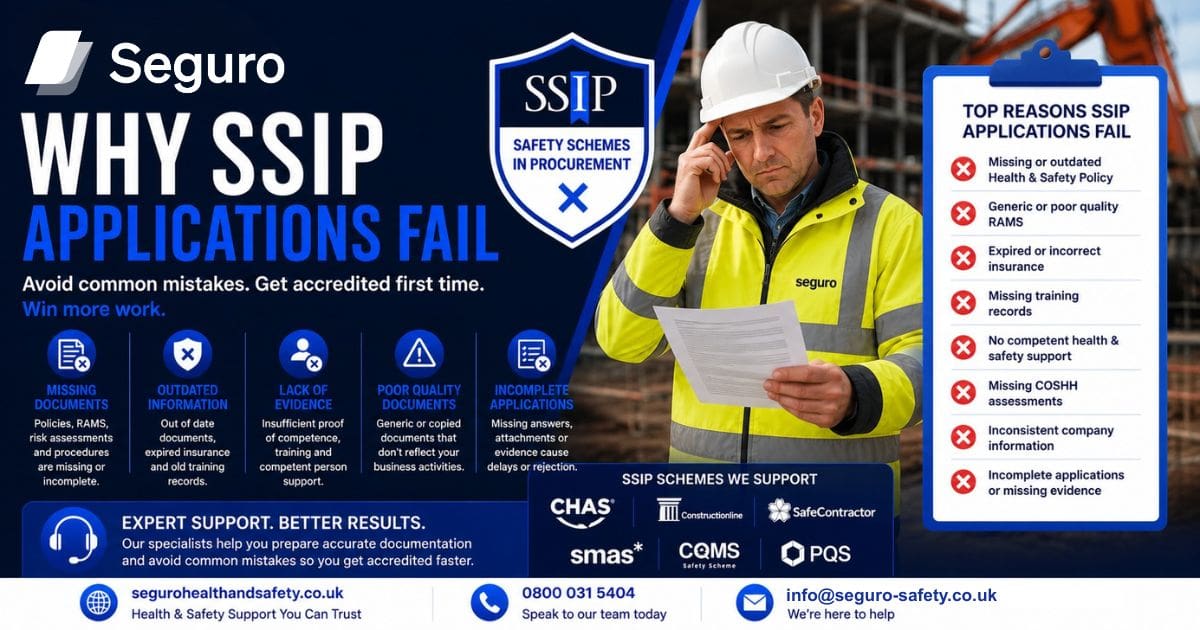
Why SSIP Applications Fail – The Most Common Mistakes Contractors Make

Applying for SSIP accreditation should be straightforward. Yet every year, contractors experience delays, assessor queries, and failed applications because their documentation does not properly demonstrate compliance.

The reality is that most SSIP applications do not fail because contractors are unsafe. They fail because the paperwork submitted does not meet the assessment requirements.

Understanding the common reasons applications fail can help contractors avoid costly delays, achieve accreditation faster, and improve their chances of winning more work.

What Is SSIP Accreditation?

SSIP stands for Safety Schemes in Procurement.

It is a recognised framework used across the UK construction industry to assess contractor health and safety competence.

Popular SSIP member schemes include:

  • CHAS
  • SafeContractor
  • SMAS
  • Constructionline
  • CQMS
  • PQS

All schemes assess contractors against broadly the same health and safety criteria.

Why Do SSIP Applications Fail?

Most failed applications are caused by documentation issues rather than genuine health and safety problems.

Assessors can only evaluate the evidence submitted. If documents are missing, incomplete, outdated, or inconsistent, the application may be rejected or delayed until corrections are made.

1. Missing Health & Safety Policy

One of the most common reasons applications fail is the absence of a suitable Health & Safety Policy.

Typical issues include:

  • No policy provided
  • Unsigned policy
  • Undated policy
  • Policy not reviewed
  • Policy copied from another business
  • Policy not relevant to company activities

The policy should clearly explain how health and safety is managed within the business and identify responsibilities.

2. Generic Risk Assessments

Many contractors submit generic risk assessments downloaded from the internet.

Assessors frequently reject these because they:

  • Do not reflect actual work activities
  • Contain irrelevant hazards
  • Lack suitable control measures
  • Appear copied without review

Risk assessments should be specific to the work your business carries out.

3. Poor Quality RAMS

RAMS (Risk Assessments and Method Statements) are a critical part of most SSIP applications.

Common mistakes include:

  • Generic templates
  • Missing control measures
  • No sequence of work
  • No emergency arrangements
  • Activities not matching company services
  • Poorly written documentation

Good RAMS demonstrate that hazards have been identified and controlled appropriately.

4. Expired Insurance Documents

Insurance issues are among the easiest reasons for assessors to identify problems.

Common examples include:

  • Expired insurance certificates
  • Missing Employers’ Liability Insurance
  • Missing Public Liability Insurance
  • Incorrect company name
  • Insufficient cover levels

Always check insurance dates before submitting an application.

5. Missing Training Records

Assessors need evidence that employees are competent to perform their duties safely.

Missing evidence may include:

  • CSCS cards
  • First Aid certificates
  • IPAF training
  • PASMA certificates
  • Asbestos awareness training
  • Manual handling training
  • Toolbox talks

A training matrix is often helpful for demonstrating competence across the workforce.

6. No Competent Health & Safety Support

Many contractors overlook the requirement to demonstrate access to competent health and safety advice.

Assessors may request:

  • Competent Person evidence
  • Consultant qualifications
  • NEBOSH certificates
  • IOSH qualifications
  • Service agreements
  • Competent Person certificates

Without suitable evidence, the application may not satisfy assessment requirements.

7. Missing COSHH Assessments

If hazardous substances are used, COSHH assessments are often required.

Examples include:

  • Paints
  • Adhesives
  • Solvents
  • Cleaning chemicals
  • Dust-producing activities
  • Silica exposure
  • Fumes

Failure to provide COSHH assessments where substances are used commonly results in assessor queries.

8. Company Information Does Not Match

A surprisingly common issue occurs when company information differs across documents.

Examples include:

  • Different company names
  • Different addresses
  • Different trading names
  • Different insurance details
  • Incorrect registration information

Consistency across all submitted documentation is essential.

9. Missing Accident Reporting Procedures

SSIP assessors expect businesses to have a process for recording and investigating accidents.

Common issues include:

  • No procedure provided
  • Incomplete reporting arrangements
  • No RIDDOR reference
  • No investigation process

Even businesses with no accident history should have a documented procedure.

10. Outdated Documentation

Many contractors continue using documents that have not been reviewed for years.

Common examples include:

  • Policies with old review dates
  • Expired training certificates
  • Outdated legislation references
  • Old company details
  • Obsolete procedures

Documentation should be reviewed regularly and updated whenever business activities change.

11. Submitting Incomplete Applications

Some contractors rush through the application process and miss key questions or supporting evidence.

Typical problems include:

  • Blank sections
  • Missing uploads
  • Incomplete answers
  • Incorrect supporting documents
  • Lack of explanations

Taking time to review submissions before sending them can prevent avoidable delays.

12. Failure to Respond to Assessor Queries

Even strong applications may generate follow up questions.

Problems arise when:

  • Queries are ignored
  • Responses are delayed
  • Additional evidence is not provided
  • Documents remain incomplete

Quick responses often help applications progress smoothly.

How to Improve Your Chances of Approval

Before submitting your SSIP application, ask yourself:

  • Is my Health & Safety Policy current and signed?
  • Are my RAMS relevant to my work?
  • Are all insurance documents valid?
  • Can I demonstrate workforce competence?
  • Have I included COSHH assessments where required?
  • Do I have evidence of competent health and safety support?
  • Does all company information match?
  • Have I checked every uploaded document?

A simple review can prevent most common application failures.

How a Done For You SSIP Service Helps

Many contractors choose professional support because it removes uncertainty from the process.

A specialist consultant can:

  • Review documentation
  • Identify compliance gaps
  • Prepare policies
  • Create RAMS
  • Review training evidence
  • Check insurance documents
  • Submit applications
  • Manage assessor queries

This significantly reduces the likelihood of rejection.

How Seguro Can Help

Seguro Health & Safety helps contractors achieve accreditation through:

  • CHAS Applications
  • Constructionline Accreditation
  • SafeContractor Applications
  • SMAS Accreditation
  • CQMS Applications
  • PQS Accreditation
  • Health & Safety Policies
  • RAMS
  • Risk Assessments
  • COSHH Assessments
  • Competent Person Support
  • Accreditation Renewals

With extensive experience supporting UK contractors, Seguro helps businesses avoid common mistakes and achieve accreditation more efficiently.

Conclusion

Most SSIP applications fail because the supporting documentation does not properly demonstrate compliance.

The most common issues include:

  • Missing policies
  • Generic RAMS
  • Expired insurance
  • Missing training records
  • Lack of competent person evidence
  • Missing COSHH assessments
  • Inconsistent company information
  • Incomplete applications

By preparing accurate, up to date documentation and reviewing everything before submission, contractors can significantly improve their chances of achieving accreditation first time.

Request a call back for more information or call 0800 031 5404

Book a CALL
shape Ask Amanda

Frequently Asked Questions

Why do SSIP applications fail?

SSIP applications usually fail because the supporting documents do not properly demonstrate compliance. Common reasons include missing policies, generic RAMS, expired insurance, missing training records, no competent person evidence, missing COSHH assessments and inconsistent company information.

What are the most common SSIP application mistakes?

The most common SSIP application mistakes include submitting unsigned or outdated policies, using generic risk assessments or RAMS, uploading expired insurance certificates, failing to provide training evidence, missing accident procedures and not showing access to competent health and safety advice.

Can generic RAMS cause an SSIP application to fail?

Yes. Generic RAMS can cause an SSIP application to fail or become delayed because they may not reflect the contractor’s actual work activities, hazards, control measures, equipment or safe system of work.

Can expired insurance delay SSIP approval?

Yes. Expired insurance is one of the easiest issues for assessors to identify. Contractors should check that Employers’ Liability Insurance and Public Liability Insurance are current, correctly named and suitable for the work being assessed.

Do I need training records for SSIP accreditation?

Yes. SSIP assessors usually need evidence that workers are competent for their roles. This may include CSCS cards, first aid certificates, IPAF, PASMA, asbestos awareness, manual handling, toolbox talks and other relevant training records.

Does SSIP require competent person evidence?

Yes. SSIP schemes often ask contractors to show how they access competent health and safety advice. Evidence may include a competent person certificate, consultant CV, NEBOSH or IOSH qualifications, or a health and safety support agreement.

Will missing COSHH assessments affect my SSIP application?

Missing COSHH assessments can affect an SSIP application if your business uses or creates hazardous substances such as paints, adhesives, solvents, cleaning chemicals, dust, silica or fumes. COSHH assessments should identify the risks and control measures.

How can I avoid SSIP application failure?

You can reduce the risk of SSIP application failure by reviewing all documents before submission, ensuring policies are signed and current, checking insurance dates, using task-specific RAMS, providing training records, including COSHH assessments where needed and showing competent health and safety support.

What happens if my SSIP application is rejected?

If an SSIP application is rejected or delayed, the assessor will usually request further evidence or corrected documents. You may need to update policies, improve RAMS, provide missing certificates or clarify how health and safety is managed before approval can be granted.

Can Seguro help if my SSIP application has failed?

Yes. Seguro Health & Safety can help review failed or delayed SSIP applications, identify missing evidence, update policies, improve RAMS, check training records, provide competent person support and help prepare a stronger resubmission.

How much does SSIP accreditation cost

Insight by

Bob Evans

Bob Evans

Published on

7 February 2026

SSIP

How Much Does SSIP Accreditation Cost? – UK Price Guide for Contractors

“How much does SSIP cost?” is one of the most common questions in the UK construction industry.

The short answer:

SSIP costs vary by scheme, but all schemes assess the same core health & safety standards.

So the real question is:

What are you actually paying for?

Quick Answer

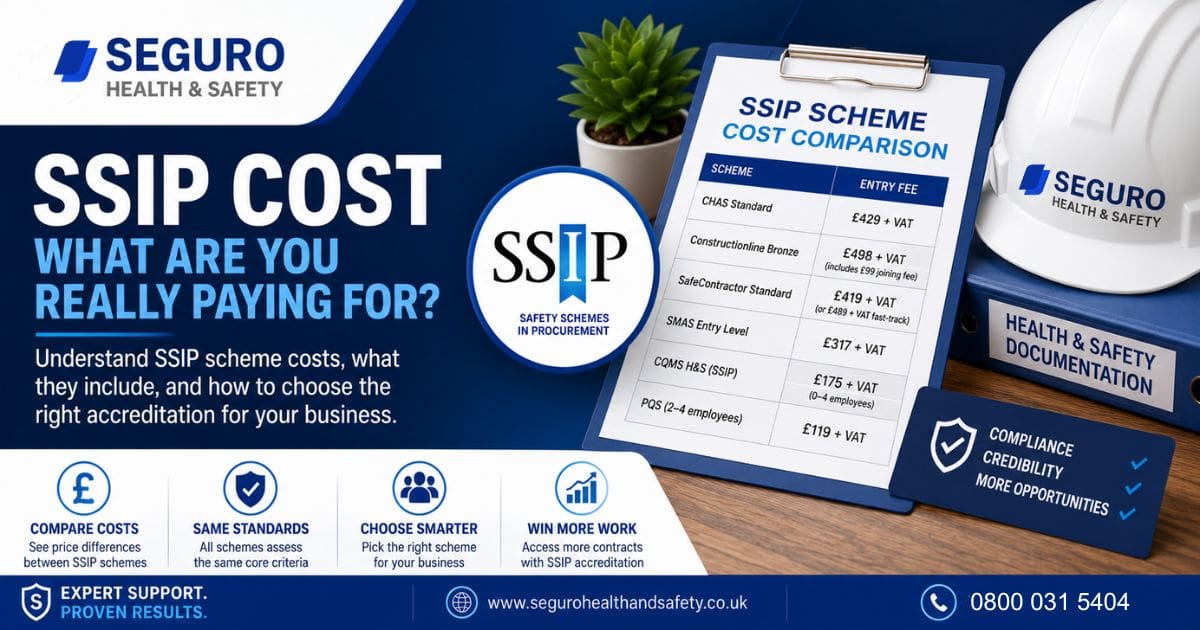
SSIP accreditation typically costs between £119 + VAT and £498 + VAT, depending on the scheme, business size, and level. All SSIP schemes assess the same core criteria, so price differences are usually based on brand recognition, administration, and market demand rather than higher standards.

Typical SSIP Accreditation Costs (UK)

Below are entry level SSIP scheme fees only (excluding consultancy support or document preparation)

Scheme

Entry Fee

CHAS Standard

£429 + VAT

Constructionline Bronze

£498 + VAT (includes £99 joining fee)

SafeContractor Standard

£419 + VAT (£489 + VAT fast-track)

SMAS Entry Level

£317 + VAT

CQMS H&S (SSIP)

£175 + VAT (0–4 employees)

PQS (2–4 employees)

£119 + VAT

These are the base fees charged by the scheme only.

Important: All SSIP Schemes Are Equal

One of the biggest misunderstandings in the industry:

You are not paying for a “better” standard with a more expensive scheme.

All SSIP member schemes:

Assess against the same SSIP core criteria
Review your health & safety systems
Require the same level of compliance

Learn more in our SSIP accreditation explained guide

Why Do SSIP Scheme Prices Differ?

If the standards are the same, why do prices vary so much?

Brand Recognition

Some schemes, like CHAS, are:

  • Widely recognised
  • Often named in tenders
  • Preferred by larger contractors
  • Owned by a large US corporation

This drives higher pricing.

Market Demand

Many contractors assume:

“I need CHAS”

But in reality:

Many clients accept any SSIP scheme. This creates artificial demand for higher-cost options, like CHAS, which is owned by a US corporation and keeps raising prices.

Administration & Service Model

Some schemes include:

  • Faster review times
  • Additional memberships
  • Extra services

This can increase cost — without changing the assessment standard.

The Key Point Contractors Miss

You may not need the most expensive accreditation.

Many:

  • Main contractors
  • Local authorities
  • Commercial clients

Accept any valid SSIP scheme.

Always Check First

Before applying:

Ask your client:

“Which SSIP schemes do you accept?”

This simple step can save you hundreds of pounds every year.

The Real Cost of SSIP Accreditation

The scheme fee is only part of the picture.

Most contractors also need:

  • Site-specific RAMS
  • A compliant Health & Safety Policy
  • Training and competency records
  • Competent Person support
  • Ongoing document management

Where Costs Increase

Costs rise when:

❌ Documents are missing
❌ Applications are rejected
❌ Revisions are required
❌ Submissions are delayed

This is where most contractors lose time and money.

How to Save Money: The Cost vs Time Trade-Off

You can:

Option 1: Do It Yourself

  • Lower upfront cost
  • Higher risk of delays
  • More time required

Option 2: Get Expert Support

  • Slightly higher upfront cost
  • Faster approval
  • Less stress
  • Higher success rate

See our done-for-you CHAS support service

SSIP Cost vs Value

SSIP isn’t just a cost, it’s an investment.

With accreditation, you can:

Win more contracts
Access new supply chains
Reduce PQQ paperwork
Improve compliance systems

Many contractors recover the cost from one job alone.

Cost Comparison Insight

Lowest cost: PQS (£119 + VAT)
Highest cost: Constructionline Bronze (£498 + VAT)

But remember: Both assess the same core standard.

Top Tips to Save Money on SSIP

1 Ask Your Client First

You may not need the most expensive scheme.

2 Choose the Right Scheme

Match your accreditation to your work and clients.

See our  CHAS vs Constructionline comparison

3 Prepare Documents Properly

Avoid delays and rework.

Read common reasons CHAS applications fail

4 Get Advice Early

The right guidance saves time, money, and frustration.

The Smart Way to Manage SSIP Cost

Most contractors don’t fail because of cost…

They fail because of poor preparation.

Done For You SSIP Support

At Seguro Health & Safety, we help you:

Choose the right scheme
Prepare compliant documents
Complete your application
Handle assessor queries

This reduces delays and avoids repeat costs.

Get SSIP Accredited Without Overspending

If you want to:

Choose the right scheme
Avoid unnecessary costs
Get approved first time

Speak to our team today and get expert support

Start here: Done For You CHAS Accreditation

CALL Amanda on 0800 031 5404 to get started

shape Ask Amanda

Frequantly Ask Questions

How much does SSIP accreditation cost in the UK?

SSIP accreditation typically costs between £119 + VAT and £498 + VAT, depending on the scheme, business size and level. All SSIP schemes assess the same core criteria, so the price difference is usually due to brand recognition and administration rather than higher standards.

Why do SSIP schemes have different prices?

SSIP scheme prices differ due to brand recognition, market demand and administration models. Although costs vary, all SSIP member schemes assess contractors against the same core health and safety criteria.

Is CHAS more expensive than other SSIP schemes?

CHAS is often more expensive than other SSIP schemes because it is widely recognised and frequently specified in tenders. However, it does not assess a higher standard than other SSIP schemes.

Are cheaper SSIP schemes less valid?

No. All SSIP member schemes are assessed against the same core criteria, meaning lower-cost schemes provide the same level of health and safety compliance as higher-cost options.

What does the SSIP accreditation fee include?

The SSIP fee typically covers the assessment of your health and safety policies, risk assessments, training records and compliance systems. It does not usually include document preparation or consultancy support.

What additional costs should contractors expect?

Additional costs may include preparing risk assessments and method statements (RAMS), updating your health and safety policy, providing training records, and getting competent person support. These are often required to pass the assessment.

Can I reduce SSIP accreditation costs?

Yes. You can reduce SSIP costs by choosing the right scheme for your client’s requirements, preparing your documents correctly the first time, and avoiding repeated submissions or delays.

Do all clients accept any SSIP scheme?

Many clients accept any SSIP member scheme, but some specify particular schemes such as CHAS. It is important to check client requirements before applying to avoid unnecessary costs.

Is SSIP accreditation worth the cost?

SSIP accreditation is often worth the cost because it helps contractors demonstrate compliance, reduce prequalification paperwork, and gain access to more contracts and tender opportunities.

Can Seguro help reduce the cost of SSIP accreditation?

Yes. Seguro Health and Safety can help you choose the right scheme, prepare compliant documents, complete your application and avoid costly delays or failed submissions.

Benefits of Constructionline Accreditation for UK Contractors (Bronze, Silver & Gold)

Insight by

Bob Evans

Bob Evans

Published on

15 January 2026

Constructionline

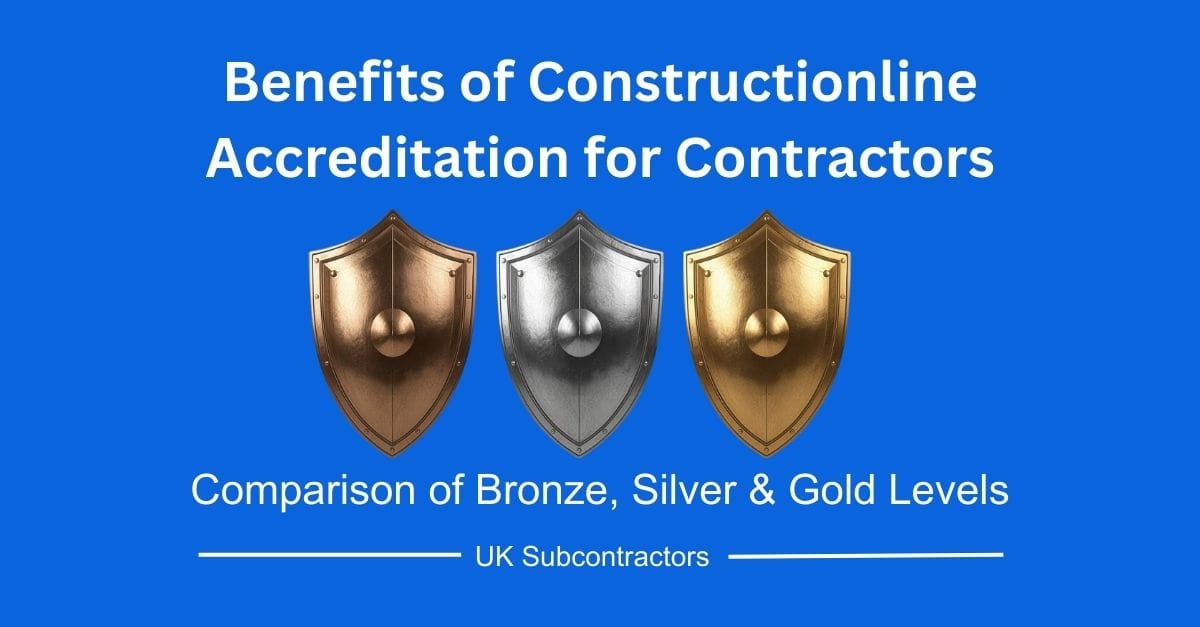
Benefits of Constructionline Accreditation for Contractors

What Is Constructionline Accreditation?

Constructionline is a UK construction pre-qualification scheme used by buyers to assess whether contractors meet minimum standards for health & safety, financial stability, insurance, and compliance.

Many principal contractors, local authorities, and housing associations will not tender to contractors without Constructionline.

What Are the Main Benefits of Constructionline Accreditation?

Constructionline accreditation helps contractors:

  • Win more work
  • Reduce PQQ paperwork
  • Prove health & safety competence
  • Meet buyer and framework requirements
  • Improve credibility with principal contractors

For small subcontractors, it often acts as a gateway requirement rather than a competitive advantage.

How Constructionline Helps Small UK Subcontractors

1. Access to Tender Opportunities

Many buyers use Constructionline as a filter.
Without accreditation, you may not appear on tender lists at all.

Being accredited allows you to:

  • Be visible to buyers searching the database
  • Meet minimum procurement standards
  • Tender for public and private sector work

2. Fewer Repeated PQQs

Constructionline replaces multiple pre-qualification questionnaires with one verified profile.

This saves:

  • Time
  • Admin effort
  • Repeated document uploads

This is particularly valuable for subcontractors with small office teams.

3. Demonstrates Health & Safety Competence

At Silver and Gold level, Constructionline includes SSIP-recognised health & safety assessment.

This shows buyers that your business:

  • Manages risk properly
  • Has suitable policies and procedures
  • Meets PAS 91 H&S requirements

4. Builds Trust and Credibility

Constructionline is widely recognised across the UK construction industry.

Accreditation signals that your business is:

  • Compliant
  • Insured
  • Financially checked
  • Professionally managed

This can directly influence tender decisions.

Constructionline Levels Explained

Constructionline Bronze

Best for: Very small or domestic-focused subcontractors

Includes:

  • Company verification
  • Financial checks
  • Insurance validation

Does not include SSIP health & safety assessment.

Bronze is often insufficient for commercial or public-sector work.

Constructionline Silver

Best for: Most UK subcontractors

Includes:

  • All Bronze requirements
  • SSIP health & safety assessment
  • PAS 91 H&S alignment

Silver is the most commonly required level for tendering and is often the minimum accepted by principal contractors.

Constructionline Gold

Best for: Public sector, frameworks, higher-risk work

Includes everything in Silver, plus:

  • Quality management (ISO 9001 equivalent)
  • Environmental management (ISO 14001 equivalent)
  • Equality, diversity, and modern slavery compliance

Gold provides the highest level of procurement acceptance.

How Much Does Constructionline Cost?

Typical annual costs (approximate):

  • Bronze: £150–£200
  • Silver: £300–£450
  • Gold: £600–£1,000+

Additional costs may apply if you need:

  • New or updated policies
  • Health & safety advisor support
  • Training records or RAMS

Common Constructionline Mistakes Contractors Make

Applying for the Wrong Level

Many subcontractors apply for Bronze when buyers require Silver or Gold, causing delays and lost tenders.

Weak Health & Safety Evidence

Common failures include:

  • Generic policies
  • Outdated risk assessments
  • No training or competence records

Silver and Gold require evidence, not just documents.

Leaving the Application Too Late

Constructionline is often needed before tender submission.
Late applications are one of the most common reasons contractors miss opportunities.

Is Constructionline Worth It for Small Subcontractors?

For most UK subcontractors, yes.

If you work for:

  • Principal contractors
  • Local authorities
  • Housing associations
  • Commercial developers

Constructionline is often mandatory, not optional.

Consultant Advice: Which Level Should You Choose?

  • Domestic / early-stage → Bronze
  • Commercial subcontractor → Silver
  • Public sector / frameworks → Gold

Choosing the right level first time avoids delays, extra costs, and failed tenders.

Conclusion

  • Constructionline is a UK construction pre-qualification scheme
  • Silver includes SSIP health & safety assessment
  • Gold includes quality, environmental, and social value checks
  • Most subcontractors need at least Silver
  • Applying early and at the correct level is critical

Get in touch with Natasha today and get your accreditaton started.

Request a call back
shape

Constructionline: What it is, How it Works, and Why it Matters

Insight by

Bob Evans

Bob Evans

Published on

12 January 2026

Constructionline

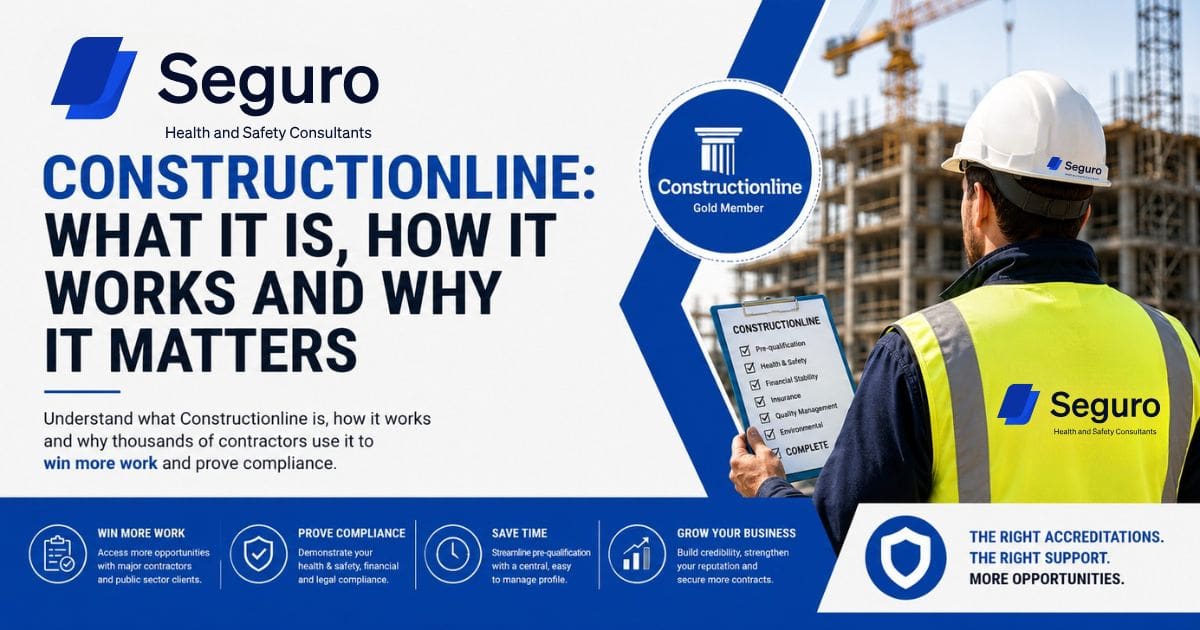
What Is Constructionline?

Constructionline is a UK-based pre-qualification and accreditation scheme used across the construction industry to assess the financial, technical, and compliance credentials of contractors and suppliers.

It is widely recognised by:

  • Main contractors
  • Local authorities and councils
  • Housing associations
  • Public sector procurement teams
  • Large commercial clients

Being registered helps contractors demonstrate that they meet recognised standards when bidding for work.

Why Constructionline Is Important

Constructionline simplifies procurement by allowing buyers to verify contractor credentials once, rather than repeating checks for every tender.

For contractors, it helps to:

  • Improve credibility during tendering
  • Reduce repetitive PQQ submissions
  • Access public and private sector opportunities
  • Demonstrate compliance with health and safety, financial, and legal requirements

For buyers, it provides confidence that suppliers have been independently assessed.

Constructionline and SSIP Recognition

Constructionline is part of the SSIP umbrella group, meaning it aligns with the Safety Schemes in Procurement core criteria.

Contractors can use it to demonstrate:

  • Health and Safety competence
  • Valid policies and procedures

Risk assessment and method statement capability

Higher levels of membership often require additional evidence beyond basic SSIP compliance.

Constructionline Membership Levels Explained

Constructionline operates a tiered membership structure:

Bronze

  • Entry-level verification
  • Basic company and financial checks
  • Suitable for smaller contracts

Silver

  • Includes SSIP health and safety assessment
  • Common requirement for public sector work

Gold

  • Enhanced verification
  • Includes environmental management and quality management checks
  • Often required for higher-risk or higher-value projects

The level required depends on the type of work and client expectations.

What Does Constructionline Assess?

Constructionline reviews a range of information, including:

  • Company details and legal status
  • Financial standing and turnover
  • Health and safety policies and competence
  • Insurance documentation
  • Environmental and quality management (at higher levels)
  • Past performance and experience

All information must be kept up to date to maintain active status.

Who Needs Constructionline?

Constructionline is commonly required for:

  • Contractors bidding for public sector work
  • Subcontractors working for Tier 1 contractors
  • Companies involved in framework agreements
  • Businesses looking to streamline tender processes

While not legally required, many organisations will not tender without it.

Constructionline and Compliance

Construction-line supports compliance with:

  • Procurement requirements
  • Health and safety competence standards
  • Public sector tender frameworks

However, it does not replace ongoing management responsibilities. Contractors must continue to manage safety, quality, and compliance on site.

Keeping Your Constructionline Profile Up to Date

To remain compliant and avoid suspension:

  • Review your profile regularly
  • Update insurance documents before expiry
  • Maintain valid health and safety assessments
  • Respond promptly to verification requests

Expired or incorrect information can affect tender eligibility.

Common Challenges with Applications

Typical issues include:

  • Incomplete health and safety documentation
  • Incorrect insurance levels
  • Financial information not matching accounts
  • Selecting the wrong membership level

Support from experienced compliance professionals can reduce delays and rejections.

Summary

Constructionline is a key procurement and verification platform in the UK construction industry. It helps buyers assess contractor competence and allows contractors to demonstrate compliance efficiently. Understanding the membership levels, requirements, and ongoing obligations is essential for businesses seeking to win and retain work.

Looking for more advice, give us a call on 0800 031 4504

Request a call back
shape Safety Advisor

What is PQS accreditation

Insight by

Bob Evans

Bob Evans

Published on

1 January 2026

PQS accreditation

What Is PQS Accreditation? (UK Contractors Explained)

PQS accreditation stands for Pre-Qualification Scheme accreditation. It is used in the UK construction and services sectors to assess whether a contractor meets recognised standards for health & safety, insurance, financial stability, and legal compliance.

Many clients and principal contractors require the accreditation before allowing businesses to tender for work.

What Does PQS Mean?

A PQS accreditation confirms that a business has been independently assessed against industry-recognised criteria. It demonstrates that a contractor:

  • Manages health and safety effectively
  • Has appropriate insurance in place
  • Is financially viable
  • Meets legal and regulatory obligations

Instead of completing multiple PQQs, accredited contractors can use PQS as proof of compliance.

Who Needs PQS Accreditation?

The accreditation is commonly required for:

  • Construction contractors and subcontractors
  • Electrical, mechanical, and building services companies
  • Maintenance and facilities management providers
  • Businesses tendering for commercial or public sector work

For many buyers, PQS accreditation is a minimum entry requirement.

What Does The Accreditation Assess?

A PQS assessment typically reviews:

Health & Safety Management

  • Health & Safety Policy
  • Risk assessments and method statements (RAMS)
  • Training and competence records
  • Accident reporting procedures

Company and Financial Information

  • Business structure and ownership
  • Public and employers’ liability insurance
  • Financial declarations or accounts

Compliance and Governance

  • Legal compliance
  • Modern slavery and equality policies (where applicable)
  • Environmental considerations

Get a price for a PQS accreditation

How Long Does The Accreditation Last?

PQS accreditations are valid for 12 months and require annual renewal to ensure information remains current and compliant.

Benefits of the Accreditation

PQS accreditation helps contractors:

  • Win more work
  • Reduce repeated PQQ paperwork
  • Demonstrate competence to buyers
  • Meet procurement requirements quickly

For small contractors, it saves time and improves credibility.

Common Misunderstandings

  • It is not optional for many contracts
  • Generic policies are not sufficient
  • Accreditation must be maintained, not just achieved

Conclusion

  • PQS accreditation is a UK pre-qualification assessment

  • It proves contractor competence and compliance

  • Often required before tendering

  • Covers health & safety, insurance and financial checks

  • Typically renewed annually


Expert Advice

Choosing the right PQS scheme, and getting your documentation right first time, can be the difference between winning work and being delayed or rejected at the pre-qualification stage.

The first question most contractors ask is “how much does it cost?”


In many cases, PQS accreditation is significantly more cost-effective than other SSIP schemes such as CHAS, while meeting the same SSIP-recognised standards. All SSIP accreditations follow the same core criteria, so you’re not compromising on compliance.

PQS fees can vary, so rather than guessing, complete a short form and we’ll confirm the exact current cost for your business.

Click the button below.

How to Get Constructionline Accreditation 2026 Guide – Step by Step Process

Insight by

Bob Evans

Bob Evans

Published on

4 December 2025

Constructionline

How to Get Constructionline Accreditation (Step-by-Step Guide for 2026)

What is Constructionline?

Constructionline is the UK’s largest pre-qualification platform for contractors, suppliers, and construction businesses. It provides clients with verified evidence of your:

  • Health and safety compliance
  • Business legitimacy
  • Financial stability
  • Environmental and quality management
  • Social responsibility
  • Supply-chain reliability

It helps contractors win more work and reduce repetitive PQQ paperwork.

Quick Answer: How to Get Constructionline Accreditation in 2026

To get Constructionline accredited, you must:

  1. Choose your Constructionline level (Associate, Silver, Gold, or Platinum).
  2. Register your business on the Constructionline portal.
  3. Complete the PAS 91-aligned questionnaire.
  4. Upload evidence of health and safety, insurance, finances, and policies.
  5. Complete a third-party SSIP assessment (if applying for Gold).
  6. Respond to assessor queries.
  7. Receive approval and appear on the Constructionline database.


How can we help?

We can complete the application, gather all required documents and answers to questions, and compile all necessary evidence, allowing you to focus on your job. We are efficient, economical and have a 100% success rate. Get accredited and win more work.

Get ConstructionLine Accredited Today

Constructionline Accreditation Levels (Explained)

1. Constructionline Associate

Entry-level listing. Shows your company exists and provides basic company information.

Suitable for very small firms, new businesses, and subcontractors.

2. Constructionline Silver (PAS 91 Basic Compliance)

Most common level. Requires:

  • Business details
  • Financial information
  • Insurance
  • Health & safety documentation
  • Environmental & quality basics

Silver is generally enough for subcontractors and suppliers.

3. Constructionline Gold (PAS 91 + Enhanced Standards)

Includes everything from Silver plus:

  • Environmental management (ISO 14001 or equivalent)
  • Quality management (ISO 9001 or equivalent)
  • Equality & diversity
  • Anti-bribery
  • GDPR compliance
  • Modern slavery
  • Social value evidence
  • Full SSIP accreditation (CHAS, SMAS, SafeContractor)

Often required for principal contractors, councils, and large tenders.

4. Constructionline Platinum (Highest Level)

Includes enhanced audits and validation of:

  • Financial performance and ratios
  • Supply-chain management
  • CSR and sustainability
  • BIM capabilities
  • Risk management strategy

Required for the most complex, high-value projects.

How to Get Constructionline Accreditation (Step-by-Step Guide)

Step 1 — Choose Your Constructionline Level

Your level depends on:

  • Size of your business
  • Type of work you do
  • Tender requirements
  • Client expectations

Most construction firms aim for Silver or Gold.

Step 2 — Register on the Constructionline Portal

You’ll need to enter:

  • Company name and address
  • Legal structure
  • Registration details (Companies House, VAT, etc.)
  • Sector and service type
  • Number of employees

Once complete, you’ll receive login details to begin the assessment.

Step 3 — Complete the PAS 91 Questionnaire

PAS 91 is the standard UK pre-qualification questionnaire used across construction procurement.

Questions cover:

  • Company identity
  • Insurance
  • Financial stability
  • Health & safety compliance
  • Environmental management
  • Quality management
  • Equal opportunities
  • Modern slavery
  • GDPR compliance

Constructionline will not proceed until all sections are complete.

Step 4 — Upload Required Documents

This is the core of your accreditation.

Key Documents for Silver Level

You MUST provide:

  • Health & Safety Policy
  • Risk assessments & method statements (RAMS)
  • Training records & competence (CSCS, NVQs, CPCS)
  • Insurance certificates (EL/PL/PI)
  • Accident reporting procedures
  • Environmental policy
  • Quality policy
  • Anti-bribery and corruption policy
  • Equality & diversity policy

Additional Documents for Gold Level

Gold requires evidence, not just policies:

  • ISO 9001 / quality management system
  • ISO 14001 / environmental management
  • GDPR processes
  • Modern slavery documentation
  • Carbon reduction / sustainability evidence
  • Full SSIP certificate (CHAS, SMAS, SafeContractor or equivalent)

Platinum Requirements (Advanced)

For high-value contractors only:

  • Audited financial accounts
  • BIM Level 2 capability
  • Corporate social responsibility report
  • Advanced supply-chain management plans
  • Risk management framework

Step 5 — Undergo SSIP Health & Safety Assessment (Gold Only)

If you don’t already have SSIP, Constructionline partners with:

  • CHAS
  • SMAS
  • SafeContractor
  • Acclaim

This verifies you meet health & safety standards aligned with CDM 2015.

Step 6 — Assessment & Clarifications

Constructionline assessors review your evidence.
They may request:

  • Extra documents
  • Updated policies
  • Missing certificates
  • Clarification on processes

Responding quickly reduces assessment time.

Step 7 — Approval & Certificate Issued

Once approved, you will receive:

  • Your Constructionline certificate
  • A listing on the national database
  • Access to client tenders
  • Your verified badge to add to your website

Accreditation lasts 12 months.

How can we help?

We can complete the application, gather all required documents and answers to questions, and compile all necessary evidence, allowing you to focus on your job. We are efficient, economical and have a 100% success rate. Quote Request.

Common Reasons Constructionline Applications Fail

❌ Insurance expired or incorrect levels
❌ No evidence of competence (CSCS, NVQs)
❌ Out-of-date policies (must be reviewed annually)
❌ No subcontractor management system
❌ RAMS missing or generic
❌ No evidence for ISO-equivalent systems
❌ Missing SSIP certificate (Gold level)

Avoid these, and your application is far more likely to pass the first time.

Get ConstructionLine Accredited Today

FAQs

How long does Constructionline accreditation take?

Most applications take 5–15 working days, depending on document readiness.

How much does Constructionline accreditation cost?

Prices vary by company size and level:

  • Associate: £100–£150
  • Silver: £300–£600
  • Gold: £600–£1,200
  • Platinum: £2,000+

Do I need Constructionline to win work?

Not legally — but many main contractors, councils, and housing associations require Silver or Gold.

Can sole traders join Constructionline?

Yes. Sole traders often start with Associate or Silver depending on client requirements.

Does Constructionline include SSIP?

SSIP is included only at Gold level via partner schemes.

More information can be found below: 

What is a Dynamic Risk Assessment

Insight by

Bob Evans

Bob Evans

Published on

25 November 2025

Risk assessments

What Is a Dynamic Risk Assessment (DRA)?

How to identify risks in real time and keep your construction site safe

A Dynamic Risk Assessment is a real-time evaluation of hazards carried out on the spot, usually by site workers, supervisors, and subcontractors. Unlike a standard written risk assessment completed before work begins, a DRA helps workers respond to unexpected hazards, changing site conditions, and evolving risks during the job.

In the construction sector—where environments shift daily, and multiple trades work in close proximity Dynamic Risk Assessment is essential for preventing accidents, delays, and costly safety breaches.

SHOP For  Your Method and Risk Assessments Here

Why Dynamic Risk Assessments Are Important in Construction

1. Construction Sites Change Constantly

Weather, plant movement, deliveries, ground conditions and access routes can change in minutes. A DRA ensures risks are reassessed when conditions shift.

2. Workers Face Unplanned Hazards

Unexpected hazards include:

  • New excavations

  • Temporary power cables

  • Materials stored incorrectly

  • MEWPs or forklifts operating nearby

  • Slips, trips and uneven ground

A written risk assessment won’t always cover these, but a DRA will.

3. Compliance With UK Legislation

The Health and Safety at Work Act 1974 and Management of Health and Safety at Work Regulations 1999 require employers to manage risk as it arises. DRAs support these legal duties.

4. Reduces Accidents and Delays

By empowering workers to pause, think, and react, DRAs significantly reduce the chance of injury, project delays, insurance claims and HSE notices.

Who Should Carry Out a Dynamic Risk Assessment on Site?

A DRA can be performed by:

  • Site managers

  • Supervisors

  • Tradespeople

  • Plant operators

  • Subcontractors

  • Anyone who encounters a change in conditions

It’s important that every worker is trained to recognise hazards and understands they have the authority to stop work immediately if they believe new risks have emerged.

How to Carry Out a Dynamic Risk Assessment

Step 1: Stop and Observe the Task

Pause before starting the activity. Look at the area, equipment, and people nearby.

Step 2: Identify New or Unexpected Hazards

Common construction examples:

  • Unstable loads

  • Missing edge protection

  • Live services exposed

  • Unsafe weather conditions (wind, rain, heat)

  • New contractors working overhead

  • Confined space risks

Step 3: Evaluate the Risk Level

Ask:

  • How likely is an accident?

  • What is the potential severity?

  • Who could be harmed?

  • Do control measures already exist?

Step 4: Implement Controls Immediately

Typical controls include:

  • Changing the access route

  • Stopping plant movements

  • Using a banksman

  • Wearing additional PPE

  • Delaying the task

  • Getting a supervisor’s approval

Step 5: Continue or Stop the Task

If risks cannot be controlled safely: STOP WORK.
Report to a supervisor and update the formal RAMS if necessary.

Dynamic Risk Assessment vs. Standard Risk Assessment

Standard (Written) Risk Assessment Dynamic Risk Assessment (On-the-Spot)
Completed before work starts Completed during the task
Based on planned hazards Based on real-time hazards
Required by law Supports legal compliance
Usually done by managers Done by anyone on site
Good for predictable risks Essential for unexpected risks

Both are needed. A DRA does not replace RAMS—it strengthens them.

Best Practices for Dynamic Risk Assessment in Construction

  • Train all workers in hazard awareness

  • Encourage a “Stop Work Authority” culture

  • Keep RAMS up to date

  • Hold daily briefings or toolbox talks

  • Use simple DRA checklists

  • Ensure supervisors support DRAs, not rush them

  • Use technology (apps, mobile checklists, AI-based risk monitoring)

SHOP For  Your Method and Risk Assessments Here

Dynamic Risk Assessment Checklist

Before starting a task, ask:

  1. Are conditions the same as planned?

  2. Has anything changed since the RAMS briefing?

  3. Are other trades affecting the area?

  4. Is my equipment safe and suitable?

  5. Are weather or ground conditions safe?

  6. Do I need extra PPE or controls?

  7. Should I stop and report before continuing?

Frequently Asked Questions (FAQs)

Is a Dynamic Risk Assessment a legal requirement?

Not specifically—but the law requires employers to manage risks as they arise, making DRAs essential for compliance.

Do DRAs replace RAMS?

No. DRAs support RAMS by covering unexpected hazards.

Who can perform a DRA?

Anyone on site—workers, operators, supervisors, and contractors.

Should DRAs be documented?

Yes, when practical. Apps and mobile forms make this simple.

Conclusion: Why Your Construction Business Needs Dynamic Risk Assessment

Dynamic Risk Assessments keep your workers safe, your projects compliant, and your business protected. In a fast-changing environment like construction, they are a vital line of defence against accidents.

Combined with AI tools, DRAs help you:
✔ reduce incidents
✔ improve productivity
✔ meet UK safety standards
✔ protect your workforce
✔ strengthen your RAMS

What Are Construction RAMS? A Simple Guide for UK Contractors

Insight by

Bob Evans

Bob Evans

Published on

19 November 2025

Risk assessments

Construction RAMS: Complete Guide – What They Are + How to Write Them Properly

Your essential guide to Risk Assessments and Method Statements for UK construction businesses.

What Are Construction RAMS?

RAMS stands for Risk Assessment and Method Statement.

They are the two core documents contractors must produce before starting any construction work:

  1. Risk Assessment (RA) – identifies hazards, evaluates risks, and records control measures.
  2. Method Statement (MS) – explains step-by-step how a task will be carried out safely.

Together, RAMS ensure:

Workers understand the job

Controls are in place

You comply with CDM 2015

You satisfy client, principal contractor or SSIP accreditation requirements

SHOP For  Your Method and Risk Assessments Here

Why RAMS for Construction

Construction remains one of the UK’s highest-risk industries. RAMS help to:

  • Prevent accidents and injuries
  • Ensure compliance with HSE and CDM regulations
  • Demonstrate competence to clients
  • Protect your business legally and financially
  • Achieve CHAS, Constructionline, SafeContractor and other SSIP accreditations

Poor or incomplete RAMS are a major reason for work being stopped on site.

What Should Construction RAMS Include?

A compliant set of RAMS typically contains:

1. Project details

  • Company name
  • Project address
  • Site contact
  • Principal contractor
  • Start/end dates

2. Description of the task

What work is being done, where, and by who.

3. Key hazards

Common construction hazards include:

  • Working at height
  • Manual handling
  • Excavations
  • Plant and machinery
  • COSHH substances
  • Live services
  • Noise, vibration and dust

4. Risk evaluation

For each hazard:

  • Likelihood
  • Severity
  • Risk level
  • Control measures

5. Method Statement (safe system of work)

A clear, step-by-step description of how the work will be completed safely, including:

  • Preparation
  • Sequence of operations
  • PPE required
  • Tools and equipment
  • Emergency arrangements

6. Qualifications and training

Evidence of competency:

  • CSCS cards
  • CPCS/NPORS
  • SSSTS/SMSTS
  • Task-specific training

7. Sign-off

Signatures from operatives, supervisors, and management.

How to Write RAMS for Construction (Step-by-Step)

Step 1 — Understand the scope of work

Speak with the site manager, client or principal contractor. Confirm:

  • Access routes
  • Site conditions
  • What other trades are doing
  • Any unique project risks

Step 2 — Identify hazards and control measures

Use HSE guidance to ensure hazards are correctly assessed.

Include hierarchical controls:

  1. Eliminate
  2. Substitute
  3. Engineering controls
  4. Administrative controls
  5. PPE

Step 3 — Write a clear Method Statement

Explain the job in a way all workers can understand.

Use bullet points, diagrams (if needed), and avoid jargon.

Step 4 — Add emergency procedures

Cover fire, first aid, plant breakdown, spills, rescue procedures, etc.

Step 5 — Review and update regularly

RAMS must be project-specific, not generic. Update when:

  • Conditions change
  • Equipment changes
  • Workers change
  • Additional risks appear

Common Mistakes in Construction RAMS

❌ Copy-and-paste documents

❌ No project-specific details

❌ Not covering all hazards

❌ No reference to other trades on site

❌ Overly complex or unclear documents

❌ Missing signatures

Not reviewed after site changes

RAMS for SSIP Accreditations (CHAS, Constructionline, SafeContractor)

If you’re applying for CHAS, Constructionline or any SSIP scheme, RAMS are essential.

They must demonstrate:

  • Competent risk assessments
  • Task-specific method statements
  • Evidence of briefings
  • Clear safety controls
  • Worker competence

Most SSIP failures happen because RAMS are generic or incomplete.


Benefits of Outsourcing Your RAMS

A professional H&S advisor can ensure:

Legally compliant documents

Faster approvals by principal contractors

Reduced project delays

Peace of mind

Support with SSIP accreditations

If RAMS are rejected, it costs time, money and reputation.


Shop for your RAMS

Some of our RAMs are 18 pages long, contain 12,000 words, and are written by fully qualified professional health and safety consultants. We have over 300 available to purchase for as little as £10 each.

SHOP For  Your Method and Risk Assessments Here

Conclusion

Construction RAMS are essential for safe, compliant work under CDM 2015.

Clear, task-specific RAMS protect workers, reduce delays, impress clients and support accreditation.

What is SSIP? – A Contractors Guide

Insight by

Bob Evans

Bob Evans

Published on

4 November 2025

Health and safety blog

SSIP Accreditation: What It Is & Why It Matters for Contractors Guide

What is SSIP? Everything construction businesses need to know about the pre qualification and winning more opportunities.

What Is SSIP?

SSIP (Safety Schemes in Procurement) is the UK’s national umbrella organisation for health & safety assessment schemes.
Instead of completing multiple safety accreditations, SSIP allows businesses to gain recognition once and have it accepted by many different buyers.

SSIP includes well known schemes such as:

  • CHAS
  • PQS
  • Constructionline
  • SafeContractor
  • SMAS Worksafe

If a contractor holds a CHAS, Constructionline, or PQS-approved accreditation, clients can trust that their health & safety systems meet core standards.

Why The Accreditation Matters

SSIP is now one of the most important benchmarks for contractors, subcontractors, and trades in the UK. Here’s why:

1. Win More Work With Recognised Safety Standards

Major contractors, councils, FM companies, and developers increasingly require CHAS, Constructionline, and PQS as part of PQQ or onboarding.

2. Saves Time on Repetitive Safety Pre-Qualification

SSIP prevents businesses from having to complete multiple health & safety assessments for different clients—saving hours of admin every month.

3. Reduces Cost of Compliance

Instead of paying for several accreditations, one SSIP certificate is accepted by many buyers.

4. Demonstrates Legal Compliance

SSIP assessments align with UK safety laws including:

  • Health and Safety at Work Act

  • Management of Health and Safety at Work Regulations

  • CDM Regulations

This reassures clients that your company operates safely and competently.

5. Strengthens Your Brand & Credibility

Displaying an SSIP badge shows customers, inspectors, and project managers that you take safety seriously.

What Do The Assessors Check?

To gain accreditation through any approved scheme, your company must provide evidence of:

Health & Safety Management

  • Up to date H&S policy
  • Competent person support
  • Safety arrangements
  • Toolbox talks & site inductions

Risk Management

  • Recent RAMS
  • COSHH assessments
  • Site-specific risk controls

Training & Competence

  • CSCS/CPCS evidence
  • Certificates of training
  • Induction process

Incident & Reporting Systems

  • Accident records
  • RIDDOR procedures
  • Near-miss processes

Insurance

  • Employer’s liability
  • Public liability
  • Professional indemnity (if relevant)

When applying for enhanced schemes (e.g., SafePQQ), additional checks are conducted to assess environmental, quality, and social value standards.

How to Get SSIP Accreditation (Step-by-Step)

Step 1: Choose a Scheme

Decide whether CHAS, SafeContractor, SMAS, or Constructionline best matches your business needs.

Step 2: Complete the Online Assessment

Provide your company details, trade activities, and scope of works.

Step 3: Upload Documentation

Submit your health & safety policy, RAMS, training records, and insurance certificates.

Step 4: Assessment Review

An SSIP auditor reviews everything and may request additional evidence.

Step 5: Receive Your Certificate

Once approved, your business is added to the national database and can display the SSIP badge.

Accreditation lasts 12 months and must be renewed annually.

Most Common Reasons Applications Fail

Avoid these issues to secure fast approval:

❌ Outdated or missing H&S policy
❌ No recent or adequate RAMS
❌ Missing staff training certificates
❌ Incomplete accident records
❌ Insurance out of date or incorrect
❌ Competent person details missing

Fixing these in advance boosts your first-time pass rate.

SSIP vs Non-SSIP Schemes

Scheme Type Accepted by Buyers? Benefits
SSIP Certified Widely accepted Saves time, reduces cost, proves competence
Non-SSIP Schemes Limited acceptance May require additional paperwork

SSIP is designed to simplify compliance across the entire supply chain.

Is it Worth It for Contractors?

Absolutely. The Accreditation helps you:

✔ Win more work
✔ Reduce tendering admin
✔ Get recognised by major contractors
✔ Demonstrate health & safety competence
✔ Strengthen your professional image

If you want to grow in construction, FM, engineering, or local authority supply chains, SSIP is now an essential requirement—not just a “nice to have.”

CALL Amanda on 0800 031 5404 to get started

shape Ask Amanda

Frequently Asked Questions

What does SSIP accreditation mean?

SSIP accreditation means your business has been assessed against recognised health and safety standards and can demonstrate that it has suitable policies, procedures, risk assessments and evidence of compliance in place.

Is CHAS an SSIP scheme?

Yes. CHAS is an SSIP member scheme. This means CHAS assesses contractors against the SSIP core health and safety criteria.

Which schemes are SSIP recognised?

Common SSIP recognised schemes include CHAS, SMAS, SafeContractor and Constructionline Acclaim. These schemes assess contractors against the SSIP core criteria.

Do contractors need SSIP accreditation?

Many UK contractors need SSIP accreditation because main contractors, local authorities and commercial clients often request it before allowing businesses to tender for work or start on site.

What documents are needed for the accreditation?

Typical documents include a Health and Safety Policy, risk assessments, method statements, training records, insurance certificates, accident reporting procedures and evidence of competent health and safety advice.

How long does the accreditation take?

The accreditation can often be completed within one to three weeks, depending on the scheme, the quality of your documents and whether the assessor asks for further evidence.

Can Seguro help with accreditations?

Yes. Seguro Health and Safety can help prepare your documents, complete your application, respond to assessor queries and support you through the accreditation process.