Close Navigation

Search

Health & Safety when you have 5 employees or more

Insight by

amanda

Amanda Lambert

Published on

14 April 2026

Competent person

Table of contents

Health & Safety when you have 5 employees or more

As soon as you have 5 employees or more, you have a legal requirement to comply with all work-related health and safety legislation.

Your obligations are outlined in the Safety at Work Regulations 1974.

How this changes from less than five employees is you now need to ensure you have:

  • Written Health and Safety Policy
  • Written Health and Safety Policy Statement
  • Written Risk Assessments
  • COSHH assessments
  • Toolbox talks
  • A competent person either within your business or a consultant.

We act as competent people for over 800 companies. When we act as your competent person, we will complete all the documents you need to comply and keep the documents up to date as legislation changes. You also have access to over 1,000 documents including risk and method statements, COSHH data, toolbox talks, and more. We charge a small monthly fee. 

If you are not sure exactly what your business will require, you can find details on it by visiting the HSE website. Every business is different, and a competent person will be able to cover all aspects for you.

If you wish to employ your own competent person, they should be fully qualified in all aspects of Health & Safety; this can prove to be an expensive requirement if you employ them full-time. 

A more competitive way is to use a remote competent person service. We offer this service using one of our safety consultants as your competent person. We will make sure all your documents and training are up to date today, and be there to answer any questions. You also get free access to over 1,000 safety documents including RAMS.

There are a number of resources on the HSE website that can help you with any changes that may affect you as you continue to grow.

We are a friendly and professional team working in the background to help and support like-minded people get on with their work.

Request a call back for more information or call 0800 031 5404

Request a call back

shape Health & Safety Consultancy, Safety Advisor, Safety Consultant

Frequently Asked Questions

Do I need a health and safety policy if I have 5 employees or more?

Yes. If your business has 5 or more employees, you must have a written health and safety policy. The policy should explain how your business manages health and safety, who is responsible, and what arrangements are in place to protect employees and others affected by your work.

What health and safety documents do I need when I have 5 employees or more?

Businesses with 5 or more employees should have a written health and safety policy, written risk assessments, COSHH assessments where hazardous substances are used, training records, toolbox talk evidence, accident procedures and access to a competent person for health and safety advice.

Do I need written risk assessments if I employ 5 people?

Yes. If you employ 5 or more people, your significant risk assessment findings must be recorded in writing. This helps show that hazards have been identified and suitable control measures have been put in place.

Do subcontractors count as employees for health and safety?

Subcontractors may not count as PAYE employees, but you still have health and safety duties towards anyone affected by your work. If subcontractors are working under your control, you must ensure their work is planned, managed and carried out safely.

Do I need a competent person for health and safety?

Yes. Employers must have access to competent health and safety advice. This can be someone within the business with suitable knowledge and experience, or an external health and safety consultant or safety advisor.

What is a competent person in health and safety?

A competent person is someone with the knowledge, training and experience needed to help a business meet its health and safety duties. They can advise on policies, risk assessments, training, compliance, accident procedures and safe working arrangements.

Do I need COSHH assessments if I have 5 employees or more?

If your business uses substances that could be hazardous to health, you need COSHH assessments. This applies to materials such as chemicals, dusts, fumes, paints, solvents, adhesives and cleaning products.

What happens if I do not have proper health and safety documents in place?

Without proper health and safety documents, your business may fail client checks, struggle with CHAS or SSIP accreditation, be refused access to sites, face enforcement action, or increase the risk of accidents and legal claims.

Can Seguro help my business meet health and safety requirements?

Yes. Seguro can support businesses with health and safety policies, risk assessments, COSHH assessments, toolbox talks, training evidence, competent person support and accreditation preparation.

Do I need health and safety support if I am a small business?

Yes. Small businesses still have legal health and safety duties. If you have 5 or more employees, your responsibilities increase because key documents such as your health and safety policy and risk assessments must be recorded in writing.

Benefits of using Elearning

Insight by

amanda

Amanda Lambert

Published on

21 October 2025

Health and safety blog

What are the benefits of using Elearning?

There are a number of benefits to Elearning whether you choose to use it on its own, or to enhance any existing in house training you may provide.

It saves time and is cost effective

Instead of having to arrange a training session at a set time and place you can carry out Elearning at a time and place that suits you. This helps to reduce the time taken away from the office, removes travel costs and increases workplace productivity.

Learning with 24/7 access

Many traditional training courses operate within normal 9-5 office hours. Meaning you and your staff have to leave your jobs and take time out of the office to attend. This can also mean additional hassle of travel to and from the venue. Most Elearning courses have an average completion time of an hour, and CPD approved courses allow once completed, to print out certificates of proof.

It’s discreet

Not every employee will feel comfortable learning in a large group. We all learn at different speeds and levels and may find some topics harder to understand than others. Elearning allows your staff to learn on their own and to tackle the subject at their own pace.  The interactive tasks that are set ensure a thorough understanding throughout each module.

If your looking for any Health & Safety Elearning courses we have some that you may be interested in.

Available health and safety online training courses

You can also select a course you are interested in and click on the FREE trial button on the course. Select any courses from the list below:

The courses available are:

Need support

Once you have seen what we offer, don’t hesitate to get in touch, and we will be happy to set you up with your health and safety online training solution.

If you get stuck or need some help feel free to get in touch.

Do i need a Health & Safety Policy

Insight by

amanda

Amanda Lambert

Published on

19 October 2025

Health and safety blog

Do I need a Health & Safety Policy

It is a legal requirement to have a Health & Safety Policy in place in you have more than 5 employees. Employees are defined as someone who you pay through the PAYE system, this does not include anyone who you use as a subcontractor.

Health and Safety at Work etc Act 1974. Often referred to as HASAW or HSW, this Act of Parliament is the main piece of UK health and safety legislation. It places a duty on all employers “to ensure, so far as is reasonably practicable, the health, safety and welfare at work” of all their employees.

Less than 5 employees

There may also be a time when you have less than 5 employees and you are asked for a Health & Safety Policy. This can occur if you want to become a supplier to a large company who expect a policy no matter how many employees you have. If this is their policy they will expect it from every supplier with no exception, we can help you to develop a company policy at a reasonable price.

How to write the policy

A policy is a written statement which has three essential parts:

1) Health & Safety Policy

The health and safety policy details a statement of intent. The statement of intent details your aims and objectives, health and safety policy, processes and systems to prevent accidents, train your employees, supply PPE, etc. The policy is signed and dated by the most senior person, the managing director.

(2) Organisation of Health and Safety – Roles and Responsibilities

The organisation of health and safety is best done by developing an organisation chart, with the most senior person at the top, then detailing the people who are responsible for the day-to-day running of all matters concerning health and safety. An example is:

  • Managing director
  • Health and safety advisor
  • Fire safety manager
  • Health and safety training manager
  • Risk assessments and method statements manager
  • PPE manager
  • Control of substances hazardous to health COSHH manager

In small businesses, one person may have many roles

3) Arrangements for health and safety – How are risks managed?

The arrangements for health and safety should detail how the organisation aims to achieve its aims. For example:

  • Develop risk assessments
  • Training of people
  • Consulting with people
  • Fire and emergency arrangements
  • First aid arrangements
  • Reporting of accidents, injuries and dangerous incidents
  • Arrangements for working at height, manual handling, etc.

Buy a policy

We have written several health and safety policies. Click on the link to review them: Health and safety policies.

We will write a bespoke policy for you if you can’t see your company type above.

Please get in touch if you would like some free advise. Complete out contact form or call 0800 031 5404.

How can i check if someone is SSIP registered?

Insight by

amanda

Amanda Lambert

Published on

18 September 2025

Accreditations

How Can I Check if Someone Is SSIP Registered?

If you’re hiring contractors, awarding construction work, or managing supply chains, verifying a contractor’s health and safety credentials is an important part of due diligence.

One of the most common questions clients ask is:

“How can I check if a contractor is SSIP registered?”

The good news is that checking a contractor’s SSIP status is usually straightforward. In this guide, we’ll explain what SSIP registration means, how to verify it, and what to do if a contractor claims to be accredited but cannot provide evidence.

What Does SSIP Registered Mean?

SSIP stands for Safety Schemes in Procurement.

It is a framework that allows contractors to demonstrate compliance with recognised health and safety standards through an approved assessment scheme.

A contractor who is SSIP registered has successfully completed an assessment through an SSIP member scheme such as:

  • CHAS
  • SafeContractor
  • SMAS
  • Constructionline
  • CQMS
  • PQS

The assessment reviews the contractor’s health and safety management arrangements, including policies, risk assessments, training records, insurance and competent health and safety support.

Why Check a Contractor’s SSIP Registration?

Verifying accreditation helps ensure that contractors have demonstrated a suitable level of health and safety management.

Benefits include:

  • Reducing supply chain risk
  • Meeting procurement requirements
  • Supporting contractor selection decisions
  • Demonstrating due diligence
  • Improving workplace safety standards
  • Helping satisfy CDM and client compliance obligations

Many principal contractors and organisations make accreditation checks part of their onboarding process.

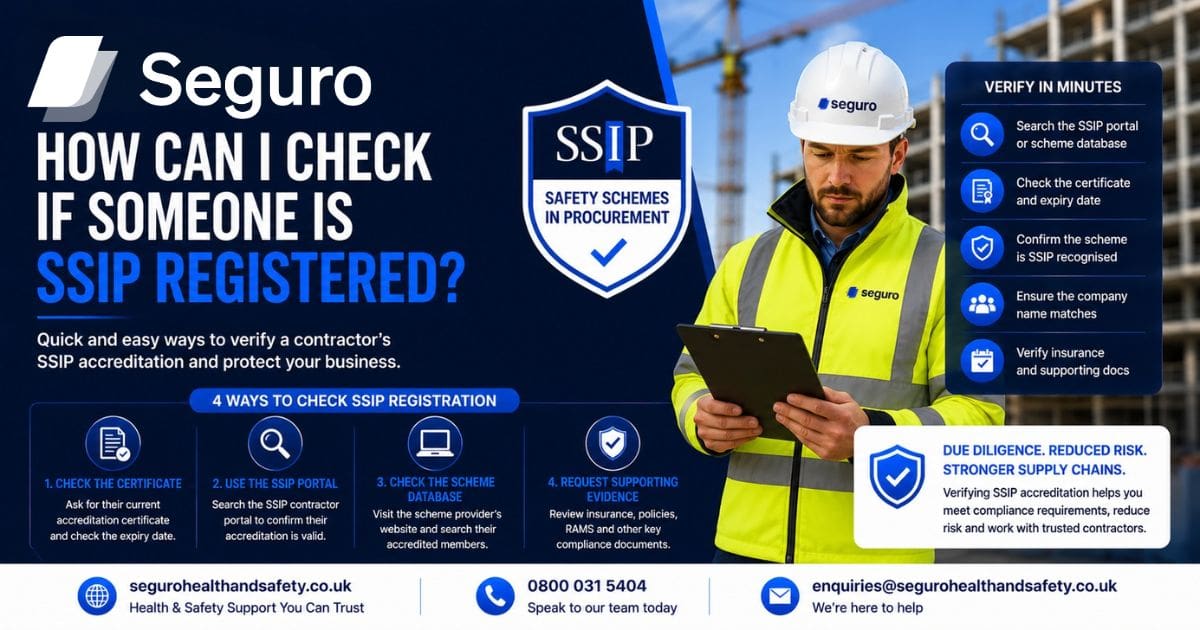
How to Check if Someone Is SSIP Registered

There are several ways to verify a contractor’s SSIP status.

1. Ask for Their Accreditation Certificate

The simplest method is to request a copy of the contractor’s current accreditation certificate.

The certificate should include:

  • Company name
  • Accreditation scheme
  • Registration number
  • Expiry date
  • Scope of certification

Always check that the accreditation is still valid and has not expired.

2. Use the SSIP Portal

SSIP provides a contractor search facility that allows clients to verify whether a business holds a recognised SSIP accreditation.

By searching the contractor’s:

  • Company name
  • Registration number
  • Accreditation details

You can confirm whether they are currently recognised under the SSIP framework.

This is often the quickest and most reliable verification method.

3. Check the Accreditation Provider’s Database

Many SSIP member schemes operate their own contractor directories.

For example, accredited contractors may be searchable through their scheme provider’s database.

Common schemes include:

If the contractor appears within the scheme’s directory and the accreditation is current, this generally confirms their status.

4. Request Supporting Evidence

In addition to accreditation certificates, many clients request:

  • Employers’ Liability Insurance
  • Public Liability Insurance
  • Health & Safety Policy
  • RAMS
  • Training records
  • Competent person details

Accreditation should complement wider contractor due diligence rather than replace it completely.

What Information Should You Check?

When reviewing accreditation, verify:

Company Name

Ensure the legal trading name matches the business you are engaging.

Expiry Date

Many SSIP accreditations require annual renewal.

An expired accreditation should not be treated as current.

Scheme Provider

Confirm the accreditation is from a recognised SSIP member scheme.

Scope of Work

Check that the accreditation aligns with the contractor’s activities.

Insurance Status

Ensure insurance documents remain valid and current.

Can You Trust SSIP Accreditation?

SSIP accreditation provides independent verification that a contractor has been assessed against recognised health and safety standards.

However, accreditation should form part of a wider contractor selection process.

Clients should still consider:

  • Experience
  • References
  • Competence
  • Qualifications
  • Insurance
  • Project suitability

Accreditation is an important indicator but should not be the only factor in contractor approval.

What If a Contractor Claims to Be SSIP Registered but Cannot Prove It?

If a contractor cannot provide evidence of accreditation:

Request Documentation

Ask for a current certificate or registration number.

Verify Directly

Use the SSIP portal or accreditation provider database.

Confirm Expiry Dates

Some contractors may have previously held accreditation that has since lapsed.

Proceed With Caution

If accreditation is a contractual requirement, work should not proceed until suitable evidence is provided.

How Long Does SSIP Accreditation Last?

Most SSIP accreditations are valid for approximately 12 months.

Contractors must renew their accreditation annually to maintain recognised status.

Failure to renew can result in removal from contractor databases and loss of approved status.

Which Accreditations Are Recognised Under SSIP?

Examples of recognised SSIP member schemes include:

  • CHAS
  • SafeContractor
  • SMAS
  • Constructionline
  • CQMS
  • PQS

All assess contractors against the SSIP core health and safety criteria.

Although schemes differ in branding and additional services, the underlying assessment standards remain broadly consistent.

Why Many Clients Require SSIP Registration

Clients increasingly request SSIP accreditation because it helps:

  • Demonstrate compliance
  • Simplify contractor pre-qualification
  • Reduce repeated assessments
  • Improve supply chain consistency
  • Support health and safety management

For contractors, accreditation can improve credibility and access to larger projects and framework opportunities.

How Seguro Can Help

Seguro Health & Safety helps contractors achieve and maintain SSIP accreditation through:

  • CHAS applications
  • SafeContractor applications
  • SMAS accreditation
  • Constructionline support
  • CQMS accreditation
  • PQS accreditation
  • Health & Safety Policies
  • Risk Assessments
  • RAMS
  • Competent Person Services
  • Accreditation renewals

Whether you are checking accreditation as a client or applying for accreditation as a contractor, professional support can help ensure compliance and reduce delays.

Conclusion

Checking whether someone is SSIP registered is an important part of contractor due diligence.

The easiest methods are to request a current accreditation certificate, use the SSIP contractor search facility, or check the accreditation provider’s database.

By verifying accreditation status, reviewing supporting documentation and confirming renewal dates, clients can make more informed contractor selection decisions while helping maintain high health and safety standards across their projects.

CALL Amanda today on 0800 031 5404 and see how we can support you

Amanda is our technical sales advisor

Get Started Today
shape Ask Amanda

Frequently Asked Questions

How can I check if someone is SSIP registered?

You can check if someone is SSIP registered by requesting a copy of their accreditation certificate, searching the SSIP contractor database, checking the accreditation provider’s online directory, or asking for their accreditation registration number.

What does SSIP registered mean?

SSIP registered means a contractor has successfully completed a health and safety assessment through a recognised SSIP member scheme such as CHAS, SafeContractor, SMAS, Constructionline, CQMS or PQS and has demonstrated compliance with the SSIP core criteria.

Can I verify a contractor’s SSIP accreditation online?

Yes. Many SSIP member schemes provide online contractor directories and the SSIP portal offers contractor verification tools that allow clients to check accreditation status and validity.

What information do I need to check SSIP registration?

You will usually need the contractor’s company name, accreditation number, registration details or a copy of their accreditation certificate to verify their SSIP status.

How long does SSIP accreditation remain valid?

Most SSIP accreditations are valid for 12 months and must be renewed annually to maintain recognised accreditation status.

What should I check on an SSIP certificate?

You should verify the company name, accreditation scheme, registration number, issue date, expiry date and scope of certification to ensure the accreditation is current and relevant.

Which accreditation schemes are recognised by SSIP?

Recognised SSIP member schemes include CHAS, SafeContractor, SMAS, Constructionline, CQMS and PQS. All assess contractors against the SSIP core health and safety criteria.

What if a contractor claims to be SSIP registered but cannot provide evidence?

If a contractor cannot provide evidence of accreditation, you should request a current certificate, verify their status through the SSIP database or accreditation provider and confirm that the accreditation has not expired before proceeding.

Does SSIP accreditation guarantee contractor competence?

SSIP accreditation demonstrates that a contractor has been assessed against recognised health and safety standards. However, clients should also consider experience, qualifications, references, insurance and project suitability as part of their contractor selection process.

Why do clients require contractors to be SSIP registered?

Clients often require SSIP registration to simplify contractor pre-qualification, demonstrate health and safety compliance, reduce supply chain risk, support due diligence and improve consistency across procurement processes.

Can Seguro help contractors become SSIP registered?

Yes. Seguro Health & Safety helps contractors achieve and maintain SSIP accreditation through support with CHAS, SafeContractor, SMAS, Constructionline, CQMS and PQS applications, health and safety policies, RAMS, risk assessments and accreditation renewals.

All your Health & Safety requirements in one place

Insight by

amanda

Amanda Lambert

Published on

18 June 2025

Health and safety blog

All your H&S requirements in one place

Here at Seguro we can be a one stop shop for your safety needs. We can help you with one off client requests or by being your competent person providing you with our full Safety package the choice is yours.

All our our clients have different needs so we can tailor a package to fit your Health & Safety requirements.

Competent Person

We provide a full Health & Safety Management System including a policy, employee handbook and an environmental policy. Expert advice is available for you 24/7.

Accreditation

If your looking for an accreditation but not sure which one we can recommend one to suit your individual needs

We can help you to provide the paperwork needed to enable you to show you are capable of working safely. These vary depending on what accreditation you are looking to complete.

We stay with you until the accreditation is achieved.

Risk Assessments & Method Statements

We have a full library of Risk Assessments & Method Statements available for you to purchase from as little as £10. All of our documents are available in word format for you to be able to amend and use as you need in your business.

examples

Safety Advisor

This is a support service for less than 5 employees, this comes with expert advice as well as access to our online documents and Risk assessments. This can be purchased separately or comes free with accreditation applications for less than 5 employees.

We offer many more services including PQQ preparation, Construction Phase Plan preparation. Why not visit our website and see if we can help you with any issues you have now and throughout 2025.

Complete the form below, and we will be happy to provide you with assistance.


    I confirm I have read and agree to the Seguro Health and Safety Consultants Privacy Policy.

    The Difference Between Safety Advisor and Competent Person

    Insight by

    amanda

    Amanda Lambert

    Published on

    12 June 2025

    Competent person

    The Difference Between a Safety Advisor and a Safety Consultant

    Many contractors hear the terms “Safety Advisor” and “Safety Consultant” used interchangeably, but they are not always the same thing.

    Understanding the difference is important because choosing the wrong level of support can affect your legal compliance, accreditation success, and ability to win contracts.

    What Is a Safety Advisor?

    A Safety Advisor is typically an external consultant who provides health and safety support and advice when needed.

    This service is often suited to:

    • Sole traders
    • Small contractors
    • Businesses with 4 employees or less
    • Companies with lower-risk activities

    The key point is that a professional Safety Advisor should hold recognised health and safety qualifications such as:

    • NEBOSH
    • IOSH

    These qualifications demonstrate competence in health and safety management, not just practical construction experience.

    A Safety Advisor service usually includes:

    • Health & safety advice
    • Support with risk assessments
    • RAMS preparation
    • Basic compliance guidance
    • Assistance with contractor requirements
    • A service agreement
    • A competency certificate
    • Consultant CV and qualifications

    For smaller businesses, this is often a flexible and cost effective way to access competent advice without employing a full time health and safety professional.

    In many cases, support is provided on an as needed basis rather than through a monthly retainer.

    What Is a Safety Consultant?

    A Safety Consultant has a more formal legal role within a business.

    Under UK health and safety legislation, businesses with more than five employees are generally expected to appoint someone who is competent in health and safety management.

    Importantly, this does not simply mean someone who is experienced on site.

    A site manager or supervisor may be highly competent at running construction work but may not be competent in managing the company’s health and safety systems unless they also hold recognised qualifications such as NEBOSH or IOSH.

    A Safety Consultant service is usually more comprehensive and ongoing.

    This type of support commonly includes:

    • Monthly retained support
    • Full Health & Safety Management System
    • Health & Safety Policy
    • Staff handbook
    • Equal opportunities policy
    • Ongoing compliance advice
    • Accident and incident support
    • Updates to documentation
    • Liaison with the HSE if required
    • Ongoing business support as the company grows

    In many cases, the consultant effectively becomes an extension of the business and should be informed about changes within the organisation, including:

    • New work activities
    • Additional employees
    • New equipment
    • New premises
    • Higher-risk projects

    The Main Difference

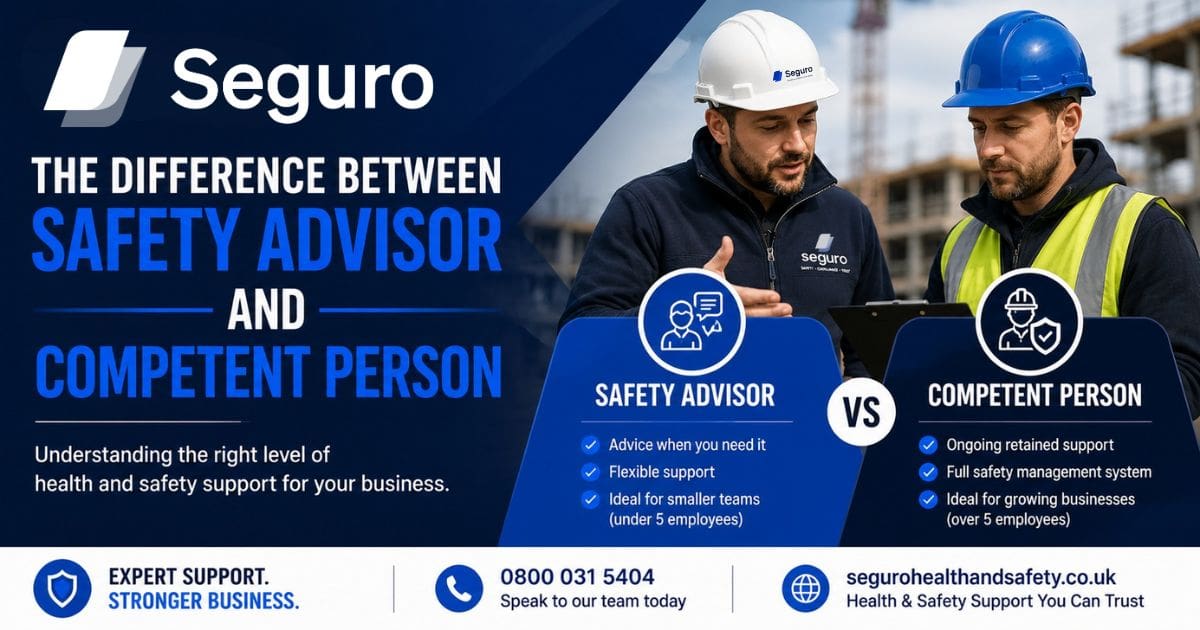
    The main difference between the two services is the level of ongoing involvement and legal responsibility. To keep this simple, think of it like this:

    4 employees or less = Safety Advisor

    Typically:

    • Flexible support
    • Lower-cost option
    • Suitable for smaller businesses
    • Advice when needed
    • Less ongoing involvement

    More than 5 employees = Competent Person 

    Typically:

    • Ongoing retained support
    • More comprehensive compliance management
    • Suitable for growing businesses
    • Full management systems
    • Regular involvement in company operations

    Why This Matters

    Clients, principal contractors, and accreditation schemes increasingly ask contractors to demonstrate they have competent health and safety support in place.

    Even businesses with fewer than five employees may still need:

    • A formal Health & Safety Policy
    • Professional advice
    • Dedicated support arrangements, especially when working for larger contractors or public sector clients.

    This is why there is no absolute “one size fits all” rule.

    Some small businesses need only occasional support, while others require a more structured compliance system to meet client expectations.

    Choosing the Right Support

    The right level of support depends on:

    • Number of employees
    • Type of work carried out
    • Risk profile
    • Client requirements
    • Accreditation goals
    • Business growth plans

    For many contractors, getting the right support early helps:

    • Improve compliance
    • Reduce stress
    • Strengthen accreditation applications
    • Improve organisation
    • Win more work

    If you are unsure which level of support your business requires, professional advice can help clarify your legal duties and ensure your systems are appropriate for your business size and activities.

    For guidance on your specific circumstances, Seguro Health & Safety can help review your requirements and recommend the most suitable level of support.

    CALL Colin on 0800 031 5404 to ask a question

    Colin is our safety consultant.

    Book a CALL
    shape Health & Safety Consultancy, Safety Advisor, Safety Consultant

    Frequently Asked Questions

    What is the difference between a Safety Advisor and a Competent Person?

    A Safety Advisor usually provides health and safety advice and support when needed, often for smaller businesses. A Competent Person has a more formal role in helping the business manage health and safety duties and should have suitable health and safety knowledge, experience and qualifications such as NEBOSH or IOSH.”

    Do I legally need a Competent Person for health and safety?

    Employers must have access to competent health and safety assistance. This may be provided by someone inside the business with suitable competence or by an external Safety Advisor or health and safety consultant.

    Can a site manager be the Competent Person?

    A site manager may be competent at running construction work, but this does not automatically mean they are competent in health and safety management. To act as the Competent Person, they should have suitable health and safety knowledge, experience and recognised qualifications.

    What qualifications should a Safety Advisor have?

    A professional Safety Advisor should normally hold recognised health and safety qualifications such as NEBOSH or IOSH. These qualifications help demonstrate competence in health and safety management and compliance support.

    Do businesses with fewer than 5 employees need a Safety Advisor?

    Businesses with fewer than 5 employees may still need health and safety advice, especially if clients request proof of competent support, RAMS, policies or accreditation evidence. A Safety Advisor service can provide flexible support when required.

    What health and safety support is needed for businesses with more than 5 employees?

    Businesses with more than 5 employees generally need more structured health and safety support, including a written Health and Safety Policy, risk assessments, ongoing competent advice and a suitable safety management system.

    What does a Competent Person service include?

    A Competent Person service may include ongoing retained support, a full health and safety management system, health and safety policy, staff handbook, risk assessment support, RAMS guidance, accident support, legal updates and liaison with the HSE if required.

    What does a Safety Advisor service include?

    A Safety Advisor service may include health and safety advice, a service agreement, certificate of support, consultant CV and qualifications, and assistance with documents such as risk assessments, RAMS and contractor compliance paperwork when needed.

    Can a client ask for proof of competent health and safety support?

    Yes. Clients, main contractors and accreditation schemes may ask for evidence that your business has access to competent health and safety support, even if you have fewer than 5 employees.

    How do I know whether I need a Safety Advisor or Competent Person?

    The right support depends on your number of employees, type of work, risk level, client requirements and accreditation goals. Smaller businesses may need flexible Safety Advisor support, while growing businesses or those with more than 5 employees may need ongoing Competent Person support.

    Remote Safety Advisor Service for Small Businesses

    Insight by

    amanda

    Amanda Lambert

    Published on

    5 June 2025

    Health and safety blog

    What Is a Remote Safety Advisor Service and Why Are SMEs Choosing One?

    For many UK SMEs, managing Health & Safety compliance is no longer just about passing an accreditation audit. Businesses now need ongoing support, up to date documentation, and access to expert advice throughout the year.

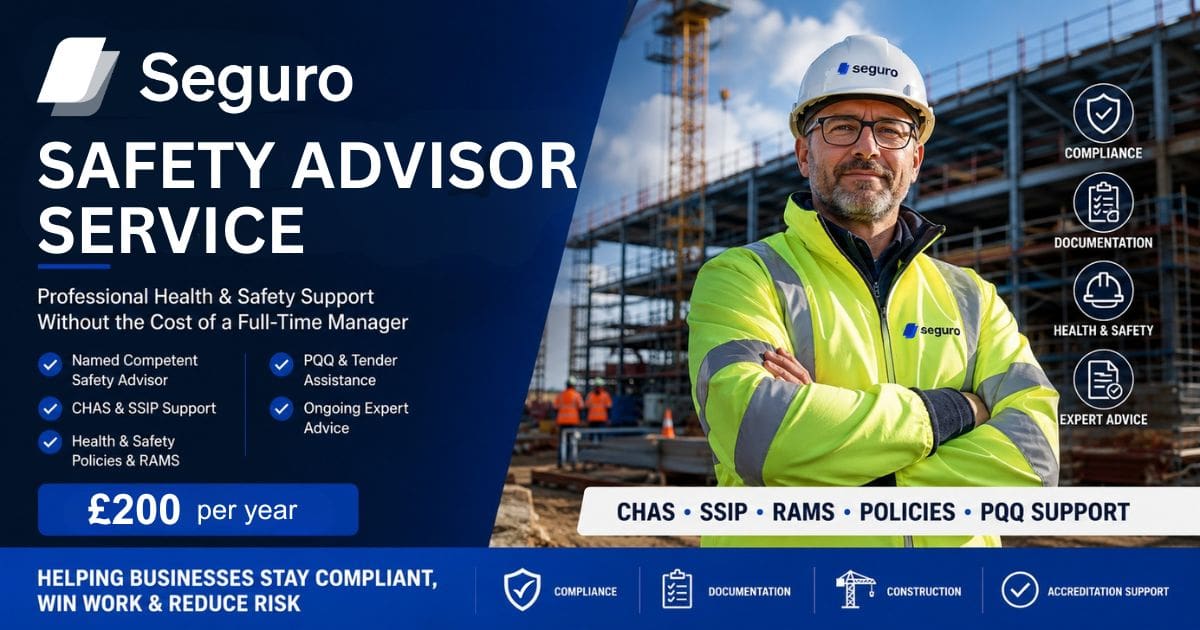
    A Remote Safety Advisor Service gives small businesses access to professional Health & Safety support without the cost of employing a full time in house advisor.

    At Seguro Health & Safety Services, the Safety Advisor Service is designed to support businesses throughout their accreditation process and long after approval is achieved.

    What Does a Safety Advisor Service Include?

    A Safety Advisor Service provides businesses with ongoing Health & Safety guidance, documentation support, and compliance assistance.

    For SMEs with four employees or less, our service includes:

    • Support implementing Health & Safety documentation into day to day operations
    • Ongoing Health & Safety advice by telephone or email
    • Access to ready made risk assessments and method statements
    • General COSHH assessments from a pre prepared library
    • Monthly Health & Safety newsletters and legislation updates
    • Support with PQQ documentation and accreditation requirements (additional costs may apply)

    This type of service helps businesses maintain compliance between audits, rather than preparing only for inspections as renewal dates approach.

    Which Accreditations Are Supported?

    The service supports businesses working towards or maintaining several recognised contractor accreditation schemes, including:

    • CHAS
    • PQS
    • SafeContractor
    • Constructionline
    • CQMS
    • Avetta
    • Builders Profile

    These accreditations are often required when tendering for contracts in construction, facilities management, engineering, and subcontracting industries. Additional fees for accreditation support apply.

    Remote Safety Advisor vs In House Health & Safety Advisor

    One of the most common questions SMEs ask is whether they need an in house Health & Safety advisor or whether a remote service is enough.

    For smaller businesses, a remote Safety Advisor is often the more practical and cost effective solution.

    Cost Comparison

    Hiring a full-time in house Health & Safety professional can involve:

    • Salary costs
    • Pension contributions
    • Training expenses
    • Software subscriptions
    • Ongoing CPD and compliance updates

    By comparison, Seguro’s remote Safety Advisor Service for businesses with four employees or less costs £200 + VAT per year.

    This gives SMEs access to professional support without committing to a permanent salary expense.

    Why SMEs Use Remote Health & Safety Support

    Small businesses typically do not need a full time Health & Safety manager every day. However, they still need to:

    • Stay legally compliant
    • Produce risk assessments
    • Maintain documentation
    • Meet contractor accreditation standards
    • Respond to client PQQ requirements

    A remote advisor helps bridge that gap by giving businesses access to expert support only when needed.

    For many SMEs, this creates a more scalable and affordable compliance model.

    What Ongoing Support Is Included?

    Businesses using Seguro’s Safety Advisor Service receive:

    Unlimited Telephone and Email Advice

    Clients can contact the team throughout working hours for guidance on Health & Safety queries, compliance concerns, and documentation support.

    Risk Assessments and Method Statements

    Access is provided to over 80 risk assessments and supporting documents, helping businesses quickly produce standard Health & Safety paperwork.

    COSHH Documentation

    Clients can access pre-prepared COSHH assessments from Seguro’s document library.

    Legislation Updates

    Health & Safety laws and compliance expectations regularly change. Ongoing updates help businesses stay informed and compliant.

    Why Accreditation Support Matters

    Many SMEs pursue contractor accreditations because clients increasingly require them before awarding contracts.

    Accreditations such as CHAS, Constructionline, and SafeContractor demonstrate that a business has appropriate Health & Safety systems in place.

    However, achieving accreditation is only part of the process. Maintaining compliance year round is equally important.

    This is why ongoing advisory support can provide long term value beyond the initial application.

    How Seguro Supports SMEs

    Seguro currently supports more than 200 clients with Health & Safety compliance and accreditation support.

    The company reports a 95% yearly retention rate, reflecting the demand for ongoing outsourced Health & Safety services among SMEs.

    Businesses can communicate by phone or email, depending on their preferred way of working.

    Is the Safety Advisor Service Free With Accreditation Support?

    Yes, for businesses with 4 or less employees. Businesses that use Seguro to complete accreditation submissions can receive the Safety Advisor Service free of charge as part of their accreditation application support.

    This can be particularly valuable for SMEs applying for:

    • CHAS
    • Constructionline
    • PQS
    • CQMS
    • Other SSIP-related contractor schemes

    For businesses new to SSIP compliance, this can simplify both the accreditation process and ongoing compliance management.

    Call Matt on 0800 0315404 to ask a question

    Matt is our health and safety advisor and supports small companies.

    Get Started Today
    shape Safety Advisor

    Frequently Asked Questions

    What is a remote Safety Advisor Service?

    A remote Safety Advisor Service provides outsourced Health and Safety support to businesses without the need for a full-time in-house advisor. It usually includes compliance advice, documentation support, risk assessments, method statements, COSHH support, accreditation assistance and ongoing telephone or email guidance.

    Why are SMEs choosing a remote Safety Advisor Service?

    Many SMEs choose a remote Safety Advisor Service because it provides professional Health and Safety support without the cost of employing a full-time advisor. It helps businesses stay legally compliant, maintain documentation, meet accreditation requirements and respond to client PQQ requests.

    What does Seguro’s Safety Advisor Service include?

    Seguro’s Safety Advisor Service includes support with implementing Health and Safety documentation, ongoing telephone and email advice, access to ready-made risk assessments and method statements, general COSHH assessments, annual document reviews, monthly Health and Safety newsletters, legislation updates and support with PQQ and accreditation requirements.

    Which accreditations does Seguro support?

    Seguro supports businesses working towards or maintaining accreditations including CHAS, SafeContractor, Constructionline, Exor, Altius, Avetta and Builders Profile. These accreditations are commonly required in construction, facilities management, engineering and subcontracting.

    Is a remote Safety Advisor suitable for small businesses?

    Yes. A remote Safety Advisor is suitable for many small businesses because they may not need a full-time Health and Safety manager every day. Remote support gives them access to expert advice when needed while keeping costs manageable.

    How much does Seguro’s remote Safety Advisor Service cost?

    Seguro’s remote Safety Advisor Service for businesses with four employees or fewer costs £200 plus VAT per year. This provides access to professional Health and Safety support without the cost of employing an in-house advisor.

    Is the Safety Advisor Service free with accreditation support?

    Yes, for businesses with four employees or fewer. Businesses that use Seguro to complete accreditation submissions can receive the Safety Advisor Service free of charge alongside their accreditation application support.

    What ongoing support is included with Seguro’s Safety Advisor Service?

    Ongoing support includes unlimited telephone and email advice during working hours, access to over 80 risk assessments and supporting documents, pre-prepared COSHH assessments, Health and Safety legislation updates and annual document reviews.

    Can a remote Safety Advisor help with CHAS and SafeContractor?

    Yes. A remote Safety Advisor can help businesses prepare and maintain the Health and Safety documentation needed for accreditations such as CHAS, SafeContractor and other SSIP-related contractor schemes.

    What are SSIP accreditations?

    SSIP stands for Safety Schemes in Procurement. SSIP schemes assess whether contractors meet recognised Health and Safety standards and are often required before businesses can tender for certain contracts.

    Why does ongoing Health and Safety support matter after accreditation approval?

    Ongoing Health and Safety support matters because achieving accreditation is only part of the process. Businesses must maintain compliance year-round, keep documents updated, respond to client requirements and stay informed about legal and compliance changes.

    How does Seguro support SMEs with Health and Safety compliance?

    Seguro supports SMEs with Health and Safety compliance by providing outsourced advice, accreditation support, documentation reviews, risk assessment resources, COSHH information, legislation updates and telephone or email support.

    What is SSIP Deem to Satisfy?

    Insight by

    amanda

    Amanda Lambert

    Published on

    14 May 2025

    Health and safety blog

    What Is SSIP Deem to Satisfy?

    Quick Answer: 

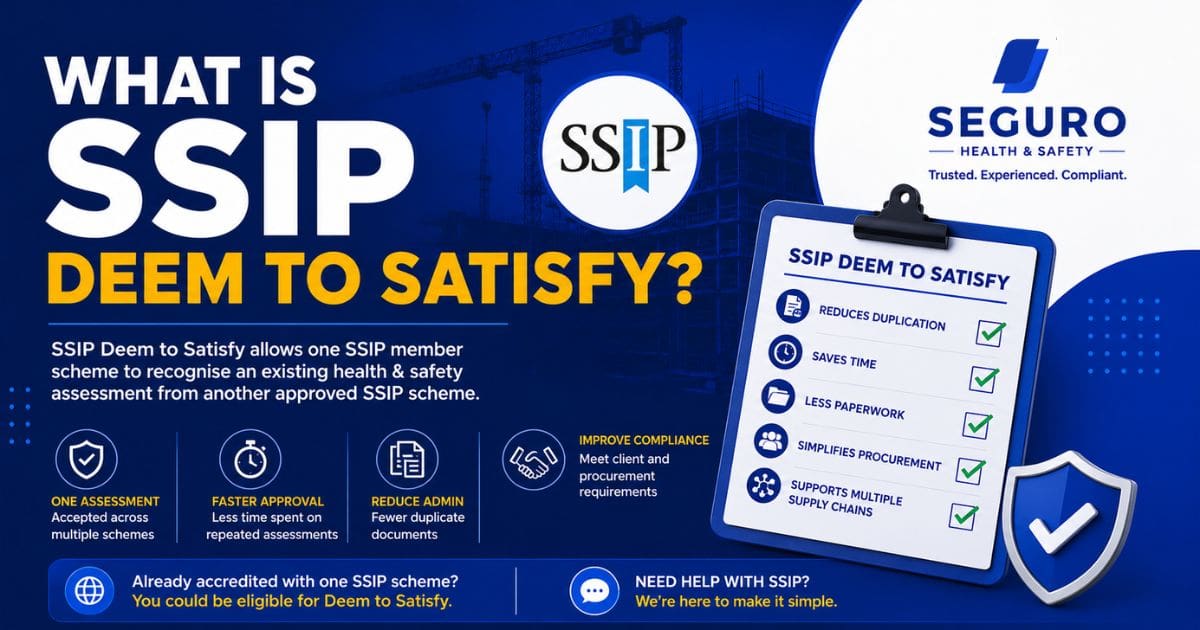
    SSIP Deem to Satisfy is a process that allows one SSIP member scheme to recognise an existing valid SSIP assessment from another approved scheme, helping contractors reduce duplicated health and safety assessments and simplify procurement compliance.

    In simple terms:

    If you already hold a valid SSIP accreditation, you may not need to complete the full assessment process again when applying to another SSIP member scheme.

    This helps contractors:

    • Reduce duplication
    • Save time
    • Avoid repeating paperwork
    • Simplify procurement compliance

    For many UK contractors, Deem to Satisfy makes it easier to work with multiple clients who request different SSIP schemes.

    What Does SSIP Mean?

    SSIP stands for Safety Schemes in Procurement.

    It is an umbrella organisation that brings together recognised health and safety accreditation schemes including:

    • CHAS
    • Constructionline
    • SafeContractor
    • SMAS
    • CQMS
    • PQS

    All SSIP member schemes assess the same core health and safety standards.

    What Is SSIP

    How Does SSIP Deem to Satisfy Work?

    The process works by allowing one SSIP assessment to be recognised by another member scheme.

    For example:

    • A contractor holds CHAS accreditation
    • Another client requests SMAS
    • Instead of starting from scratch, SMAS may accept the existing SSIP assessment through Deem to Satisfy

    The second scheme may:

    • Reduce the amount of information required
    • Skip duplicated assessment sections
    • Fast-track approval

    However, some additional checks may still apply depending on the scheme.

    Why Was Deem to Satisfy Created?

    Before SSIP Deem to Satisfy, contractors often had to:

    • Complete multiple health and safety applications
    • Submit the same documents repeatedly
    • Pay for repeated assessments
    • Waste time duplicating compliance work

    Deem to Satisfy was introduced to:

    • Reduce unnecessary duplication
    • Simplify procurement
    • Improve consistency across schemes
    • Support contractors working across multiple supply chains

    Which SSIP Schemes Use Deem to Satisfy?

    Many SSIP member schemes participate in the process, including:

    • CHAS
    • SafeContractor
    • SMAS
    • Constructionline
    • CQMS
    • PQS

    Acceptance can vary depending on:

    • Accreditation level
    • Scope of work
    • Expiry dates
    • Additional scheme requirements

    SSIP Schemes Comparison

    Is CHAS Deem to Satisfy?

    CHAS itself is an SSIP member scheme and may participate in the Deem to Satisfy process.

    This means:

    • Existing SSIP accreditations may support a CHAS application
    • CHAS accreditation may support applications to other SSIP schemes

    However, CHAS may still request:

    • Additional evidence
    • Further compliance checks
    • Scheme-specific requirements

    This is especially common with:

    • CHAS Advanced
    • CHAS Elite
    • Common Assessment Standard (CAS)

    SSIP vs CHAS

    What Information Is Usually Required?

    Even with Deem to Satisfy, contractors may still need to provide:

    • Existing accreditation details
    • Valid certification
    • Insurance
    • Company information
    • Additional supporting evidence

    Some schemes may also review:

    • Environmental policies
    • Quality systems
    • Financial information
    • Modern slavery compliance

    Benefits of SSIP Deem to Satisfy

    1. Reduces Duplicate Assessments

    You avoid repeating the same health and safety assessment multiple times.

    2. Saves Time

    Applications can often be completed faster.

    3. Reduces Administration

    Less paperwork and fewer repeated uploads.

    4. Supports Procurement Compliance

    Makes it easier to work for:

    • Main contractors
    • Local authorities
    • Public sector clients
    • Large commercial organisations

    5. Improves Scalability

    Helpful for contractors working across multiple frameworks or supply chains.

    Does Deem to Satisfy Mean Automatic Approval?

    No.

    This is one of the biggest misunderstandings.

    Deem to Satisfy does NOT guarantee automatic approval.

    The receiving scheme may still:

    • Review documents
    • Request updates
    • Ask additional questions
    • Require extra compliance evidence

    The process simply reduces duplicated assessment where possible.

    Common Problems With Deem to Satisfy Applications

    Applications may still fail due to:

    • Expired accreditation
    • Incorrect company information
    • Missing insurance
    • Inconsistent documents
    • Weak RAMS
    • Outdated health & safety policies
    • Scheme-specific requirements not being met

    Why SSIP Applications Fail

    Is Deem to Satisfy Suitable for Small Contractors?

    Yes.

    Small contractors often benefit significantly because it:

    • Reduces admin
    • Saves time
    • Simplifies onboarding
    • Helps meet procurement requirements faster

    This is particularly useful for:

    • Subcontractors
    • Sole traders
    • Small construction businesses
    • Growing contractors

    SSIP for Small Contractors

    How to Improve Your Chances of Approval

    To improve approval success:

    • Keep documents updated
    • Ensure company information matches across all documents
    • Use tailored RAMS
    • Maintain valid insurance
    • Provide clear evidence of competence
    • Use professional health & safety support if needed

    Done for You SSIP Support

    Many contractors choose professional support to:

    • Handle applications
    • Prepare documents
    • Upload evidence
    • Manage assessor responses
    • Reduce delays and rejection risk

    At Seguro Health and Safety, we support contractors with:

    • CHAS
    • Constructionline
    • SafeContractor
    • SMAS
    • PQS
    • SSIP applications and renewals

    Done for You SSIP

    Need Help With SSIP Accreditation?

    If you need support with:

    • SSIP applications
    • CHAS accreditation
    • RAMS
    • Health & safety documentation
    • Procurement compliance

    CALL Amanda on 0800 031 5404 to get started

    shape Ask Amanda

    Frequently Asked Questions

    What is SSIP Deem to Satisfy?

    SSIP Deem to Satisfy is a process that allows one SSIP member scheme to recognise an existing valid health and safety assessment completed through another approved SSIP scheme. This can reduce duplication and make procurement compliance easier.

    Does SSIP Deem to Satisfy mean automatic approval?

    No. SSIP Deem to Satisfy does not guarantee automatic approval. The receiving scheme may still check your company details, insurance, accreditation status and any additional scheme-specific requirements.

    Which schemes accept SSIP Deem to Satisfy?

    Many SSIP member schemes may use the Deem to Satisfy process, including CHAS, Constructionline, SafeContractor, SMAS, CQMS and PQS. Acceptance can depend on the scheme, accreditation level, expiry date and scope of work.

    Can CHAS be used for SSIP Deem to Satisfy?

    Yes. CHAS is an SSIP member scheme, so a valid CHAS accreditation may help support a Deem to Satisfy application with another SSIP scheme. However, additional checks may still be required.

    Can another SSIP accreditation be used to apply for CHAS?

    Yes. In some cases, an existing valid SSIP accreditation from another member scheme may support a CHAS application through Deem to Satisfy. CHAS may still request additional evidence depending on the level of accreditation required.

    What information is needed for SSIP Deem to Satisfy?

    You may need to provide your existing SSIP certificate, accreditation details, company information, insurance documents and any extra evidence requested by the receiving scheme.

    What are the benefits of SSIP Deem to Satisfy?

    The main benefits are reduced duplication, less paperwork, faster applications, lower administration time and easier compliance with different client procurement requirements.

    Why can Deem to Satisfy applications still fail?

    Deem to Satisfy applications can still fail if the accreditation has expired, company information is inconsistent, insurance is missing or incorrect, documents are outdated, or additional scheme-specific requirements are not met.

    Is SSIP Deem to Satisfy useful for small contractors?

    Yes. SSIP Deem to Satisfy can be very useful for small contractors because it reduces repeated paperwork and helps them meet different client or main contractor requirements more efficiently.

    Can Seguro help with SSIP Deem to Satisfy applications?

    Yes. Seguro Health and Safety can help contractors with SSIP Deem to Satisfy, CHAS, Constructionline, SafeContractor, SMAS, PQS and other SSIP applications by preparing documents, managing submissions and responding to assessor queries.

    Try Our Online Training for FREE

    Insight by

    Bob Evans

    Bob Evans

    Published on

    14 December 2024

    Health and safety blog

    Introduction

    Our fully approved, health and safety online training courses are perfect for gaining qualifications for you and your employees. We can deliver all the training you need for an SSIP assessment and all essential health and safety awareness.

    Our engaging courses can be taken at any time, in any place and on any device. All courses are approved and priced to offer the best possible value to your business.

    FREE Trial

    You can sign up here for a free trial of our health and safety online training courses.

    A trial account gives you free access to the first module of all our available courses.

    Any progress you make will be saved, so if you decide to buy, you can continue from where you left off.

    So complete the form on this page to get instant access, and let’s get started.

    Start your FREE trial

    Available health and safety online training courses

    You can also select a course you are interested in and click on the FREE trial button on the course. Select any courses from the list below:

    The courses available are:

    Need support

    Once you have seen what we offer, don’t hesitate to get in touch, and we will be happy to set you up with your health and safety online training solution.

    If you get stuck or need some help feel free to get in touch.

    Testimonial

    Hyperion

    I just wanted to send you a quick email about the amazing staff you have on your team.

    Natasha has been dealing with Hyperion for a couple of years now, and we have received nothing but exceptional service from this young lady. I get the quickest responses, with as much help as possible provided every single time. She has gone above and beyond for myself and Mark every time I have spoken to her.

    I thought I would just share this with you as I feel her remarkable customer service and attitude towards the job should most definitely be recognised, and she’s an absolute credit to yourself and the rest of the team.

    Thanks to all at Seguro

    Kind Regards

    Saskia

    What is Builders Profile?

    Insight by

    amanda

    Amanda Lambert

    Published on

    14 August 2024

    Health and safety blog

    What Is Builders Profile?

    Builders Profile is a UK construction compliance and pre-qualification platform used to assess and verify contractor competence. It allows contractors to upload evidence once and share it with multiple clients, reducing repeated PQQs and simplifying compliance.

    It is widely used by principal contractors, house builders, and developers across the UK.

    What Does Builders Profile Do?

    It acts as a central compliance hub where contractors store and manage key business information, including:

    • Health & safety documentation
    • Insurance certificates
    • Training and competence records
    • Company and financial details
    • Accreditation evidence

    Clients can access this information directly, saving time for both parties.

    Who Uses Builders Profile?

    It is commonly used by:

    • Construction contractors and subcontractors
    • Trades working for house builders and developers
    • Principal contractors managing supply chains
    • Facilities management and maintenance companies

    Many large contractors require suppliers to be registered on Builders Profile before onboarding.

    Is Builders Profile an Accreditation?

    No. It is not an accreditation like CHAS, SMAS, or Constructionline.

    Instead, it is a compliance and verification platform that may host evidence of your accreditations, helping clients review your compliance in one place.

    What Information Is Assessed on Your Profile?

    While the Profile itself does not certify you, it typically reviews and verifies:

    • Health & Safety policies and procedures
    • Risk assessments and method statements (RAMS)
    • Training records (e.g. CSCS, trade qualifications)
    • Insurance and company information
    • Modern slavery, equality, and environmental policies

    Benefits of Using Builders Profile

    Your Profile helps contractors:

    • Reduce repeated PQQ submissions
    • Speed up supplier onboarding
    • Improve visibility with clients
    • Demonstrate compliance efficiently
    • Manage documents in one central system

    How Long Does Builders Profile Registration Last?

    Registration is usually annual, with ongoing updates required to keep documents current and visible to clients.

    Summary

    • Builders Profile is a UK construction compliance platform
    • Used to store and share contractor information
    • Not an accreditation or SSIP scheme
    • Reduces repeated PQQs
    • Widely used by principal contractors and house builders

    Expert Insight

    Your Profile works best when combined with recognised accreditations such as CHAS, SMAS, Constructionline or CQMS, ensuring your compliance evidence meets buyer expectations.

    Get a Accredited

    • ast Turnaround. Documents ready in 5 days
    • Fixed Fees. There are no hidden charges
    • Trusted Friendly consultant. 
    Get Start Today
    shape What is Builders Profile