
Close Navigation

Search

CHAS Deem to satisfy – Everything you need to know

Insight by

amanda

Amanda Lambert

Published on

3 October 2016

CHAS

CHAS Deem to Satisfy: What It Means for Contractors (2026 Guide)

If you’ve seen “Deem to Satisfy” in CHAS, here’s the simple answer:

CHAS Deem to Satisfy means your existing accreditation can be recognised as meeting CHAS requirements, without repeating the full assessment.

It’s designed to reduce duplication, speed up approvals, and get you on site faster.

Quick Answer

  • Already accredited with another scheme? You may qualify for Deem to Satisfy
  • Saves time?  Yes (no full reassessment)
  • Still checked?  Yes (validation still required)
  • If you’re applying from scratch, follow our step-by-step CHAS accreditation guide.

How CHAS Deem to Satisfy Works

CHAS is part of:

Safety Schemes in Procurement (SSIP). All SSIP schemes follow the same core health & safety criteria, which allows CHAS to:

  1. Review your existing SSIP certificate
  2. Verify it meets CHAS standards
  3. Grant CHAS status without a full reassessment

In practice, if you already meet SSIP standards, CHAS may accept them rather than requiring you to start from scratch. Deem to Satisfy works alongside SSIP accreditation schemes like CHAS.

When Can You Use Deem to Satisfy?

You can typically use it if you already hold accreditation from another SSIP scheme, such as:

  • Constructionline
  • PQS
  • SMAS Worksafe
  • SafeContractor

Common scenario:

  • A client specifically asks for CHAS
  • You already have another SSIP certificate
  • You use Deem to Satisfy to get CHAS quickly

What CHAS Still Checks

Even with Deem to Satisfy, CHAS will still verify:

  • Your accreditation is valid and current
  • Your business details match
  • Your scope of work is appropriate
  • Any additional CHAS specific requirements

It’s not automatic approval; it’s streamlined approval.

Benefits of CHAS Deem to Satisfy

  • Avoid duplicate assessments
  • Faster route to CHAS accreditation
  • Lower admin burden
  • Maintain compliance across multiple clients
  • Stay competitive in tenders

Common Misunderstandings

“I’m already SSIP accredited, so I’m automatically CHAS approved.”

Not true: you must still apply via Deem to Satisfy.
Incorrect: CHAS still validates your status

When You Should Use It

Use Deem to Satisfy if:

  • A client specifically requests CHAS
  • You already hold a valid SSIP accreditation
  • You want to avoid repeating the full process

Simple Takeaway

Deem to Satisfy = Faster CHAS approval using your existing SSIP accreditation.

If you are looking for a CHAS accreditation, you may want to understand the full cost. See our CHAS accreditation cost breakdown.

Need help getting approved? Our CHAS support service handles the full process for you.

CALL Amanda on 0800 031 5404 to ask a question

Get Started


shape Ask Amanda

Frequently Asked Questions

What does Deem to Satisfy mean?

Deem to Satisfy means CHAS may recognise an existing valid SSIP accreditation as meeting the CHAS health and safety assessment requirements, helping contractors avoid repeating the full assessment process.

Can I get CHAS if I already have another SSIP accreditation?

Yes. If you already hold a valid SSIP accreditation from another recognised scheme, you may be able to apply for CHAS using the Deemto Satisfy route instead of completing a full CHAS assessment.

Is CHAS Deem to Satisfy automatic?

No. Deem/Satisfy is not automatic. CHAS still needs to verify your existing accreditation, business details, scope of work and whether your current certificate meets the required standard.

Which accreditations can be used for Deem to Satisfy?

Contractors may be able to use another valid SSIP accreditation, such as Constructionline, SafeContractor, SMAS, CQMS or PQS, to support a CHAS Deem to Satisfy application.

Why would a contractor use Deem to Satisfy?

A contractor may use Deem to Satisfy when a client specifically asks for CHAS, but the contractor already holds another SSIP accreditation. This can reduce duplication, save time and help meet client requirements faster.

Does Deem to Satisfy mean I do not need documents?

No. You may still need to provide evidence, including your existing SSIP certificate and business information. CHAS may also request additional documents if your current accreditation does not fully cover the required scope.

How long does Deem to Satisfy take?

CHAS Deem to Satisfy can be quicker than a full CHAS assessment because the core health and safety assessment has already been completed by another SSIP scheme. The timescale depends on validation and any additional information requested.

Is CHAS Deem to Satisfy the same as full CHAS accreditation?

Deem to Satisfy can provide a route to CHAS recognition based on an existing SSIP accreditation. However, CHAS still validates the application and may require additional information before approval.

Related CHAS Guides

CHAS new E form process

Insight by

amanda

Amanda Lambert

Published on

12 July 2016

CHAS

CHAS new E form Process

In 2016 CHAS have introduced a new system where you can apply for your CHAS direct on their online portal. Previously you were only able to pay online and had to submit your documents separately.

The online E form Process is not available for groups or for other members of the SSIP umbrella group they need to contact chas.admin@chas.co.uk. You will also need to use the old way of applying if you a Designers or Principal Designer.

The new  process is different as you will need to pay for your CHAS on submission. Before you start your application you need to make sure you have everything you need to hand in electronic format:

  • Examples of Risk assessments and Method Statements in situ on previous jobs
  • COSHH Assessments specific to your business
  • Evidence of Health & Safety Training specific to your business and employees
  • Evidence of Contractor Management & Competence Assessment
  • plus other necessary documents
  • valid payment method

Once you have everything in place start the process by clicking here:

CHAS

Once you have made payment your application will  be assigned to an assessor and they will login and commence the assessment. The assessment can take up to 10 working days and this can result in a pass or feedback requiring more information. All updates will be sent to you via the E Forms system.

The assessment process remains the same whereby, if more information is needed you will need to provide this to get your certificate.

Using the E Forms system means that once you have been passed by the assessor a confirmation letter and an electronic copy of your certificate will be uploaded to your account.  You will then receive a hard copy of the certificate & accreditation pack post within 10 working days.

If you are unsure if you have the right information or would like some support to complete the accreditation please get in touch.

CHAS Accreditation Cost Breakdown (Guide Prices)

Insight by

amanda

Amanda Lambert

Published on

24 November 2015

CHAS

CHAS Accreditation Cost (2026): Full Breakdown for UK Contractors

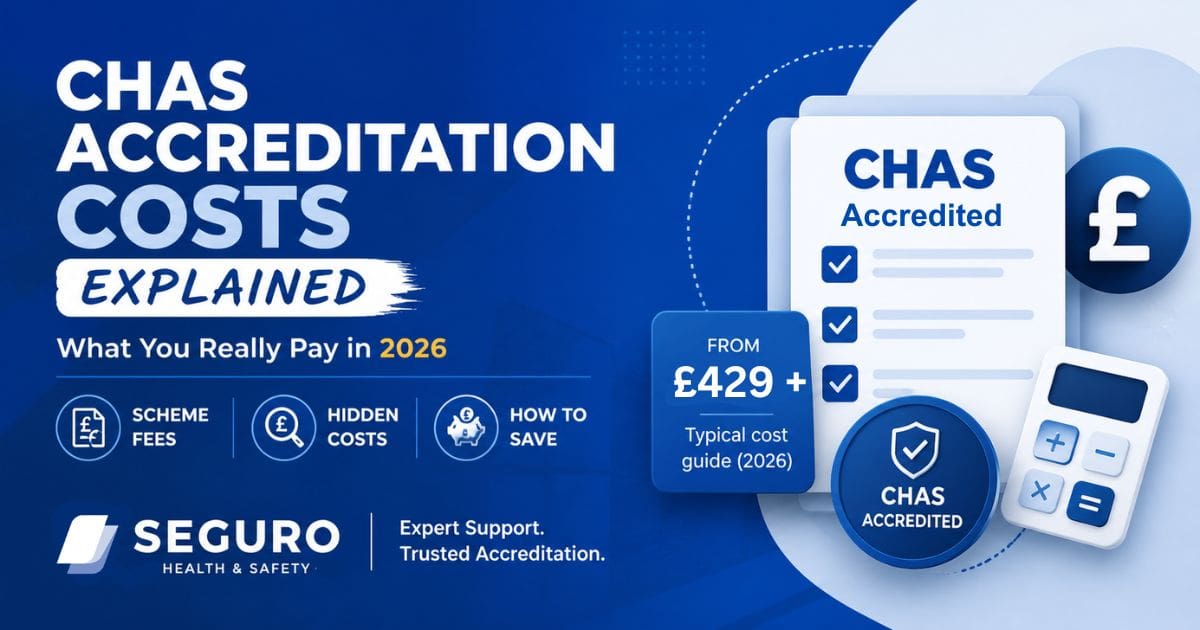
CHAS accreditation typically costs between £400 and £3,500+ per year, depending on your company size and the level you choose (Standard, Advanced, or Elite).

Additional costs may include training, documentation, and health & safety support.

To understand the full process, see our guide on how to get CHAS accreditation.

What Affects CHAS Accreditation Cost?

CHAS pricing is based on:

  • Number of employees
  • Level of accreditation
  • Risk profile of your business

The larger your business and the higher the level, the more you will pay.

CHAS Accreditation Levels Explained

CHAS Standard (Entry Level)

  • Health & safety assessment
  • SSIP accreditation

Suitable for most small contractors

CHAS Advanced

  • Includes Standard
  • Adds PAS 91 requirements

Often needed for larger contracts.

CHAS Elite (Highest Level)

  • Includes Advanced
  • Aligns with Common Assessment Standard (CAS)
  • Covers 13 areas, including:
    • Health & safety
    • Environmental
    • Quality
    • Financial and governance

Required for many public sector frameworks

CHAS Accreditation Cost Breakdown (Guide Prices)

CHAS Standard:

  • 1 person: ~£429+ VAT
  • 2–4 people: ~£499+ VAT
  • 5–9 people: ~£829+ VAT
  • 9–15 people: ~£1009+ VAT
  • 16–30 people: ~£1179+ VAT

CHAS Advanced:

  • 1 person: ~£659+ VAT
  • 2–4 people: ~£799+ VAT
  • 5–9 people: ~£1259+ VAT
  • 9–15 people: ~£1539+ VAT
  • 16–30 people: ~£1809+ VAT

CHAS Elite:

  • 1 person: ~£909+ VAT
  • 2–4 people: ~£989+ VAT
  • 5–9 people: ~£1479+ VAT
  • 9–15 people: ~£1879+ VAT
  • 16–30 people: ~£2279+ VAT

All CHAS certifications must be renewed annually


Other CHAS accreditation Costs

Training

To comply with the standard, you may be required to train your personnel in the following courses if you have not already done so.

  • Asbestos: The Control of Asbestos Regulations
  • Working at Height The Work at Height Regulations CHAS 2013 Ltd –
  • First Aid The Health and Safety (First-Aid) Regulations
  • Fire precautions: The Regulatory Reform (Fire Safety) Order 2005 and the Dangerous Substances and Explosive Atmospheres Regulations
  • Noise and vibration: The Control of Noise at Work Regulations (NAW Regs) and The Control of Vibration at Work Regulations
  • Personal Protective Equipment Personal Protective Equipment at Work Regulations (PPE Regs)
  • Substances hazardous to Health Control of Substances Hazardous to Health Regs (COSHH)
  • Electricity Electricity at Work Regs
  • Manual Handling Operations Regulations (MHO Regs)
  • Work Equipment Provision and Use of Work Equipment (PUWE) Regs

Competent person safety advisor

You must employ a competent safety advisor if you employ more than five people. If you are a large organisation, you may already have one. Employing a qualified safety advisor may be prohibitive if you are a small contractor.

We are the remote competent person safety advisor for over eight hundred companies. We can offer this service to you for a fraction of the cost.

Additional Costs to Consider

CHAS is not just the fee—you may also need:

Training Costs

Depending on your work:

  • Working at height
  • Asbestos awareness
  • First aid
  • COSHH
  • Manual handling

Documentation Costs

If you don’t already have:

  • RAMS
  • Health & safety policy
  • Procedures

Competent Person (Safety Advisor)

UK law requires access to a competent health & safety advisor

This can be:

  • In-house (expensive)
  • Outsourced (more cost-effective)

How to Reduce CHAS Costs

To keep costs down:

Choose the correct CHAS level

Prepare documents before applying

Keep training up to date

Avoid failed applications (costs time + delays)

Use expert support to get it right first time

Can You Save Money with Other SSIP Schemes?

CHAS is one of several SSIP schemes.

Alternatives include:

Some schemes are cheaper, especially for small businesses.

Please note:

  • All SSIP schemes follow the same core criteria.
  • Many clients still specify CHAS by name.
  • To understand what’s involved in passing, see the full CHAS assessment criteria explained.

Is CHAS Worth the Cost?

CHAS is not legally required…

But it is often commercially essential.

Without it, you may:

  • Lose contract opportunities
  • Fail pre-qualification
  • Be excluded from tenders.
  • Once approved, you’ll be recognised as a CHAS-accredited contractor.

With it, you can:

  • Demonstrate compliance
  • Win more work
  • Reduce repeated assessments

Final Thought

CHAS accreditation costs are not just fees…

It’s an investment in:

  • Compliance
  • Credibility
  • Business growth

CALL Amanda on 0800 031 5404 to get started

Get a price
shape Ask Amanda

Related CHAS Guides

Frequently asked questions

How much does CHAS accreditation cost?

CHAS accreditation costs vary depending on your company’s size and the level selected. Smaller contractors usually pay less, while larger businesses and higher levels, such as CHAS Advanced or CHAS Elite, cost more.

What affects the cost of CHAS accreditation?

The cost of CHAS accreditation is mainly determined by the number of employees, the chosen accreditation level, your business risk profile, and whether you need additional support with documents, training, or competent person advice.

What are the CHAS accreditation levels?

CHAS offers different levels, including CHAS Standard, CHAS Advanced and CHAS Elite. Standard focuses on health and safety and SSIP. Advanced includes wider checks such as PAS 91. Elite is aligned with the Common Assessment Standard.

Are there extra costs besides the CHAS fee?

Yes. Additional CHAS costs may include training, RAMS, health and safety policies, procedures, insurance updates and competent person support if your current documents or evidence are missing or out of date.

Do I need a competent person for CHAS accreditation?

Yes. CHAS applicants normally need to show they have access to competent health and safety advice. This may be provided by an in-house safety advisor or an outsourced competent person service.

Can I reduce the cost of CHAS accreditation?

You can reduce CHAS accreditation costs by choosing the correct level, preparing documents before applying, keeping training up to date, avoiding failed submissions and considering whether another SSIP scheme is more suitable for your client’s requirements. Get support.

Is CHAS accreditation legally required?

CHAS accreditation is not a legal requirement, but many public sector organisations, main contractors and commercial clients require it before allowing contractors to tender or work on their sites.

Is CHAS worth the cost?

CHAS can be worth the cost if your clients ask for it or if it helps you access tenders and win work. For many contractors, the value lies in proving compliance and being accepted by clients more quickly. If you are not sure, ask.

What is CHAS Accreditation?

Insight by

amanda

Amanda Lambert

Published on

19 August 2015

CHAS

What is CHAS Accreditation? (Simple Guide for UK Contractors)

Quick Answer

CHAS accreditation (Contractors Health and Safety Assessment Scheme) is a UK health and safety certification that proves a contractor meets recognised compliance standards.

It is widely used by public and private sector clients to assess whether a business is competent, safe, and suitable for work.

What CHAS Accreditation Means

CHAS is a pre-qualification scheme that evaluates your company’s:

  • Health and safety policies
  • Risk assessments and procedures
  • Competence and training
  • Overall compliance systems

In simple terms, CHAS shows clients you meet minimum safety standards and are ready to work.

To understand what’s involved in passing, see the full CHAS assessment criteria explained.

Background and Development

  • Originally developed by local government health and safety professionals
  • Supported by the Health and Safety Executive (HSE)
  • Helped pioneer:
    • SSIP (Safety Schemes in Procurement)
    • Common Assessment Standard (CAS)

CHAS is now part of a wider framework used across the UK construction industry.

Who Owns CHAS?

  • Originally administered by the London Borough of Merton
  • Acquired by Veriforce in 2022
  • Still operates as a recognised UK compliance scheme

Who Uses CHAS?

CHAS is used by:

  • Local authorities
  • Main contractors
  • Housing providers
  • Commercial organisations

It helps them shortlist safe and compliant contractors

How CHAS Accreditation Works

To become CHAS accredited:

  1. Submit an application
  2. Provide evidence of your health & safety systems
  3. Undergo an assessment
  4. Receive approval if compliant

Once approved:

  • Your business is added to the CHAS database
  • Clients can verify your accreditation
  • Once approved, you’ll be recognised as a CHAS-accredited contractor.

Why CHAS is Important

CHAS helps contractors:

  • Demonstrate competence and compliance
  • Meet requirements under UK regulations such as CDM
  • Avoid repeating multiple pre-qualification checks
  • Win more work from clients who require SSIP

Common Pitfalls to Avoid

Many contractors struggle with:

  • Missing documents
  • Poor RAMS
  • Outdated policies
  • Incorrect insurance

CHAS and CDM Regulations

Under UK Construction (Design and Management) Regulations (CDM):

  • Clients must appoint competent contractors
  • CHAS is recognised as a scheme that helps demonstrate this competence

This makes CHAS a key part of legal and commercial compliance

Final Thought

CHAS accreditation is not just a certificate.

It’s proof that your business:

  • Works safely
  • Meets industry standards
  • Is ready to deliver work professionally

CALL Amanda on 0800 031 5404 for immediate support

Get a price
shape Ask Amanda

Frequently asked questions

What is CHAS accreditation?

CHAS accreditation (Contractors Health and Safety Assessment Scheme) is a UK certification that demonstrates a contractor meets recognised health and safety standards. It is used by clients to assess whether a business is competent and compliant before awarding work.

What does CHAS stand for?

CHAS stands for Contractors Health and Safety Assessment Scheme. It is a pre-qualification scheme used across the UK construction industry to verify health and safety compliance.

Who uses CHAS accreditation?

CHAS accreditation is used by local authorities, main contractors, housing associations and private sector organisations to shortlist contractors, suppliers and consultants who meet health and safety standards.

Why is CHAS important?

CHAS accreditation is important because it proves your business meets health and safety standards, helps you prequalify for work and reduces the need to complete multiple pre-qualification questionnaires. Many clients require it before allowing contractors to tender.

How does CHAS accreditation work?

To get CHAS accreditation, a business must submit an application and provide evidence of its health and safety systems. The submission is assessed, and if compliant, the company is approved and listed on the CHAS database for clients to verify.

Is CHAS part of SSIP?

Yes. CHAS is a founding member of SSIP (Safety Schemes in Procurement), which is a framework designed to standardise health and safety assessments and reduce duplication across the construction industry.

Who owns CHAS?

CHAS was originally developed by the local government and administered by the London Borough of Merton. It was acquired by Veriforce in 2022 and continues to operate as a recognised health and safety accreditation scheme.

Does CHAS accreditation prove competence under CDM regulations?

Yes. CHAS is recognised as a scheme that helps demonstrate contractor competence under the Construction (Design and Management) Regulations, which require clients to appoint competent contractors.