Close Navigation

Search

Improving UK construction safety

Insight by

amanda

Amanda Lambert

Published on

17 February 2026

Accreditations

Building a Strong Safety Culture On Site

Creating a strong safety culture starts with shared responsibility:

  • Every team member, from site managers to operatives, must understand their role in keeping the site safe.
  • Open communication, regular safety briefings, and visible leadership commitment encourage workers to report hazards without fear.
  • Practical, ongoing training reinforces safe behaviours, turning compliance into everyday practice.

Over time, this culture reduces accidents, improves morale, and builds trust across the workforce.

Benefits of Prioritising Safety Productivity, Morale, and Trust

Prioritising safety delivers measurable benefits beyond simply reducing incidents. Sites with robust safety practices often see higher productivity because work can proceed without delays caused by accidents or near misses.

Team morale improves when workers feel valued and protected, fostering loyalty and collaboration. Clients and contractors gain confidence in your operations, enhancing your reputation in the competitive UK construction sector. Ultimately, safety becomes a strategic advantage that supports project success and long-term growth.

Taking Steps to Improve Safety Today

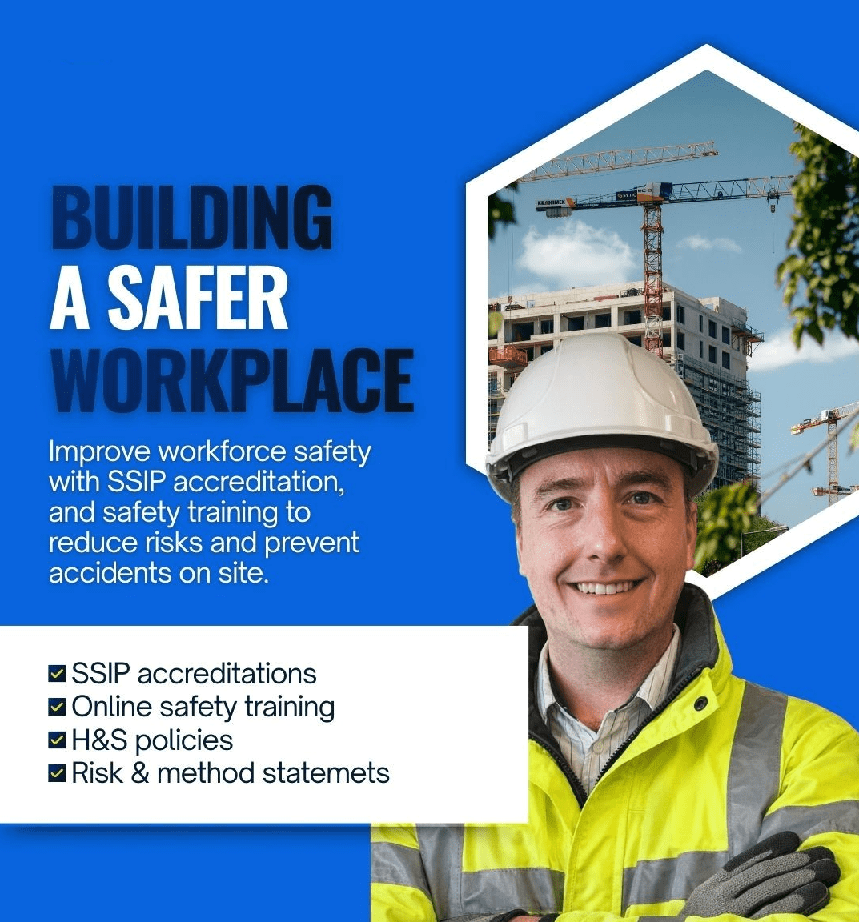
Investing in SSIP accreditation and engaging professional safety advisors is a crucial first step. Start by:

  • Conducting thorough risk assessments and site inspections

  • Integrating safety planning from project inception

  • Delivering practical, ongoing training tailored to site needs

  • Encouraging open communication and reporting of hazards

  • Leading by example to reinforce safe behaviours

Continuous improvement is key. Even small steps, like updating toolbox talks, reviewing near misses, or involving teams in safety discussions, can have a significant impact on overall site safety.

Accepting the inherent risks of construction doesn’t mean accepting harm, with expert guidance, practical processes, and a strong safety culture, every site can move closer to zero harm.

Conclusion

Building safer construction sites in the UK requires more than regulatory compliance, it demands a culture where safety is embedded into every task, decision, and interaction. SSIP accreditation, HSE aligned practices, and dedicated safety advisors help transform safety from paperwork into real world impact.

By prioritising people, communication, and continuous improvement, construction teams can protect their workforce, boost productivity, and raise the bar for safety across the industry.

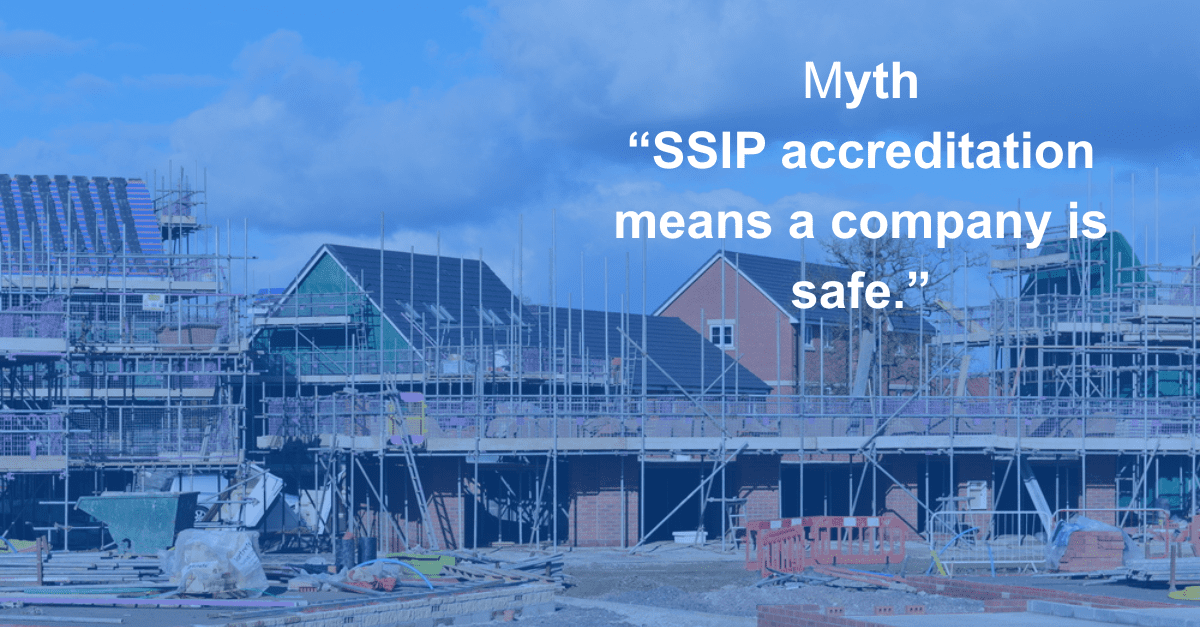
Myth: “SSIP accreditations mean a company is safe.”

Insight by

amanda

Amanda Lambert

Published on

5 February 2026

Accreditations

Does a SSIP accreditation mean a company is safe?

SSIP accreditation does not mean a company is safe to work with. It only verifies that a business has achieved a minimum health and safety standard based on documentation reviewed at a specific moment.

SSIP assessments are primarily desktop audits. They focus on policies, procedures, and written risk assessments rather than how work is actually carried out on site.

As a result, a company may hold valid SSIP certification while still having poor supervision, inadequate training, unsafe behaviours, or weak safety leadership.

What it doesn’t measure:

  • Ongoing compliance
  • Safety culture
  • Site-specific risk control
  • Competence of individual workers
  • Real-world performance over time

To properly assess whether a company is safe, SSIP should be used as a baseline entry check, not a seal of approval.

Meaningful safety assurance requires

  • active monitoring
  • site inspections
  • performance data
  • accident trends
  • evidence that health and safety is managed in practice, not just on paper.

Conclusion

Getting accredited is a starting point, not proof of safety.

Get in touch

Questions and Answers

Does SSIP accreditation mean a contractor is safe?

No accreditation confirms that a contractor meets a basic health and safety documentation standard. It does not prove that the contractor operates safely on site or maintains good safety performance.

What does SSIP actually assess?

SSIP assesses written health and safety policies, procedures, and management systems through a desktop review. It does not normally include site inspections or observation of work activities.

Can a company with SSIP still be unsafe?

Yes. A company can hold valid accreditation and still have unsafe working practices, poor supervision, or inadequate training if these issues are not visible in documentation.

Is SSIP enough for contractor selection?

No it should be treated as a minimum requirement. Clients should also review accident history, carry out site audits, monitor performance, and assess competence and safety culture.

Top Safety Advisor Tip

Carry an annual safety audit and work out your strengths, weaknesses, opportunities and strengths.

Then work on your weakness and make them into your strengths, and seek out new opportunities.

We are here to support you.

How to get PQS Approved

Insight by

amanda

Amanda Lambert

Published on

20 January 2026

Accreditations

How to Get PQS Approved

PQS approval (Pre-Qualification Scheme approval) is used by clients and principal contractors to assess whether a business meets required standards for health & safety, financial stability, insurance, and compliance. Getting PQS approved allows contractors to tender for work without repeatedly completing lengthy pre-qualification questionnaires.

What Is PQS Approval?

A PQS (Pre-Qualification Scheme) is a system used to verify that contractors are competent, compliant, and suitable to carry out work. Common PQS platforms in the UK include Constructionline, CHAS, SafeContractor, SMAS and PQS itself.

PQS approval confirms that your business meets recognised industry standards.

Start your PQS accreditation today

Step-by-Step: How to Get PQS Approved

1. Choose the Right PQS Scheme

Select a PQS that matches your target clients and contracts. Many contractors choose schemes aligned with SSIP core criteria to maximise acceptance.

2. Prepare Your Health & Safety Documentation

You will need evidence, not just statements. This typically includes:

  • A current Health & Safety Policy

  • Risk assessments and method statements (RAMS)

  • Training and competence records

  • Accident and incident procedures

3. Appoint a Competent Person

Under Regulation 7 of the Management of Health and Safety at Work Regulations 1999, businesses must have access to competent health & safety advice. This can be:

  • An internal competent person, or

  • An external health & safety consultant

4. Submit Company and Financial Information

Most PQS schemes require:

  • Company details and structure

  • Employers’ and public liability insurance

  • Financial information or turnover declaration

5. Complete the Assessment and Respond to Queries

Once submitted, your application may be reviewed with follow-up questions. Prompt, accurate responses help avoid delays or rejection.

How Long Does PQS Approval Take?

  • Simple applications: 5–10 working days

  • More complex applications: 2–4 weeks, depending on documentation readiness

Preparation is the key factor.

Common Reasons PQS Applications Fail

  • Out-of-date or generic policies

  • Missing training records

  • No evidence of a competent person

  • Applying for a scheme above your current capability

These issues are common but avoidable.

Is PQS Approval Worth It?

For most UK contractors, yes.

PQS approval:

  • Reduces repeated PQQ paperwork

  • Improves credibility with buyers

  • Increases access to tender opportunities

  • Demonstrates legal and safety compliance

Many clients now treat PQS approval as a minimum requirement.

Conclusion

  • PQS approval verifies contractor competence and compliance

  • Health & safety evidence is essential

  • A competent person is legally required

  • Preparation reduces delays and failures

  • PQS approval helps contractors win more work

Save up to £500 with your SSIP assessment renewal

Insight by

Bob Evans

Bob Evans

Published on

21 September 2025

Accreditations

Save up to £500 with your SSIP assessment renewal.

Don’t miss the deadline for your SSIP assessment renewal. Ensure your business stays compliant.

The problem

CHAS and other SSIP providers raise their assessment fees annually, increasing costs. An American corporation owns CHAS, and their fees have been raised yearly. They are now very high compared to other SSIP accreditation suppliers.

We have a solution

There are over thirty SSIP accreditation suppliers who all do the same thing, to the same standard. The standard is controlled by SSIP, which was created to develop a fair playing field and reduce costs.

CHAS is the most popular and well-known; however, the suppliers below are also prominent and are much more economical than CHAS.

Our preferred SSIP assessment renewal supplier is PQS; they have the lowest fees and are great to deal with. They have a good customer service team and have created easy-to-use systems to complete the accreditation documentation.

Our preferred SSIP supplier list.

What will an SSIP accreditation cover?

All assessments are completed using the SSIP Core Criteria as the threshold standard and cover the following:

  • Health & Safety policy
  • Competent Advice
  • Training arrangements
  • Monitoring, audit and review
  • Workforce involvement
  • Accident reporting and enforcement action
  • Subcontracting/consulting
  • Risk Assessments and Safe Systems of Work
  • Cooperations with others
  • Welfare provision
  • Hazard elimination

The assessment completed will be proportionate and relevant to the type of work you undertake and the size of your business, noting the size of your business will include any labour staff working for you.

About PQS accreditation

The PQS is an accreditation supplier and SSIP member. PQS charge a much lower fee than CHAS, saving you up to £500 depending on your type of accreditation.

There is no difference between CHAS and PQS; they are SSIP members and work according to the same rules and guidance.

If you are worried that your customers are asking for CHAS, it’s OK, as SSIP allow you to obtain a CHAS certificate even when PQS has accredited you through their deem to satisfy process.

If your SSIP accreditation is coming up for renewal, contact us, and we can advise you on the best solution for your business and budget.

Complete the form below, and we will contact you and provide you with some support.


    I confirm I have read and agree to the Seguro Health and Safety Consultants Privacy Policy.

    How can i check if someone is SSIP registered?

    Insight by

    amanda

    Amanda Lambert

    Published on

    18 September 2025

    Accreditations

    Introduction

    If you are a construction client looking to check whether the contractor you intend to employ is SSIP (Safety Schemes in Procurement) registered, look no further! We will show you how to determine whether someone is SSIP-registered, giving you the peace of mind you need before starting your project.

    Get Accredited and Win More Work!

    Contractor

    If you are a contractor looking to become SSIP registered, you will need to select an accreditation company. The accreditation companies we work with are:

    CHAS
    PQS
    ConstructionLine
    Safe contractor
    SMAS
    CQMA
    Builders profile
    Evetta
    Other

    The most expensive is CHAS, and the least costly is PQS. Due to the Deem to Satisfy system by SSIP, a PQS accreditation is equivalent to a CHAS accreditation, and for a small fee, you can obtain certificates for both.

    The driver for selection is normally your customer; if they insist on CHAS, you can get accredited with PQS and request a certificate for CHAS within the process.

    Independent Advice

    Feel free to call us, and we can advise you on the best selection for your needs. We have completed thousands of applications and understand the market inside out. We don’t mind which company you select; the assessment process is the same, thanks to SSIP.

    Get Accredited and Win More Work!

    Checking if a contractor is SSIP registered is straightforward

    Go to the SSIP website and click onto the SSIP Portal.

    In the search section type in the contractor name and press enter. If they are registered, the SSIP website. portal will give you the registration and renewal date details.

    In order to find out the details and check it is the correct company you will need:

    • Company full registered
    • Registered address

    Contacting the company and requesting a copy of their SSIP certificate and any additional and relevant documentation is also advisable. They should be willing to provide you with this information if they are a reputable company.

    If you are not happy with the work someone has done for you this would not fall under SSIP. You would need to go to trading standards if you cannot resolve the issue with the company. Trading standards website

    Testimonial

    Ash Electrics

    We have now received our Gold award, with 100% thanks to yourselves.

    I will share our feedback on your service but just to say a huge thank you, you have always been helpful and supportive and that has been very much appreciated.

    With very best wishes

    Jane