Close Navigation

Search

Company policies Method Statements Risk assessments Health and safety policies CHAS accreditation Constructionline accreditation Safe Contractor accreditation PQS accreditation

How Much Does a Construction Safety Consultant Cost? UK Price Guide

Insight by

Bob Evans

Bob Evans

Published on

4 June 2026

Competent person

How Much Does a Construction Safety Consultant Cost?

The Complete UK Guide to Health and Safety Consultancy Costs

One of the most common questions asked by construction businesses is:

“How much does a construction safety consultant cost?”

The answer depends on the type of support required, the size of the business, the complexity of the work undertaken and whether ongoing support is needed.

Some contractors only require assistance with a single risk assessment or CHAS application, while others need ongoing Health and Safety management throughout the year.

This guide explains typical Health and Safety consultancy costs in the UK construction sector and the factors that influence pricing.

What Does a Construction Safety Consultant Do?

A construction safety consultant helps businesses manage workplace risks and comply with Health and Safety legislation.

Services may include:

  • Health and Safety policies
  • Risk assessments
  • Method statements (RAMS)
  • Site inspections
  • Safety audits
  • CHAS accreditation support
  • SSIP applications
  • Constructionline support
  • COSHH assessments
  • Accident investigations
  • CDM compliance advice
  • Training and toolbox talks
  • Competent person services

Many contractors use consultants to supplement internal resources or meet accreditation and procurement requirements.

Typical Construction Safety Consultant Costs

Health and Safety consultancy fees vary significantly depending on the service required.

Health and Safety Consultant Hourly Rate UK

Independent health and safety consultants typically charge:

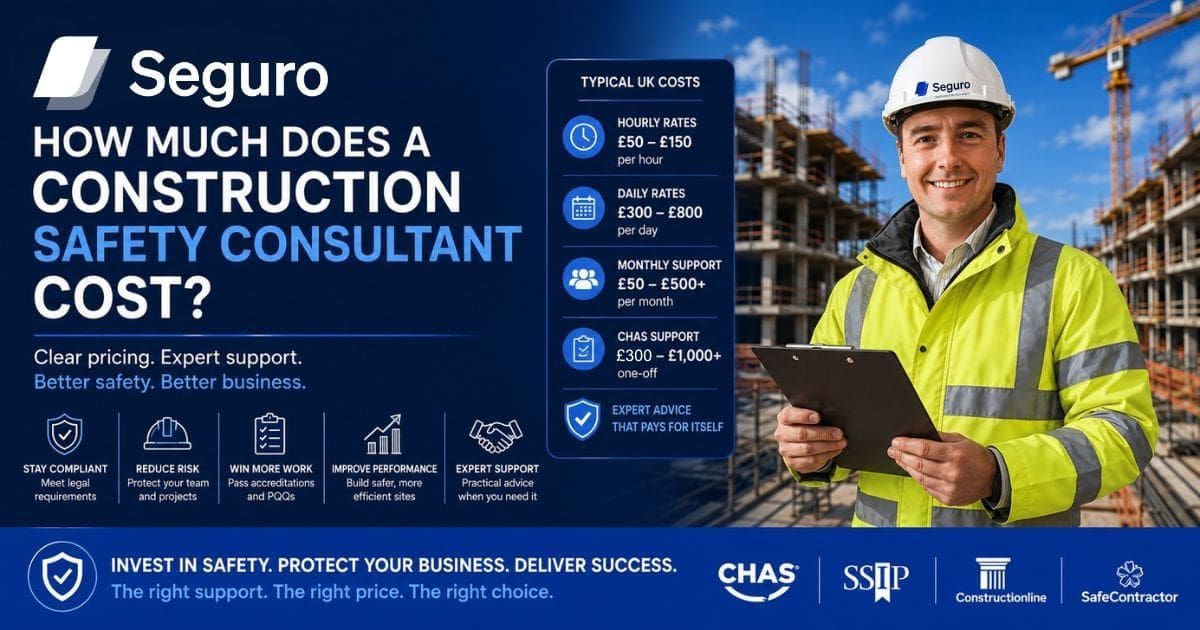
£50 to £150 per hour

Factors affecting hourly rates include:

  • Experience
  • Qualifications
  • Industry specialisms
  • Geographic location
  • Complexity of work

Specialist consultants operating in high risk sectors may charge higher rates.

Health and Safety Consultant Day Rate

Construction health and safety consultants commonly work on a day-rate basis.

Typical daily rates range from:

£300 to £800 per day

Highly specialised consultants working on major infrastructure or complex projects may charge more.

Monthly Retainer Services

Many contractors prefer ongoing support through a monthly consultancy arrangement.

Typical monthly costs range from:

£50 to £500+ per month – Seguro competent safety consultant service £50 per month

The level of support often depends on:

  • Number of employees
  • Number of projects
  • Frequency of advice required
  • Documentation management requirements
  • Site inspection requirements

Retainer arrangements can provide predictable costs and ongoing access to competent advice.

Cost of CHAS Accreditation Support

Many contractors engage consultants specifically to help achieve CHAS accreditation.

Typical consultancy fees range from:

£300 to £1,000 – Seguro fees are 4 employees or less £300, more than 5 employees £450

Pricing depends on:

  • Existing documentation
  • Business size
  • Number of employees
  • Previous accreditation history
  • Quality of current systems

Businesses starting from scratch often require more support than companies renewing existing accreditation.

Cost of Risk Assessments

Simple risk assessments may cost:

£50 to £250 – Seguro charges – Prewritten from our shop £10 | Bespoke written for a project £150

More detailed assessments involving:

  • Complex construction activities
  • Specialist plant
  • Multiple hazards
  • Large sites

Cost of RAMS (Risk Assessments and Method Statements)

RAMS preparation costs typically range from:

£100 to £500 – Seguro charges. Prewritten from our shop £10 | Bespoke written for a project £150

Factors affecting price include:

  • Complexity of activities
  • Number of work tasks
  • Client requirements
  • Project duration
  • Site conditions

Cost of Site Inspections

Construction site inspections commonly cost:

£150 to £1,250 per visit

Pricing varies according to:

  • Site size
  • Travel requirements
  • Reporting requirements
  • Risk profile
  • Duration of inspection

Regular inspections may be available at discounted rates.

Cost of a Competent Person Service

Many small construction companies outsource their competent Health and Safety advice.

Typical costs range from:

£50 to £300 per month – Seguro competent safety consultant service £50 per month

These services often include:

  • Health and safety system set up
  • Telephone support
  • Email support
  • Documentation reviews
  • FREE Access to over 1,000 pre-written documents within our shop
  • Legislative updates
  • General compliance guidance

For many small businesses, this is significantly cheaper than employing an in house safety manager.

Cost of Employing an In House Safety Manager

Businesses sometimes compare consultancy costs against direct employment. Typical annual salaries for Health and Safety professionals may range from:

£35,000 to £70,000+ per year

Additional costs can include:

  • Pension contributions
  • National Insurance
  • Training
  • CPD requirements
  • Software
  • Equipment
  • Recruitment costs

For smaller businesses, outsourced consultancy support is often more cost effective.

What Affects Construction Safety Consultant Costs?

Several factors influence consultancy fees.

Business Size

Larger businesses generally require:

  • More documentation
  • More advice
  • Additional site visits
  • Greater administration

This typically increases costs.

Project Complexity

Projects involving:

  • Demolition
  • Deep excavations
  • Temporary works
  • Rail infrastructure
  • High rise construction

Usually require more specialist input.

Existing Documentation

Businesses with established systems generally require less consultancy support.

Those starting from scratch often require:

  • Policies
  • Risk assessments
  • Procedures
  • Forms
  • Training records

Accreditation Requirements

Some clients require:

  • CHAS
  • SafeContractor
  • Constructionline
  • Avetta
  • Altius

Meeting these requirements may involve additional consultancy work.

Site Visits

Remote consultancy support is often less expensive than regular site attendance. Travel time, reporting, and inspection requirements can increase fees. A health and safety consultant hourly rate uk is about £50 per hour, but charges typically are for a full day.

Is a Construction Safety Consultant Worth the Cost?

Many contractors view consultancy fees as an investment rather than an expense.

Effective Health and Safety management can help businesses:

  • Win more contracts
  • Pass accreditation assessments
  • Improve compliance
  • Reduce accident risks
  • Avoid enforcement action
  • Improve client confidence
  • Access larger projects

For many small businesses, consultancy costs are often small compared with the value of contracts won.

How to Choose a Construction Safety Consultant

When comparing providers, consider:

  • Industry experience
  • Construction sector knowledge
  • Professional qualifications
  • Accreditation expertise
  • Scope of support
  • Response times
  • Client reviews
  • Fixed fee transparency

The cheapest option is not always the best value if it fails to meet client or accreditation requirements.

Key Takeaway

Construction safety consultant costs vary according to the level of support required.

Ongoing consultancy support, site inspections and accreditation management can range from a few hundred pounds to several thousand pounds per year.

For many contractors, professional Health and Safety support provides access to expert knowledge, improved compliance and increased opportunities to win work.

The cost guide for the health and safety consultant day rate and the health and safety consultant hourly rate in the UK is shown above.


Ask Amanda. Call 0800 0315404 for support

Amanda is our technical sales advisor

Get a price
shape Ask Amanda

Frequently Asked Questions

How much does a construction safety consultant cost in the UK?

Construction safety consultant costs vary depending on the level of support required. Hourly rates typically range from £50 to £150, daily rates often range from £300 to £800, and ongoing support packages can range from £50 to £500 or more per month. For more information, go to Construction Health and Safety Consultant: Complete Guide for UK Contractors

What affects the cost of a health and safety consultant?

The cost of a health and safety consultant depends on factors such as business size, project complexity, industry sector, documentation requirements, site visits, accreditation support needs and the consultant’s experience and qualifications.

Is hiring a construction safety consultant cheaper than employing a safety manager?

For many small and medium sized businesses, outsourcing health and safety support can be more cost effective than employing a full time safety manager. Consultancy services provide access to professional advice without the ongoing employment costs associated with salaries, pensions and training.

How much does CHAS accreditation support cost?

CHAS accreditation support costs vary depending on the quality of existing documentation, company size and the amount of assistance required. Businesses with compliant documentation already in place generally require less support than those starting from scratch.

How much does a construction risk assessment cost?

The cost of a construction risk assessment depends on the complexity of the activity being assessed, the number of hazards involved and the level of detail required. More complex projects generally require more detailed assessments and therefore higher consultancy input.

How much do RAMS cost?

The cost of Risk Assessments and Method Statements (RAMS) depends on the type of work, client requirements, project complexity and the number of activities being covered. Bespoke RAMS usually require more preparation than standard templates.

What is included in construction health and safety consultancy?

Construction health and safety consultancy may include health and safety policies, risk assessments, RAMS, COSHH assessments, site inspections, audits, accident investigations, accreditation support, competent person services, training and compliance advice.

What is a competent person service?

A competent person service provides businesses with access to professional health and safety advice from a suitably qualified and experienced advisor. This support can help businesses meet their legal obligations and demonstrate compliance when requested by clients or accreditation bodies.

Do small construction companies need a health and safety consultant?

Small construction companies are not legally required to employ a health and safety consultant, but many choose to use one to access competent advice, maintain compliance documentation, support accreditation applications and manage workplace risks effectively.

Are site inspections included in health and safety consultancy services?

Some consultancy services include site inspections, while others charge separately. Site inspection costs often depend on the location, size of the site, reporting requirements and frequency of visits.

Why do construction companies use health and safety consultants?

Construction companies use health and safety consultants to help manage compliance, prepare documentation, improve site safety, support accreditation requirements, reduce risks and provide access to specialist knowledge without employing a full time safety professional.

Can a health and safety consultant help businesses win more contracts?

Many clients require evidence of health and safety compliance before awarding work. Health and safety consultants can help businesses prepare the documentation and systems often required for accreditations, PQQs and contractor assessments.

Construction Safety Consultant vs Safety Advisor: Which Does Your Business Need?

Insight by

Bob Evans

Bob Evans

Published on

15 May 2026

Competent person

Construction Safety Consultant vs Safety Advisor: Which Does Your Business Need?

For many UK contractors, health and safety support becomes a priority only when something goes wrong. A failed CHAS application. A lost tender. A site audit issue. An accident. Or a main contractor refusing access to site because the required documents are missing.

The reality is that construction compliance has changed significantly over the last decade. Main contractors, local authorities, housing providers, and commercial clients increasingly expect subcontractors to demonstrate strong health and safety management before work even begins.

That is why more construction businesses are turning to external support through a Construction Safety Consultant or Safety Advisor.

But what is the difference between the two, and which one does your business actually need?

This guide explains the differences, legal requirements, common contractor mistakes, and how professional compliance support can help businesses win bigger contracts, reduce risk, and become fully accredited.

What Is a Construction Safety Consultant?

A Construction Safety Consultant is typically focused on higher level compliance strategy, risk management, and project support. This becomes a legal requirement to have as a business once you are 5 employees or more.

Their role is often broader and more consultancy led than a traditional Safety Advisor.

A consultant may help businesses:

  • Develop full health and safety management systems
  • Support large or complex construction projects
  • Advice on legal compliance
  • Prepare businesses for audits and accreditations
  • Improve operational safety processes
  • Reduce commercial and legal risk
  • Support tender submissions
  • Assist with investigations and enforcement issues

Construction Safety Consultants are commonly used by:

  • Principal contractors
  • Growing subcontractors
  • Businesses entering public sector frameworks
  • Companies managing multiple sites
  • Contractors bidding for higher-value projects

They often become involved when a company needs more than just documentation and requires strategic guidance.

What Is a Safety Advisor?

A Safety Advisor is usually more operational and focused on day to day compliance support. This service is a good support for companies that have 4 or less employees.

A Safety Advisor may support with:

  • Health and safety policies
  • RAMS reviews
  • Construction phase plans
  • Toolbox talks
  • Site inspections
  • Training advice
  • Accident reporting
  • Compliance questions
  • Document updates
  • SSIP accreditation support

For many small contractors, a Safety Advisor provides ongoing support without the cost of employing a full time internal health and safety manager.

This is particularly common among:

  • Electrical contractors
  • Roofing contractors
  • Groundworkers
  • Fire door contractors
  • Maintenance contractors
  • Small construction businesses

Construction Safety Consultant vs Safety Advisor

Although the terms are sometimes used interchangeably, there are key differences.

Construction Safety Consultant ( 5 or more employees)

Safety Advisor (less than 4 employees)

Strategic support

Operational support

Often project or business-wide

Often ongoing monthly support

Focus on systems and risk strategy

Focus on compliance maintenance

Used for complex projects

Used for everyday contractor support

Supports major tenders and frameworks

Supports ongoing legal compliance

Higher-level consultancy

Practical day-to-day guidance

In reality, many contractors benefit from both.

A business may use consultancy support to improve systems, gain accreditation, or prepare for larger contracts, while also using a retained Safety Advisor to manage ongoing compliance.

Do You Need a Safety Advisor?

In many cases, yes.

Under the Management of Health and Safety at Work Regulations, businesses are recommended to have a source for health and safety assistance. Once you reach 5 employees or more this is a requirement.

For construction companies, this means having access to someone with the appropriate knowledge, experience, and understanding of health and safety law.

Smaller contractors often assume they can manage health and safety themselves. However, problems usually arise when:

  • Applying for CHAS or SSIP accreditation
  • Completing tender questionnaires
  • Responding to main contractor compliance requests
  • Producing suitable RAMS
  • Managing accidents or incidents
  • Handling HSE inspections

Without competent support, many contractors rely on outdated templates, incomplete documentation, or reactive compliance management.

This frequently leads to failed audits, project delays, and lost work opportunities.

Legal Health & Safety Requirements You Can’t Ignore

Construction businesses in the UK have legal duties under several pieces of legislation.

Ignoring these responsibilities can result in enforcement action, prosecution, or exclusion from contracts.

Key legal requirements include:

Health and Safety at Work Act

Requires employers to protect employees and others affected by their work activities.

CDM Regulations

Construction projects must be properly planned, managed, and monitored to ensure safety.

Risk Assessments

Businesses must identify hazards and implement suitable control measures.

RAMS

Many contractors must provide Risk Assessments and Method Statements before starting work.

Training and Competence

Workers must have adequate training, supervision, and competence for their tasks.

Accident Reporting

Certain incidents must be reported under RIDDOR requirements.

COSHH Assessments

Hazardous substances must be assessed and controlled.

Insurance Requirements

Public liability and employer’s liability insurance are commonly required by clients and accreditation schemes.

Many contractors only realise gaps exist when an accreditation assessor or client requests evidence.

Common Health & Safety Mistakes Contractors Make

Most contractors do not intentionally ignore safety.

The issue is usually poor systems, outdated documentation, or lack of guidance.

Some of the most common mistakes include:

Using Generic RAMS Templates

Documents copied online often fail to reflect the actual work being carried out.

Expired Insurance Documents

Outdated insurance dates are one of the most common accreditation failures.

Unsigned Health & Safety Policies

Policies should normally be reviewed and signed annually.

Missing Training Records

Businesses often struggle to demonstrate workforce competence.

Poor Worker Communication Evidence

Assessors increasingly expect proof that safety information is communicated to workers.

No COSHH Assessments

Many contractors overlook hazardous substance requirements entirely.

Reactive Compliance

Health and safety is only addressed when a problem occurs.

No Competent Support

Without expert guidance, businesses often miss critical legal or accreditation requirements.

What Happens If You Don’t Have Proper H&S in Place?

Poor compliance affects far more than safety alone.

It can directly impact your ability to grow the business.

Common consequences include:

Failed CHAS or SSIP Applications

Missing or poorly prepared documentation is a major reason contractors fail assessments.

Lost Contracts

Many clients will not allow contractors onto site without suitable compliance evidence.

Delayed Site Access

Projects can stall while missing documents are corrected.

HSE Enforcement

Improvement notices, prohibition notices, and prosecutions can occur where serious failings exist.

Increased Insurance Risk

Poor safety management may increase claims and insurance costs.

Reputational Damage

Contractors with poor compliance records often struggle to secure repeat work.

Workplace Incidents

Ultimately, inadequate safety management increases the likelihood of accidents and injuries.

Before vs After: From No Compliance to Fully Accredited

Many contractors start with little or no structured health and safety management.

Before Support

  • No formal H&S policy
  • Inconsistent RAMS
  • No accreditation
  • Failed tenders
  • Reactive compliance
  • Missing training records
  • Poor document control

After Professional Support

  • Structured compliance systems
  • CHAS or SSIP accreditation achieved
  • Professional RAMS process
  • Improved client confidence
  • Better tender success rates
  • Reduced operational risk
  • Faster site approvals

The transformation is often not just operational — it becomes commercial.

How Compliance Helped Businesses Win Bigger Contracts

For many construction businesses, compliance becomes a gateway to growth.

Larger contractors and public sector clients increasingly expect subcontractors to demonstrate:

  • SSIP accreditation
  • Strong safety systems
  • Competent management
  • Structured documentation
  • Evidence of workforce competence

Without these systems, businesses may never even reach the tender stage.

Many contractors discover that once they become fully compliant and accredited, they can:

  • Access larger projects
  • Work for major contractors
  • Reduce pre-qualification barriers
  • Improve client trust
  • Increase repeat business opportunities

Compliance is no longer simply about avoiding problems. It has become a competitive advantage.

Why More Contractors Outsource Health & Safety

Small and medium sized contractors rarely need a full time internal health and safety advisor.

Outsourcing allows businesses to access professional expertise without the overhead costs.

Benefits include:

  • Fixed monthly costs
  • Expert guidance
  • Faster compliance support
  • Ongoing document updates
  • Access to accreditation expertise
  • Reduced management pressure
  • Improved legal confidence

For many contractors, outsourcing provides the balance between compliance, practicality, and affordability.

How to Choose the Right Support

The right solution depends on your business size, risk level, and commercial goals.

A Safety Advisor may suit you if:

  • You need ongoing compliance support
  • You require professional Health & Safety Advice
  • You want help maintaining documentation
  • You are applying for CHAS or SSIP
  • You need practical day-to-day guidance

A Construction Safety Consultant may suit you if:

  • You manage larger or complex projects
  • You need strategic safety improvements
  • You are bidding for larger frameworks
  • You require advanced compliance systems
  • You need higher-level consultancy input

Many growing contractors eventually use both services together. For more information, go to Construction Health and Safety Consultant: Complete Guide for UK Contractors

Final Thoughts

Health and safety in construction is no longer just about paperwork.

It affects:

  • Your legal compliance
  • Your ability to win contracts
  • Your reputation
  • Your operational efficiency
  • Your commercial growth

Whether you need a Construction Safety Consultant or a Safety Advisor,  the right systems can help protect both your workforce and your business.

For many contractors, professional health and safety support becomes the difference between constantly reacting to problems and confidently growing the business.

Request a call back for more information or call 0800 031 5404

shape Health & Safety Consultancy, Safety Advisor, Safety Consultant

Frequently Asked Questions

What is the difference between a Construction Safety Consultant and a Safety Advisor?

A Construction Safety Consultant usually provides strategic health and safety support, such as compliance systems, project advice, risk management and tender support and is needed for businesses of 5 or more employees. A Safety Advisor usually provides ongoing operational support, such as RAMS reviews, policy updates, Safety advice, accreditation support and day to day compliance guidance and is only for 4 or less employees

Do I need a safety advisor?

UK businesses are recommended to have access to health and safety assistance. For construction contractors, this is often a legal requirement as they employee 5 or more.  This can be appointing an internal competent person or outsourcing the role to a qualified Safety Consultant who understands.

What does a Construction Safety Consultant do?

A Construction Safety Consultant helps contractors manage health and safety compliance, improve safety systems, prepare for audits, support tenders, review documentation, advise on legal duties and reduce risk across construction projects. This is a requirement for businesses with 5 or more employees.

What does a Safety Advisor do for contractors?

A Safety Advisor supports contractors with day to day health and safety compliance. This may include acting as the competent person, reviewing RAMS, updating policies, advising on training, supporting accident procedures, helping with SSIP accreditation and answering ongoing compliance questions.

Can a small contractor outsource health and safety support?

Yes. Many small contractors outsource health and safety support instead of employing a full-time internal manager. This gives them access to competent advice, updated documents, accreditation support and practical guidance at a more manageable cost.

Can a Safety Advisor help with CHAS or SSIP accreditation?

Yes. A Safety Advisor can help contractors prepare the documents and evidence needed for CHAS, SSIP, Constructionline, SafeContractor and similar accreditation schemes. This may include reviewing policies, RAMS, training records, insurance, accident procedures and competence evidence.

What health and safety documents do contractors need?

Contractors commonly need a health and safety policy, risk assessments, method statements, COSHH assessments, training records, insurance certificates, accident procedures, toolbox talk records, site induction evidence and documents showing how workers are supervised and managed safely.

What are common health and safety mistakes contractors make?

Common mistakes include using generic RAMS templates, failing to update policies, missing training records, expired insurance documents, weak COSHH assessments, no evidence of worker communication, poor accident procedures and not having access to competent health and safety advice.

What happens if a contractor does not have proper health and safety in place?

Without proper health and safety systems, contractors may fail accreditations, lose tenders, be refused site access, face project delays, receive enforcement action, damage their reputation and increase the risk of accidents or legal claims.

Can better compliance help a contractor win bigger contracts?

Yes. Strong health and safety compliance can help contractors meet pre-qualification requirements, pass SSIP assessments, satisfy main contractor expectations and demonstrate professionalism. This can improve access to larger projects, frameworks and higher value contract opportunities.

Is a Safety Advisor the same as a competent person?

A Safety Advisor can act as the competent person if they have suitable knowledge, experience and understanding of the work being carried out. This is normally simple to identify as they would hold a NEBOSH certificate or above, and that is deemed as competent by the HSE. Many contractors outsource this role to a professional Safety Advisor to meet their legal duties.

When should a contractor hire a Construction Safety Consultant?

A contractor should consider hiring a Construction Safety Consultant when managing higher-risk work, bidding for larger contracts, preparing for accreditation, improving safety systems, responding to audit issues, or needing strategic compliance advice. It is a legal requirement if you have more than 5 employees.

Health and safety in construction

Insight by

Bob Evans

Bob Evans

Published on

28 October 2025

CHAS

Health and safety in construction

In the fast-paced world of construction, safety is of paramount importance. From home extensions to infrastructure projects that shape our country, the welfare of workers and the public is our first consideration.

When it comes to creating a culture of safety, construction companies must have robust processes and systems in place.

  • Health and safety legislation
  • Common hazards in the construction industry
  • Implementing health and safety on construction sites
  • Safety planning and risk assessment in construction projects
  • Personal protective equipment (PPE) in construction
  • Training and education for construction safety
  • Construction site inspections and audits
  • Creating a culture of safety on construction sites
  • Site Manager Compliance Kit
  • SSIP Accreditation
  • HSG150 health and safety in construction

Health and safety legislation

Health and safety legislation in the workplace is the Health and Safety at Work Act 1974This legislation sets out the duties of employers, employees, and others. 

Responsibilities of employers

  • Assess risks: Identify risks to employees, customers, and others 
  • Create a policy: Have a written health and safety policy if they employ five or more people 
  • Provide training: Ensure staff are adequately trained 
  • Provide welfare: Ensure adequate welfare provisions are available 
  • Provide information: Ensure employees have access to relevant information, instruction, and supervision 
  • Consult employees: Consult employees about risks and preventive measures 

Responsibilities of employees 

  • Have a duty of care to themselves and others

Other construction-related health and safety legislation

Common hazards in the construction industry

The construction industry is fraught with hazards that can lead to serious accidents if not properly managed.

  • There were 51 fatal injuries to workers in 2023/24
  • 47,000 workers sustained non-fatal injuries at work averaged over the three years 2021/22-2023/24

One of the most prevalent risks is falls, which can occur from heights such as scaffolding, ladders, or roofs.

Another common hazard is the risk of being struck by objects. This can happen when tools or materials are improperly secured or when heavy machinery is involved.

Construction site workers are often close to moving equipment, and the potential for accidents increases.

Exposure to hazardous substances, such as asbestos and silica dust, poses a significant risk.

Implementing health and safety on construction sites

Implementing health and safety processes and systems on construction sites is essential. Many clients now insist that contractors hold a minimum health and safety standard. SSIP (Safety Schemes in Procurement) implemented the standard. SSIP is an umbrella organisation formed in 2009 to reduce the duplication of health and safety assessments. CHAS and PQS are suppliers of the standard.

Below is a health and safety checklist for a typical site construction setup

Safety planning and risk assessment in construction projects

Planning work operations is a key factor in keeping people safe on-site. The process is to develop a method statement of how the work will be executed and then develop a risk assessment. The risk assessment analyses the risks and looks at ways to mitigate them. The project planner may adjust the method statements if the risk assessment finds that the risk is too high.

Ready for use Risk assessment and method statements templates.

Personal protective equipment (PPE) in construction

Personal protective equipment (PPE) is the last line of defence to keep people safe. PPE can include the following:

  • Hard hat
  • His visibility vests and trousers
  • Ear protection
  • Eye protection
  • Lung protection
  • Hand protection
  • Skin protection
  • Foot protection

The site manager must ensure that their workers are provided with the necessary equipment and trained on how to use it effectively. A PPE register is vital to control who had what and when.

Site training

Training and education are fundamental for a safe construction site. On-site training includes:

On-site e-learning to train site workers saves time and cost.

A training register is vital to control who had what and when.

Construction site inspections and audits

Regular inspections and audits of construction sites are critical for ensuring ongoing health and safety compliance.

Inspections help identify potential hazards that may have arisen since the last inspection and ensure that safety measures are effectively implemented.

Inspections can be conducted by internal safety officers or external auditors, providing an objective perspective on the effectiveness of the site’s safety practices.

Creating a culture of safety on construction sites

Creating a safety culture begins with a commitment from leadership to prioritise health and safety measures at all levels of the organisation.

By communicating that health and safety are priorities in the company culture, workers will feel empowered to work safely and promote safety with their workmates.

Site Manager Compliance Kit

Overview

The Site Manager Compliance Kit is an essential tool for every contractor. The Compliance Kit contains all of the information and documentation needed to comply with the requirements of today’s Safety Regulations.

Includes

  • Construction Phase Health and Safety Plan (CDM 2015), which can be easily amended and edited for specific projects
  • 70 Toolbox Talk Documents
  • 65 Completed Risk Assessments
  • 41 COSHH Assessments
  • Site inspection Check Sheets – Scaffold, Dumper, Excavator etc
  • Permits to Work – Confined Space, Excavation, Hot Work, Asbestos, etc
  • Site set-up check sheet
  • Site Induction
  • Site Rules
  • Site Registers – PPE, Plant & Equipment etc

Review the Site Manager Compliance Kit

CHAS Accreditation

If you want to implement CHAS, we can help you achieve this goal.

The CHAS assessment standards and requirements are listed below.

  • Policy
  • Occupational Health
  • Behavioural Management
  • Enforcement Actions
  • Accident Reporting and Investigation
  • Fleet Operations / Management Scheme
  • Competent Advice – Corporate and Construction
  • Drug and Alcohol Policy
  • Training and Information
  • Qualifications and Experience
  • Monitoring, Audit and Review
  • Risk Assessment and Safe System of Work
  • Workforce Involvement
  • Co-operation and Co-ordination
  • Welfare Provision
  • Subcontractors and Sub-consultants
  • Responsible Person
  • Contractor
  • Declaration

Review CHAS accreditation

HSG150 health and safety in construction

HSG150 Health and Safety in Construction explains the essential tasks for achieving healthy and safe construction sites.

It helps the reader to identify hazards and control risks and explains how to plan, organise, control, monitor and review health and safety throughout the life of a project.

It is aimed at everybody involved in construction work, including clients, designers, contractors and individual workers. Clients, designers and others who specify construction work may also find the book useful.

Download HSG150