Close Navigation

Search

Company policies Method Statements Risk assessments Health and safety policies CHAS accreditation Constructionline accreditation Safe Contractor accreditation PQS accreditation

Do I need to be a CHAS accredited contractor?

Insight by

Bob Evans

Bob Evans

Published on

10 April 2026

CHAS

Do You Need to Be a CHAS Accredited Contractor?

If you’re self-employed or running a small construction business, a common question is:

“Do I actually need CHAS accreditation to work?”

The honest answer is: it depends on the type of work you do and who you work for.

Quick Answer

  • Domestic work only? → No, not strictly required
  • Working for contractors, councils, or commercial clients? → Yes, almost always required
  • Want to win more contracts? → CHAS or SSIP is essential
  • If you’re not accredited yet, start with our CHAS accreditation step-by-step guide.

Domestic Market

If you only work directly for homeowners:

  • You are not legally required to have CHAS accreditation
  • Most domestic clients won’t ask for it

However, don’t mistake this for no responsibility.

Under UK health and safety law, you still have a duty of care to:

  • Yourself
  • Anyone working with you
  • Members of the public

If something goes wrong (accident, injury, unsafe work), you are still liable, with or without CHAS.

Bottom line: You can operate without CHAS in domestic work, but you still need proper safety systems in place.

Construction & Commercial Market

If you want to work in the wider construction industry:

CHAS (or equivalent) becomes essential.

Main contractors, developers, housing providers, and local authorities will almost always require:

  • Proof of health & safety compliance
  • A recognised accreditation standard
  • Evidence before allowing you on-site

The most widely recognised scheme is:

  • CHAS

But it’s part of a wider system called:

  • Safety Schemes in Procurement

All SSIP schemes assess the same core criteria, including:

  • Constructionline
  • SMAS Worksafe
  • SafeContractor

This means:

You don’t have to choose CHAS, but you must have an SSIP accreditation to compete.

Does Business Size Matter?

Yes, especially when it comes to compliance requirements.

Sole traders & businesses under 5 employees

  • You still need health & safety systems
  • You can get CHAS / SSIP accreditation
  • You don’t legally need a full-time safety advisor

Businesses with 5+ employees (including subcontractors)

  • You must have access to a competent health & safety advisor
  • This is a legal requirement under:
    • Management of Health and Safety at Work Regulations 1999

Most small contractors meet this by using a retained (outsourced) competent person service

What Does CHAS Actually Assess?

CHAS (and all SSIP schemes) measure your business against core health & safety standards.

These include:

  • Health & Safety Policy
  • Access to Competent Advice
  • Training and Competence
  • Risk Assessments & Method Statements (RAMS)
  • Monitoring, Audit & Review
  • Workforce Engagement
  • Accident Reporting & History
  • Subcontractor Management
  • Cooperation & Communication
  • Welfare Provision
  • Hazard Identification & Control

In simple terms, CHAS proves your business can work safely and professionally on construction projects.

Why Most Contractors Choose CHAS Anyway

Even if it’s not mandatory for your current work, many contractors get accredited because it:

  • Opens doors to higher-value contracts
  • Helps you pass pre-qualification questionnaires (PQQs)
  • Builds trust with clients instantly
  • Reduces repeated compliance checks

Final Verdict

  • Domestic-only work? CHAS is optional, but safety compliance is not
  • Construction or commercial work? CHAS or SSIP is effectively required
  • Want to grow your business? Accreditation becomes a competitive advantage
  • To stay compliant, it’s important to understand CHAS renewal requirements each year.

Simple Rule to Remember

No CHAS = limited opportunities
CHAS (or SSIP) = access to the real construction market

Need help maintaining your status? Our CHAS support service is here to help.

CALL Amanda on 0800 031 5404 for immediate support

Get Started


shape Ask Amanda

Frequently asked questions

Do I need to be a CHAS accredited contractor?

You do not normally need CHAS accreditation if you only work directly for domestic homeowners. However, if you want to work for main contractors, commercial clients, housing providers, developers or local authorities, CHAS or another SSIP accreditation is often required before you can start work.

Is CHAS a legal requirement?

CHAS accreditation itself is not a legal requirement. However, UK contractors still have legal duties to manage health and safety. CHAS helps demonstrate that your business has suitable health and safety arrangements in place.

Do domestic contractors need CHAS accreditation?

Domestic contractors are rarely asked by private homeowners for CHAS accreditation. However, they still have a duty of care to protect themselves, workers, subcontractors and members of the public from harm.

Do small contractors need CHAS accreditation?

Small contractors often need CHAS accreditation to work in the commercial construction market. Main contractors, local authorities and larger clients commonly require CHAS or another SSIP certificate before allowing subcontractors onto the site.

Can I use another SSIP scheme instead of CHAS?

Yes. CHAS is one SSIP accreditation provider, but other schemes, such as Constructionline, SafeContractor, SMAS, CQMS, and PQS, can also assess contractors against the same SSIP core criteria. The right choice depends on what your client or tender requires.

Do I need a competent health and safety advisor for CHAS?

If you employ five or more people, including subcontractors or self-employed workers under your control, you must have access to competent health and safety advice. Many small contractors meet this requirement by using an outsourced competent person service.

What does CHAS check?

CHAS checks whether your business has suitable health and safety arrangements. This includes your health and safety policy, competent advice, training records, risk assessments, method statements, accident reporting, workforce involvement, subcontractor management and welfare arrangements. Review the CHAS assessment criteria.

Why do main contractors ask for CHAS?

Main contractors use CHAS because they must control health and safety risks across their supply chains. CHAS gives them evidence that a subcontractor has been assessed against recognised SSIP health and safety standards.

Related CHAS Guides

CHAS renewal – How to renew your CHAS certificate

Insight by

amanda

Amanda Lambert

Published on

22 February 2024

CHAS

CHAS Renewal & CHAS Login: Complete Guide for UK Contractors

If you’re a contractor or construction business using CHAS for your SSIP accreditation, you’ll need to keep your certification renewed every year. Many businesses lose work because their CHAS accreditation expires, usually because the renewal process isn’t started early enough or login issues delay the submission.

If you’re applying for the first time, follow our CHAS accreditation step-by-step guide.

This guide covers exactly how to:

  • Let Seguro complete the CHAS renewal for you. For a very small fee, we can take the pain away.
  • Log in to the CHAS portal
  • Start your CHAS renewal application
  • Upload required evidence
  • Avoid common renewal failures
  • Stay compliant and win more work

STOP THINK

There is a quick way to renew your CHAS. We renew over 1,000 CHAS applications per year. We can do it for you. CALL 0800 031 5404 during office hours or complete the form on the link below:

Get your CHAS renewal within a few days with zero pain! from £300

CHAS renewal

You have to renew your CHAS accreditation every year.

The CHAS accreditation process reviews your company’s ability to perform your activities complying with Health & Safety every year.

Documentation is provided on recent jobs and processes you are working on at the time of application. As these could change within 12 months, CHAS has a process where each application is seen as new and lasts for 12 months.

CHAS assesses your Health & Safety, which is done remotely; you get access to an online portal once you have paid. Once everything is uploaded to the portal, you can submit it for approval.

The CHAS assessor will take up to 10 working days to reply to your submitted documentation with their findings.

Renewal costs

CHAS offers three membership packages with different levels of accreditation:

CHAS Standard

The entry-level package includes a health and safety assessment and SSIP accreditation. CHAS membership fees

CHAS Advanced

The mid-range package includes all the Standard package benefits, plus helps you achieve SSIP and PAS 91 accreditation. CHAS membership fees

CHAS Elite

The highest level of accreditation includes all the benefits of the other packages, plus access to the Common Assessment Standard. CHAS membership fees

How to renew your CHAS accreditation

To renew your CHAS membership, you can: 

  1. Let Seguro do it for you or:
  2. Log in to your MyCHAS portal
  3. Review your current health and safety practices
  4. Click Renew
  5. Complete the renewal application
  6. Pay the renewal fee
  7. Submit your renewal application
  8. Await the assessment results
  9. Update your company records
  10. Ongoing compliance depends on meeting the CHAS assessment criteria consistently.

If you can’t log in

Common issues:

  • Wrong email linked to your CHAS account

  • Password expired

  • Account locked due to inactivity

  • Renewal overdue

Fixes:

  • Use “Forgot Password”

  • Check the original registration email

  • Contact CHAS support if your account is blocked

CHAS Renewal: What It Means

CHAS accreditation lasts for 12 months, after which you must renew to remain certified and visible to buyers.

A CHAS renewal involves:

  • Updating your insurance documents

  • Refreshing RAMS, policies, and training records

  • Uploading evidence of compliance

  • Completing the online assessment questionnaire

  • Meeting any new CHAS requirements for that year

When to Start Your CHAS Renewal

CHAS recommends starting 6–8 weeks before your expiry date.

Why early renewal is essential:

  • Insurance documents may need updating

  • Training records may be outdated

  • Missing documentation causes delays

  • You risk losing tenders if your certificate lapses

Documents You Need for CHAS Renewal

Most contractors will need:

Mandatory

  • Employers’ Liability Certificate

  • Public Liability Certificate

  • Health & Safety Policy

  • Risk Assessments & Method Statements (RAMS)

  • Training certificates (CSCS, CITB, Asbestos Awareness, etc.)

Depending on your work

  • PUWER / LOLER evidence

  • COSHH assessments

  • SSOW (Safe Systems of Work)

  • Subcontractor approval process

  • First aid training

If anything expired since your last CHAS assessment, you must replace it before renewal.

Common CHAS Renewal Mistakes

Most renewals fail because of:

❌ Outdated insurance
❌ Missing RAMS
❌ No training evidence
❌ No subcontractor vetting system
❌ Outdated policies
❌ Not addressing changes in legislation

Fix these early, and your renewal will be smooth.

How to Make CHAS Renewal Easy

Many contractors outsource CHAS renewals because the documentation can be time-consuming. A consultant can help with:

  • Completing the online assessment

  • Uploading compliant evidence

  • Creating missing documents

  • Fixing non-conformities

  • Managing the entire renewal on your behalf

If you struggle with CHAS, outsourcing saves time and prevents failed submissions.

Why CHAS Renewal Matters

Renewing CHAS accreditation helps you:

  • Stay compliant with UK health & safety law
  • Win more tenders
  • Stay active on buyer platforms
  • Build trust with clients
  • Demonstrate competence and professionalism

If your CHAS expires, many contractors will no longer be eligible to work on certain sites.

Need Help With CHAS Renewal?

If you want fast, stress free CHAS renewal assistance, we can generate:

✔️ CHAS-ready RAMS
✔️ Updated safety policies
✔️ Subcontractor procedures
✔️ Compliance documents
✔️ Renewal checklists
✔️ CHAS explainer videos or PPTs
✔️ Lost your CHAS login

Need help getting approved? Our CHAS support service handles the full process for you.

MyCHAS Portal

You can use the MyCHAS portal to: 

  • Manage your profile
  • Monitor your accreditations
  • Access exclusive benefits
  • Upload supporting documentation
  • Access accreditation documents and assessments
  • Complete assessments and get feedback
  • Update accreditation progress and download certificates

You should receive a renewal invitation email about four weeks before your membership expires. Use your CHAS login detail to start the process.

CALL Amanda on 0800 031 5404 for support

Book a CALL
shape Ask Amanda

Related CHAS Guides

Frequently asked questions

Do you have to renew CHAS every year?

CHAS accreditation lasts for 12 months, so contractors must renew it every year to remain certified and visible to buyers.

When should I start my CHAS renewal?

You should start your CHAS renewal around 6 to 8 weeks before your expiry date. This gives you time to update insurance, training records, RAMS, policies and any other evidence before submission.

How do I renew my CHAS accreditation?

To renew CHAS, log in to your MyCHAS portal, review your current health and safety documents, complete the renewal application, pay the renewal fee, upload your evidence and submit the assessment for review.

What documents do I need for CHAS renewal?

Most contractors need updated insurance certificates, a health and safety policy, risk assessments, method statements, training certificates, accident reporting arrangements and evidence of safe working procedures. CHAS requirement checklist.

How long does CHAS renewal take?

Once your CHAS renewal has been submitted, the assessor can take up to 10 working days to review your documents and provide feedback or approval.

What happens if my CHAS accreditation expires?

If your CHAS accreditation expires, you may no longer be visible to buyers or eligible to work for clients who require current SSIP certification. This can delay tenders, site access and contract awards.

Why do CHAS renewals fail?

CHAS renewals often fail due to expired insurance, missing RAMS, outdated policies, insufficient training evidence, poor subcontractor procedures, or failure to address updated health and safety requirements.

Can someone complete my CHAS renewal for me?

Yes. Seguro can manage the renewal process for you by reviewing your documents, completing the online assessment, uploading evidence and responding to assessor queries.

SSIP Accreditation and CHAS

Insight by

amanda

Amanda Lambert

Published on

23 August 2021

CHAS

SSIP Accreditation and CHAS: What UK Contractors Need to Know (2026 Guide)

If you’re a contractor trying to win work in the UK construction sector, you’ve likely come across SSIP accreditation and CHAS.

SSIP is the system. CHAS is one of the most recognised schemes within it.

If you want to work for main contractors, councils, or commercial clients, you’ll almost always need one of them.

If you’re applying through CHAS, follow our CHAS accreditation step-by-step guide.

What Is SSIP Accreditation?

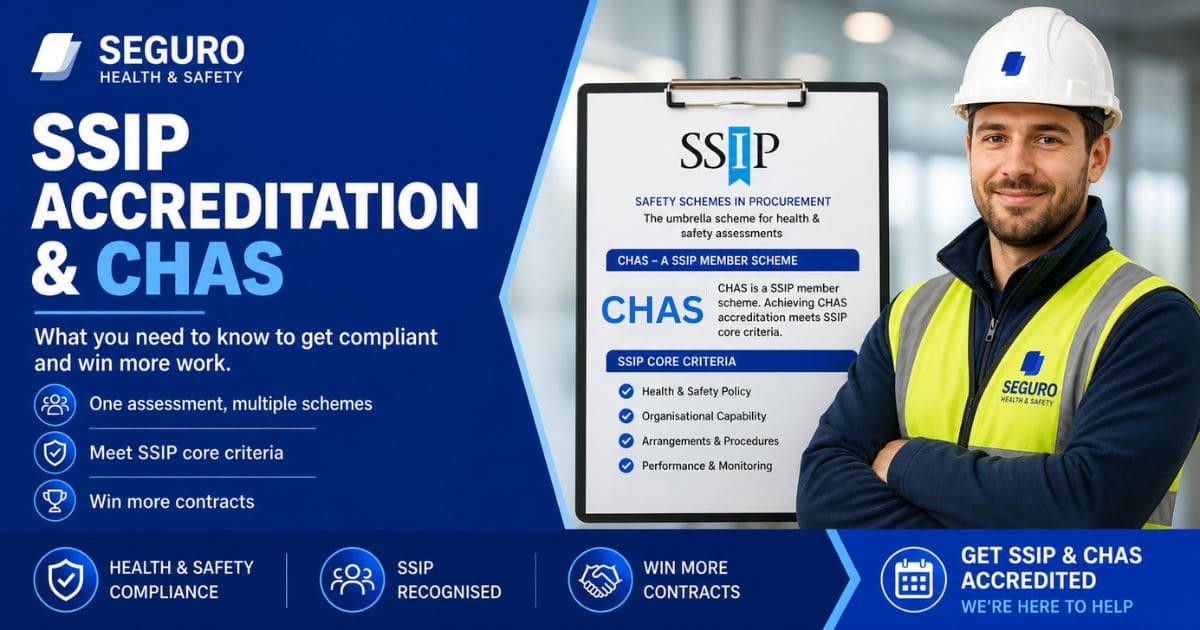
Safety Schemes in Procurement (SSIP) is an umbrella organisation that:

  • Standardises health & safety assessments
  • Reduces duplication across multiple schemes
  • Ensures all member schemes assess the same core criteria

In simple terms: SSIP means “one standard, recognised everywhere.”

What Is CHAS?

CHAS (The Contractors Health and Safety Assessment Scheme) is:

  • One of the most widely recognised SSIP schemes
  • Used by main contractors, developers, and local authorities
  • A fast way to prove your business meets health & safety requirements
  • How to get CHAS accreditation step-by-step

Quick Comparison

Feature

SSIP

CHAS

What it is

Umbrella organisation

Accreditation provider

Purpose

Standardise H&S assessments

Certify contractors

Recognition

Industry-wide

Very high

Required for tenders?

Yes (via member schemes)

Commonly specified

What Do SSIP & CHAS Actually Assess?

All SSIP schemes (including CHAS) assess the same core areas:

  • Health & Safety Policy
  • Competent Advice
  • Training & Competence
  • Risk Assessments & RAMS
  • Accident Reporting
  • Workforce Involvement
  • Monitoring & Review
  • Subcontractor Management
  • Welfare & Communication

This is why: If you pass CHAS, you meet the SSIP standard.

Do You Need SSIP or CHAS?

You DO need it if you want to:

You may not need it if:

  • You only work for domestic homeowners
  • You don’t plan to enter commercial construction

But realistically, No SSIP = limited growth in construction

CHAS vs Other SSIP Schemes

CHAS is not the only option. Other SSIP schemes include:

  • Constructionline
  • PQS
  • SMAS Worksafe
  • SafeContractor

All assess the same standards, but:

Choosing the right one depends on:

  • Your target clients
  • Tender requirements
  • Budget

How Much Does SSIP / CHAS Cost?

Typical entry-level costs:

  • CHAS: from ~£429 + VAT
  • PQS – £49 + VAT
  • SMAS: from ~£317 + VAT
  • SafeContractor: from ~£419 + VAT
  • Constructionline Bronze: from ~£498 + VAT
  • To compare options, see our CHAS vs Constructionline guide.

Important: The highest cost is often getting your documents compliant, not the scheme fee.

Why Contractors Fail SSIP / CHAS

Common mistakes include:

  • Outdated health & safety policy
  • Missing RAMS
  • No competent safety advisor
  • Weak or generic documents
  • Expired insurance
  • No training evidence

Fix these early, and approval becomes straightforward. Common reasons CHAS applications fail and how to avoid them

Benefits of CHAS / SSIP Accreditation

  • Win more contracts
  • Meet pre-qualification requirements
  • Build trust with clients
  • Reduce repeated assessments
  • Improve your safety systems

Final Verdict

  • SSIP = the standard
  • CHAS = one of the best-known ways to meet it

If you want to grow in construction, SSIP accreditation isn’t optional; it’s expected.

Need help getting approved? Our CHAS support service handles the full process for you.

CALL Amanda on 0800 031 5404 to get started

Pass first time
shape Ask Amanda

Frequently Asked Questions

What is SSIP accreditation?

SSIP accreditation is a UK health and safety pre-qualification system that assesses contractors against a standard set of criteria. It helps reduce duplication across different schemes and allows contractors to demonstrate compliance to clients and main contractors.

What is CHAS, and how does it relate to SSIP?

CHAS is a health and safety accreditation scheme and a member of SSIP. It assesses contractors against the SSIP core criteria, meaning a CHAS certificate demonstrates compliance with recognised UK construction health and safety standards.

Do I need SSIP or CHAS to work in construction?

Most contractors working for main contractors, local authorities or commercial clients need SSIP accreditation such as CHAS. It is often required for pre-qualification and for accessing construction work opportunities.

Is CHAS the same as SSIP?

No. SSIP is the umbrella organisation that sets the assessment standard, while CHAS is one of the accreditation schemes that assesses contractors against those standards.

Can I use another SSIP scheme instead of CHAS?

Yes. Other SSIP schemes, such as PQS, Constructionline, SMAS, and SafeContractor, assess contractors against the same core criteria. The choice depends on what your clients or tenders require.

How long does SSIP or CHAS accreditation last?

SSIP accreditations, such as CHAS, typically last for 12 months. Contractors must renew annually to remain compliant and visible to clients and buyers. Learn about CHAS renewal.

What does CHAS assess?

CHAS assesses health and safety policies, risk assessments, training records, competent advice, accident reporting, workforce involvement, monitoring systems and subcontractor management to ensure contractors can work safely and meet industry standards. Learn about CHAS assessment criteria.

Why is SSIP accreditation important?

SSIP accreditation is important because it proves your business meets recognised health and safety standards, helps you pass pre-qualification requirements and increases your chances of winning contracts in the construction industry.

Related CHAS Guides