



Why SSIP Applications Fail – The Most Common Mistakes Contractors Make
Applying for SSIP accreditation should be straightforward. Yet every year, contractors experience delays, assessor queries, and failed applications because their documentation does not properly demonstrate compliance.
The reality is that most SSIP applications do not fail because contractors are unsafe. They fail because the paperwork submitted does not meet the assessment requirements.
Understanding the common reasons applications fail can help contractors avoid costly delays, achieve accreditation faster, and improve their chances of winning more work.
What Is SSIP Accreditation?
SSIP stands for Safety Schemes in Procurement.
It is a recognised framework used across the UK construction industry to assess contractor health and safety competence.
Popular SSIP member schemes include:
- CHAS
- SafeContractor
- SMAS
- Constructionline
- CQMS
- PQS
All schemes assess contractors against broadly the same health and safety criteria.
Why Do SSIP Applications Fail?
Most failed applications are caused by documentation issues rather than genuine health and safety problems.
Assessors can only evaluate the evidence submitted. If documents are missing, incomplete, outdated, or inconsistent, the application may be rejected or delayed until corrections are made.
1. Missing Health & Safety Policy
One of the most common reasons applications fail is the absence of a suitable Health & Safety Policy.
Typical issues include:
- No policy provided
- Unsigned policy
- Undated policy
- Policy not reviewed
- Policy copied from another business
- Policy not relevant to company activities
The policy should clearly explain how health and safety is managed within the business and identify responsibilities.
2. Generic Risk Assessments
Many contractors submit generic risk assessments downloaded from the internet.
Assessors frequently reject these because they:
- Do not reflect actual work activities
- Contain irrelevant hazards
- Lack suitable control measures
- Appear copied without review
Risk assessments should be specific to the work your business carries out.
3. Poor Quality RAMS
RAMS (Risk Assessments and Method Statements) are a critical part of most SSIP applications.
Common mistakes include:
- Generic templates
- Missing control measures
- No sequence of work
- No emergency arrangements
- Activities not matching company services
- Poorly written documentation
Good RAMS demonstrate that hazards have been identified and controlled appropriately.
4. Expired Insurance Documents
Insurance issues are among the easiest reasons for assessors to identify problems.
Common examples include:
- Expired insurance certificates
- Missing Employers’ Liability Insurance
- Missing Public Liability Insurance
- Incorrect company name
- Insufficient cover levels
Always check insurance dates before submitting an application.
5. Missing Training Records
Assessors need evidence that employees are competent to perform their duties safely.
Missing evidence may include:
- CSCS cards
- First Aid certificates
- IPAF training
- PASMA certificates
- Asbestos awareness training
- Manual handling training
- Toolbox talks
A training matrix is often helpful for demonstrating competence across the workforce.
6. No Competent Health & Safety Support
Many contractors overlook the requirement to demonstrate access to competent health and safety advice.
Assessors may request:
- Competent Person evidence
- Consultant qualifications
- NEBOSH certificates
- IOSH qualifications
- Service agreements
- Competent Person certificates
Without suitable evidence, the application may not satisfy assessment requirements.
7. Missing COSHH Assessments
If hazardous substances are used, COSHH assessments are often required.
Examples include:
- Paints
- Adhesives
- Solvents
- Cleaning chemicals
- Dust-producing activities
- Silica exposure
- Fumes
Failure to provide COSHH assessments where substances are used commonly results in assessor queries.
8. Company Information Does Not Match
A surprisingly common issue occurs when company information differs across documents.
Examples include:
- Different company names
- Different addresses
- Different trading names
- Different insurance details
- Incorrect registration information
Consistency across all submitted documentation is essential.
9. Missing Accident Reporting Procedures
SSIP assessors expect businesses to have a process for recording and investigating accidents.
Common issues include:
- No procedure provided
- Incomplete reporting arrangements
- No RIDDOR reference
- No investigation process
Even businesses with no accident history should have a documented procedure.
10. Outdated Documentation
Many contractors continue using documents that have not been reviewed for years.
Common examples include:
- Policies with old review dates
- Expired training certificates
- Outdated legislation references
- Old company details
- Obsolete procedures
Documentation should be reviewed regularly and updated whenever business activities change.
11. Submitting Incomplete Applications
Some contractors rush through the application process and miss key questions or supporting evidence.
Typical problems include:
- Blank sections
- Missing uploads
- Incomplete answers
- Incorrect supporting documents
- Lack of explanations
Taking time to review submissions before sending them can prevent avoidable delays.
12. Failure to Respond to Assessor Queries
Even strong applications may generate follow up questions.
Problems arise when:
- Queries are ignored
- Responses are delayed
- Additional evidence is not provided
- Documents remain incomplete
Quick responses often help applications progress smoothly.
How to Improve Your Chances of Approval
Before submitting your SSIP application, ask yourself:
- Is my Health & Safety Policy current and signed?
- Are my RAMS relevant to my work?
- Are all insurance documents valid?
- Can I demonstrate workforce competence?
- Have I included COSHH assessments where required?
- Do I have evidence of competent health and safety support?
- Does all company information match?
- Have I checked every uploaded document?
A simple review can prevent most common application failures.
How a Done For You SSIP Service Helps
Many contractors choose professional support because it removes uncertainty from the process.
A specialist consultant can:
- Review documentation
- Identify compliance gaps
- Prepare policies
- Create RAMS
- Review training evidence
- Check insurance documents
- Submit applications
- Manage assessor queries
This significantly reduces the likelihood of rejection.
How Seguro Can Help
Seguro Health & Safety helps contractors achieve accreditation through:
- CHAS Applications
- Constructionline Accreditation
- SafeContractor Applications
- SMAS Accreditation
- CQMS Applications
- PQS Accreditation
- Health & Safety Policies
- RAMS
- Risk Assessments
- COSHH Assessments
- Competent Person Support
- Accreditation Renewals
With extensive experience supporting UK contractors, Seguro helps businesses avoid common mistakes and achieve accreditation more efficiently.
Conclusion
Most SSIP applications fail because the supporting documentation does not properly demonstrate compliance.
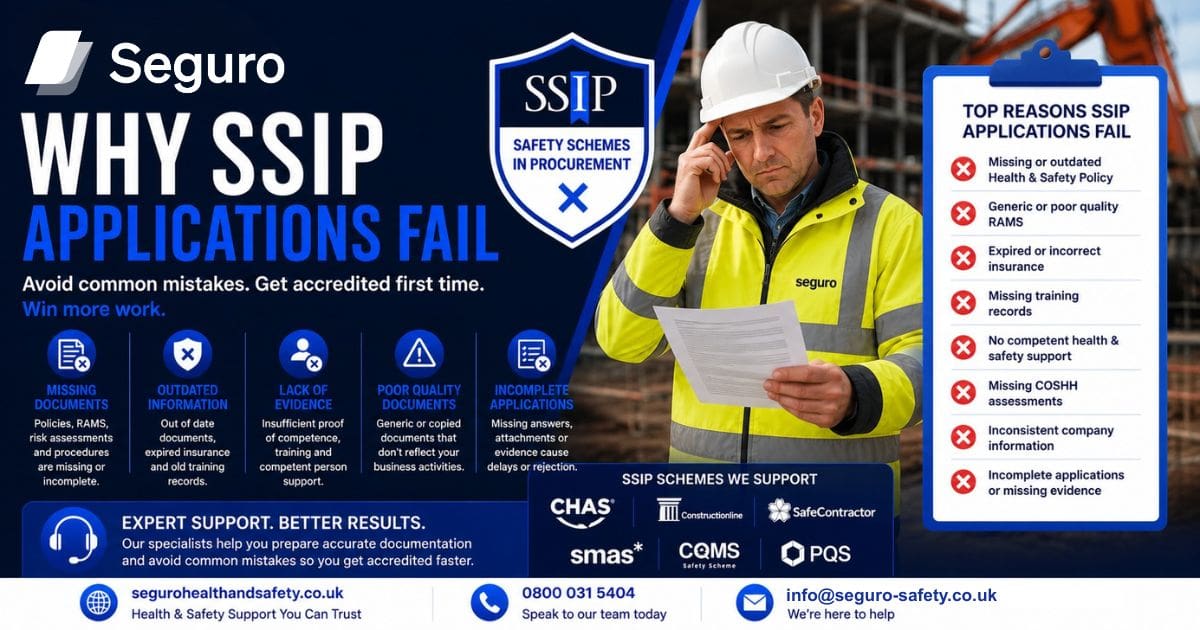
The most common issues include:
- Missing policies
- Generic RAMS
- Expired insurance
- Missing training records
- Lack of competent person evidence
- Missing COSHH assessments
- Inconsistent company information
- Incomplete applications
By preparing accurate, up to date documentation and reviewing everything before submission, contractors can significantly improve their chances of achieving accreditation first time.
Request a call back for more information or call 0800 031 5404
Book a CALL

Frequently Asked Questions
Why do SSIP applications fail?
SSIP applications usually fail because the supporting documents do not properly demonstrate compliance. Common reasons include missing policies, generic RAMS, expired insurance, missing training records, no competent person evidence, missing COSHH assessments and inconsistent company information. For more information, go to SSIP Accreditations: The Complete Guide
What are the most common SSIP application mistakes?
The most common SSIP application mistakes include submitting unsigned or outdated policies, using generic risk assessments or RAMS, uploading expired insurance certificates, failing to provide training evidence, missing accident procedures and not showing access to competent health and safety advice.
Can generic RAMS cause an SSIP application to fail?
Yes. Generic RAMS can cause an SSIP application to fail or become delayed because they may not reflect the contractor’s actual work activities, hazards, control measures, equipment or safe system of work.
Can expired insurance delay SSIP approval?
Yes. Expired insurance is one of the easiest issues for assessors to identify. Contractors should check that Employers’ Liability Insurance and Public Liability Insurance are current, correctly named and suitable for the work being assessed.
Do I need training records for SSIP accreditation?
Yes. SSIP assessors usually need evidence that workers are competent for their roles. This may include CSCS cards, first aid certificates, IPAF, PASMA, asbestos awareness, manual handling, toolbox talks and other relevant training records.
Does SSIP require competent person evidence?
Yes. SSIP schemes often ask contractors to show how they access competent health and safety advice. Evidence may include a competent person certificate, consultant CV, NEBOSH or IOSH qualifications, or a health and safety support agreement.
Will missing COSHH assessments affect my SSIP application?
Missing COSHH assessments can affect an SSIP application if your business uses or creates hazardous substances such as paints, adhesives, solvents, cleaning chemicals, dust, silica or fumes. COSHH assessments should identify the risks and control measures.
How can I avoid SSIP application failure?
You can reduce the risk of SSIP application failure by reviewing all documents before submission, ensuring policies are signed and current, checking insurance dates, using task-specific RAMS, providing training records, including COSHH assessments where needed and showing competent health and safety support.
What happens if my SSIP application is rejected?
If an SSIP application is rejected or delayed, the assessor will usually request further evidence or corrected documents. You may need to update policies, improve RAMS, provide missing certificates or clarify how health and safety is managed before approval can be granted.
Can Seguro help if my SSIP application has failed?
Yes. Seguro Health & Safety can help review failed or delayed SSIP applications, identify missing evidence, update policies, improve RAMS, check training records, provide competent person support and help prepare a stronger resubmission.