

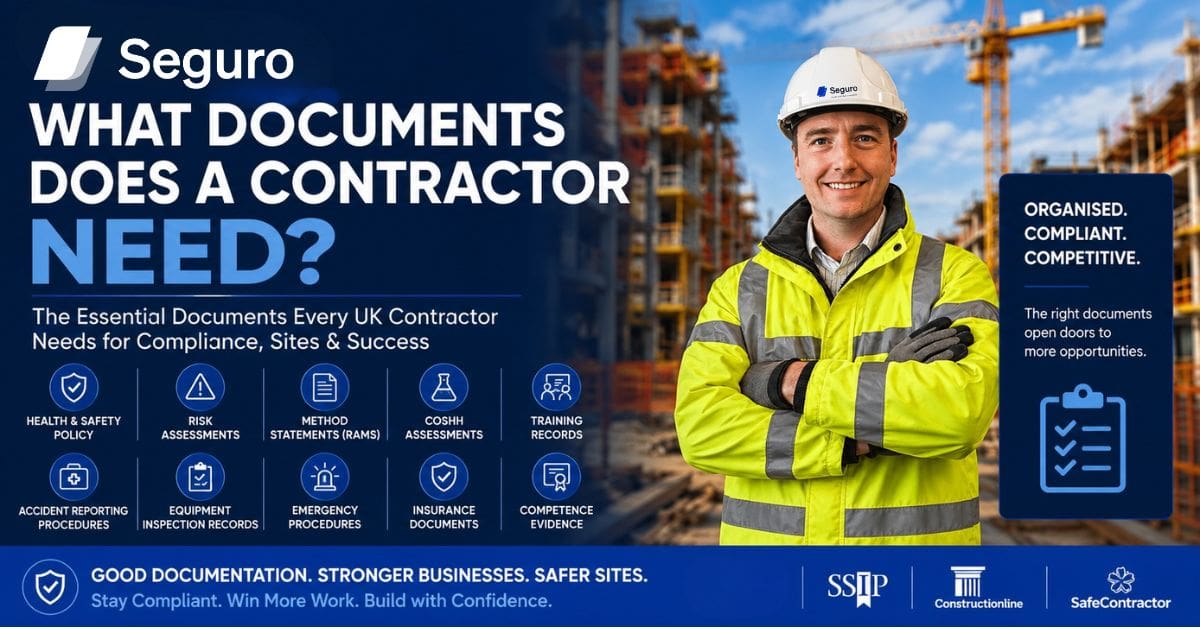


What Documents Does a Contractor Need?
The Essential Guide for UK Contractors
What construction health and safety documents are required to comply with the UK construction market?
Whether you are a sole trader, a subcontractor, or a growing construction company, having the correct health and safety documentation is essential. Clients, principal contractors, accreditation schemes and procurement teams increasingly require evidence of compliance before awarding work or allowing site access.
Clients, principal contractors, local authorities and accreditation schemes increasingly expect contractors to demonstrate compliance before work begins.
Without the correct construction health and safety documents, you may struggle to:
- Win contracts
- Pass CHAS or SSIP assessments
- Complete PQQs
- Access construction sites
- Demonstrate legal compliance
This guide explains the key documents contractors typically need and why they matter.
Why Contractors Need Construction Health and Safety Documentation
Construction Health and safety documents help demonstrate that a contractor has identified workplace risks and implemented suitable control measures.
Good documentation helps:
- Protect workers and the public
- Meet legal obligations
- Support accreditation applications
- Satisfy client requirements
- Reduce project risks
- Improve site management
Many documents may also be requested during site audits, inspections and procurement assessments.
Document List
Health and Safety Policy
A Health and Safety Policy outlines a company’s commitment to managing health and safety.
The policy typically includes:
- Statement of intent
- Management responsibilities
- Arrangements for managing safety
Businesses with five or more employees must have a written Health and Safety Policy by law, although many smaller businesses also maintain one because clients often request it.
Related Topics
- Health and Safety Policy Template
- Health and Safety Responsibilities for Small Businesses
Risk Assessments
Risk assessments identify workplace hazards and evaluate the risks associated with work activities.
Construction risk assessments commonly cover:
- Working at height
- Manual handling
- Excavations
- Plant and machinery
- Electrical works
- Slips, trips and falls
- Noise and vibration
Risk assessments help contractors plan work safely and demonstrate compliance.
Related Topics
- What Is a Risk Assessment?
- Construction Risk Assessment Examples
Method Statements (RAMS)
Method statements explain how work will be carried out safely.
They are often combined with risk assessments to form RAMS (Risk Assessments and Method Statements).
A method statement may include:
- Scope of works
- Sequence of activities
- Plant and equipment
- Control measures
- Emergency arrangements
- PPE requirements
RAMS are frequently requested before contractors are allowed on site.
Related Topics
- What Are Construction RAMS?
- How to Write a Method Statement
COSHH Assessments
Where hazardous substances are used, contractors may need COSHH assessments.
COSHH stands for:
Control of Substances Hazardous to Health
Examples include:
- Paints
- Solvents
- Adhesives
- Cement products
- Cleaning chemicals
- Fuel and oils
COSHH assessments explain:
- Health risks
- Safe handling procedures
- Storage requirements
- Emergency actions
Related Topics
- What Is COSHH?
- COSHH Assessment Guide
Training Records
Contractors should maintain records of relevant training and competence.
Examples include:
- CSCS cards
- First Aid training
- PASMA
- IPAF
- Asbestos Awareness
- Manual Handling
- Working at Height
Clients often request evidence that workers are competent to perform their duties.
Accident Reporting Procedures
Contractors should have arrangements for recording accidents, incidents and near misses.
Documentation may include:
- Accident report forms
- Investigation records
- Corrective actions
- RIDDOR reporting procedures
This helps businesses learn from incidents and improve site safety.
Equipment Inspection Records
Construction equipment often requires regular inspection and maintenance.
Examples include:
- Ladders
- Access equipment
- Power tools
- Lifting equipment
- Scaffold inspections
Inspection records help demonstrate that equipment remains safe to use.
Emergency Procedures
Contractors should have procedures covering foreseeable emergencies.
These may include:
- Fire arrangements
- First aid provision
- Evacuation procedures
- Accident response
- Spill response plans
Emergency planning helps reduce the impact of unexpected incidents.
Insurance Documents
Most clients require evidence of current insurance cover.
Common policies include:
Employers’ Liability Insurance
Required by most employers in the UK.
Public Liability Insurance
Protects against claims involving injury or property damage.
Professional Indemnity Insurance
Often required for consultants and design professionals.
Contractor Competence Records
Clients increasingly want evidence that contractors are competent.
This may include:
- Qualifications
- Training certificates
- Experience records
- Trade memberships
- Accreditation certificates
Competence evidence supports procurement and accreditation requirements.
CHAS and SSIP Documentation
Contractors applying for CHAS or other SSIP schemes are typically asked to provide evidence covering:
- Health and Safety Policy
- Risk Assessments
- Method Statements
- Training Records
- Accident Procedures
- Insurance Certificates
- Competent Advice
- Monitoring Arrangements
Having these documents prepared in advance can simplify the accreditation process.
Documents Required for Constructionline
Constructionline applications may require information relating to:
- Company details
- Health and Safety arrangements
- Insurance
- Environmental management
- Quality procedures
- Financial information
Requirements vary depending on the level of certification sought.
Documents Often Requested During PQQs
Many pre-qualification questionnaires ask for:
- Health and Safety Policy
- RAMS
- Insurance certificates
- Training records
- Accreditation certificates
- Competence evidence
- Environmental policies
- Equality policies
Keeping documentation organised can help businesses respond quickly to tender opportunities.
Common Documentation Mistakes Contractors Make
Typical problems include:
- Outdated policies
- Missing signatures
- Expired insurance certificates
- Generic risk assessments
- Missing training evidence
- Poor document control
- Incomplete RAMS
These issues frequently cause delays during accreditation and procurement processes.
Contractor Documentation Checklist
Most contractors should consider maintaining:
✓ Health and Safety Policy
✓ Risk Assessments
✓ Method Statements (RAMS)
✓ COSHH Assessments
✓ Training Records
✓ Accident Reporting Procedures
✓ Equipment Inspection Records
✓ Emergency Procedures
✓ Insurance Certificates
✓ Competence Evidence
✓ Accreditation Records
Key Takeaway
Construction health and safety documents are more than a compliance exercise. It helps businesses demonstrate competence, meet legal obligations, satisfy client requirements and access larger contract opportunities.
Maintaining accurate, current and relevant documentation can make the difference between passing a pre-qualification assessment and losing an opportunity before a tender is even submitted.


Frequently Asked Questions
What documents does a contractor need?
A contractor typically needs a health and safety policy, risk assessments, method statements, COSHH assessments where relevant, training records, accident reporting procedures, equipment inspection records, emergency procedures, insurance certificates and evidence of competence. For more information, go to Construction Health and Safety Consultant: Complete Guide for UK Contractors
What health and safety documents do contractors need?
Common contractor health and safety documents include a health and safety policy, risk assessments, method statements, RAMS, COSHH assessments, training records, accident forms, inspection records and emergency procedures.
Do contractors need a written health and safety policy?
Businesses with five or more employees must have a written health and safety policy. Smaller contractors may still be asked to provide one by clients, main contractors or accreditation schemes.
Do contractors need risk assessments?
Yes. Contractors should assess the risks associated with their work activities and put suitable control measures in place. Risk assessments are commonly required for construction work, site access, PQQs and accreditation applications.
What are RAMS in construction?
RAMS stands for Risk Assessments and Method Statements. These documents explain the risks involved in a task and describe how the work will be carried out safely.
When does a contractor need a COSHH assessment?
“A contractor needs a COSHH assessment when hazardous substances are used or created during work activities. This may include paints, solvents, adhesives, cement products, cleaning chemicals, fuels, oils, dusts or fumes.
What documents are needed for CHAS or SSIP accreditation?
CHAS and SSIP applications commonly require evidence such as a health and safety policy, risk assessments, method statements, training records, accident procedures, insurance certificates, competent health and safety advice and monitoring arrangements.
What documents are usually requested in a construction PQQ?
A construction PQQ may request a health and safety policy, RAMS, insurance certificates, training records, accreditation certificates, competence evidence, environmental policies, quality procedures and previous project experience.
Why are contractor documents important?
Contractor documents help demonstrate legal compliance, site readiness, competence and risk management. They are often required before contractors can access sites, tender for projects or pass accreditation assessments.
What are common contractor documentation mistakes?
Common mistakes include outdated policies, missing signatures, expired insurance certificates, generic risk assessments, incomplete RAMS, missing training evidence, poor document control and failure to update records after changes in work activities.