

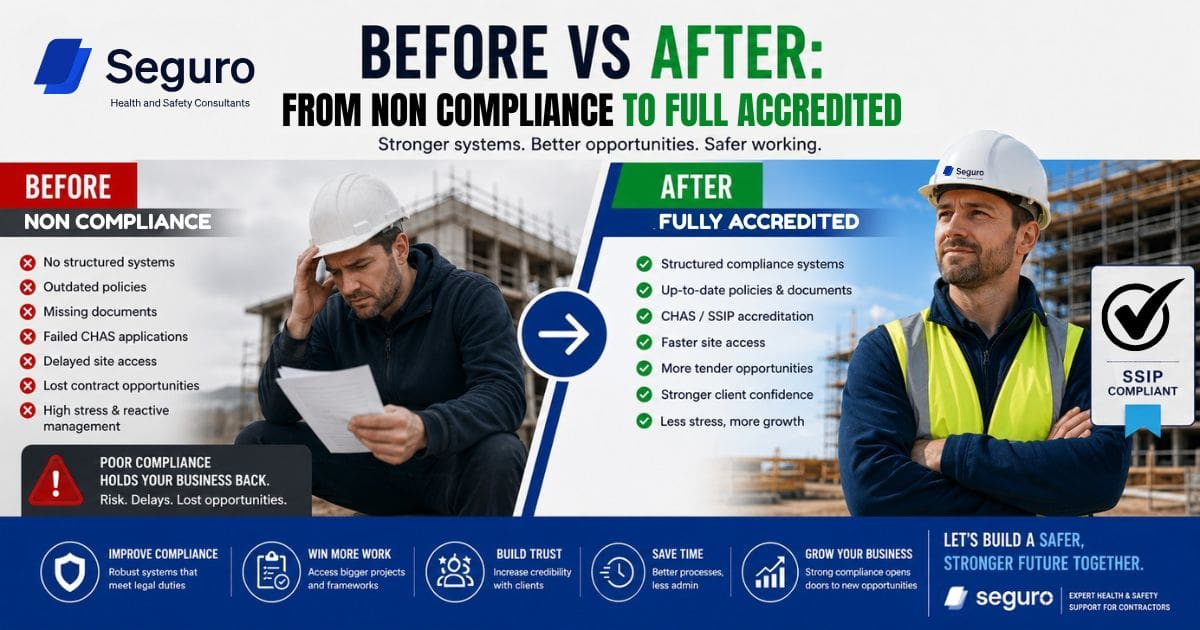


Before and after accreditation: From Non-Compliance to Fully Accredited
Many contractors start in the same position.
The business is busy.
Projects are moving.
Clients are asking for documents.
But health and safety systems are inconsistent, reactive, or incomplete. The company may have:
- No structured RAMS process
- Outdated policies
- Missing training records
- Weak compliance systems
- No competent safety advisor
- Failed CHAS applications
- Delayed site access
- Difficulty winning larger contracts
At this stage, many businesses are operating reactively rather than professionally managing compliance.
Then something changes.
- A larger opportunity appears.
- A principal contractor requests CHAS accreditation.
- A tender requires SSIP compliance.
- Or the business realises that poor systems are starting to hold back growth.
This is often the turning point from “getting by” to becoming fully accredited and commercially ready.
The Reality of “Non Compliance”
Many contractors are not intentionally unsafe. The issue is usually:
- Lack of time
- Lack of structure
- No internal compliance experience
- Rapid business growth
- Reactive paperwork management
Common signs of poor compliance include:
- RAMS copied from old jobs
- Policies not reviewed for years
- Missing COSHH assessments
- Expired insurance documents
- No training matrix
- No toolbox talk records
- No competent health & safety support
In many cases, contractors only discover these issues when:
- A CHAS application fails
- A site audit takes place
- A principal contractor requests evidence
- An accident occurs
- A project is delayed
Before Accreditation: Common Problems Contractors Face
Failed CHAS or SSIP Applications
Many contractors struggle because:
- Documents are incomplete
- Policies are generic
- RAMS are weak
- Training evidence is missing
- Accident procedures are unclear
Most failures happen because businesses cannot properly demonstrate compliance.
Delayed Site Access
Principal contractors increasingly require:
- RAMS approval
- Insurance verification
- Training evidence
- Induction records
- Competent safety support
Without these, contractors may experience:
- Delays
- Site access refusals
- Lost productivity
- Commercial pressure
Difficulty Winning Larger Contracts
As businesses grow, compliance expectations increase. Many larger contractors and public sector clients require.
- CHAS
- Constructionline
- SafeContractor
- SSIP accreditation
- Structured health & safety systems
Without accreditation, many businesses struggle to move beyond smaller subcontract opportunities.
Stress and Reactive Management
One of the biggest hidden problems is operational stress. Many businesses without structured compliance systems spend their time:
- Chasing paperwork
- Updating documents last minute
- Reacting to client requests
- Searching for certificates
- Rewriting RAMS urgently
This creates pressure across the entire business.
The Turning Point: Deciding to Improve Compliance
For many contractors, the turning point comes when they realise:
- Better compliance supports business growth
- Larger clients expect professionalism
- Good systems save time long-term
- Accreditation opens commercial opportunities
This is where businesses often begin working with:
- Safety Advisors
- Competent Persons
- Health & Safety Consultants
- Accreditation specialists
The Process: From Non Compliance to Fully Accredited
Step 1: Reviewing Existing Systems
The first stage is usually understanding:
- What documents already exist
- What is missing
- Where compliance gaps are
- What clients are requesting
This often reveals that many businesses already have some systems in place, but they are inconsistent or outdated.
Step 2: Building Core Health & Safety Documents
Most businesses then begin developing:
- Health & safety policies
- Risk assessments
- RAMS
- COSHH assessments
- Toolbox talks
- Accident procedures
- Training records
The goal is to create practical systems that reflect real operations.
Step 3: Appointing Safety Consultant Support
Many contractors then realise they need ongoing safety support. This often includes:
- Compliance guidance
- Document reviews
- Accreditation support
- Safety advice
- Legislative updates
For SMEs, outsourced support is usually more practical than employing internally.
Step 4: Preparing for Accreditation
Once systems are organised, businesses can begin preparing for:
- CHAS
- Constructionline
- SafeContractor
- SMAS
- Other SSIP schemes
This typically involves:
- Reviewing documentation
- Uploading evidence
- Correcting compliance gaps
- Responding to assessor feedback
After Accreditation: What Changes?
The difference is often significant.
Before:
- Reactive paperwork
- Compliance stress
- Delayed responses
- Weak systems
- Difficulty winning work
After:
- Structured compliance systems
- Improved professionalism
- Faster client responses
- Better organisation
- Increased confidence
- Stronger commercial positioning
Better Tender Opportunities
Many accredited contractors discover they can access:
- Larger projects
- Public sector tenders
- Approved contractor lists
- Principal contractor supply chains
Accreditation often becomes a gateway to bigger opportunities.
Improved Client Confidence
Strong compliance systems help demonstrate:
- Professionalism
- Organisation
- Competence
- Risk management
Clients often view accredited contractors as:
- Lower risk
- Easier to work with
- Better organised
- More reliable
Faster Site Onboarding
With proper systems in place, businesses can usually respond faster to:
- RAMS requests
- Insurance requests
- Site documentation requirements
- Training evidence requests
This helps reduce delays and operational pressure.
Stronger Internal Organisation
Many businesses discover that improving compliance also improves:
- Communication
- Record keeping
- Planning
- Workforce management
- Operational consistency
Good health and safety systems often improve the overall structure of the business.
Compliance Becomes a Business Asset
One of the biggest mindset shifts happens when contractors stop viewing compliance as:
- “paperwork” or
- “a box ticking exercise” and instead see it as:
- a professional system,
- a commercial advantage,
- and a growth tool.
The Most Common Improvements Contractors See
After becoming fully accredited, contractors often report:
- Better tender success
- Improved client trust
- More organised systems
- Less compliance stress
- Faster onboarding
- Improved confidence during audits
- Access to larger opportunities
For many businesses, accreditation becomes part of long term growth rather than simply a requirement.
Why More Contractors Use Outsourced Safety Consultants
Many SMEs lack the time to manage complex compliance internally. Outsourced support can help businesses:
- Maintain documents
- Stay updated
- Prepare RAMS
- Manage accreditations
- Improve systems
- Reduce admin pressure
This allows directors and managers to focus on operations while maintaining professional compliance standards.
Final Thoughts
Before and after accreditation. The difference between “non compliance” and “fully accredited” is often much bigger than paperwork. It affects:
- Reputation
- Site access
- Tender opportunities
- Client confidence
- Operational stress
- Business growth
Many contractors discover that strong health and safety systems help them:
- Operate more professionally
- Win more work
- Reduce risk
- Improve organisation
- Build stronger businesses
Compliance is no longer just about passing audits. For many contractors, it becomes part of building a trusted, scalable, and commercially successful business.
Looking for support, give us a call on 0800 031 4504


Frequently Asked Questions
What does fully accredited mean for contractors?
Fully accredited usually means a contractor has structured health and safety systems in place and has achieved recognised accreditation such as CHAS, SSIP, Constructionline, SafeContractor or similar contractor approval schemes. For more information, go to Construction Health and Safety Consultant: Complete Guide for UK Contractors
How can a contractor go from non-compliance to CHAS-accredited?
A contractor can move from non-compliance to CHAS accreditation by reviewing existing systems, identifying missing documents, creating suitable RAMS, updating policies, organising training records, checking insurance, appointing competent health and safety support and submitting the correct evidence to the accreditation scheme.
Why do contractors fail accreditation applications?
Contractors commonly fail accreditation applications due to missing documents, poor RAMS, outdated health and safety policies, expired insurance, missing training evidence, weak accident procedures, or no evidence of competent health and safety advice.
Can CHAS or SSIP accreditation help contractors win more work?
Yes. CHAS and SSIP accreditation can help contractors meet pre-qualification requirements, access larger projects, join approved contractor lists, improve client confidence and demonstrate professional health and safety compliance.
What documents do contractors need to become accredited?
Contractors commonly need a health and safety policy, RAMS, risk assessments, COSHH assessments, training records, insurance certificates, accident procedures, toolbox talk evidence and proof of competent health and safety support.
Do small contractors need health and safety compliance support?
Many small contractors benefit from outsourced health and safety advisor support because accreditation requirements can be detailed and time consuming. Professional support can help organise documents, prepare evidence and reduce the risk of failed applications.
What changes after a contractor becomes accredited?
After becoming accredited, contractors often have better organised systems, faster responses to client requests, improved tender readiness, stronger professional credibility, reduced compliance stress and access to larger contract opportunities.
Can accreditation reduce site access delays?
Yes. Accredited contractors usually have key documents such as RAMS, insurance, training records and policies ready to provide when requested. This can help reduce delays during site onboarding and principal contractor approval.
Is becoming accredited only about paperwork?
No. Accreditation is not just about paperwork. It helps contractors demonstrate that health and safety is properly managed, risks are controlled, workers are competent and the business can meet client and legal requirements.
How can Seguro help contractors become fully accredited?
Seguro can help contractors review compliance gaps, prepare health and safety documents, improve RAMS, organise evidence, provide safety consultancy support and assist with CHAS, SSIP and contractor accreditation applications.