

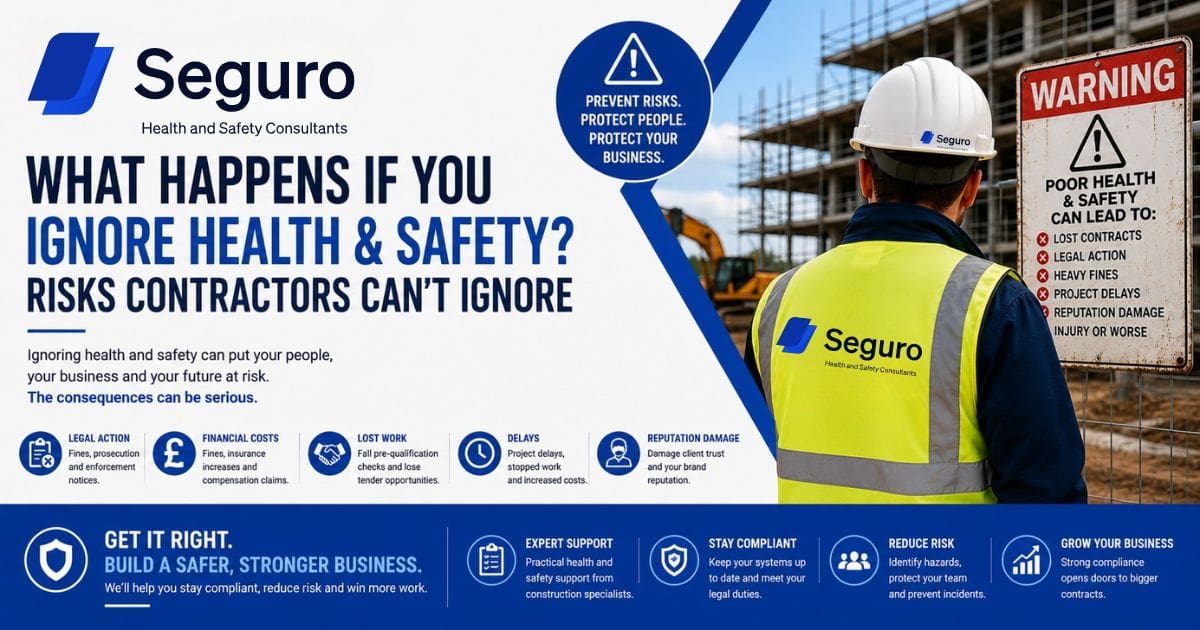


What Happens If You Ignore Health & Safety? Risks Contractors Can’t Ignore
Many contractors think health and safety only matter when:
- A client requests documents
- A CHAS application is due
- An accident happens
- The HSE visits the site
- A principal contractor raises concerns
Until then, compliance is often treated as paperwork that can wait until later.
The problem is that ignoring health and safety rarely stays a small issue for long. In today’s construction industry, poor compliance can affect:
- Your legal position
- Your ability to win work
- Your reputation
- Your site access
- Your insurance
- Your workforce
- Your long-term business growth
For many contractors, health and safety is no longer optional administration. It has become part of doing business professionally.
Why Health & Safety Matters More Than Ever
Construction remains one of the UK’s highest-risk industries.
As a result:
- Principal contractors are stricter
- Clients request more evidence
- Accreditation schemes are more detailed
- HSE enforcement remains active
- Insurance expectations continue to increase
Businesses are increasingly expected to demonstrate:
- Competence
- Safe systems of work
- Proper risk management
- Workforce training
- Compliance documentation
- Ongoing safety management
Contractors who fail to meet these expectations often struggle commercially long before enforcement action occurs.
What Happens If You Ignore Health & Safety? – The first Problem: You May Lose Work Opportunities
For many contractors, the first consequence of poor compliance is not a fine. It is losing work. Main contractors and commercial clients commonly request:
- RAMS
- Insurance certificates
- Health & safety policies
- Training records
- SSIP accreditation
- Evidence of competent support
If you cannot provide these quickly and professionally, you may:
- Lose tender opportunities
- Fail pre-qualification checks
- Be removed from approved contractor lists
- Experience delayed site access
In many cases, businesses lose projects before pricing is even considered.
Failed CHAS and SSIP Applications
Many contractors discover compliance problems when they apply for:
- CHAS
- Constructionline
- SafeContractor
- SMAS
- Other SSIP schemes
The most common reasons applications fail include:
- Missing documents
- Generic RAMS
- Expired insurance
- Weak policies
- Missing training records
- Poor accident procedures
- No competent health and safety advisor
Most failures are avoidable with proper systems and support.
Delayed Site Access and Project Disruption
Even when work is secured, poor health and safety management can significantly delay projects. Common problems include:
- RAMS rejected by principal contractors
- Missing induction records
- Missing training evidence
- Incorrect insurance details
- Missing permits or procedures
These delays:
- Frustrate clients
- Increase pressure on project teams
- Damage professionalism
- Affect cash flow
Many contractors underestimate the extent to which poor compliance disrupts operations.
Increased Risk of Accidents and Injuries
The most serious consequence of poor health and safety is harm to people. Weak systems increase the risk of:
- Falls from height
- Manual handling injuries
- Exposure to hazardous substances
- Electrical incidents
- Equipment accidents
- Vehicle collisions
- Unsafe work practices
Many incidents happen because:
- Risks were not assessed properly
- Workers were not briefed
- Unsafe shortcuts became normal
- Supervision was poor
- Procedures were unclear
Good health and safety management helps reduce these risks significantly.
HSE Enforcement Action: The Health and Safety Executive has powers to investigate businesses where serious failings are identified.
Potential enforcement includes:
- Improvement Notices: Requiring businesses to correct issues within a specified timeframe.
- Prohibition Notices: Stopping dangerous work activities immediately.
- Prosecution: Serious breaches may result in legal action.
- Fines: Financial penalties can be substantial depending on the severity of the failings.
The financial cost is often only part of the damage.
Damage to Reputation
Construction is heavily relationship driven. Poor compliance records can quickly damage:
- Client trust
- Contractor relationships
- Reputation within the supply chain
- Future tender opportunities
Word spreads quickly when contractors:
- Fail audits
- Cause site problems
- Ignore procedures
- Create avoidable risks
Strong compliance systems often improve professionalism and client confidence.
Increased Insurance Problems
Poor health and safety management can affect insurance in several ways. Potential issues include:
- Higher premiums
- Increased claims
- Reduced insurer confidence
- Difficulty obtaining cover
- Problems during claims investigations
Many insurers increasingly expect businesses to demonstrate active risk management.
Stress and Reactive Management
One of the hidden consequences of poor compliance is constant operational pressure. Many contractors become trapped in reactive management:
- Rushing documents at the last minute
- Scrambling for certificates
- Updating policies before audits
- Responding to site issues under pressure
This creates:
- Stress
- Delays
- Frustration
- Poor organisation
- Increased mistakes
Proactive systems usually significantly reduce management pressure.
The Hidden Cost of “We’ll Deal With It Later”
Many businesses postpone compliance because:
- Projects feel more urgent
- Paperwork feels time-consuming
- Health and safety is seen as secondary
However, problems usually become more expensive later. Ignoring health and safety often leads to:
- Rework
- Delays
- Failed audits
- Lost contracts
- Increased admin pressure
- Emergency compliance fixes
Good systems usually save time in the long run.
Why Small Contractors Are Still Responsible
Some smaller contractors assume that health and safety laws only apply to larger companies. This is not true. Even small businesses have duties to:
- Assess risks
- Protect workers
- Provide training
- Manage work safely
- Appoint competent support
In fact, smaller businesses often face greater challenges because they have fewer internal resources.
What Happens If You Ignore Health & Safety? – Common Warning Signs Your Compliance Needs Attention
Many contractors already know their systems are struggling. Typical warning signs include:
- Policies have not been updated for years
- RAMS are copied from old templates
- Training records are incomplete
- Documents are difficult to locate
- Clients regularly request missing information
- Site paperwork is inconsistent
- You are constantly reacting to compliance requests
These are usually signs that systems need improving before bigger problems develop.
How Better Compliance Helps Contractors Grow
Good health and safety management is not just about avoiding problems.
It also helps businesses:
- Win larger contracts
- Improve pre-qualification success
- Gain client trust
- Reduce operational disruption
- Improve professionalism
- Access public sector work
- Build long-term relationships
Many contractors discover that strong compliance becomes a commercial advantage.
Why More Contractors Use Outsourced Safety Support
Many SMEs do not need a full-time internal health and safety manager. However, they still need:
- Competent advice
- Updated documentation
- Accreditation support
- Ongoing compliance management
This is why many contractors use outsourced:
- Safety Advisor
- Health & Safety Consultant
Professional support often helps businesses stay compliant without overwhelming internal resources.
Final Thoughts
Ignoring health and safety rarely saves money or time long term.
The risks are not limited to enforcement action. Poor compliance can affect:
- Contracts
- Site access
- Reputation
- Workforce safety
- Insurance
- Business growth
The contractors that perform best long term are usually those that:
- Take compliance seriously
- Keep systems updated
- Invest in competent support
- Manage risks proactively
- Build practical safety processes
Health and safety is no longer simply a legal requirement.
It has become part of building a professional, trusted, and commercially successful construction business.
Looking for support, give us a call on 0800 031 4504


Frequently Asked Questions
What happens if contractors ignore health and safety?
Contractors who ignore health and safety may lose work opportunities, fail CHAS or SSIP applications, face delayed site access, increase accident risk, damage their reputation and face HSE enforcement action. For more information, go to Construction Health and Safety Consultant: Complete Guide for UK Contractors
Can poor health and safety stop contractors from winning work?
Yes. Many principal contractors, commercial clients and public sector organisations require evidence of proper health and safety management before approving contractors or awarding work.
Can poor health and safety cause CHAS or SSIP failure?
Yes. Contractors often fail CHAS or SSIP assessments because of missing documents, generic RAMS, expired insurance, weak policies, missing training records, poor accident procedures or no competent health and safety support.
What are the legal consequences of ignoring health and safety?
The legal consequences can include HSE improvement notices, prohibition notices, prosecution and fines. Serious breaches can also lead to business disruption, increased insurance problems and reputational damage.
Can small contractors face HSE enforcement action?
Yes. Health and safety law applies to businesses of all sizes. Small contractors still have duties to assess risks, protect workers, provide training, manage work safely and access competent health and safety advice.
What documents do contractors need to avoid compliance problems?
Contractors commonly need RAMS, risk assessments, a health and safety policy, insurance certificates, training records, COSHH assessments, accident procedures, toolbox talk records and evidence of competent health and safety support.
How can poor health and safety delay site access?
Yes, access can be delayed when RAMS are rejected, insurance documents are incorrect, training evidence is missing, induction records are incomplete, or the contractor cannot provide suitable compliance documents requested by the principal contractor.
Does ignoring health and safety increase accident risk?
Yes. Weak health and safety systems increase the risk of accidents because hazards may not be properly assessed, workers may not be briefed, supervision may be poor and safe systems of work may not be followed.
Can poor health and safety affect insurance?
Yes. Poor health and safety management can contribute to claims, higher premiums, reduced insurer confidence and difficulties during claims investigations if suitable risk management systems were not in place.
How can contractors improve health and safety compliance?
Contractors can improve compliance by keeping documents updated, producing site-specific RAMS, maintaining training records, reviewing insurance, completing COSHH assessments, communicating risks to workers and using competent health and safety support.